You’ve got a clear strategy and ambitious targets—but the right things aren’t moving. Priorities keep shifting week to week, OKRs drift, and cross-functional work falls between product, engineering, and GTM. Updates happen, but they don’t add up to momentum.
Meanwhile, every decision still flows through you, or the founder/CEO. You’re bouncing from board decks to pricing to hiring to ops fire drills, with no space left to set the cadence, chase updates, or close loops.
Work gets done, but the system isn’t doing the heavy lifting—you are. 😵💫
This is the execution gap: top-level strategy at the top, busy teams at the bottom, not enough connective tissue in between. It’s rarely a “work harder” problem; it’s an operating problem that calls for leverage.
That’s where a Chief of Staff role comes in.
The Chief of Staff role is famously ambiguous—a shape-shifter that looks different by stage, CEO style, and the biggest gaps in your operating model. To cut through the noise, we spoke with several Chiefs of Staff at SaaS companies and distilled the patterns: what the role actually owns, where it flexes, and how to set it up for success. Below, we break down the core responsibilities, how the role evolves by stage, and share a copy-paste job description—grounded in real teams, not theory.
What is a Chief of Staff in a SaaS company?
A Chief of Staff is a senior operator who makes sure the right work happens, in the right order, at the right pace. They turn the CEO’s vision into clear priorities and plans, keep leaders aligned on what matters, and close the gaps between teams so projects actually ship.
The Chief of Staff is your operational Swiss Army Knife. Their role is essentially to be the CEO's right-hand man, covering everything from strategy and sound-boarding, to being on the ground level making sure that teams are executing on leadership’s priorities.
Because of the nature of this role, its definition can often be quite ambiguous, and it can change from week to week depending on the CEO’s priorities at the time.
“I’m responsible for carrying out the CEO’s top 2-3 priorities (or ensuring they’re carried out). Success in the role allows [our CEO] to focus her time on areas where she can get the highest ROI, such as strategic relationships, deals and product vision."
— Dan Hodgson, Chief of Staff at Expert360
In practice, the Chief of Staff role is a force multiplier for the leadership team and often covers these main points:
- Turns strategy into plans: converts company priorities into OKRs, strategic initiatives, owners, and timelines—then keeps them moving.
- Runs the operating cadence: sets up lightweight rituals (weekly exec, monthly metrics/QBRs, quarterly planning), drives follow-ups, and closes loops.
- Aligns cross-functional work: keeps product, engineering, and GTM pointed at the same outcomes; surfaces risks early and unblocks decisions.
- Builds reliable visibility: maintains simple dashboards and narrative updates so leaders see progress, risks, and trade-offs clearly.
- Creates CEO leverage: absorbs prep, research, and special projects so the CEO focuses on the highest-value calls.
It’s not an extra layer of management or a glorified EA. It’s an execution system owner—someone who brings clarity, cadence, and accountability so the organisation can scale.
ℹ️ Are you wondering how a Chief of Staff differs from other similar roles?
What does a chief of staff do?
The core Chief of Staff responsibilities can look different from company to company, based on any number of factors like team size, org structure, business or operating model etc. However, in most SaaS companies or startups, the Chief of Staff covers a wide range of activities that can vary from week-to-week.
“Without trying to sound clichéd, no two weeks are the same! It all really depends on the business’ priorities. One week could be helping our sales leaders close a major deal, the next could be working with product & engineering to commercialise new tech we’ve built.”
— Dan Hodgson, Chief of Staff at Expert360
Their responsibilities are often less a checklist and more a set of roles the CoS moves between—shaping strategy with the CEO, creating operating cadence, and keeping cross-functional work on track so the right things actually ship.
Strategic partner to the CEO
The Chief of Staff acts as a true thought partner to the CEO—helping prioritise initiatives, frame decisions, and translate vision into clear, actionable plans. They prepare and refine board materials, investor updates, and off-site agendas so leadership discussions are focused and high-quality. Day to day, they pressure-test assumptions, structure ambiguous problems into options and trade-offs, and keep the strategy tethered to measurable outcomes.
Execution & alignment
A Chief of Staff is your org’s StratOps leader. This role keeps the teams aligned on what matters through simple, sustainable cadences—OKRs, planning cycles, and lightweight dashboards. The Chief of Staff tracks cross-functional initiatives end to end, setting owners and milestones and closing loops so nothing falls through the cracks.
“The Chief of Staff role came into existence [at Lawpath] when we started to grow and had hired different heads of departments. We really needed to make sure all of those department heads were aligned not only on the operational front, but also where we were going as a company.”
— Natasha Hannah, Chief of Staff at Lawpath
They bridge communication across different teams and team leads—from product, to engineering, and GTM, ensuring decisions at the top cascade into clear plans, timelines, and updates for teams.
Operational glue
A great Chief of Staff runs the rhythm of leadership: setting crisp agendas, circulating pre-reads, capturing decisions and DRIs, and driving follow-ups to completion. They coordinate special projects that don’t fit neatly into one function—entering a new market, restructuring pricing, or standing up a new motion—pulling the right people together at the right time. Along the way, they build the processes and systems that help the startup scale smoothly without adding unnecessary overhead.
“My job is all about making sure everyone in the company knows what they need to do and why it matters. This helps us all work together better and move in the same direction.”
— Renee Zhang, Chief of Staff at Mutinex
That’s the heart of operational glue: make the operating system visible and reliable so teams move in the same direction—without adding drag.
Force multiplier
The Chief of Staff creates leverage for the CEO by absorbing high-impact work—research, first drafts of strategy documents, partner evaluations, and analytical deep dives—so the CEO can focus on the highest-value calls. When there are organisational gaps, they step in as a temporary owner for HR, finance, or ops until a dedicated leader is in place. Crucially, they translate a sometimes chaotic founder vision into scoped workstreams with owners, resources, and timelines.
Culture & people
As an internal barometer of morale and alignment, the Chief of Staff surfaces issues early and helps teams course-correct quickly. They reinforce company values through clear communication and principled decision-making, modelling accountability and focus. They also support senior hiring and onboarding, ensuring new leaders connect to the strategy, the operating cadence, and the ways of working that keep speed without chaos.
Chief of staff job description (copy-paste template)
Does a Chief of Staff sound like someone you need in your company? The template below translates the Chief of Staff role into clear responsibilities and outcomes for a SaaS company.
Tailor it by adding your stage and GTM motion, who the CoS reports to (usually the CEO), the top 3 problems they’ll solve in the first 90 days, and how you’ll measure success (e.g., OKR adoption, on-time delivery of cross-functional initiatives, CEO time reclaimed). Keep it lean, outcome-focused, and explicit about decision rights and collaboration with product, engineering, and GTM.
👇Copy this template 👇
Title: Chief of Staff
Location: Remote / Hybrid
Type: Full-time
About us
We’re a fast-growing SaaS company helping [target customers] [solve problem]. We’re hiring a Chief of Staff to partner with our CEO and leadership team to sharpen strategy, accelerate execution, and build the systems that help us scale.
Role overview
You’ll operate as a strategic partner and operator—turning vision into action, aligning leaders around clear priorities, and ensuring we deliver on what matters most.
Responsibilities
- Strategic partner: Co-create priorities with the CEO, prepare board/investor materials, and run planning cycles that cascade into OKRs.
- Execution & alignment: Own leadership rhythms (exec meetings, QBRs), track cross-functional initiatives, and maintain clear reporting on progress and risks.
- Operational glue: Improve processes that enable scale; coordinate special projects across product, engineering, GTM, and finance.
- Culture & people: Support senior hiring and onboarding; reinforce values and ways of working that drive clarity and accountability.
Qualifications
- 4+ years in consulting, strategy, operations, VC/PE, or high-growth startups (SaaS a plus).
- Proven track record leading cross-functional initiatives end-to-end.
- Strong business acumen across product, GTM, finance, and data.
- Excellent written and verbal communication; highly organised and proactive.
- Low-ego, adaptable, and comfortable with ambiguity.
Why join us
- A seat at the table shaping strategy and execution across the company.
- Broad exposure to product, GTM, finance, and operations.
- Competitive salary, equity, and benefits; a culture focused on impact and craft.
The best tool for the Chief of Staff
Now what tools does a Chief of Staff need? Much like the role, it can vary depending on the activities they’re involved in. But there is one tool for sure, that covers much of the operating and strategy-driven parts of the role: Tability.
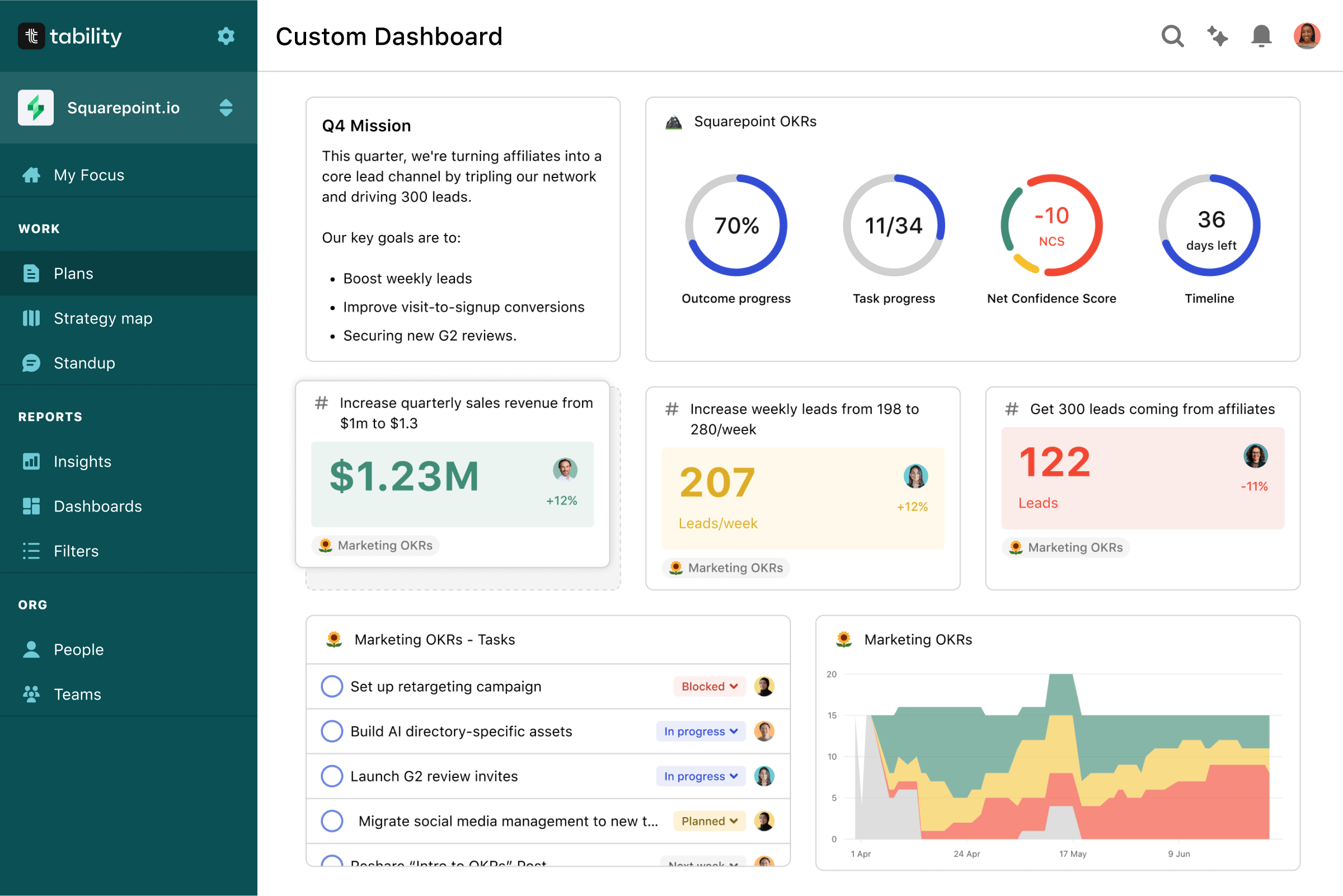
For CEOs and founders: If you’re not ready to hire a Chief of Staff, Tability feels like hiring one. It’s sole purpose is to organize your strategy and priorities and puts in the processes to make sure it gets done. With Tabby AI, the world’s first OKR agent, you can automate and drive accountability in a lot of the ways a Chief of Staff can too.
For Chiefs of Staff: Tability has everything to make your job easy. Automate check-ins, connect metrics, and spin up simple dashboards and QBR reports in minutes. Tabby AI summarises progress, highlights slippage, and suggests next moves—freeing you to focus on decisions and unblockers, not data wrangling.
Whether you’re exploring a Chief of Staff role or already in one, Tability gives you the Chief of Staff responsibilities in software—clarity, cadence, and accountability—without the overhead.
Wrap up
The Chief of Staff role isn’t a fixed template—it’s a living, evolving function that reshapes itself around your stage, your CEO’s strengths, and the biggest gaps in how work gets done. One quarter it’s standing up OKRs and operating cadence; the next it’s unblocking a cross-functional launch, tightening board comms, or redesigning how decisions are made.
What doesn’t change is its value across every team. Product, engineering, sales, success, finance, and people all benefit from a single owner of clarity, cadence, and follow-through. A great Chief of Staff connects strategy to execution, keeps priorities aligned, and turns scattered effort into collective momentum.
Bottom line: however your company changes, a strong Chief of Staff remains crucial—bringing the right kind of structure at the right time so the whole organisation can move faster, together.
For more info on Chief of Staff role: Check out our Chief of Staff Playbook


.jpg)
.png)