You’ve mapped out your strategy. You’ve set your goals. You’ve even rolled out OKRs across the company.
But now it’s Q2, and nothing’s really moving. Teams are working hard—but not always on the right things. Updates feel disconnected. And somehow, that big vision you shared at the all-hands hasn’t translated into day-to-day action.
This is the strategy-execution gap. And it’s one of the most frustrating challenges for anyone in a strategy and operations role.
Strategic initiatives are how you close that gap. They’re not just projects or task lists. They’re the focused, measurable efforts that translate your high-level goals into coordinated execution.
In this guide, we’ll break down what strategic initiatives are, how to create them, where they go wrong, and how to make sure they actually lead to meaningful progress across your business.
What are strategic initiatives?
Strategic initiatives are the action plans that turn your long-term vision and mission into measurable progress. They're not just big ideas—they’re specific, cross-functional efforts with owners, milestones, and deadlines.
Think of your strategic goals as the destination, and initiatives as the vehicle. They help you bridge the gap between planning and execution—between leadership’s vision and what your teams are doing every day.
Good initiatives are:
- Aligned with your corporate level strategy via OKRs or strategic pillars
- Time-bound (quarterly or annual is common)
- Owned by someone accountable
- Measurable, with defined outcomes
- Focused, not spread across too many things
Types of strategic initiatives
There are multiple ways to categorise strategic initiatives depending on your organisation’s maturity and structure.
By strategy level:
- Corporate-level: Top-tier efforts impacting the entire company (e.g. a merger, global expansion)
- Business-level: Changes that affect specific business units or regions (e.g. entering the SMB market)
- Functional-level: Department-level execution plans (e.g. marketing automation or new hiring practices)
By intent:
- Corrective – Fix inefficiencies, tech debt, or compliance gaps
- Defensive – Protect against market threats (e.g. tightening security)
- Offensive – Bold plays to outpace competitors (e.g. launching a new product category)
- Constructive – Build new capabilities or infrastructure (e.g. setting up a RevOps function)
- Innovative – Experiment with disruptive models or technologies (e.g. adopting AI agents or Web3 workflows)
Each type serves a purpose. What matters is choosing the right mix and ensuring every initiative ties back to your broader goals.
Why strategic initiatives fail
Most strategic plans look great on slides. But execution is where the majority fall short.
According to the Harvard Business Review, studies commonly estimate that 60% to 90% of strategic plans or initiatives fail to achieve their intended outcomes—often because execution falls apart, alignment is missing, and ownership isn’t clear.
Here’s why:
- No alignment – The initiative doesn’t support any clear goal
- Too many priorities – Teams are spread too thin
- No owner – Nobody’s clearly responsible
- Siloed execution – No collaboration between functions
- Lack of tracking – No real-time visibility on progress
A common pattern: companies launch a strategic initiative with enthusiasm, fueled by kickoff meetings and flashy presentations—but by Q2, it’s buried in a spreadsheet, derailed by reorgs, or quietly dropped as priorities shift. Teams get distracted, momentum fades, and no one’s quite sure what happened to that big push from earlier in the year.
You can’t prevent all distractions. But you can build a system that keeps your initiatives grounded—clear ownership, visible milestones, and a strong connection to the goals that matter most.
How to create effective strategic initiatives
Strong initiatives don’t start with the idea. They start with alignment.
Too often, teams kick off initiatives because an idea sounds promising or exciting, without clearly tying it back to the bigger strategic goals of the business. This can lead to wasted resources, scattered effort, and a frustrating sense of spinning your wheels without meaningful progress.
To avoid these common pitfalls, your strategic initiatives should always start from a place of alignment. Before launching into execution, it’s critical to ensure everyone clearly understands how an initiative connects to your organisation’s objectives and what success looks like.
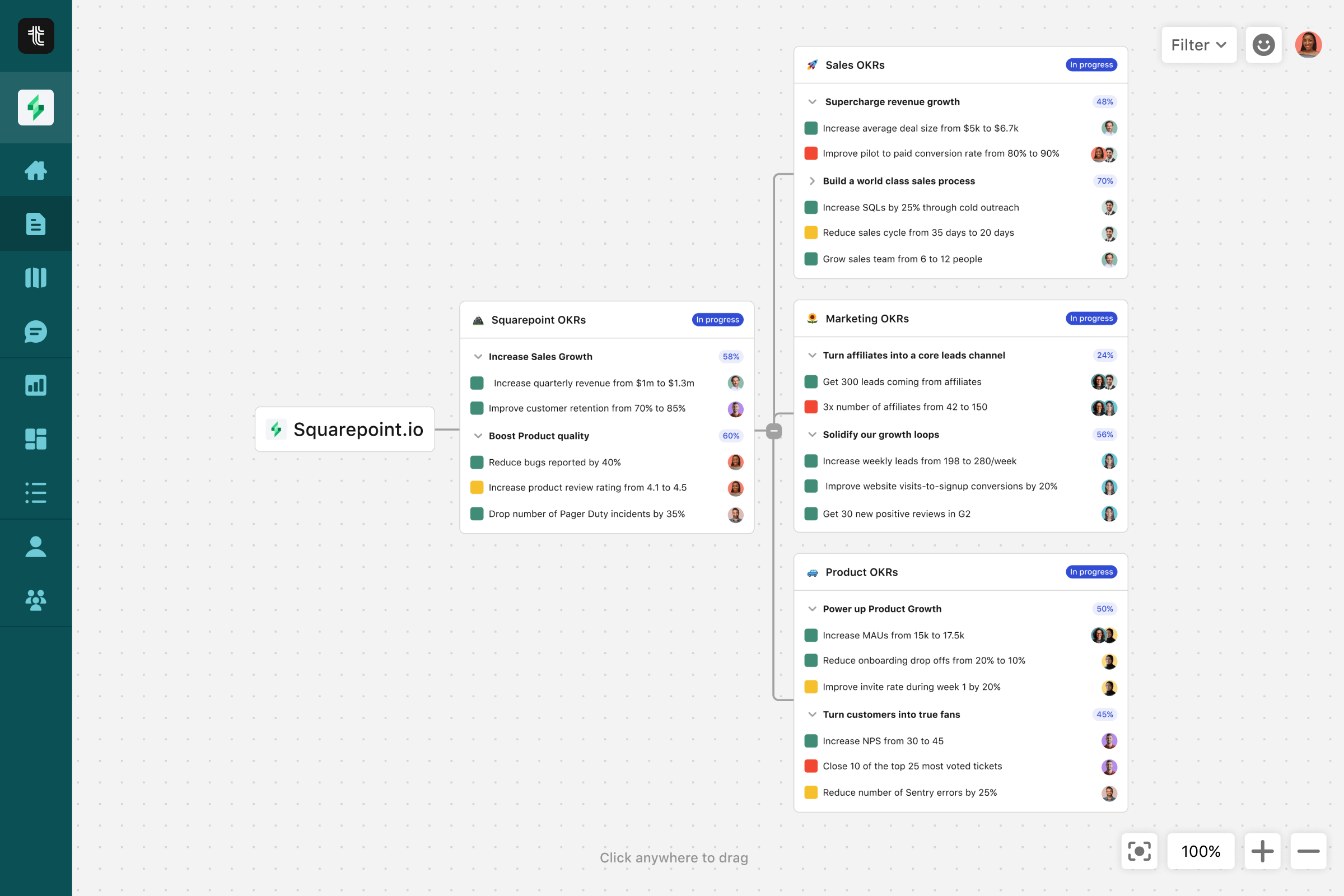
.png)
Here’s a step-by-step framework to take your strategic initiatives from concept to action, ensuring they’re clearly aligned, effectively owned, and ready for successful execution:
1. Start with alignment
Every initiative must directly tie to a strategic goal. If you’re using OKRs, each initiative should link back to at least one Key Result.
Example:
- Objective: Expand into APAC
- Key Result: Acquire 1,000 customers in Singapore by Q4
- Initiative: Localise onboarding and build out a regional Customer Success team
If an initiative doesn’t support a strategic objective or KR, it probably isn’t strategic.
2. Assign clear ownership
Every strategic initiative should have one clearly defined owner—ideally someone who can make cross-functional decisions and drive execution.
- Assign a single, accountable lead for each initiative
- Optionally add a co-lead for complex, cross-functional initiatives
- Clearly define roles and responsibilities for collaborators
- Make ownership visible across your organisation to ensure accountability
3. Break initiatives into projects and tasks
Strategic initiatives are often broad and require more detailed execution planning. Break each initiative down into smaller, actionable projects and tasks.
- Projects are discrete, manageable pieces of work that advance the initiative
- Tasks are specific actions required to complete a project
- Assign owners and deadlines to each project and task
- Identify clear metrics (leading indicators like signups, or lagging indicators like revenue) for tracking progress
This detailed breakdown ensures everyone knows exactly what they’re responsible for and how their work ties back to strategic objectives.
4. Communicate clearly and often
Simply documenting your initiatives isn’t enough—you must actively communicate them across the organisation. Make sure everyone clearly understands why initiatives matter, how they align to your overall strategy execution, and what success looks like.
- Use visual tools like roadmaps, alignment maps, or dashboards
- Regularly share updates in team meetings, Slack channels, and all-hands
- Continuously reinforce how initiatives connect to OKRs and strategic goals
Putting in place the right team engagement activities helps build good communication habits, give clarity around goals, and keeps teams motivated, aligned, and focused on what truly matters.
Examples of strategic initiatives by team
Strategic initiatives can look different across teams, but they all share the same purpose: driving progress toward critical business outcomes. Below are some real-world examples of strategic initiatives across various departments to help inspire your own planning:
Product
- Launch self-serve onboarding by Q2
- Sunset 3 underused features to streamline UX
Marketing
- Grow organic traffic by 50% through targeted content
- Launch a co-marketing campaign with 3 partners
Sales
- Implement a new CRM workflow by Q3
- Hire 5 outbound reps for mid-market expansion
People & Culture
- Reduce time-to-hire from 45 to 30 days
- Build an internal mobility program for high performers
Customer Success
- Lower churn by 15% in the enterprise segment
- Launch NPS surveys and close-the-loop processes
Engineering
- Migrate to a scalable microservices architecture
- Improve test coverage to 85% by end of year
ℹ️ If you’re unsure what your team should be tracking, start with finding the right success metrics. Visit our comprehensive list of KPI examples by team for more success metrics that may be relevant for you.
How to track and report on initiatives
Visibility is key. If you can’t track it, you can’t improve it.
Strategic initiatives often start with enthusiasm, but without consistent visibility into progress, it’s easy for teams to drift off course. Updates become infrequent, blockers remain hidden, and by the time leaders realise there’s a problem, it’s often too late to get back on track.
Best-in-class teams avoid this trap by putting visibility front and center. They establish clear, real-time insights into initiative status, ensure accountability through regular check-ins, and leverage tools designed specifically for strategic alignment.
Here’s what best-in-class teams do:
1. Use a central tracking system
Whether it’s Tability, Asana, Notion, or a custom OKR dashboard, centralise all initiative-related information in one easy-to-access location. Clearly link initiatives to their owners, relevant OKRs, key milestones, and associated tasks. Having everything in one place keeps teams aligned, ensures clarity around accountability, and provides a real-time snapshot of initiative health.
ℹ️ See our list of best OKR software to see which one is right for your organisation.
2. Add regular check-ins
Successful execution isn’t about quarterly reviews—it’s about consistent OKR tracking and ongoing accountability. Establish a clear, regular cadence for updates to ensure initiatives stay on track and blockers get addressed promptly.
- Weekly: Quick async check-ins to update progress, surface any immediate issues, and keep momentum going.
- Monthly: Cross-functional team reviews to ensure alignment and proactively tackle challenges or dependencies between teams.
- Quarterly: Comprehensive strategic reviews to reflect, adjust, and reset initiatives as needed.
To encourage consistent participation, make these check-ins easy and lightweight. Regular, frequent updates enable quick course corrections rather than waiting for quarterly retrospectives to address issues.
3. Visualise progress
Don’t just track—visualise. Use intuitive dashboards or visual tools that clearly illustrate how each initiative supports your company’s broader strategic goals. Dashboards should connect the dots, showing clear links from daily tasks to strategic outcomes, helping everyone understand their contribution and the impact of their work.
Strategic initiatives vs. OKRs vs. Tasks/Projects
Let’s break down how these terms fit together and how they interact:
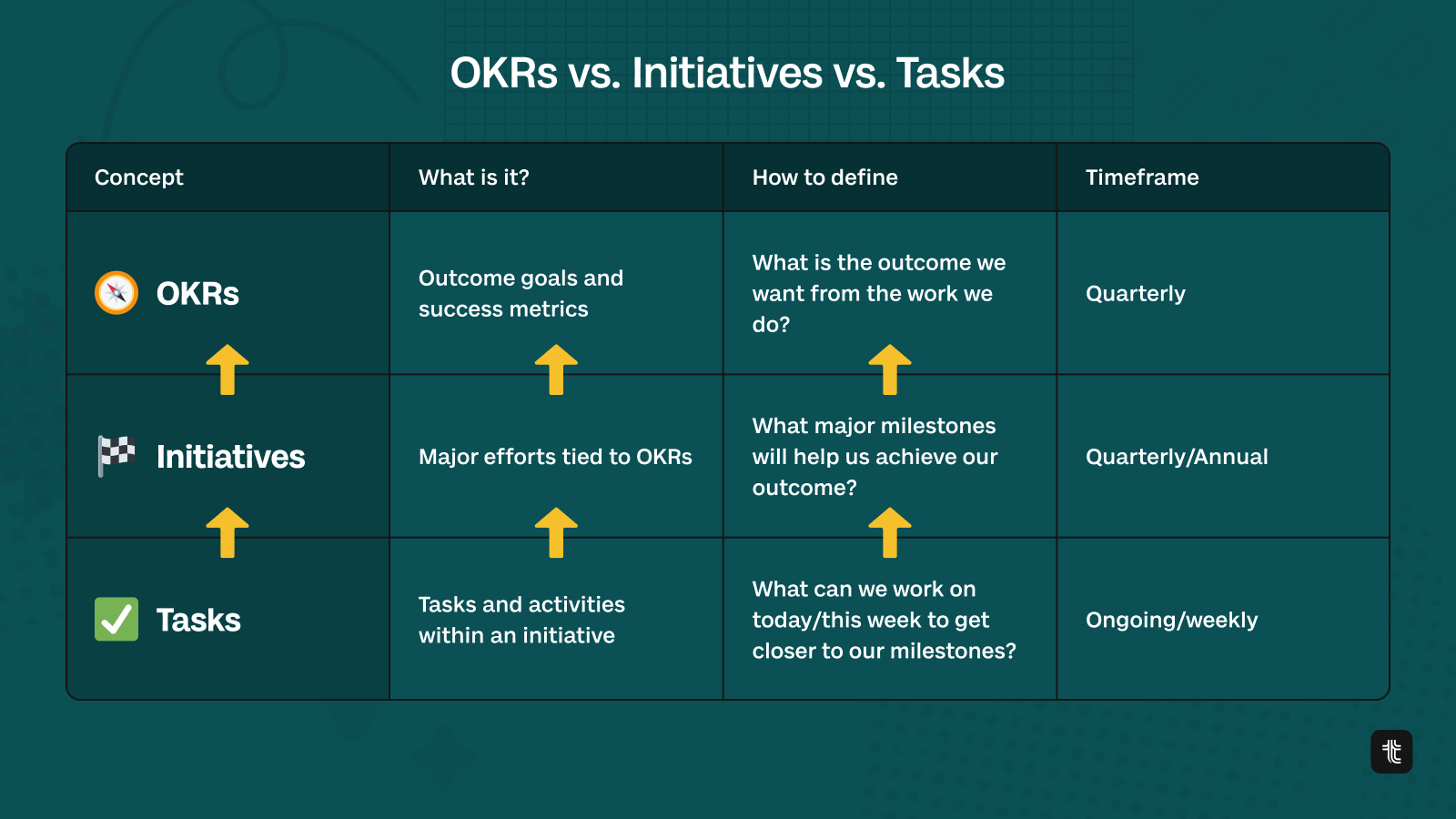
Think of this as a hierarchy:
- Start with Objectives and Key Results (OKRs): These define what success looks like—what outcomes matter most to your business right now.
- Define Strategic Initiatives: These are the big bets or programs of work designed to move the needle on your key results. Initiatives are broader than projects—they may include several streams of work and span teams.
- Break initiatives into projects: Projects are the tactical execution layer. Each project has its own scope, timeline, and deliverables that support the initiative.
Example:
- Objective: Improve customer satisfaction
- Key Result: Increase NPS from 40 to 60 by Q4
- Initiative: Launch new customer self-serve onboarding flow
- Projects: Updated onboarding emails, updated product walkthrough, redesigned in-app tips
ℹ️ More OKR examples
This structure ensures alignment from top to bottom—strategy informs goals, goals inform initiatives, and initiatives guide the work being done across teams. It gives everyone clarity on how their daily work ladders up to company priorities. Instead of teams working in silos or chasing unrelated tasks, this approach creates a clear line of sight from the company’s long-term vision down to the next item on someone’s to-do list. When done right, it connects execution to strategy in a way that drives real progress.
Common pitfalls (and how to avoid them)
When strategic initiatives fail, it’s rarely due to a lack of ambition or enthusiasm. Instead, common execution mistakes tend to trip teams up. Recognising these pitfalls early can save your organisation from stalled progress, frustration, and wasted resources. Here are the most frequent reasons strategic initiatives fall short—and practical ways to avoid them:
Too many initiatives
Teams often start with a long list of ambitious initiatives, hoping to make significant progress quickly. But when everything becomes a priority, nothing is. Spreading your team’s energy across too many initiatives at once dilutes focus, leads to fragmented efforts, and inevitably results in burnout or stalled progress.
What to do instead: Prioritise ruthlessly—aim for 3–5 impactful initiatives per team each quarter. Clearly communicate why these initiatives matter most to the organisation, and give teams explicit permission to say no to tasks outside these priorities.
No real-time updates
Many teams still rely on static spreadsheets, quarterly reviews, or infrequent updates to track their strategic initiatives. By the time these reports are compiled, they’re already outdated. This lag makes it nearly impossible to identify problems early or adjust course effectively.
What to do instead: Invest in tools that offer real-time visibility into progress, such as dashboards or goal-tracking software. Empower teams to update progress frequently, ensuring leadership and team members have a clear, up-to-date view of initiative health.
Top-down only
When strategic initiatives are dictated solely by leadership or upper management without input from the teams doing the work, crucial details can be overlooked. Frontline teams often have valuable insights into feasibility, potential obstacles, and better approaches to achieving goals—yet their voices frequently go unheard in top-down planning.
What to do instead: Actively involve team members early in initiative planning. Facilitate regular feedback sessions, run brainstorming workshops, and solicit their insights before finalising strategic decisions. This approach not only improves initiative quality but also increases team buy-in and motivation.
Poor handoffs
Initiatives often require multiple departments or teams to collaborate. However, unclear handoffs—when responsibilities shift from one team to another—are a frequent source of friction, delays, and dropped work. For example, marketing may create assets without clear guidance from sales, leading to wasted effort and misalignment.
What to do instead: Document and communicate roles, responsibilities, and timelines at each transition point. Hold explicit handoff meetings, create shared checklists or transition documents, and regularly review these transition points to refine processes and ensure smoother collaboration.
How Tability can help with your strategic initiatives
Tability is built specifically to help teams turn big-picture goals into focused, actionable plans. Here’s how key features make executing strategic initiatives simpler and more effective:
1. Initiative-to-OKR Alignment
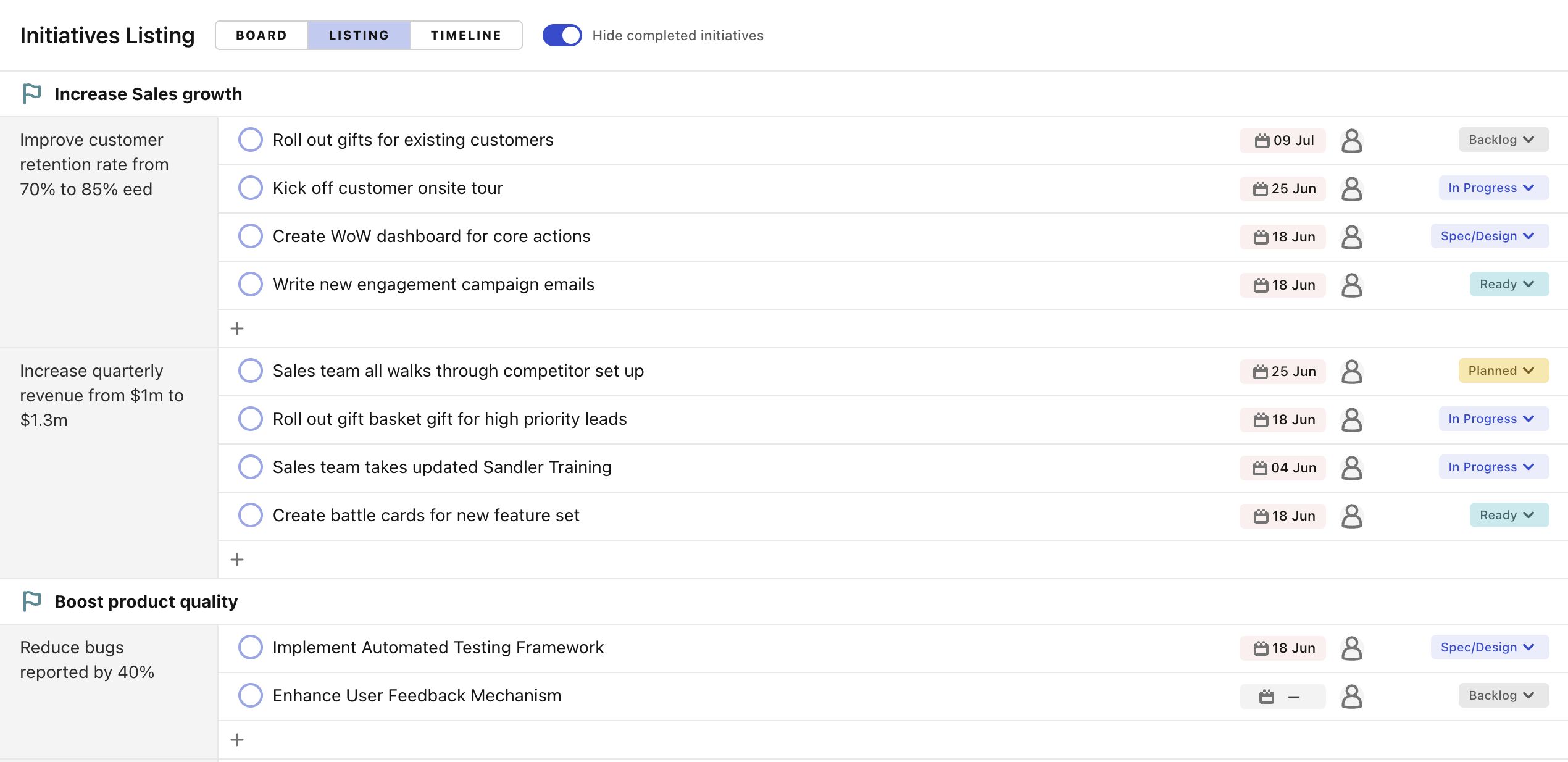
Tability clearly links initiatives to your OKR, so your team always sees how their projects directly support strategic outcomes. This alignment ensures everyone stays focused on the right priorities, reducing wasted effort on tasks that don’t move the needle.
2. Real-Time Progress Dashboards
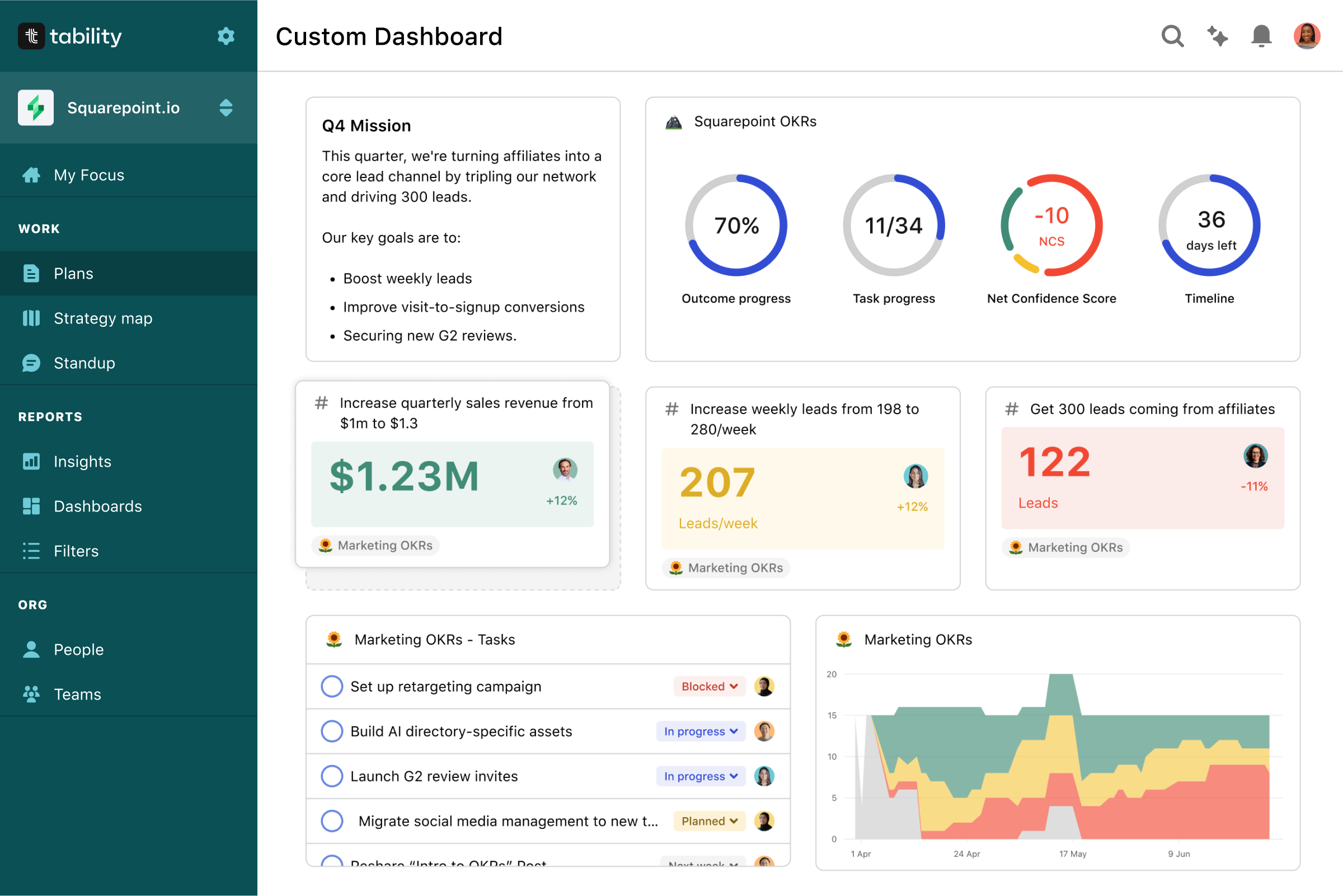
Instead of outdated spreadsheets, Tability’s live dashboards show real-time initiative progress. Teams can quickly spot what’s on track or at risk, allowing leaders to address blockers immediately and keep momentum going.
3. Weekly Check-ins and Accountability
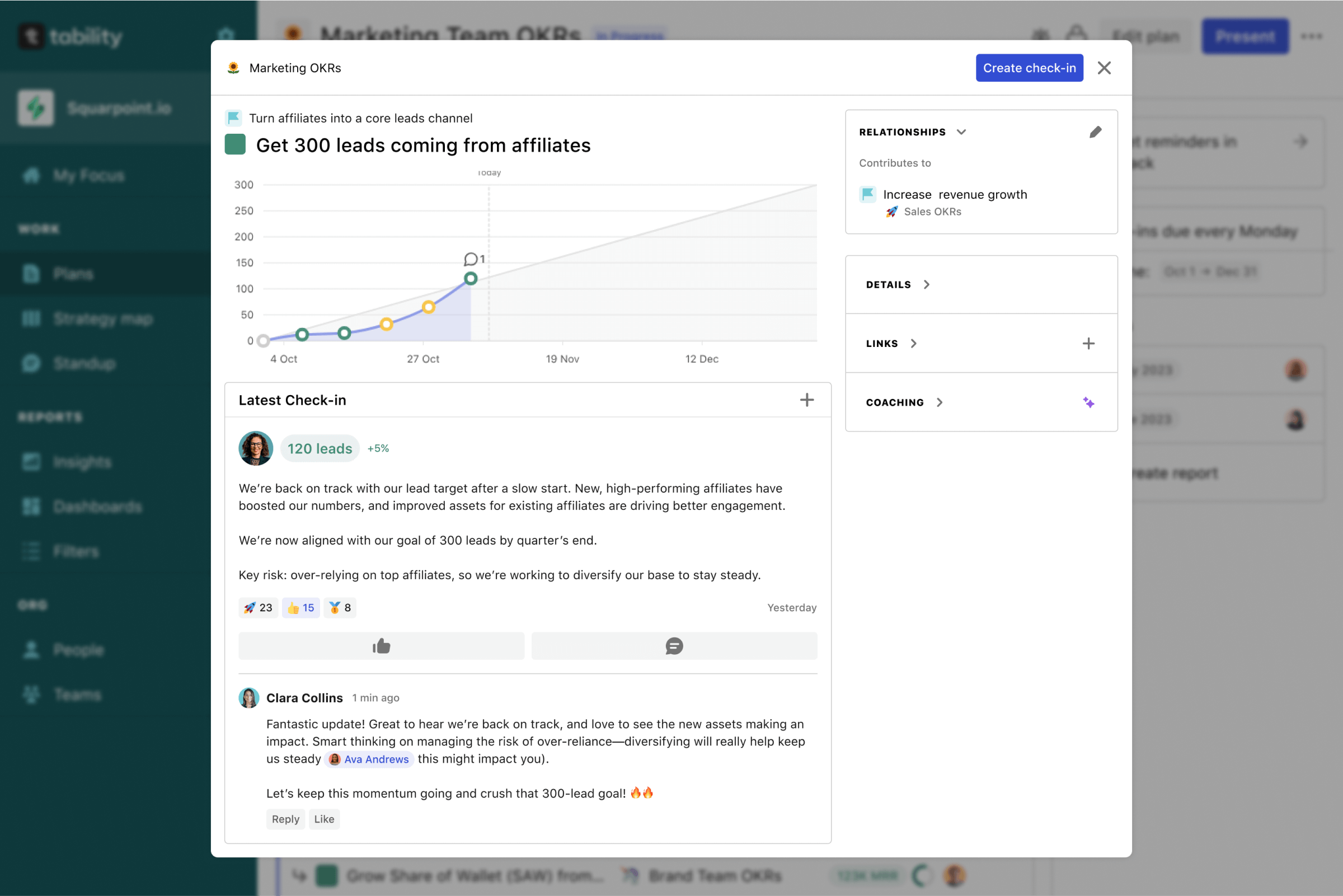
With simple weekly check-ins, initiative owners regularly report progress, surface issues, and flag achievements—all within one centralised platform. This practice builds accountability, ensures transparency, and keeps execution aligned with your strategic vision. You even have the option of automating your OKR tracking.
Using Tability transforms strategic execution from a vague plan into a clear, measurable, and collaborative process.
Final thoughts: closing the strategy–execution gap
Setting bold goals is the easy part. The real challenge is making sure they turn into meaningful action across your teams. Too often, strategy gets stuck in slide decks while execution moves in a different direction—disconnected, reactive, and misaligned.
That’s where strategic initiatives come in. They’re the connective tissue between high-level vision and daily work—bringing structure, focus, and accountability to your most important work goals.
So the next time you set a company objective, go beyond the what. Ask: What are the key initiatives that will get us there? Who’s responsible? How will we stay aligned along the way?
When you build that bridge between strategy and execution, teams gain clarity, momentum builds, and progress becomes measurable. That’s how you turn vision into outcomes—and strategy into impact.


.jpg)
.png)



.png)