
Most companies reach a point where things are moving fast but not clearly. Teams are busy, projects are multiplying, and leadership can't tell what's actually working. That's usually when someone says: "We need a BizOps team."
But what does a BizOps team actually do? And what makes it different from finance, RevOps, or StratOps?
This article answers both. It's written for leaders trying to understand the function before they build it, and for people already in the seat who want a clearer frame for what they own.
What is BizOps?
BizOps — short for Business Operations — is the function responsible for improving how a company operates internally. It's not about selling more (that's RevOps). It's not about executing the three-year plan (that's StratOps). BizOps is the operational engine in between: making sure the day-to-day and quarter-to-quarter work of the business runs efficiently and in the right direction.
A BizOps team typically sits close to the CEO or COO, with a mandate that crosses functions. They go where the problems are.
What a BizOps team actually does
The scope varies by company size and stage, but across most organisations, a BizOps team owns six core responsibilities.

1. Cross-functional projects and initiatives
Most strategic problems don't fit neatly inside one team's budget or reporting line. BizOps takes ownership of those cross-functional initiatives that are too important to fall through the cracks but don't have a natural home.
Examples: launching a new market, standing up a new operational process, leading a company-wide OKR rollout, or integrating a new tool across five teams.
2. Planning and goal coordination
BizOps often runs or supports the company's goal-setting cycles. This means working with leadership to set OKRs, translating strategy into quarterly priorities, and making sure every team has clear objectives that ladder up to the company's direction.
Without this coordination, teams optimise locally and drift apart. BizOps creates the operating cadence that keeps everyone moving in the same direction.
3. Data, reporting, and performance visibility
BizOps teams are often the internal analytics layer for the leadership team. They build dashboards, track key metrics, and surface the performance data that executives need to make decisions quickly.
This doesn't mean BizOps replaces your data team. It means BizOps translates data into operational decisions. They ask: what does this number mean for how we should run the business this quarter?
4. Operational efficiency and process improvement
BizOps audits how work actually gets done and fixes what's broken. This includes identifying bottlenecks, streamlining workflows, running internal process reviews, and implementing tools that reduce friction.
Think of it as continuous improvement with a business-context lens — applied to how a modern company ships, sells, and serves.
5. Business case development and special projects
When the CEO wants to explore a new idea, a potential acquisition, or a strategic bet, BizOps often runs the analysis. They build financial models, assess operational feasibility, and synthesise the options.
This positions BizOps as the internal consulting function. They're generalists with enough context to quickly go deep on any business problem.
6. Tool and technology operations
BizOps teams frequently own the evaluation and rollout of internal tools — from project management platforms to goal-tracking software. They bridge the gap between what teams need operationally and what IT provisions technically.
How BizOps teams are structured
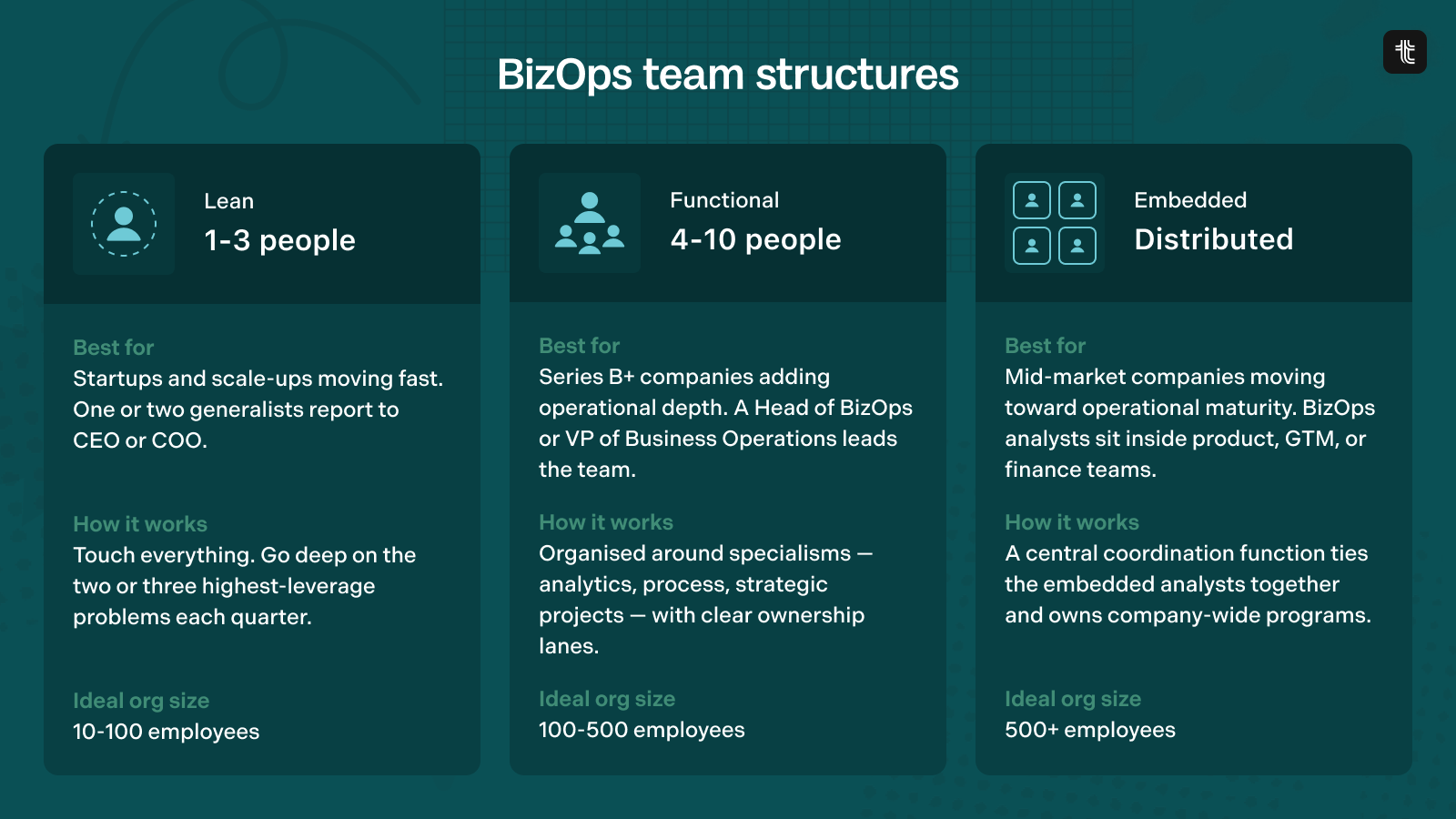
There's no one-size-fits-all structure, but here are the most common patterns:
- Lean (1–3 people): Common at startups and scale-ups. BizOps is one or two generalists reporting to the CEO or COO. They touch everything but go deep on the highest-leverage problems each quarter.
- Functional (4–10 people): Often organised around specialisms — analytics, process, strategic projects. Reporting lines may include a Head of BizOps or VP of Business Operations.
- Embedded model: BizOps analysts embedded within product, GTM, or finance teams, with a central function for coordination. Common at mid-market companies moving toward operational maturity.
Reporting line matters. BizOps closest to the CEO tends to get broader scope and faster access to decision-makers. BizOps under the COO tends to focus more on operational delivery and efficiency programmes.
BizOps vs StratOps, RevOps, and Finance
This is where most people get confused. Here's a clean separation:
- BizOps focuses on internal operational efficiency — how the company works, how work gets done, and whether teams are running well.
- StratOps (strategic operations) is the function that bridges strategy and execution at a company-wide level. It owns the operating cadence, goal architecture, and strategic visibility that makes long-term plans real. BizOps solves today's problems. StratOps builds the system that makes next year's execution possible.
- RevOps focuses on the revenue motion — aligning sales, marketing, and customer success around a single pipeline and revenue architecture. See BizOps vs RevOps for a deeper breakdown.
- Finance owns the money — budgeting, forecasting, controls. BizOps often works alongside finance but focuses on operational decisions rather than financial compliance or reporting.
At many companies, BizOps and StratOps functions overlap or are run by the same team. The distinction matters most at scale, when you need someone explicitly accountable for strategy execution as a system, not just operational projects.
When do you need a BizOps team?
The honest answer: earlier than most founders think. Here are the signals:
- Leadership is spending more time on coordination than decisions
- Cross-functional projects keep stalling with no clear owner
- You can't tell which teams are on track without a long meeting
- Strategy and execution are out of sync — teams know the plan but aren't sure how to connect their work to it
- Your operating model is being held together with spreadsheets and Slack
If two or more of these are true, you're already past the point where BizOps would have been useful.
How Tability helps BizOps teams run better
BizOps teams are only as good as their visibility into what's actually happening. Without a shared system for goals, check-ins, and initiative tracking, BizOps ends up spending its time chasing updates instead of solving problems.
Tability is purpose-built for exactly that. It gives BizOps teams (and the leadership teams they support) a single place to track goals, connect initiatives to outcomes, and run a weekly check-in cadence that keeps the business accountable without turning every meeting into a status update.
Instead of pulling numbers from ten different sources every Monday, your BizOps team walks into the week already knowing what's on track, what's at risk, and where they need to focus.
Book a 30-minute demo and see how teams use Tability to run their operating cadence from goal-setting through weekly check-ins.

.jpg)
.png)