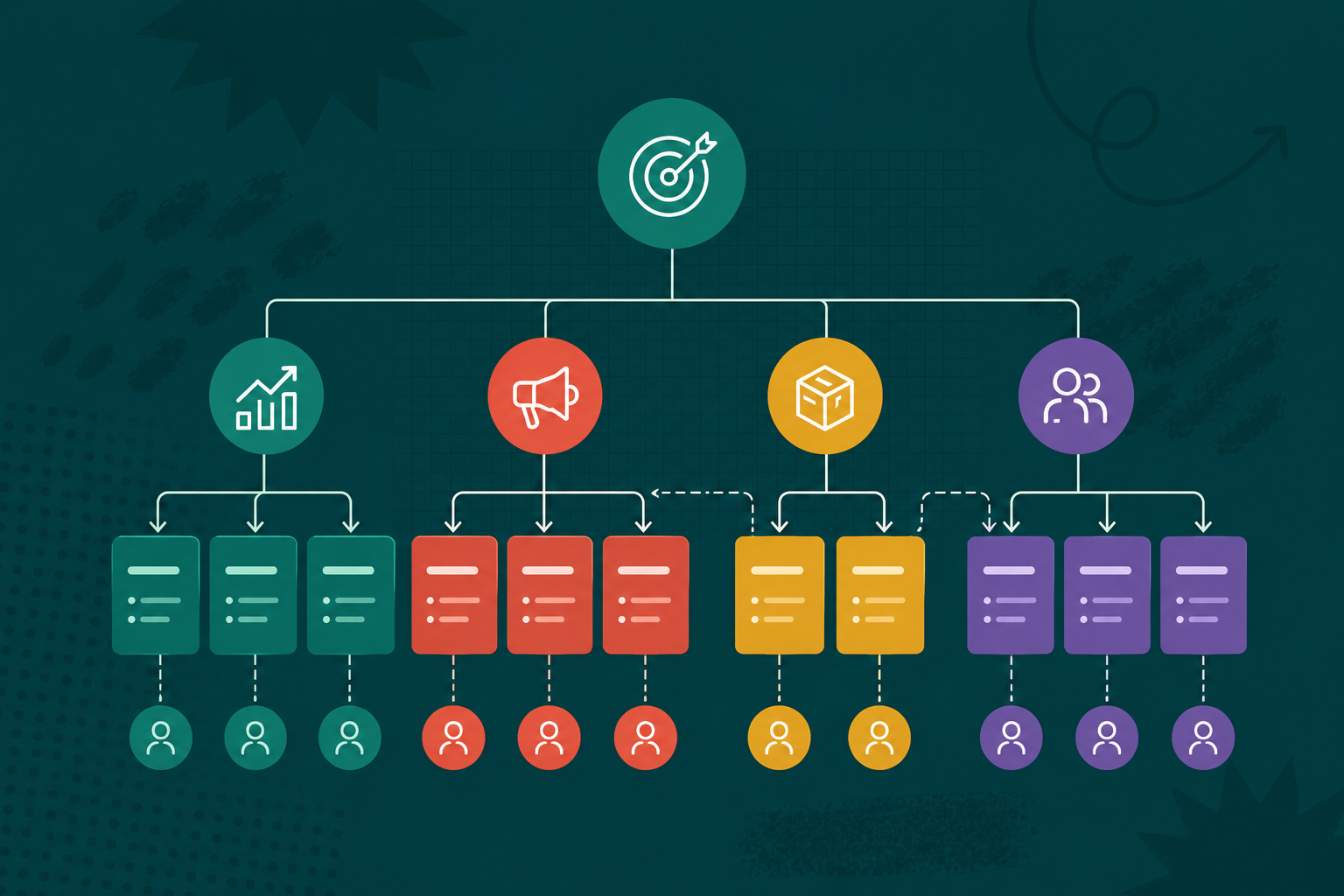
Cascading goals are goals that flow down through an organisation level by level. The company sets its top goals, each team derives its own goals from the level above, and those break down again for the teams below. The result is a tree where every team goal ladders up to a company goal.
The appeal is obvious. You can look at the tree and see exactly how a frontline goal connects to a company priority. Cascading objectives give you a clean line of sight from the top of the org to the bottom – which is why this model has a strong appeal with senior leadership teams.
The challenge is that sometimes teams try to be too strict, which can quickly turn this into a costly framework rather than helping organisations be more effective.
In this guide we’ll see how cascading goals work, where they tend to break, and a lighter way to get the same visibility without the maintenance cost.
How cascading goals work
Cascading starts at the top and works down. Say the company goal is to grow to 10,000 paying customers this year.
Leadership hands that down. Each team takes the goal above it and turns it into its own:
- Sales: add 4,000 new customers
- Marketing: generate 20,000 qualified leads
- Product: ship the three features blocking enterprise deals
- Success: lift the renewal rate from 85% to 92%
Then each of those cascades again. The Marketing lead goal becomes a set of channel goals. The Sales customer goal gets split across regions. The pattern repeats at every level until the goal reaches the people doing the work.
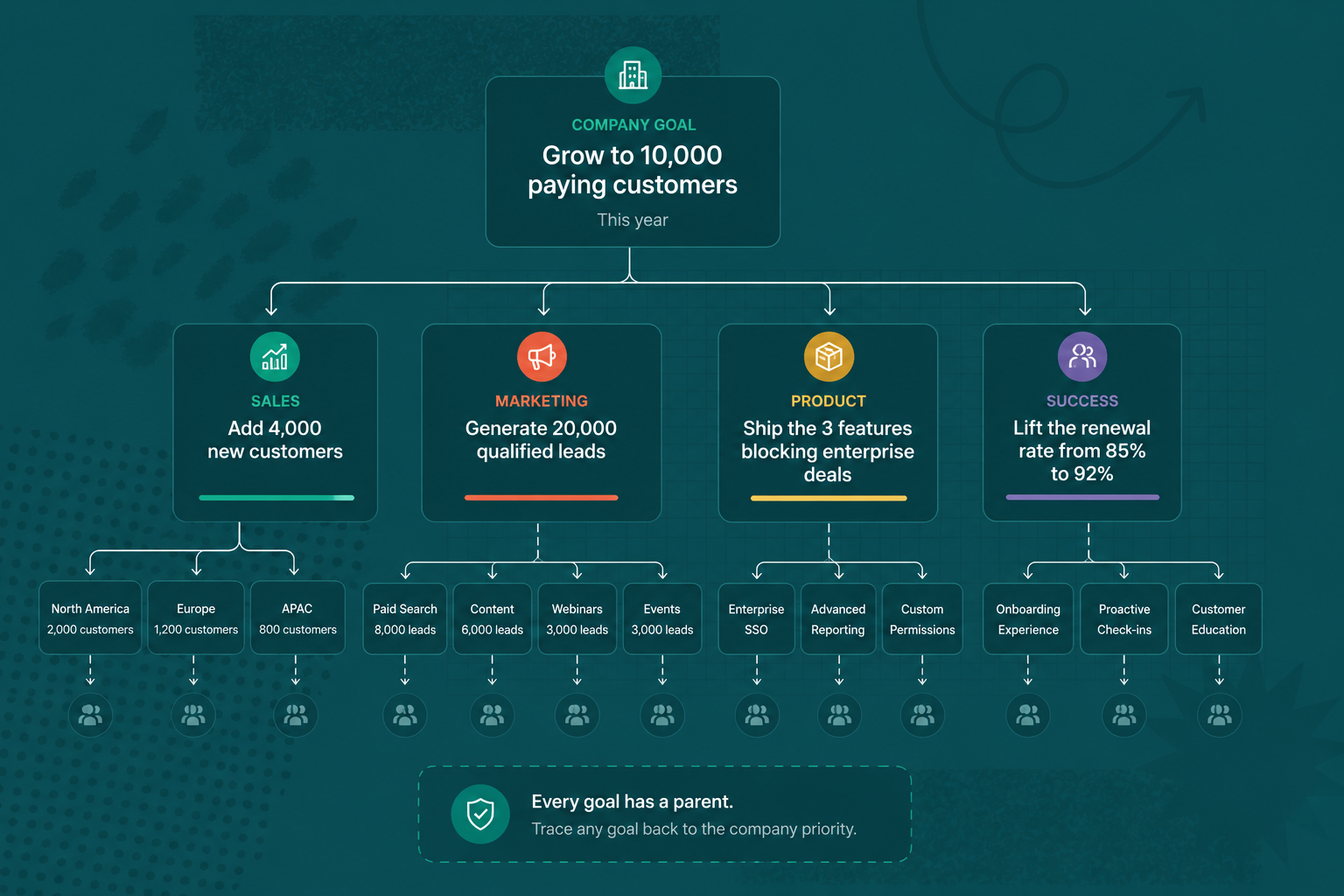
Done well, you end up with a chart where nothing is orphaned. Every goal has a parent, and you can trace any goal back to the company priority it serves. That traceability is the whole reason teams reach for goal cascading in the first place.
Where the cascading goals model breaks down
The model assumes two things: that the strategy above you is right, and that if it's correct, it will stay perfect for at least a quarter.
Both assumptions are shaky. If a top-level goal turns out to be wrong, every goal cascading from it will be wrong too. And every time a goal at the top changes, the change has to ripple through every layer beneath it. The result? Someone has to spend hours rewiring the tree, or the team quietly stops updating it.
There's a third cost. Teams like Support or Design often can't map cleanly onto a sales or marketing number, so they either shoehorn their goals into a parent that doesn't fit, or leadership adds more top-level goals to give them something to attach to. Either way you start to lose clarity and focus.
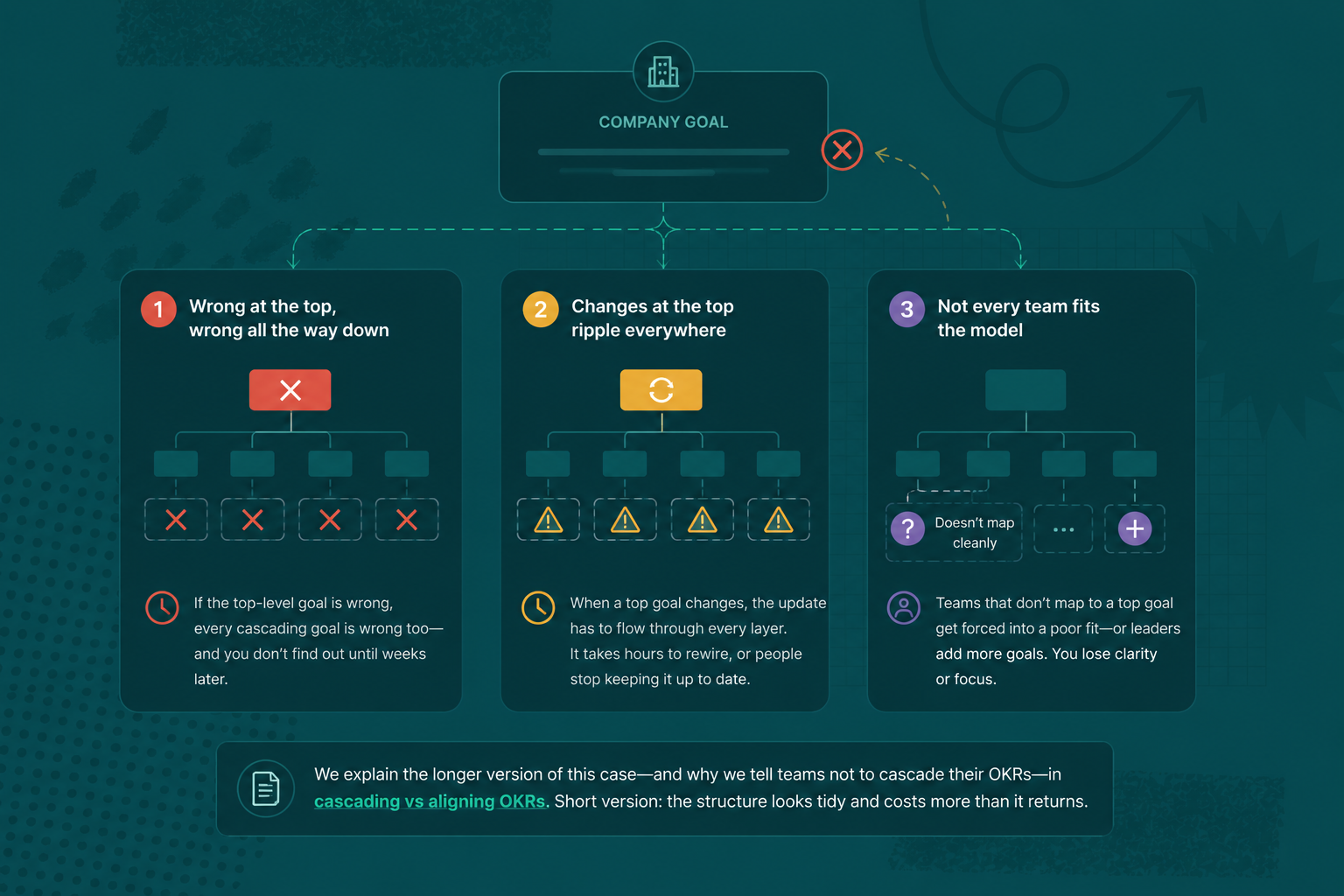
We've made the longer version of this case before, including why we tell teams not to cascade their OKRs. You can read that in cascading vs aligning OKRs. The short version: the structure looks tidy and costs more than it returns.
A lighter way to get the same visibility
Here's the part worth sitting with. What people actually want from cascading goals is rarely the rigid tree. It's the visibility. Senior leaders and managers need a way to visualise goal dependencies and understand how a team's work connects to the company's goals.
You can get that without cascading.
Set company goals at the top, then let each team write their own goals that align with those priorities, rather than deriving them line by line. No strict parent-and-child rule, no rebuild every time something shifts. Then, where a real relationship exists, link the goals together.
That's what the dependencies map in Tability is for.
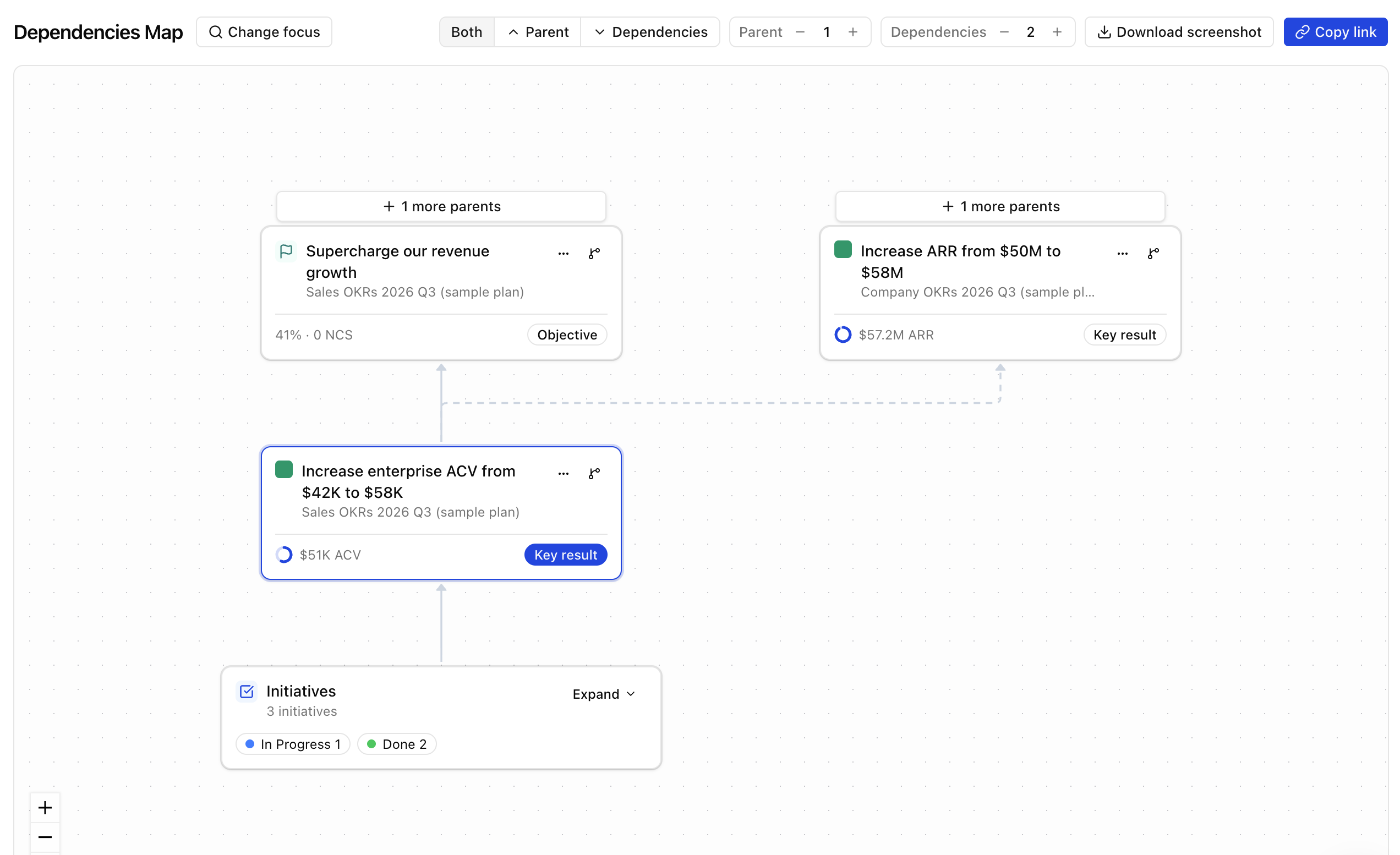
Once teams have set their goals and connected the ones that genuinely relate, the map shows you the links: which team goals feed which company goals, and what depends on what. You can focus on a single goal and see everything behind it, even when the chain crosses team boundaries.
You get the line of sight that makes cascading attractive, without the waterfall planning that makes it painful.
How to align goals in five steps
Alignment sounds looser than cascading, but it still needs a method. Here's the sequence, from a blank page to team goals that connect to the top.
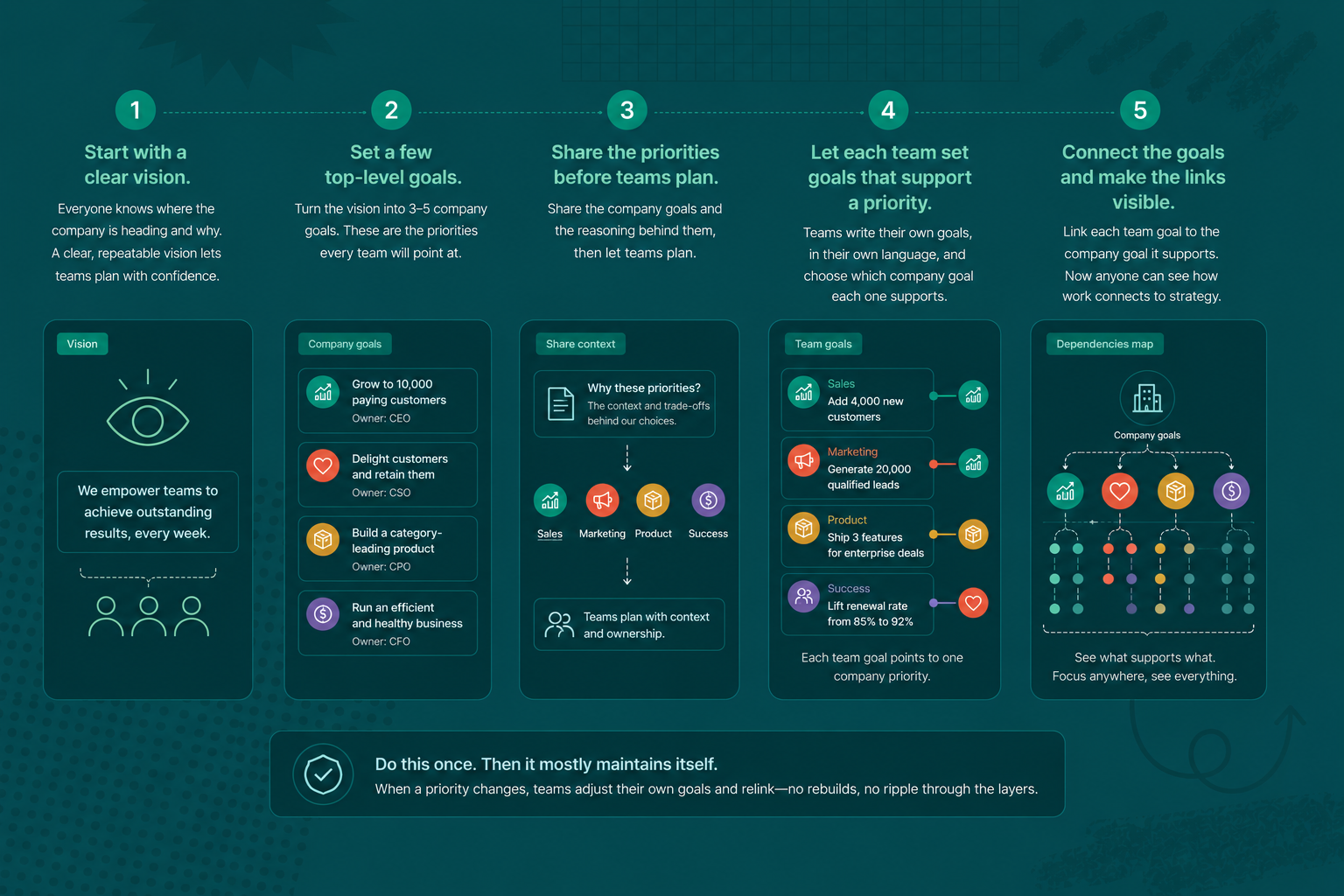
- Start with a clear vision. Before any goals, everyone needs to know where the company is heading and why. A vision people can repeat back in their own words is what lets teams plan without waiting to be told. If the vision is vague, alignment has nothing to align to.
- Set a few top-level goals. Turn the vision into a short list of company goals for the period. Three to five. These are the priorities every team will point at, so keep them measurable and give each one an owner. A long list here quietly recreates the sprawl you were trying to avoid.
- Share the priorities before teams plan. Hand teams the company goals and the reasoning behind them, then let them plan. This is the step cascading skips. A team that understands why a priority matters writes a better goal than a team handed a number to hit.
- Let each team set goals that support a priority. Each team writes its own goals, in its own language, and chooses which company goal each one supports. They own the wording and the target. The single rule is that every team goal points at a company priority. That's the difference from cascading: the team decides how it contributes rather than inheriting a slice of the goal above it.
- Connect the goals and make the links visible. Once the goals exist, link each one to the company goal it supports. Now you have what cascading promised, a clear line from team work to company priority, without the rigid tree. This is where the dependencies map earns its place: it draws the connections for you, so anyone can pick a goal and see what it supports and what feeds it.
Do this once and the structure mostly maintains itself. When a priority changes, teams adjust their own goals and relink, instead of waiting for a rebuild to ripple down the layers.
When cascading goals make sense
To be fair to the model, it isn't always the wrong choice. Cascading goals can work when the org is genuinely top-down, the strategy is stable, and the work is predictable enough that a plan set in January still holds in March. Some manufacturing and operations contexts fit that.
Most modern teams don't. If yours moves quickly and expects to adjust its plan as it learns, a strict cascade will fight you more than it helps.
Find the right trade-off.
Cascading goals give you traceability by forcing every goal to descend from the one above it. That structure is the source of both the appeal and the cost. If what you want is visibility, you can get it by aligning goals to shared priorities and linking the ones that relate. That keeps the line of sight and drops the maintenance.

.jpg)
.png)