
Most ops teams at growth-stage companies eventually hit the same conversation: "Wait, are we BizOps or StratOps?" Sometimes the answer is both. Sometimes neither. And often the people asking have been doing one while calling it the other.
This confusion is not just semantic. If you mis-scope the function, you'll hire the wrong person, set the wrong priorities, and wonder six months later why nothing has changed.
Here's the clearest way to think about the difference.
What is BizOps?
BizOps (Business Operations) is the function that makes the business run better today. It's cross-functional by design, sitting between the teams that create value and the infrastructure that supports them. A BizOps team's job is to identify and remove operational friction: misaligned processes, missing data, manual work that should be automated, and coordination gaps that cost the company time and money.
BizOps is operational by nature. It asks: "What's slowing us down right now, and how do we fix it?" The output tends to be process improvements, better tooling, dashboards, and the cross-functional projects that no single team can own alone.
If your company is scaling fast and the machine is starting to grind, that's usually a BizOps problem.
What is StratOps?
StratOps (Strategic Operations) is the function that makes the strategy actually happen. It owns the bridge between where leadership wants to go and what teams are actually working on. A StratOps function runs the goal-setting process (usually OKRs), manages the check-in cadence, and keeps the whole organisation aligned to strategic priorities.
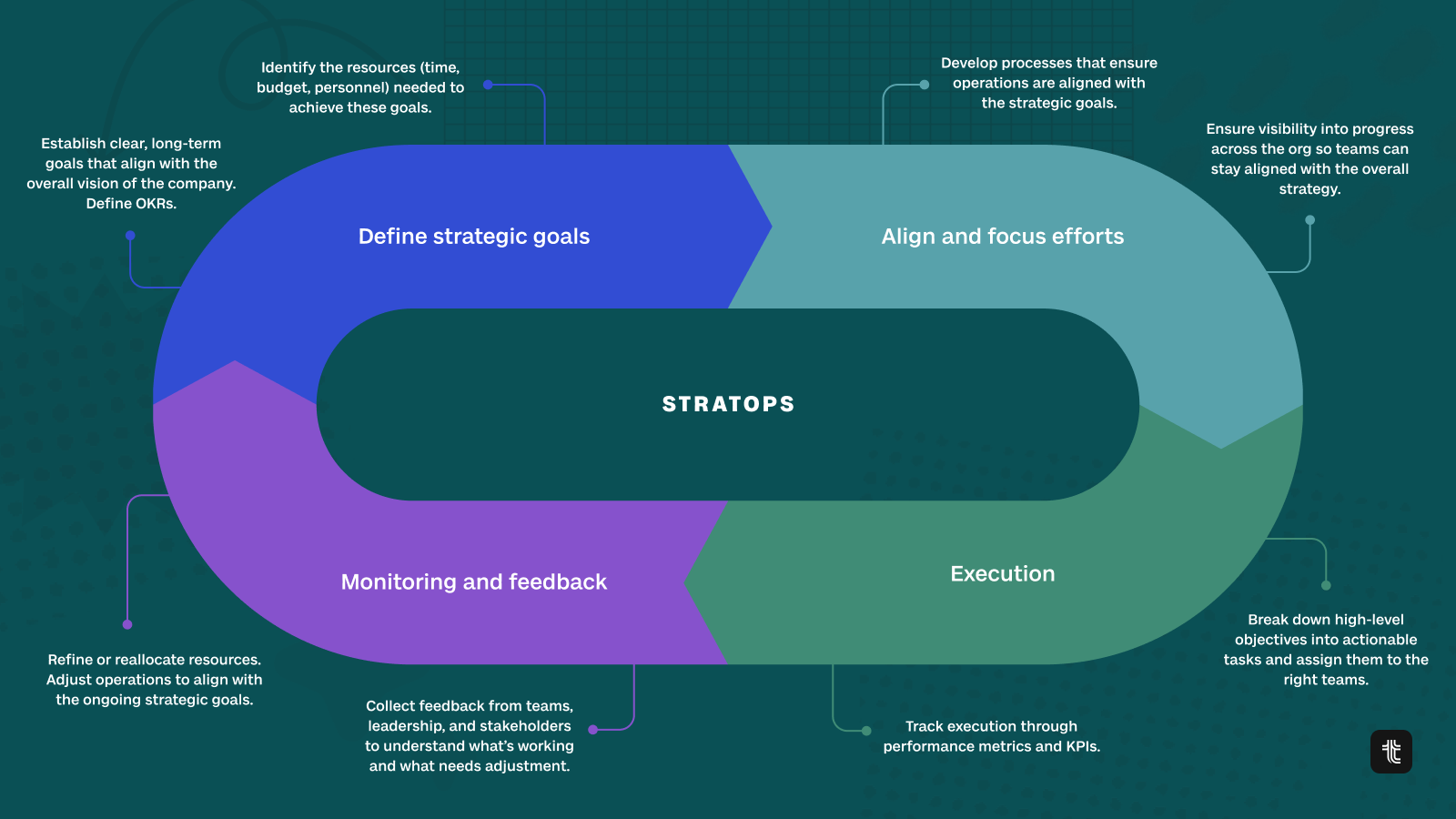
Where BizOps asks "what's slowing us down?", StratOps asks "are we working on the right things?" It's less about fixing today's friction and more about making sure the company is executing against a coherent strategy over time.
A well-run StratOps function means fewer "wait, why are we doing this?" moments in quarterly reviews, and more "here's what we're doing and exactly why."
BizOps vs StratOps: the key differences
The clearest way to separate them is by what failure looks like.
A BizOps failure is operational: teams are duplicating work, handoffs are breaking down, leadership doesn't have the data they need to make decisions. The company is inefficient.
A StratOps failure is strategic: teams are working hard but on the wrong things, goals aren't connected to real priorities, and execution is happening in silos. The company is misaligned.
Both failures are common. Both are expensive. They just need different fixes.
Where BizOps and StratOps overlap
They're not watertight categories. In practice, there's genuine overlap in a few areas.
Goal infrastructure. Both functions care about how goals are set and tracked. BizOps might own the dashboard; StratOps owns the OKR cycle. At smaller companies, the same team often owns both.
Cross-functional coordination. Both BizOps and StratOps end up facilitating the conversations that don't naturally happen between teams. StratOps does this through the planning cadence; BizOps through specific projects and process fixes.
Data and reporting. BizOps builds the dashboards. StratOps uses them to inform the next quarter's priorities. Neither can do their job well without the other.
At companies with a single S&O team (often the case pre-Series C), one person or function ends up covering both. That's fine, as long as you're clear about which hat you're wearing. The strategy and operations manager role is a good example of how both functions get bundled in practice.
Do you need BizOps, StratOps, or both?
A useful rule of thumb: if your main problem is that things don't work well, you need BizOps. If your main problem is that teams are working hard but not in the same direction, you need StratOps.
At smaller companies (sub-100 people), a single operations role can cover both. The chief of staff or head of operations often runs the OKR process while also fixing broken processes. That's hybrid BizOps/StratOps in practice, and it works.
At larger companies, the functions start to separate. You might have a BizOps team under the COO and a dedicated StratOps function under the CEO that owns goal-setting and strategic alignment.
The trigger for splitting them is usually scale: when one person can no longer be the connective tissue for both operational efficiency and strategic alignment at the same time.
For a deeper look at how StratOps fits alongside other operational functions, our article on strategy execution covers this in more detail.
How Tability supports both functions
Whether you're running BizOps, StratOps, or a hybrid, the underlying need is the same: a system that connects goals to work and makes progress visible.
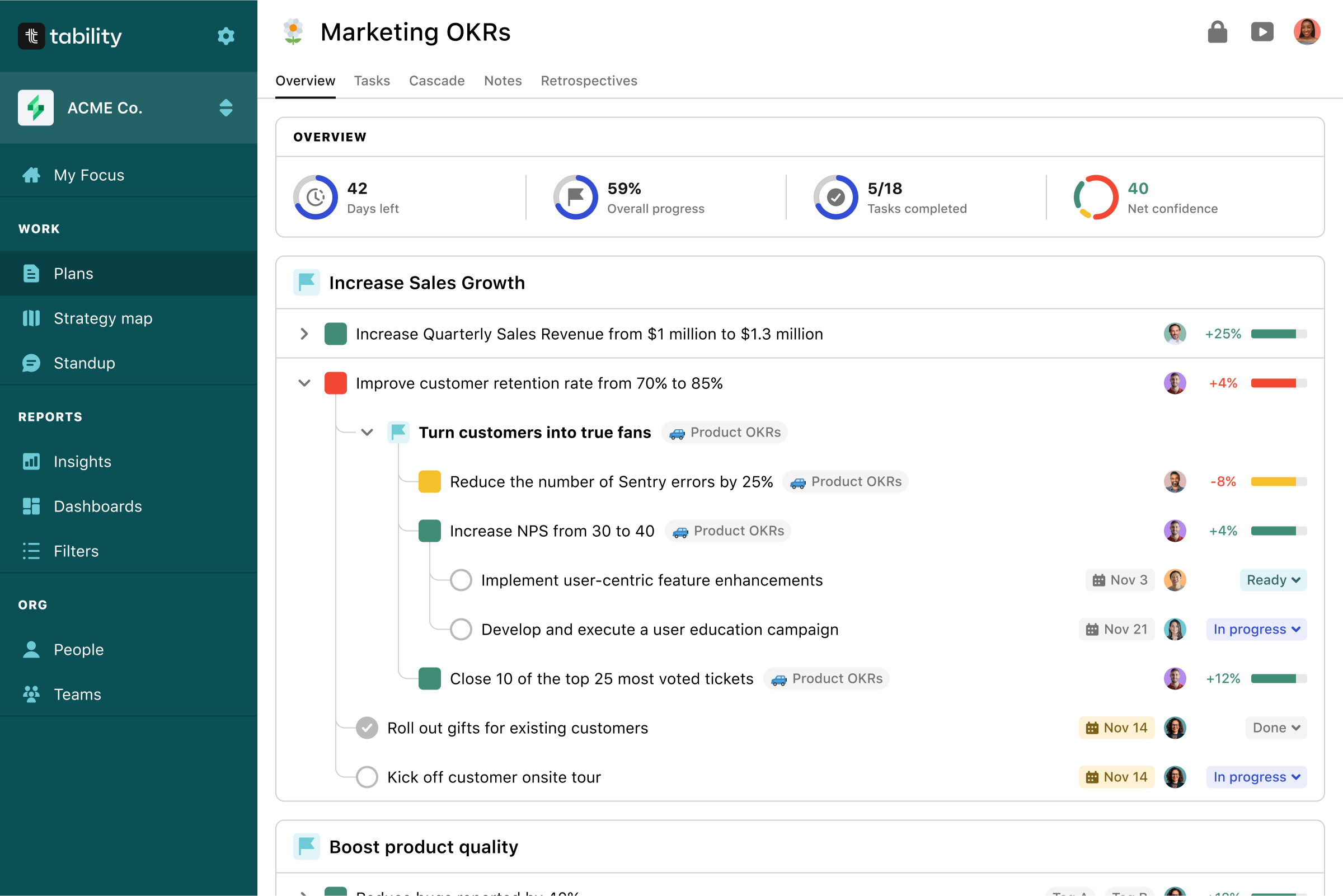
Tability is built for exactly that. StratOps teams use it to run their OKR cycles: setting objectives, tracking key results, and running weekly check-ins. BizOps teams use it to track the cross-functional projects and process improvements they're responsible for delivering.
Instead of strategy living in a deck and work living in a project tool that never gets updated, Tability keeps both in the same place. Which means fewer quarterly reviews that start with "wait, what did we actually ship?"
Book a 30-minute demo and see how other S&O teams are using Tability to run both functions from a single platform.

.jpg)
.png)