Corporate-level strategy sits at the top of an organisation's strategic hierarchy. It shapes the long-term direction of the company by answering the most fundamental question: What businesses should we be in?
It’s about defining the overall scope and structure of the organisation—whether that's expanding into new markets, diversifying product lines, acquiring competitors, or optimising a portfolio of business units.
But corporate strategy is more than just a vision—it’s a structured process that spans analysis, decision-making, planning, and execution. It connects purpose to action, aligning leadership ambition with on-the-ground reality. It also requires collaboration across every business tier, from board members and C-suite executives to functional leaders and operational teams.
This article distils insights from leading sources to give you a comprehensive overview of corporate-level strategy, including how it differs from other types of strategy, what the development process looks like, who’s involved at each stage, and how strategy implementation bridges the gap between planning and execution.
What is a corporate-level strategy?
A corporate-level strategy is a high-level plan that guides an organisation’s growth, resource allocation, and structural decisions across its entire portfolio of businesses. Unlike operational plans focused on the day-to-day, corporate strategy looks several years ahead and shapes the company's overall direction.
Typically crafted by the CEO, executive team, and the board, this strategy focuses on long-term impact, competitiveness, and sustainability. It requires synthesising insights from across the organisation and broader market forces.
Corporate-level strategy typically covers:
- Connecting strategy to purpose: Ensuring decisions are anchored in the organisation’s purpose and long-term vision.
- Planning for growth and future direction: Making high-level decisions about where to invest, divest, or expand.
- Designing the organisation for long-term success: Designing an operational and governance model that enables scale, flexibility, and accountability.
Connecting strategy to purpose
Corporate strategy ensures that the organisation's long-term vision is not just aspirational but actionable. This involves identifying emerging trends, evaluating market shifts, and making strategic bets that are consistent with the company’s purpose and values. Leadership plays a key role in bridging the company's mission with new business ventures or areas for growth. A clear understanding of the difference between vision and mission is essential at this stage, as it ensures strategic decisions align with the company’s core identity.
Planning for growth and future direction
A central component of corporate strategy is deciding where the company should grow—and where it should scale back. These decisions shape the company’s future footprint and competitive posture, making them among the most high-stakes elements of strategic planning.
This work is typically led by the CEO, with input from the executive team, corporate development leaders, and often the board of directors. The process involves evaluating opportunities and risks, modelling financial and operational impact, and aligning with the company's long-term objectives.
Key decision areas include:
- Diversification: Expanding into new industries or product lines to reduce dependence on a single market and open new revenue streams.
- Vertical integration: Gaining more control over supply chains—either upstream (e.g. acquiring suppliers) or downstream (e.g. acquiring distribution channels).
- Mergers and acquisitions: Pursuing strategic growth by buying or merging with other businesses to gain capabilities, customers, or market share.
- Global expansion: Entering international markets to increase scale, reach new customer bases, or leverage regional advantages.
- Divestitures: Selling or spinning off underperforming or non-core business units to sharpen focus and improve capital efficiency.
Each decision requires rigorous analysis, alignment with the company’s mission, and the ability to manage complexity and change during execution.
Designing the organisation for long-term success
Once direction is set, corporate strategy also dictates how the organisation should be structured to deliver on those ambitions. This includes decisions around centralisation vs. decentralisation, business unit autonomy, talent distribution, and governance. The goal is to create an operational model that enables growth while remaining flexible to market changes.
These choices help shape the organisation’s overall portfolio and influence how resources and focus are distributed across business units. While the upside of a well-defined corporate strategy includes better alignment, economies of scale, and balanced risk, challenges such as managing complexity and maintaining cross-functional alignment are equally important to plan for.
Common types of corporate strategies include:
- Stability: Maintaining current business operations
- Expansion: Entering new markets or launching new products
- Retrenchment: Scaling back operations or exiting markets
- Combination: Blending approaches across business units
The strategy pyramid: aligning across levels
One of the most effective frameworks for strategic alignment is the strategy pyramid:

This hierarchical structure ensures that every part of the organisation is working toward a common purpose, with each level translating high-level decisions into more detailed plans and actions:
- Corporate strategy: Determines what industries or markets the organisation should be in.
- Business strategy: Define strategic pillars and focuses on how a specific business unit will compete—through cost leadership, differentiation, or market focus.
- Functional strategy: Defines what each department (e.g., Marketing, HR, Finance) will do to support business unit goals.
- Operational execution: Involves the day-to-day processes, projects, and systems that teams use to implement functional strategies.
In essence, corporate strategy sets the vision, business strategy defines how to compete, functional strategy outlines department-level plans, and operational execution makes it all happen through detailed work on the ground.
How corporate strategy is developed
Corporate strategy development typically follows a four-step process. Each phase builds on the previous one to ensure clarity, alignment, and adaptability across the business.
The four key phases are:
- Strategic analysis
- Strategy formulation
- Implementation
- Monitoring and adjustment
Here’s how it works:
Strategic analysis
This is the foundation of any corporate strategy. Strategic analysis involves a comprehensive assessment of both internal capabilities and external conditions. Common tools include SWOT analysis (Strengths, Weaknesses, Opportunities, Threats), PESTEL analysis (Political, Economic, Social, Technological, Environmental, and Legal factors), and competitive benchmarking.
Activities include:
- Conduct market research using techniques like web scraping, to understand customer needs, trends, and emerging opportunities.
- Analyse financial statements to assess performance, profitability, and cost structures
- Review competitor performance to benchmark against industry peers
- Gather insights from customers and frontline employees to uncover on-the-ground realities and opportunities
- Assess organisational culture to understand values, behaviours, and readiness for change
- Evaluate leadership capability to ensure strategic direction can be effectively championed and implemented
- Review operational efficiency to identify process bottlenecks and areas for optimisation
This phase is typically led by executive leadership and strategy teams, but it often involves contributions from department heads, finance, marketing, and sometimes external consultants. The goal is to develop a clear, data-informed picture of the company's current state and what external forces could influence its direction.
Strategy formulation
Once the analysis is complete, the next step is to formulate the actual strategy. This is where the organisation defines its long-term direction based on insights from the strategic analysis phase.
Key activities include:
- Identify target markets: Determine which industries or segments the organisation should enter or expand in.
- Select positioning strategies: Choose how the company will compete—through differentiation, cost leadership, or niche focus.
- Determine growth approaches: Decide whether growth should be organic, through partnerships, or via mergers and acquisitions.
- Allocate resources: Assign financial and human capital to priority areas in line with strategic objectives.
- Use scenario planning: Explore multiple future scenarios to assess risks and model outcomes of different strategic directions.
This phase is usually led by the CEO, executive team, and corporate strategy leaders, often in close collaboration with finance, business development, and key business unit leaders. It’s a highly collaborative process that balances top-down vision with bottom-up input. Stakeholder alignment is critical, and leadership may also involve board members at this stage to validate direction and secure buy-in.
Objectives and Key Results (OKRs) may be drafted during this phase to define clear outcomes for strategic goals. While more often used in execution, early OKRs help translate broad ambitions into measurable targets and ensure early alignment across the organisation.
What are OKRs? See our in-depth guide to OKRs.
Implementation
A strategy is only as good as its execution. Strategy implementation is the stage where the high-level plan is translated into concrete action across the organisation. This is where the effort of connecting strategy and execution truly takes place.
This phase is typically driven by department heads and business unit leaders, guided by the executive team or a central strategy office. Project managers and team leads play an essential role in translating strategic objectives into operational plans and timelines. In many organisations, the Chief of Staff plays a complementary role—ensuring cross-functional coordination, facilitating leadership alignment, and helping to operationalise key strategic initiatives.
Activities include:
- Cascading goals to teams to ensure alignment with organisational priorities
- Set team-level OKRs or KPIs that support broader strategic objectives
- Allocate budgets and resources to the initiatives and teams that drive execution
- Align performance incentives to reinforce desired behaviours and outcomes
- Communicate the strategy clearly through town halls, team meetings, and internal platforms, helping every department understand its role in success
Implementation requires building internal alignment, establishing accountability, and ensuring teams are not only informed but also empowered with the tools, talent, and authority to execute. Strategic Operations (StratOps) teams often support this phase by coordinating OKR workflows, aligning cross-functional teams, and maintaining visibility on strategic priorities. Regular check-ins, performance reviews, and adaptive planning sessions help maintain momentum and surface issues before they escalate.
Monitoring and adjustment
The final step is to measure performance and make course corrections. Monitoring and adjustment ensure that the strategy stays on track and evolves as conditions change.
This phase is typically led by the strategy office or executive team, in close coordination with department leaders and operations teams. Weekly check-ins, progress reviews, and reporting cadences become vital tools for maintaining visibility into what's working and what isn’t.
Activities include tracking KPIs, reviewing OKRs, analysing performance dashboards, and using tools like Balanced Scorecards to align execution with high-level goals. Strategic planning software or OKR software can support real-time visibility, automate reporting, and surface risks early.
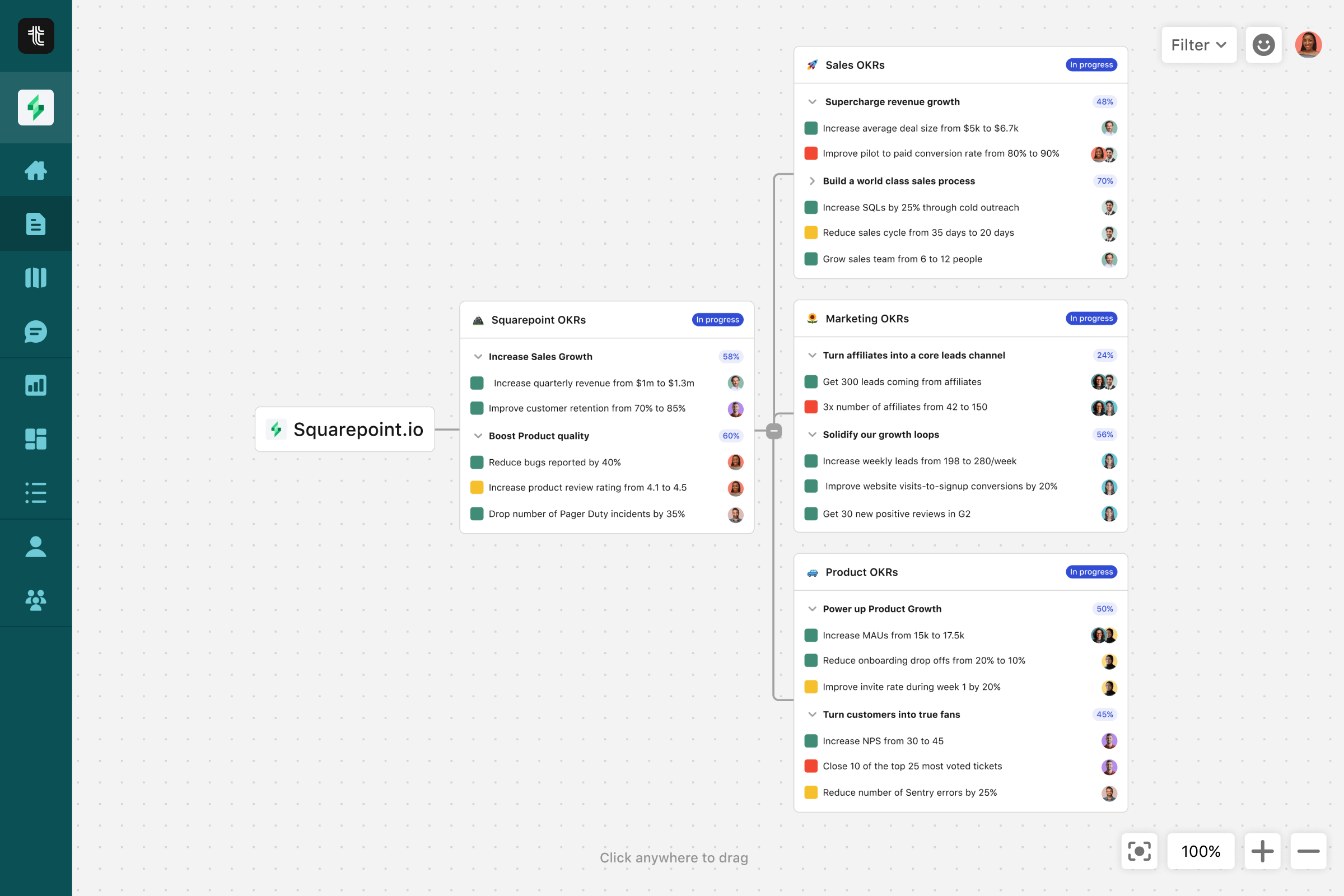
Continuous feedback loops—often driven through team retrospectives, one-on-one reviews, and company-wide updates—enable organisations to make timely course corrections. Teams are encouraged to flag blockers, suggest adjustments, and take ownership of results, ensuring the strategy remains a living, adaptive framework rather than a static plan on a slide.
Final thoughts
Corporate-level strategy defines the organisation’s path forward. It’s not just about bold visions—it’s about building the processes, structures, and systems that make those visions achievable. From selecting markets and managing portfolios to aligning teams and tracking execution, corporate strategy touches every layer of the business.
When developed and implemented well, it becomes the backbone of long-term success—creating alignment across leadership, clarity of purpose at every level, and a roadmap for sustainable growth.
As companies face increasing complexity and rapid change, the ability to connect strategy to execution—supported by roles like Chief of Staff and Strategic Operations—has never been more critical. Whether you're scaling a startup or leading a multi-business enterprise, a clear and well-executed corporate strategy ensures you’re not just moving, but moving in the right direction.

.jpg)

.png)