Most teams have more goals than they can possibly execute. Ask any strategy and operations leader about their company's annual plan and they'll describe a sprawling list of initiatives, each one backed by a deck and a sponsor. Every single one is 'strategic.'
That's the problem. When everything is important, nothing is.
Wildly important goals — WIGs, if you've spent time in 4DX circles — exist to solve exactly this. The name sounds dramatic because the concept is deliberately provocative. The question it forces is one most leadership teams avoid: if we could only move one dial this quarter, what would it be?
What is a Wildly Important Goal?
A WIG is the one or two goals that matter so much that everything else is secondary. The term comes from The 4 Disciplines of Execution (4DX), a framework developed by FranklinCovey and popularised by Chris McChesney, Sean Covey, and Jim Huling.
The logic is simple. People have limited bandwidth. Execution requires focus. The more goals you pursue simultaneously, the more likely each one gets a fraction of the attention it needs and delivers a fraction of the results you want. A WIG isn't a nice goal or a relevant goal. It's the goal that, if achieved, would make the biggest difference to your organisation's success this year.
Most teams set too many of them. Two WIGs per team, at most, is the 4DX recommendation. In practice, the harder part isn't setting the right number. It's having the discipline to say no to everything else.
The Four Disciplines of 4DX (and where the WIG fits)
4DX structures execution around four disciplines, and the WIG is the foundation of all of them:
- Focus on the Wildly Important — choose your WIG with precision; the other disciplines depend on it
- Act on lead measures — identify the leading behaviours (not just outcomes) that will move the WIG
- Keep a Compelling Scoreboard — make progress visible to the team in real time
- Create a Cadence of Accountability — run short, weekly WIG sessions to review commitments
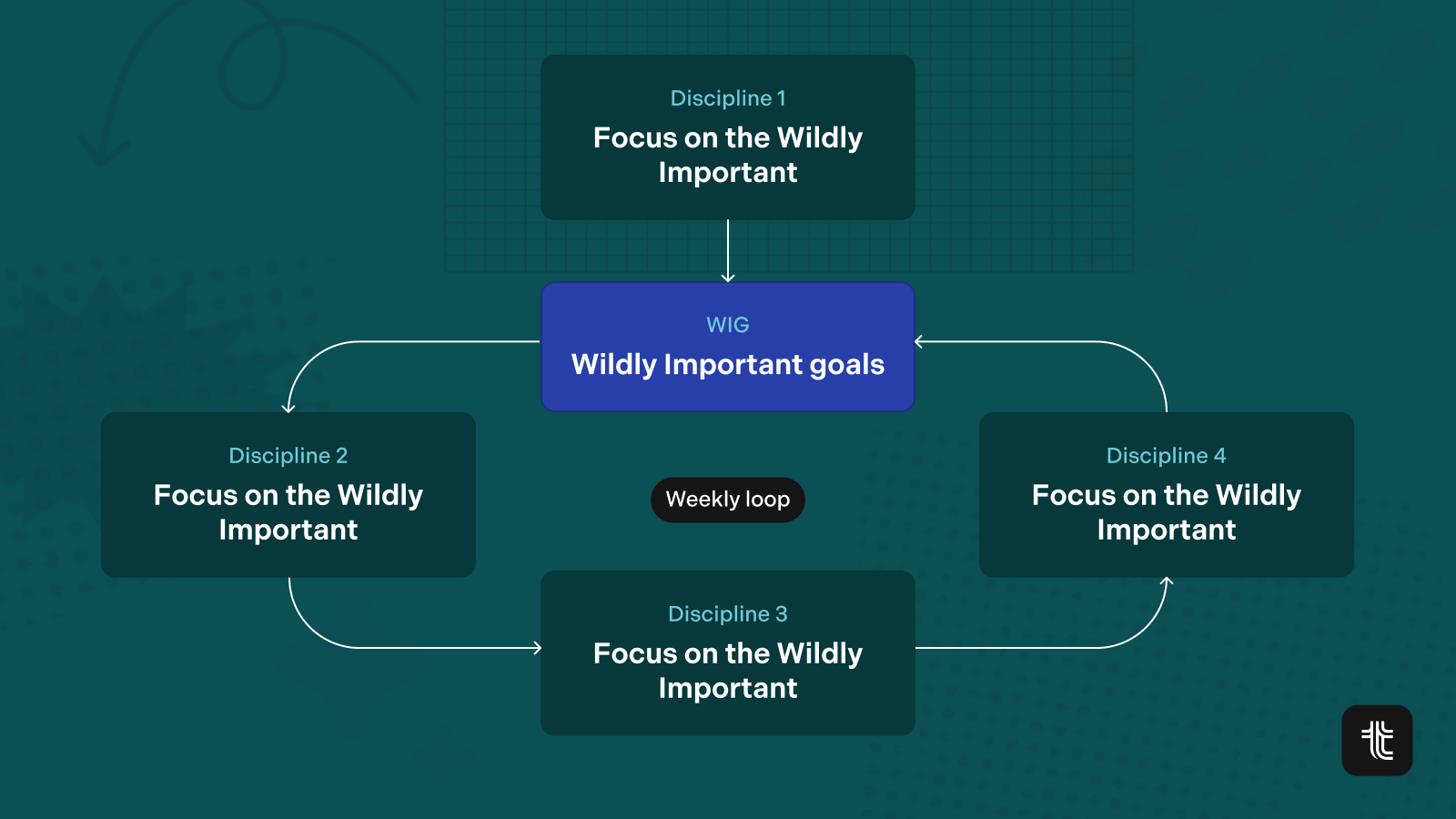
The WIG without the cadence is just a goal statement. The cadence without the WIG is just meetings. The two work together, which is why organisations that implement 4DX see better execution than those who simply set goals at the start of the year and check back in December.
WIGs vs OKRs: Complementary, not competing
One of the most common questions in strategy and ops conversations: do we need WIGs if we're already running OKRs?
The short answer is that the two frameworks solve related but different problems. OKRs give you a structured way to set and cascade goals across a team or company. WIGs give you a focusing mechanism — a way to identify which of your goals is the one that cannot fail.
Think of it this way: your OKR framework might have six key results for a given quarter. A WIG discipline applied to that set asks you to pick the one or two key results where execution is non-negotiable. Not because the others don't matter, but because attention is finite and you need to know where to direct it when things get hard.
4DX vs OKRs isn't really a battle to be won. The better question is how both disciplines can inform your operating rhythm. In practice, many high-performing teams use OKRs to structure goals and WIG thinking to prioritise which ones demand non-negotiable focus.
What makes a good WIG
Not every goal qualifies. There are many types of goals a team might work toward — process improvements, stretch targets, capability builds — but a WIG is specifically the outcome goal where falling short isn't acceptable. The FranklinCovey research points to a few defining characteristics.
The WIG must matter. It should connect directly to the organisation's strategy, not to a nice-to-have or a process improvement. If you could deliver it and leadership wouldn't notice at the next board meeting, it's probably not wildly important.
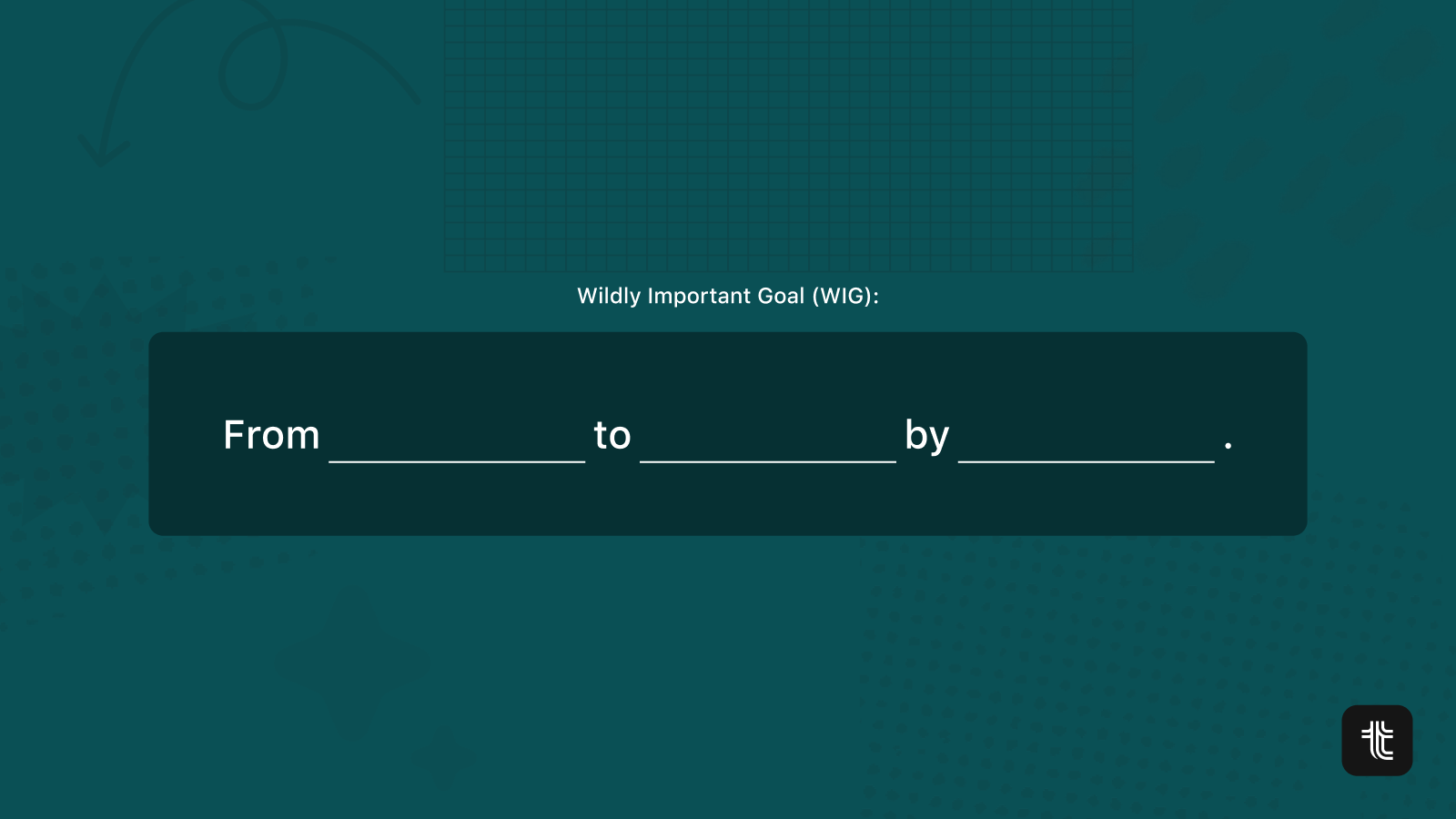
The WIG must be measurable. 'From X to Y by Z' is the recommended format: a specific starting point, a specific destination, and a clear deadline. This isn't optional. Without a measurable endpoint, there's no accountability and no way to know if you've won.
The WIG should be achievable but not easy. It should require focus and discipline. If it's something the team would achieve through normal operations regardless of what they prioritise, it's not a WIG. It's a task.
Think of a BHAG as the long-range version of a WIG: the decade-scale ambition that WIGs should ladder into at the quarterly or annual level. The BHAG tells you where you're ultimately heading; the WIG tells you what has to happen this year or this quarter to get there.
WIGs in the Operating Cadence
The most common failure mode is treating WIGs as annual planning artefacts. Teams set them in January, put them in a slide deck, and revisit them in November when compiling results.
That's not how WIGs work. The 4DX model demands a weekly cadence: a short team meeting (15 to 20 minutes) where each person reports on the commitments they made the week before and the commitments they're making for the coming week. The scoreboard is visible. The progress is tracked. The accountability is real.
This cadence is also what makes WIGs compatible with StratOps as an operating model. StratOps, the function that bridges strategy execution, uses a regular check-in rhythm to keep teams honest about whether their activity is actually moving the metrics that matter. A WIG gives that rhythm something concrete to centre on.
If you're running an OKR framework, the weekly check-in is already part of your operating model. Layering a WIG focus on top of that is straightforward: your regular check-ins become the place where WIG progress is tracked alongside your key result scores. You're not adding another meeting. You're adding focus to the ones you already have.
Why most WIGs fail (and how to avoid it)
The failure modes are consistent across teams and industries.
The first is goal proliferation. Leadership sets a WIG but doesn't remove other priorities. The WIG ends up competing with everything else and gets the same fraction of attention as every other goal. If you're not willing to explicitly deprioritise something to make room for the WIG, you haven't actually committed to it.
The second is a lag-only scoreboard. Teams track the WIG outcome (the lag measure) but not the lead measures that drive it. Lead measures are the behaviours and activities within the team's control that predict WIG success. Without visibility on leads, the team only finds out if they're winning or losing after it's too late to adjust.
The third is cadence collapse. The weekly WIG sessions start strong, then get cancelled, then become a monthly report-in, then disappear. When the cadence goes, so does the accountability.
The StratOps function exists in part to prevent this kind of execution drift. Regular check-ins, a visible scoreboard, and a clear owner for each commitment aren't just good ideas. They're the minimum viable operating infrastructure for any WIG to survive contact with a busy quarter.
Where Tability fits
Tability is designed for teams that run a regular goal and check-in cadence. You can track your WIG as a key result, assign a clear owner, set target values, and run weekly check-ins that hold the team accountable to lead measures as well as the lag outcome.
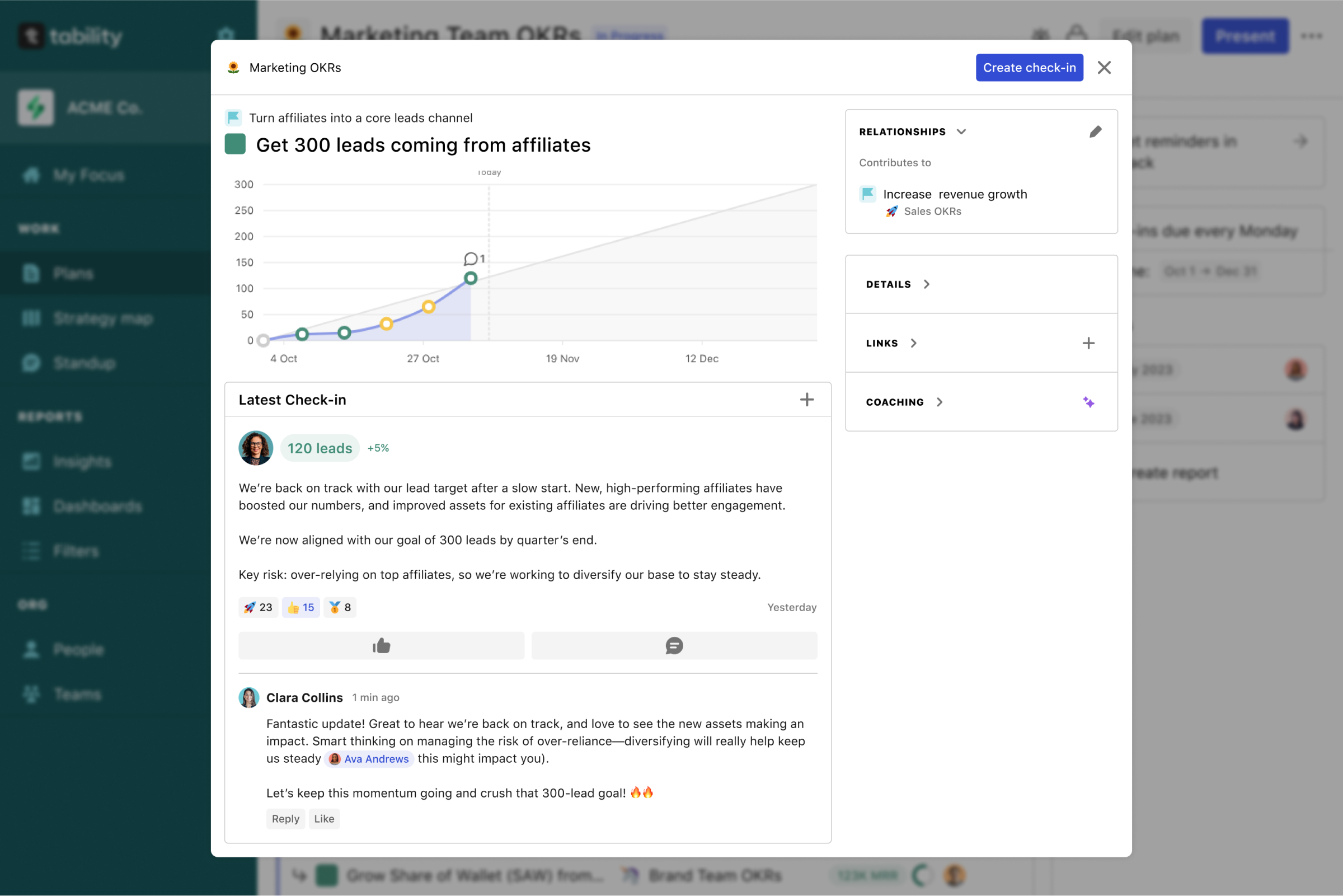
The scoreboard isn't a slide deck updated once a month. It's a live view of where you stand, updated weekly by the people doing the work.
If you're implementing 4DX, starting with OKRs, or trying to bring more focus to your organisation's execution without adding overhead, Tability is worth a look. Sign up free or book 30 minutes with the team and we'll show you how it fits your operating model. Tability or not.


.jpg)