
Most organisations have a strategy. They have a vision, a set of priorities, maybe a freshly-printed slide deck from the last offsite. What they don't have is a reliable system for turning that strategy into the day-to-day work of real teams.
That's the strategy execution problem. And it's not a small one. Research from Bridges Business Consultancy found that roughly 90% of strategies are never fully executed. Not because the strategies are bad, but because execution is treated as someone else's problem.
This guide covers what strategy execution actually is, why it breaks down so consistently, and how modern organisations are fixing it.
What is strategy execution?
Strategy execution is the process of translating strategic plans into action. It's the work that happens between 'we've decided to do X' and 'we've actually done X.'
This sounds obvious. But in practice, it's where most organisations lose the thread. Strategy gets set at the top, handed down through layers of management, and by the time it reaches the people doing the work, it looks different, feels vague, and competes with dozens of other priorities.
Execution isn't just task management, though. It encompasses everything involved in turning strategic intent into measurable outcomes: allocating resources, setting goals, defining ownership, building a review cadence, and adapting when things don't go to plan.
Why most strategies fail at strategy execution
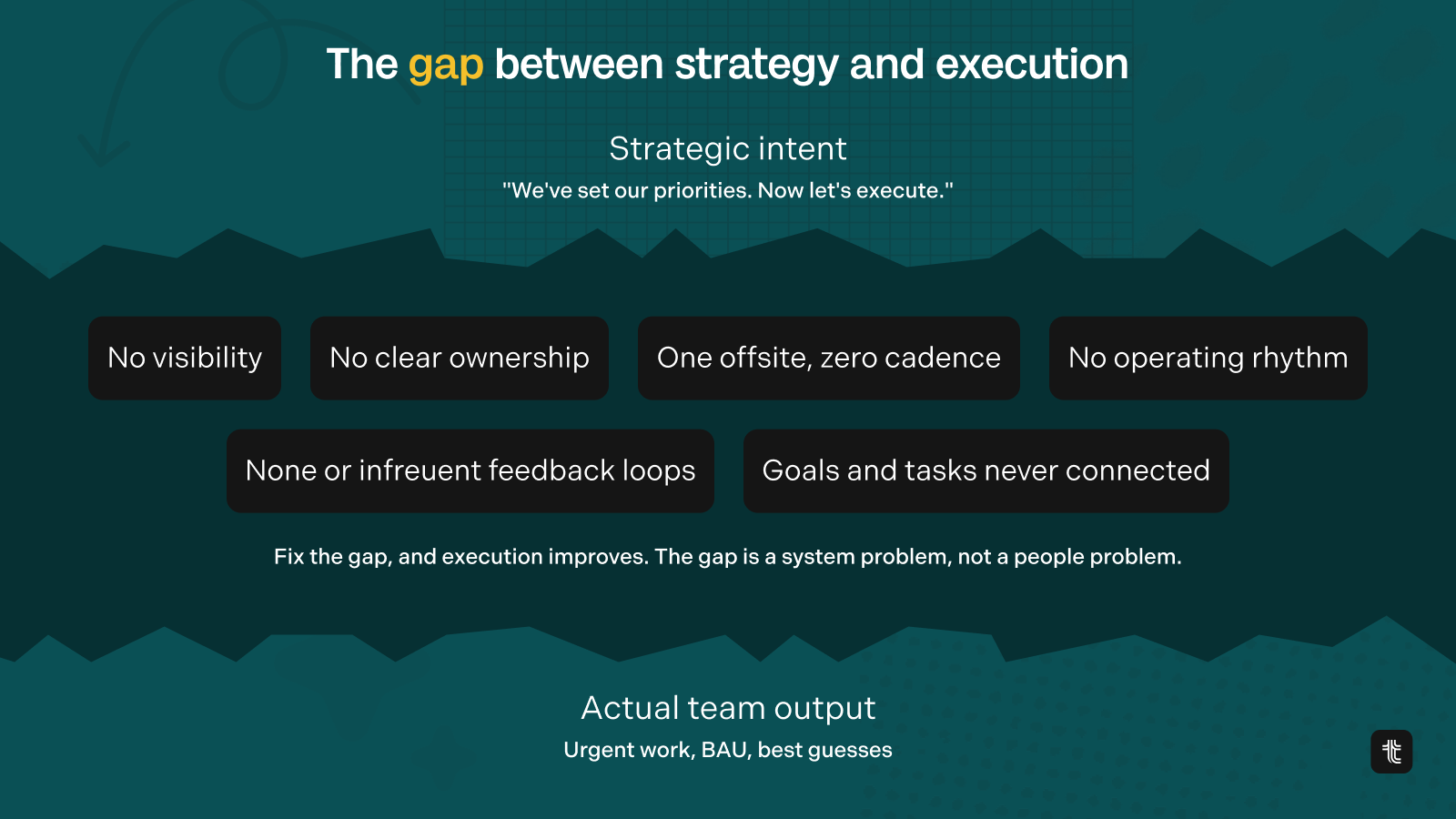
The failure isn't usually a lack of ambition or effort. Most execution breakdowns trace back to a small set of recurring problems.
No clear ownership. Strategies often identify what needs to happen without naming who is accountable for making it happen. When everyone is responsible, no one is.
Misalignment between strategy and day-to-day work. Teams spend their time on the urgent, not the strategic. Without a system that connects high-level goals to weekly priorities, the strategy sits in a document while the real work runs on inertia.
No feedback loop. Many organisations set annual goals and review them once a year. By the time they discover something isn't working, they've lost 12 months. Execution requires regular check-ins, not annual retrospectives.
Strategy is treated as an event, not a cadence. The offsite happens, the deck is circulated, and then everyone goes back to their normal work. Real execution requires a continuous operating rhythm, not a one-time planning exercise.
The strategy execution framework that works
There's no single universally agreed framework for strategy execution, but the ones that work tend to share four elements.
1. Clear strategic objectives. Goals must be specific enough to guide decisions and measurable enough to track progress. Vague objectives like 'grow the business' or 'improve customer experience' don't give teams enough to act on.
2. Cascaded ownership. Strategic objectives need to flow from company level down to team level to individual level. Each layer should understand how their work connects to the whole. Without this cascade, teams optimise locally instead of collectively.
3. A regular operating cadence. Execution doesn't happen by decree. It happens through the meetings, check-ins, and reviews where people report progress, surface blockers, and adapt their approach. The cadence is what makes execution continuous rather than episodic.
4. Visibility and accountability. Leaders need to see what's progressing, what's stuck, and where the gaps are. Without visibility, decisions get made on gut feel rather than evidence.
This is essentially what StratOps teams build and maintain. The StratOps function exists specifically to bridge the gap between strategy and execution, providing the infrastructure that keeps the organisation moving in the right direction.
How to execute strategy using OKRs
OKRs (Objectives and Key Results) have become one of the most widely-used frameworks for strategy execution. Used properly, they do three things at once: connect strategy to operations, make progress measurable, and force prioritisation.
Here's how the translation works in practice.
From strategic priority to objective. Take a strategic priority (say, 'become the go-to platform for mid-market teams') and turn it into a time-bound, inspiring objective: 'Establish Tability as the default OKR tool for 100-500 person teams by end of Q4.'
From objective to key results. Define 2-4 measurable outcomes that would prove the objective was achieved. These become the scorecard for execution.
From key results to initiatives. Break down each key result into the specific projects, experiments, or actions that will move the number. These are the tasks that fill people's calendars.
Weekly check-ins. Run a brief status update each week against each key result. Not to report, but to surface blockers and decide whether to adjust. This is the feedback loop that most organisations are missing.
The OKR framework is covered in more detail in our dedicated guide, but the core mechanism is simple: OKRs give you a shared language for strategy execution that works at every level of the organisation.
The role of StratOps in strategy execution
Most organisations don't have a team explicitly responsible for execution infrastructure. Strategy gets set by leadership. Operations manages day-to-day delivery. Nobody owns the connection between the two.
StratOps changes that. A StratOps team (or person, in smaller organisations) owns the systems, processes, and rhythms that make strategy execution possible. This includes:
- Designing and maintaining the goal hierarchy
- Running the quarterly planning and OKR-setting process
- Facilitating the regular review cadence
- Identifying where execution is breaking down and intervening
- Building the dashboards and reporting tools that give leadership visibility
This is strategic operations in practice. Not strategy consulting. Not project management. A distinct function that bridges the two.
Tools for strategy execution
The right tools reduce friction in the execution process. At minimum, you need something that handles goal tracking, progress visibility, and the check-in cadence.
Tools like Tability are purpose-built for this. They give teams a single place to set OKRs, track progress, run weekly check-ins, and see how work at every level connects back to the company's strategic priorities. Unlike general-purpose project management tools, they're designed around the operating cadence that makes execution continuous.
The alternative is a combination of spreadsheets, slide decks, and meeting notes that nobody actually updates. We've seen a lot of organisations run strategy execution this way. It works, barely, until it doesn't.
Strategy execution is a system, not a skill
The most common mistake is treating strategy execution as a capability that individuals either have or don't. 'We need someone who can execute' is a common thing to hear in leadership teams. But execution problems are almost always system problems.
When people don't know how their work connects to the strategy, that's a system problem. When nobody owns a goal, that's a system problem. When there's no regular review cadence, that's a system problem.
Fix the system, and execution improves. Tools, processes, cadences, ownership structures: these are the levers, not willpower. If you want to go deeper on how this works in practice, our guide to what is strategic planning covers the foundation, and our article on strategic thinking covers the leadership capabilities that make execution possible.
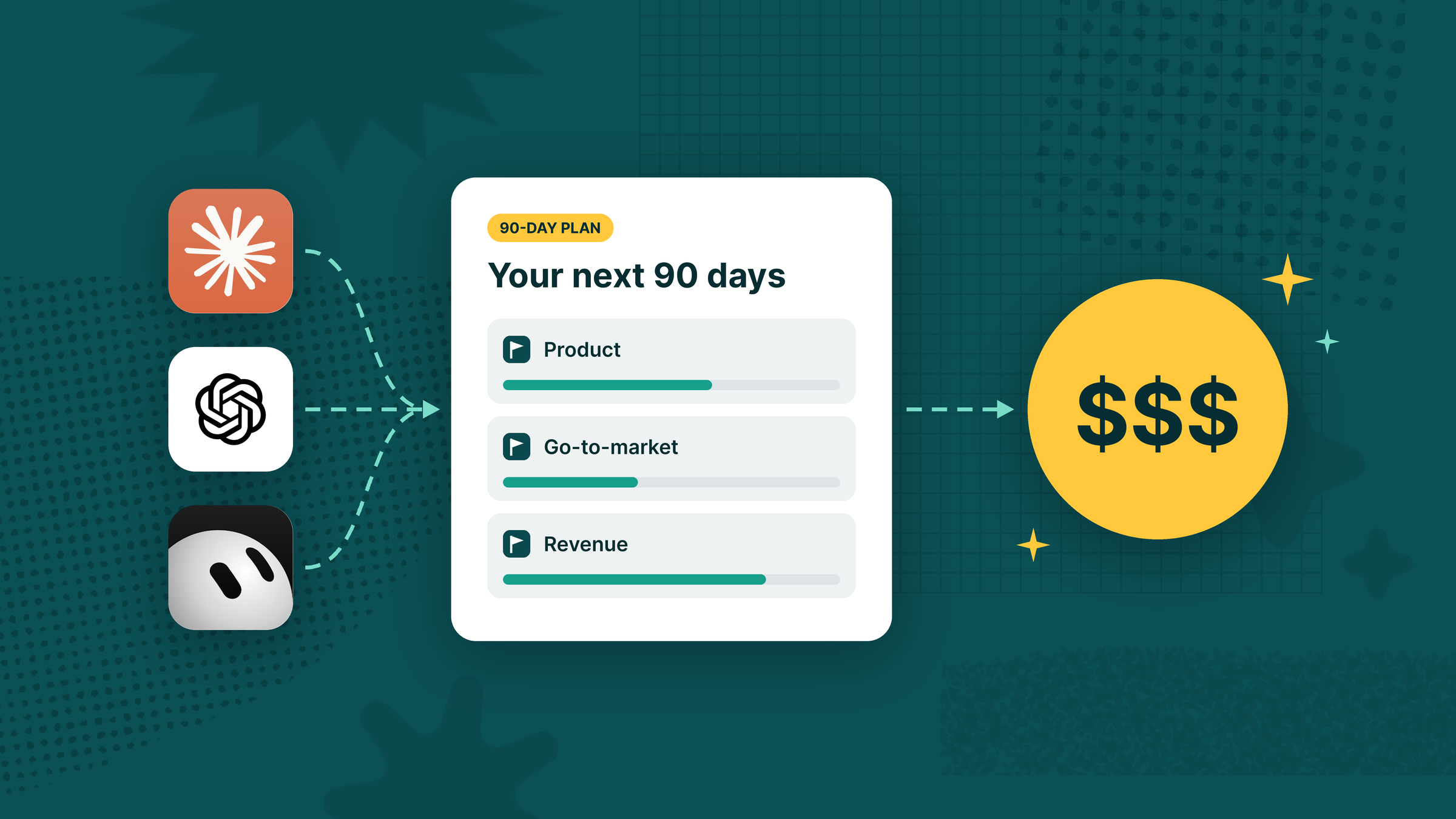
If you're building or improving the execution infrastructure at your organisation, Tability is the easiest way to get started. Book 30 minutes with us and we'll show you what a StratOps-enabled execution system looks like in practice.

.jpg)
.png)