For as long as OKRs have existed, people have written every update. That was the right way to do it, for a reason this chapter will come to. It is about to stop being enough.
The first half of this chapter makes that case. The second half covers what agents can take on, what stays with people and how to bring agents in without losing the weekly attention that makes OKRs work.
If you arrived here from the rest of the guide: everything in the first eighteen chapters works with people alone, and a team should get that rhythm working before adding agents to it.
The work multiplied
In four months of 2026, the number of code changes merged each day in Anthropic's main codebase went from about 2,500 to more than 30,000, according to the company's own account. It did not hire twelve times as many engineers. Each engineer was directing agents that did the building.
That is an early and extreme case. The direction is the same wherever agents are put to work. A product team that ran five bets a quarter can run twenty in parallel. Marketing tests ten campaigns where it used to test two. Every one of those bets is meant to move a goal, and somebody is supposed to know whether it did.
Human reporting did not
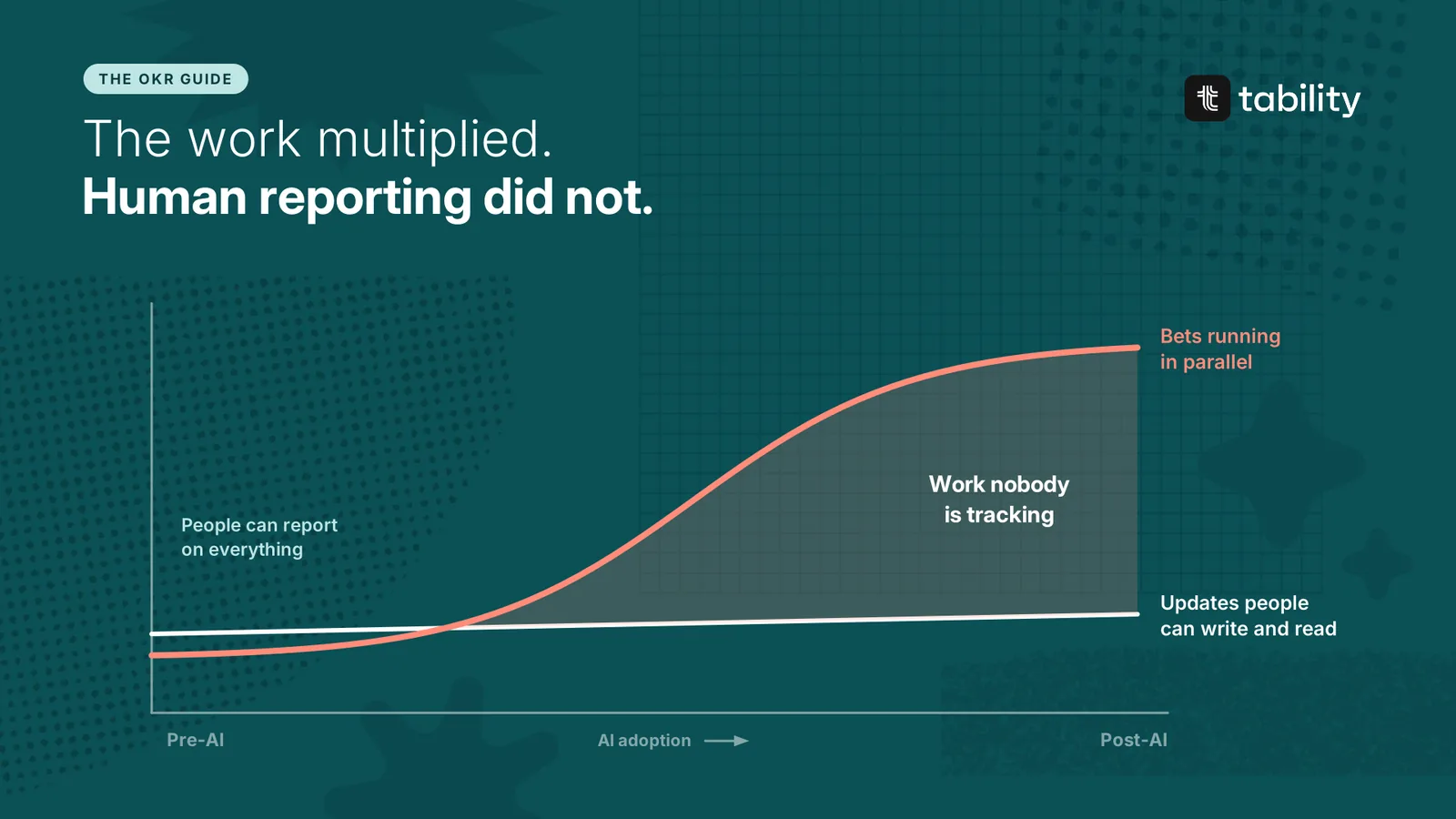
The number of updates a person can write in a week has not moved, and neither has the number a manager can read.
Pre-AI, that was fine. A team's output was small enough for its people to report on all of it. Post-AI, the work grows several times over while the capacity to report on it stays flat. The space between the two lines is work that nobody is tracking.
There are two bad ways to close it. You can ask people to write four times as many updates, and they will spend their week reporting. Or you can let the reporting thin out, and lose sight of what your bets are doing in the very period when you are placing the most of them.
Why updates were written by people until now
OKR updates were human work for a good reason. Automated reporting used to mean a table of KPIs: numbers refreshed on a schedule, with nothing to say what they meant. The value of a check-in was always the narrative around the number, and only a person could supply it.
That is no longer true. Give a current model the data behind a Key Result and the history of its check-ins, and it will write an update much as the owner would: where the number stands, how it compares with the trend, what changed this week and what looks at risk. For a Key Result backed by data, the draft is often as good as the one a busy owner would have written on a Friday afternoon.
Where people's time should go
In a company that can build almost anything quickly, the scarce resource is judgement: choosing which bets to place, reading what comes back and deciding what to do next. Every hour spent collecting numbers and typing status is an hour taken from that.
Agents can give those hours back. They do the collecting and the summarising. People receive the analysis and spend their attention on what it means.
One thing is still missing on the agent's side. A person carries the wider context: the thread in Slack, the customer who sounded hesitant, the reorganisation that has not been announced. That context is why people will go on making the better final call.
So the answer is a split. Agents let the tracking scale with the work. People decide. OKRs that are written, tracked and read by people alone will not keep up, and the rest of this chapter covers what to change.
What agents can do now
An agent is an AI model that can take a goal, use tools and keep working until the task is done. The current generation, including Claude, Codex and Grok Bot, can read documents, query databases, write and test code, draft a campaign, and stay on one task for hours.
In a team that runs OKRs, that shows up in two places.
-
Doing the work. Agents carry out initiatives: building a feature, analysing a dataset, drafting the content for a launch.
-
Tracking the work. Agents pull the numbers behind a Key Result, notice when a trend changes and write the weekly update.
Both depend on the same condition. An agent can only act on what it can reach, so it has to be connected to the systems where the data and the goals live.
Why agents need the goals
Building got cheap. A team with agents ships several times more than it did before, and no manager can inspect all of it. Direction has to do the job that inspection used to do.
Agents have the same need as people here, only more so. A person who joins a team picks up the priorities in meetings and conversations. An agent starts every task with what it has been given and nothing else. If it cannot see what the company is trying to achieve, it will complete the task in front of it very well and may miss the point entirely.
A useful way to think about it: agents are an extra remote team. They are capable and fast, they were not in the room, and they work from what is written down. Give them what you would give any remote team.
-
The goal behind the task, and how it will be measured.
-
The constraints.
-
A person to report to.
-
A rhythm for reporting back.
An OKR system already holds the first of those in a form that both people and agents can read.
What agents are good at, and what people still know
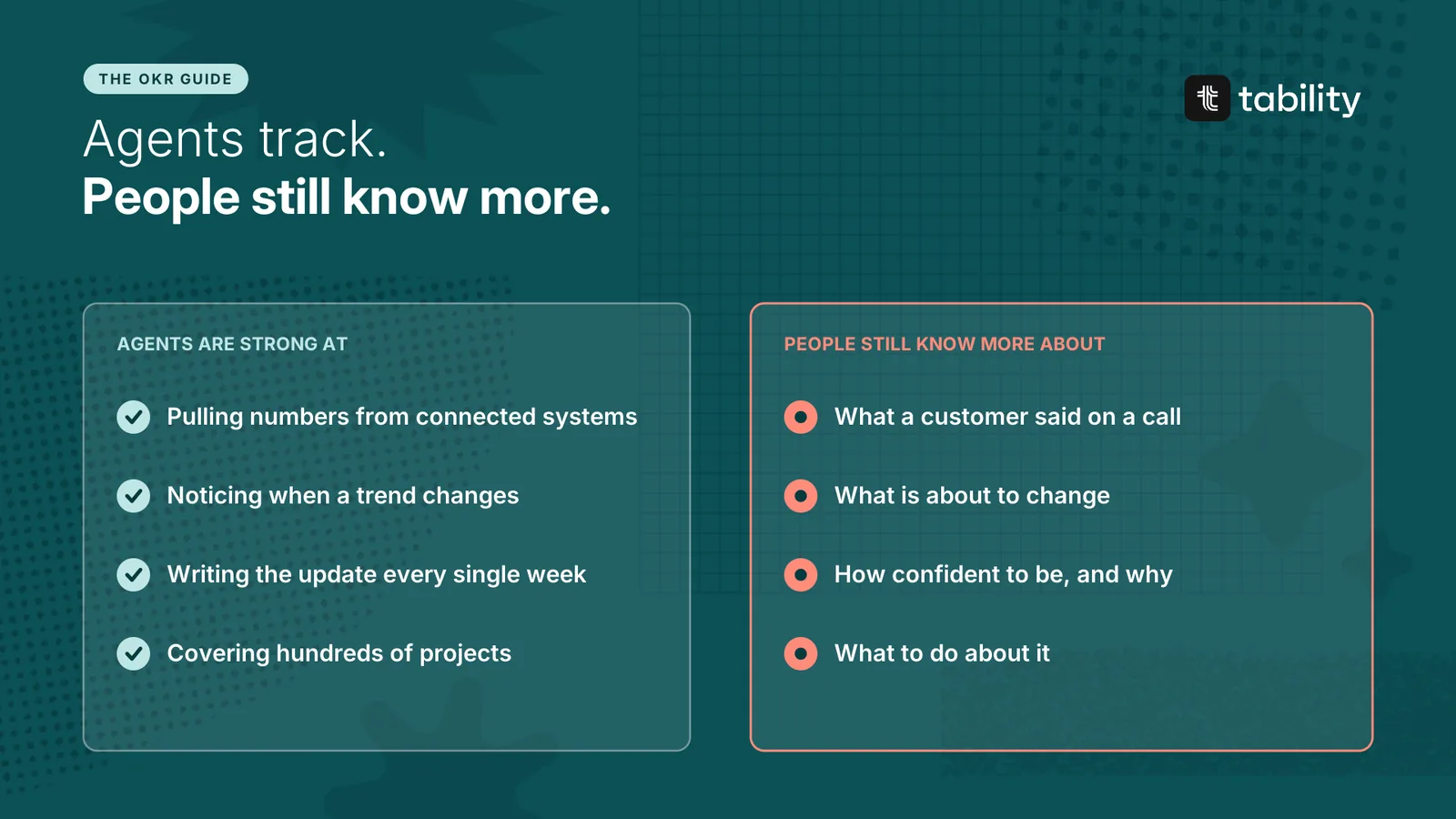
Agents are strong at the mechanical side of tracking. They pull numbers from every connected system, compare this week with the last eight, write the update in the same format every time and never skip a week. They can do that for four hundred Key Results as easily as for four.
People hold information that is in no system. A customer said something worrying on a call. Two engineers are about to leave. The number is up because of a one-off deal that will not repeat. That knowledge decides whether a Key Result is really on track, and an agent has no way to reach it unless a person writes it down.
So agents do not replace the owner of a Key Result. They take over the parts of tracking that are about collecting and summarising. The owner keeps the judgement: how confident to be, what the number means and what to do next. With more to track, the review by exception described earlier in this guide matters even more: agents watch everything, and people look at the handful of items that need them.
Three levels of involvement
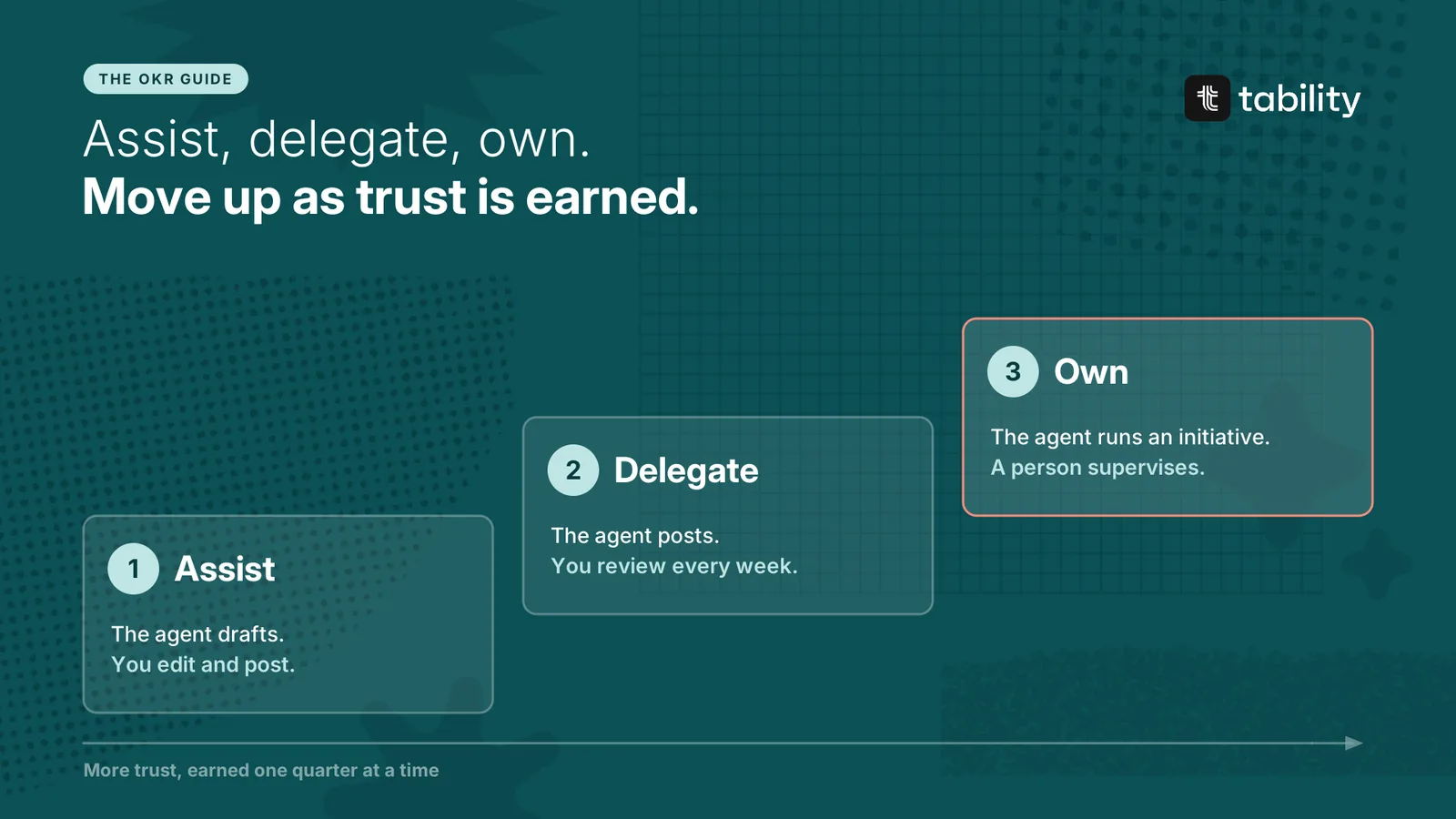
| Level | What the agent does | What the person does |
|---|---|---|
| Assist | Drafts the update | Edits it and posts it |
| Delegate | Posts the update | Reviews it every week |
| Own | Runs an initiative from start to finish | Supervises and stays accountable |
Start at the first level and move up one Key Result at a time, as the agent's work proves reliable. Different goals in the same team can sit at different levels. A Key Result fed by a clean data source might be delegated in a month. One that depends on customer conversations may stay at assist for good.
What does not change
Every Key Result has a human owner. An agent can write the update. A person is accountable for the result.
People set the goals. Agents can help draft and challenge them. Choosing what the company commits to is a decision for the people who will answer for it.
The weekly review stays. If agents write updates that nobody reads, the company has automated its way out of knowing what is going on. The next chapter covers this in detail.
Targets and outcomes are closed by people. An agent can report the final number. Whether a goal was achieved, and what was learned, is recorded by its owner.
The rest of this part
-
Automated check-ins: what to hand to agents, what to keep and the safeguards.
-
Connect your OKRs to your AI tools: how the connection works and what you can do with it.
Questions about OKRs and AI agents
Can AI agents run OKRs for you? They can run parts of the process: pulling numbers, writing updates and carrying out initiatives. People still choose the goals, judge confidence, own the results and make the decisions in the weekly review.
Do agents replace check-ins? No. They can write some or all of a check-in. The check-in still has an owner, and it still has to be read.
What do agents need to work with OKRs? Access to the goals, access to the data behind the Key Results, a person to report to and a schedule.
Should a small team bother? Only once the weekly rhythm works with people. Agents speed up a process that exists. They do not create one.