Writing a good goal is the easy part of planning. The hard part is making every team's goals add up to one company.
Most teams spend their planning time the other way around. They give direction an afternoon and then argue about whether the target should be 12% or 15% until the quarter is already under way. This chapter covers how to set OKRs when you have a strategy to start from, and it puts the effort where it pays off.
Direction first, goals second
A team's planning should take two weeks at most. Split that time in two. The first week goes to agreeing on what matters this quarter. The second week goes to writing the OKRs.
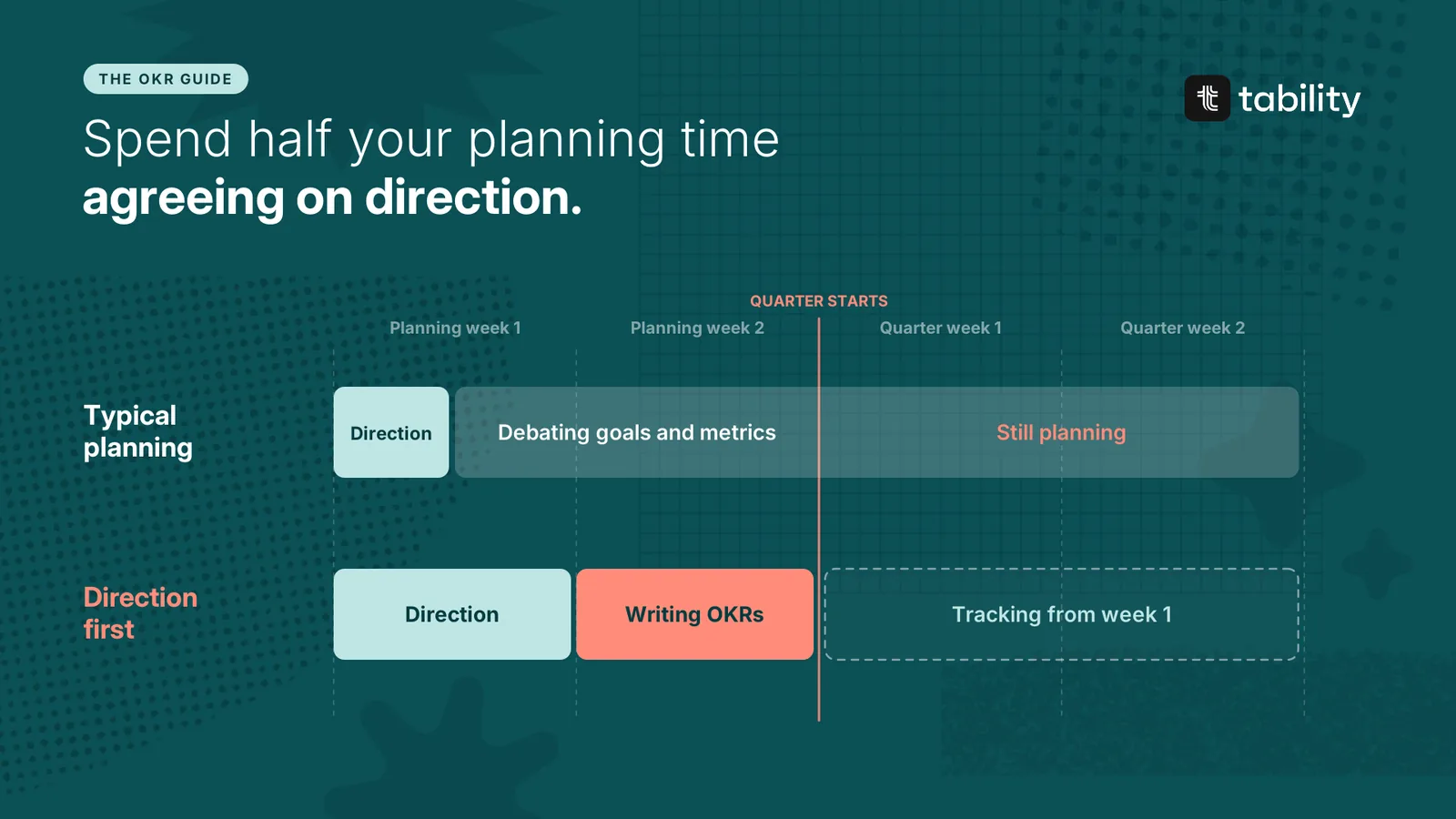
It feels slow at the start, because for the first week nobody writes a single Key Result. It is faster overall. A Key Result written against a problem everyone has already agreed on is easy to judge. A Key Result written in isolation invites a debate about the problem it should have been solving, and that debate is what eats planning cycles.
Start from the strategy
This chapter assumes you have the top of the chain in place: a long-term view and two or three company priorities for the year, as described in the OKR process. Each quarter, leadership restates those priorities and says what they mean for the next 90 days.
If you do not have that yet, and what you have is a roadmap full of projects, read From roadmap to OKRs first. It shows how to work backwards from your projects to the direction behind them.
Step 1: List problems, not projects
Ask each team to write down the problems it wants to solve this quarter, and why each one matters to the company priorities.
Problems make a better planning unit than requests. A request such as "we need a new dashboard" is a solution. It arrives without the problem behind it, so the team receiving it cannot rank it against its own work, cannot push back, and cannot offer a cheaper fix. A problem such as "account managers find out about churn risk too late" can be discussed, compared and owned.
Step 2: Rank them
Each team puts its problems in order of importance. A strict order, with no ties. The ranking forces the conversation that a flat list lets you avoid.
Step 3: Draw the line
Now each team draws a line across its list and names the problems it will not solve this quarter.
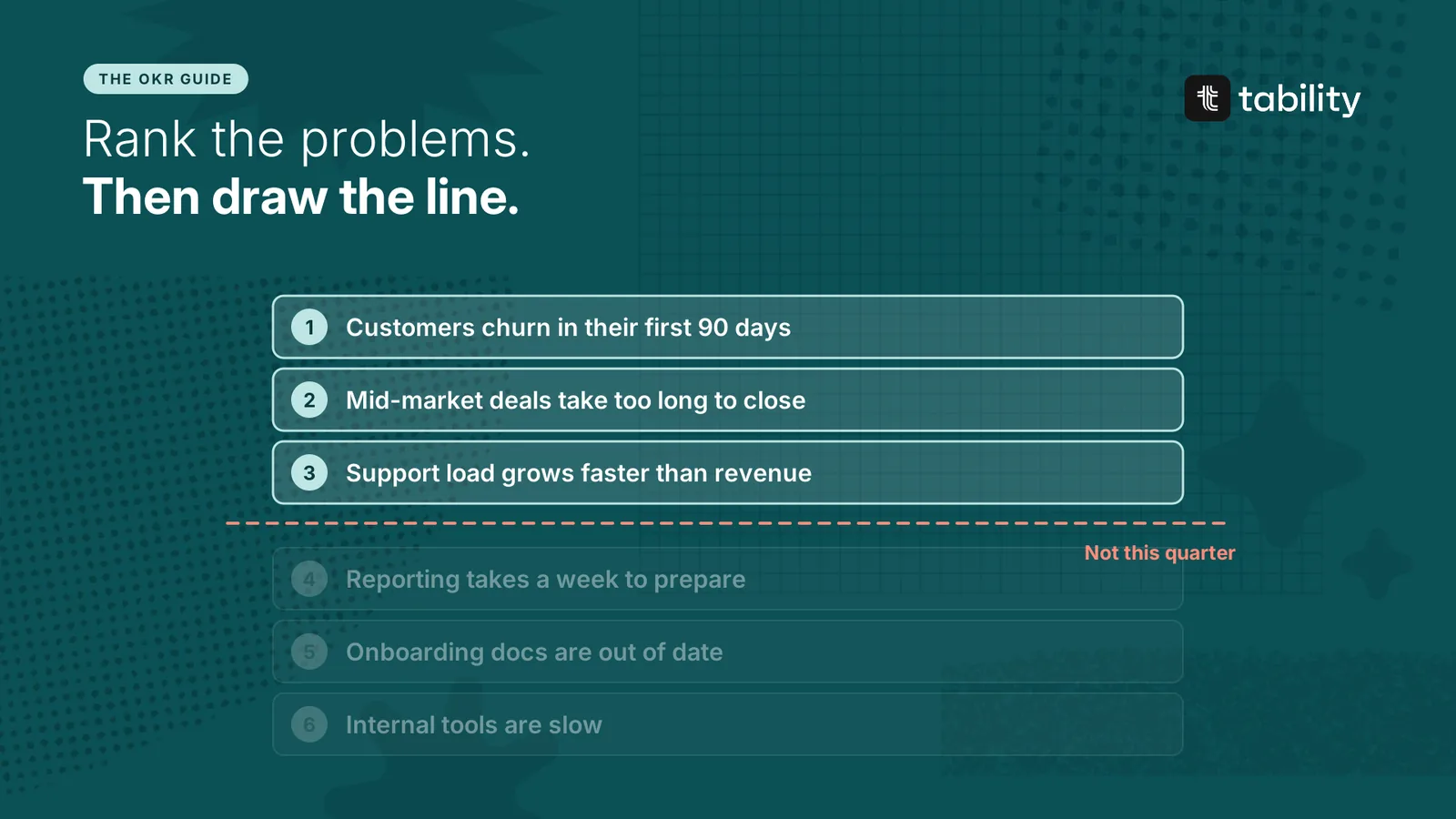
This step makes the other two honest. Capacity is finite, and a ranked list with no cut-off is a wish list where everything competes for the same people. Naming what will not get done turns the plan into a set of trade-offs the company has agreed to. It also gives the team an answer when those items come back as urgent requests in week six.
Step 4: Settle ownership in the room
Run these sessions with leadership present for every team. That is what lets ownership move while people are still in the room. If engineering says a problem is not theirs and operations sees it as a priority, it comes off one list and lands on the other there and then. The alternative is finding out in week eight that nobody owned it.
It helps to separate two kinds of teams: those responsible for a result and those responsible for building what gets there. A launch runs through marketing, support and operations as well as product. Deciding who owns the result, and who contributes, changes who needs to be in the conversation.
Step 5: Write the OKRs last
Only now does each team write its OKRs. The problems above the line become Objectives, up to three per team. For each one, the team picks two to four Key Results that would prove the problem is solved.
This part should take an hour or two per team. Accept Key Results that are good enough. You will learn more about the right metric from three weeks of tracking than from three more meetings. The next two chapters cover how to write OKRs and how to write good Key Results.
Leave the health metrics out of it. Revenue, satisfaction and uptime describe the state of the business and do not need re-debating every quarter. They stay on your KPI dashboard. Planning time goes to the smaller set of goals that describe what each team intends to change.
Step 6: Share the plan next to last quarter's results
Publish the quarter's OKRs to the whole company, alongside how the previous quarter went. The pairing matters. People read the new plan as a response to what happened, and not as a list handed down.
Then make every team's OKRs visible to every other team. Alignment comes from people being able to read each other's goals, as covered in cascading vs. aligning OKRs.
How long OKR planning should take
Two weeks at most. Start two weeks before the quarter, so the OKRs are published on day one and the first check-in happens in week 1.
| When | What happens | Who |
|---|---|---|
| Before planning starts | Leadership restates the company priorities. One meeting, one page | Leadership |
| Planning week 1 | Teams list problems, rank them and draw the line. Ownership is settled | Each team, with leadership in the room |
| Planning week 2 | Teams write Objectives and Key Results, then read each other's drafts | Each team |
| Week 1 of the quarter | Publish on day one, next to last quarter's results. First check-in | Everyone |
Any longer and you start tracking late. A team that is still planning three weeks into a 13-week quarter has used up close to a quarter of its runway before the first check-in.
A small company can compress all of this into a few days. A large one needs more calendar time from top to bottom, because several layers go through the same steps. Each team's own planning should still fit inside two weeks.
Traps to avoid when setting OKRs
Debating metrics before agreeing on problems. If a Key Result discussion keeps going in circles, the disagreement is usually about the problem.
No line. If every problem makes the cut, you have not prioritised.
Planning in silos. Teams that plan alone discover their dependencies in the middle of the quarter.
Starting from last quarter's list. Copying forward is a habit worth resisting. Start from this quarter's problems and bring back only the goals that still earn their place.