OKRs are the middle layer of a longer chain. Above them sits your strategy. Below them sits the work your teams do every week. The OKR process is what keeps those layers connected, so that a decision made on a Tuesday afternoon still points at where the company wants to be in three years.
This chapter shows the whole process on one page. The rest of the guide goes deep on each part.
The OKR process at a glance
The process has four horizons. Each one answers a different question, and each one changes at a different speed.
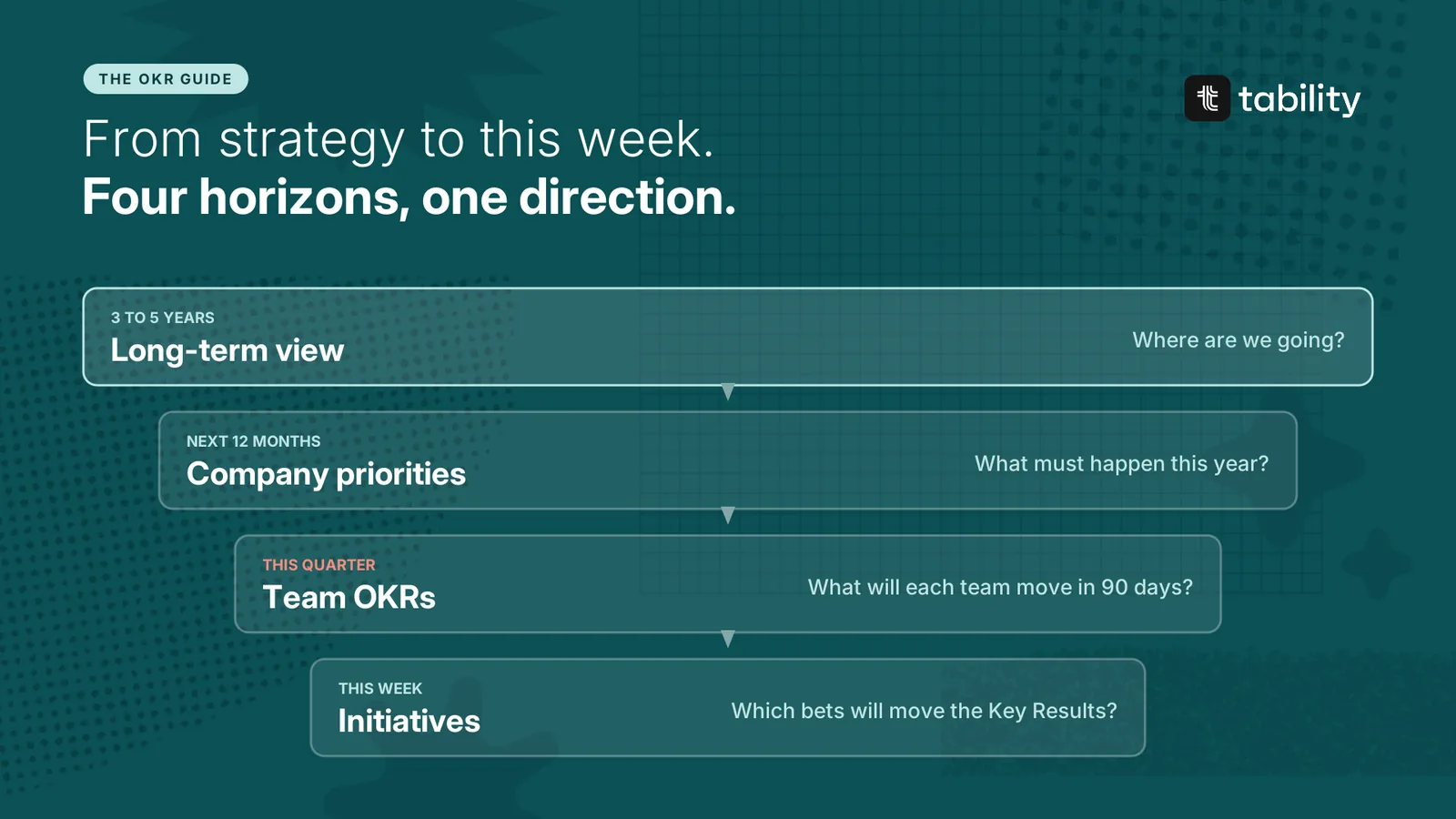
| Horizon | Question it answers | Owned by | Changes |
|---|---|---|---|
| Long-term view (3 to 5 years) | Where are we going? | Founders and leadership | Rarely |
| Next 12 months | What must happen this year? | Leadership | Once a year, reviewed each quarter |
| The quarter | What will each team move in the next 90 days? | Teams | Every quarter |
| The week | Which bets will move the Key Results? | Teams | Every week |
Each horizon narrows the one above it, down to the work a team chooses this week. Tracking then runs the other way. Weekly check-ins on the Key Results show whether this week's bets are working, whether the quarter is on course, and whether the year still makes sense.
Step 1: Write down the long-term view
Start with where the company should be in three to five years. One paragraph is enough. It should say who you serve, what will be true for them, and what kind of company you will be when you get there.
The test is simple. Ask five people in different teams what the company is trying to become. If you get five different answers, OKRs will not fix that. You will just get five well-measured sets of goals pointing in different directions.
Most companies already have this in a strategy deck. The work is to shrink it to something people can repeat. Our article on corporate level strategy covers how the top of that pyramid is built.
Step 2: Pick what must happen in the next 12 months
Now ask what has to be true a year from today for the long-term view to stay on track. Pick two or three priorities and give each one a measure.
These are your company Objectives. They are the lighthouse from chapter 2: the fixed point every team steers by. They need to be few, written in plain language, and visible where the work happens.
Resist the urge to cover everything the company does. Sales will keep selling and support will keep answering tickets without an Objective telling them to. Company Objectives are for the things that must change. The steady work belongs in your KPIs.
Step 3: Bring it into the quarter
A year is too long to steer by. So each quarter, the annual priorities get translated into goals for the next 90 days. This is the OKR planning process, and it takes about two weeks.
-
Leadership shares the company OKRs for the quarter. Two weeks before it starts.
-
Teams draft their own OKRs in response. Each team asks what it can move this quarter that helps most. Teams write their own goals. Nobody hands them a slice of someone else's. See cascading vs. aligning OKRs.
-
Everyone reads everyone else's draft. One session to catch gaps, overlaps and dependencies between teams.
-
Publish in week one. Then stop editing.
Spend the two weeks on direction. A team that agrees on where it is going and has a rough Key Result is in better shape than a team with a perfect metric and no shared understanding. Keep it to three Objectives per team, with two to four Key Results each. The details are in how to write OKRs.
Step 4: Choose this week's bets
OKRs say what should change. Initiatives are how you try to change it, and this is where the OKR mindset differs most from a classic roadmap.
A roadmap is a timeline of projects fixed at the start of the quarter. Planning turns into a game of Tetris, where the aim is to fit as many projects as possible into the weeks available, and success means shipping them on schedule.
With OKRs, the Key Results drive the work. Every week the team asks which bets it believes will move a Key Result in the right direction, runs them, and looks at what happened. Bets that move the number get more investment. Bets that do not are dropped, and new ones take their place. The list of initiatives at the end of the quarter should look different from the list at the start. More in OKRs vs. initiatives.
Track progress every week
Tracking is a separate job from choosing initiatives, and it belongs with the OKRs. It is how you check that the goals are still on course.
Every week, each Key Result gets a check-in: the current value, a confidence level, and a short note on what changed. One named owner is responsible for it.
Then the team meets for fifteen to thirty minutes. Everyone has read the updates beforehand. Nothing green gets discussed. The time goes to the Key Results that are at risk, and each one ends with a decision, which is often a change to next week's bets. More in the weekly ritual to track OKRs.
Without that meeting the updates go unread, and unread OKRs stop doing anything.
The OKR cycle
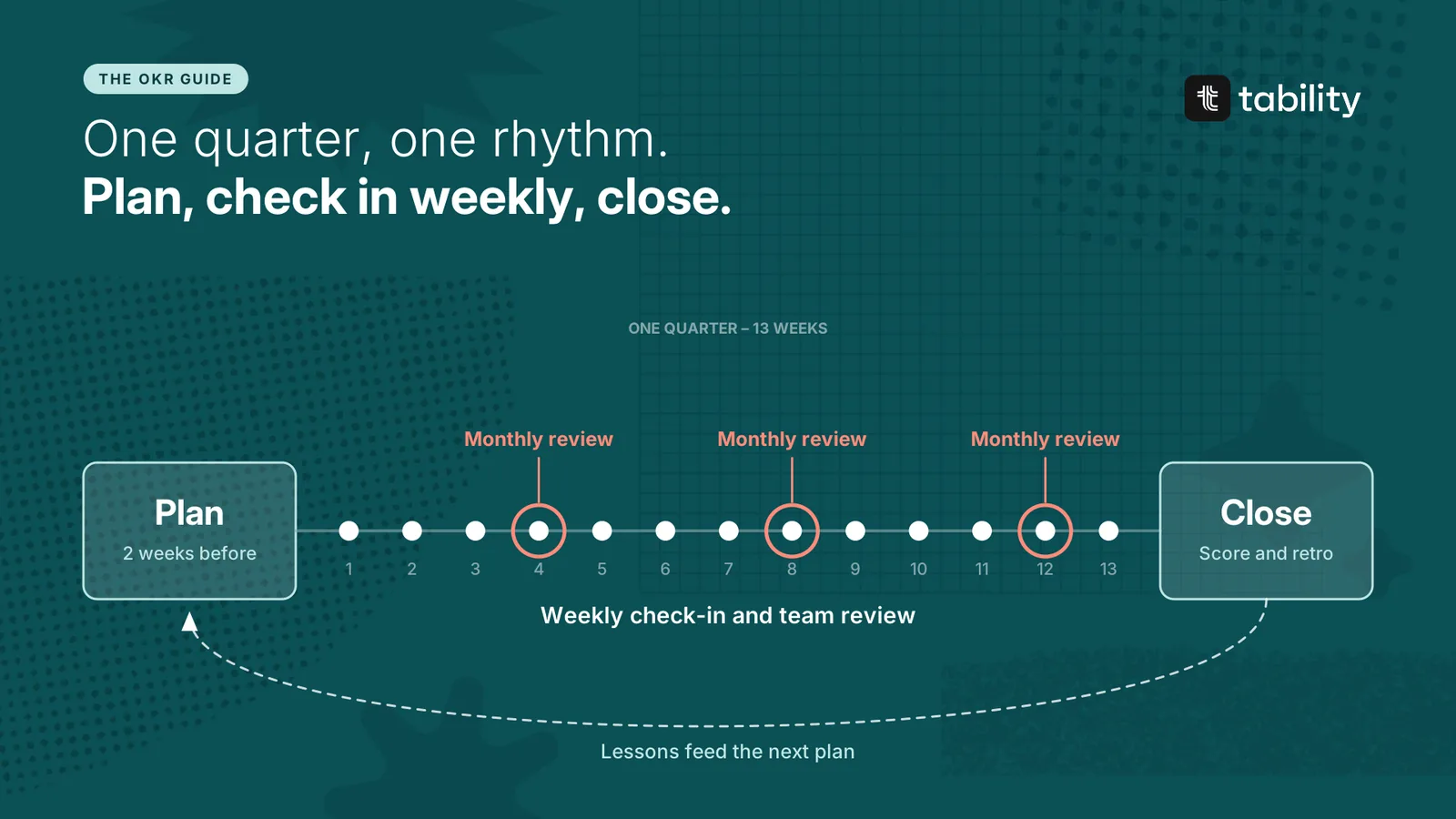
Put together, a quarter looks like this.
| When | What happens |
|---|---|
| Two weeks before | Leadership shares company OKRs. Teams draft theirs. |
| Week 1 | OKRs are published. Check-in day is set. |
| Weeks 1 to 13 | Weekly check-in and team review. |
| Weeks 4, 8 and 12 | Monthly leadership review across all teams. |
| Week 13 | Score the Key Results, run the retrospective, start the next plan. |
The cadence is the same every quarter. That is deliberate. When the rhythm is predictable, people stop thinking about the process and spend their attention on the goals.
The OKR meetings you need
Three recurring meetings and one planning session. That is all.
| Meeting | When | Who | Length | Purpose |
|---|---|---|---|---|
| Quarterly planning | Two weeks before the quarter | Leadership, then each team | 2 hours, then 1 hour per team | Agree on direction, draft and align OKRs |
| Weekly team review | Every week | The team | 15 to 30 minutes | Discuss what is at risk, decide what to change |
| Monthly leadership review | Weeks 4, 8 and 12 | Leadership and team leads | 45 minutes | Cross-team risks, dependencies, resourcing |
| Retrospective | Week 13 | Each team | 1 hour | Score, learn, feed the next plan |
Three rules apply to all of them:
-
Read before you meet. The updates are written. The meeting is for discussion.
-
Skip the greens. If it is on track, it does not need airtime.
-
End with an owner. Every item at risk leaves with a decision and a name.
Who does what
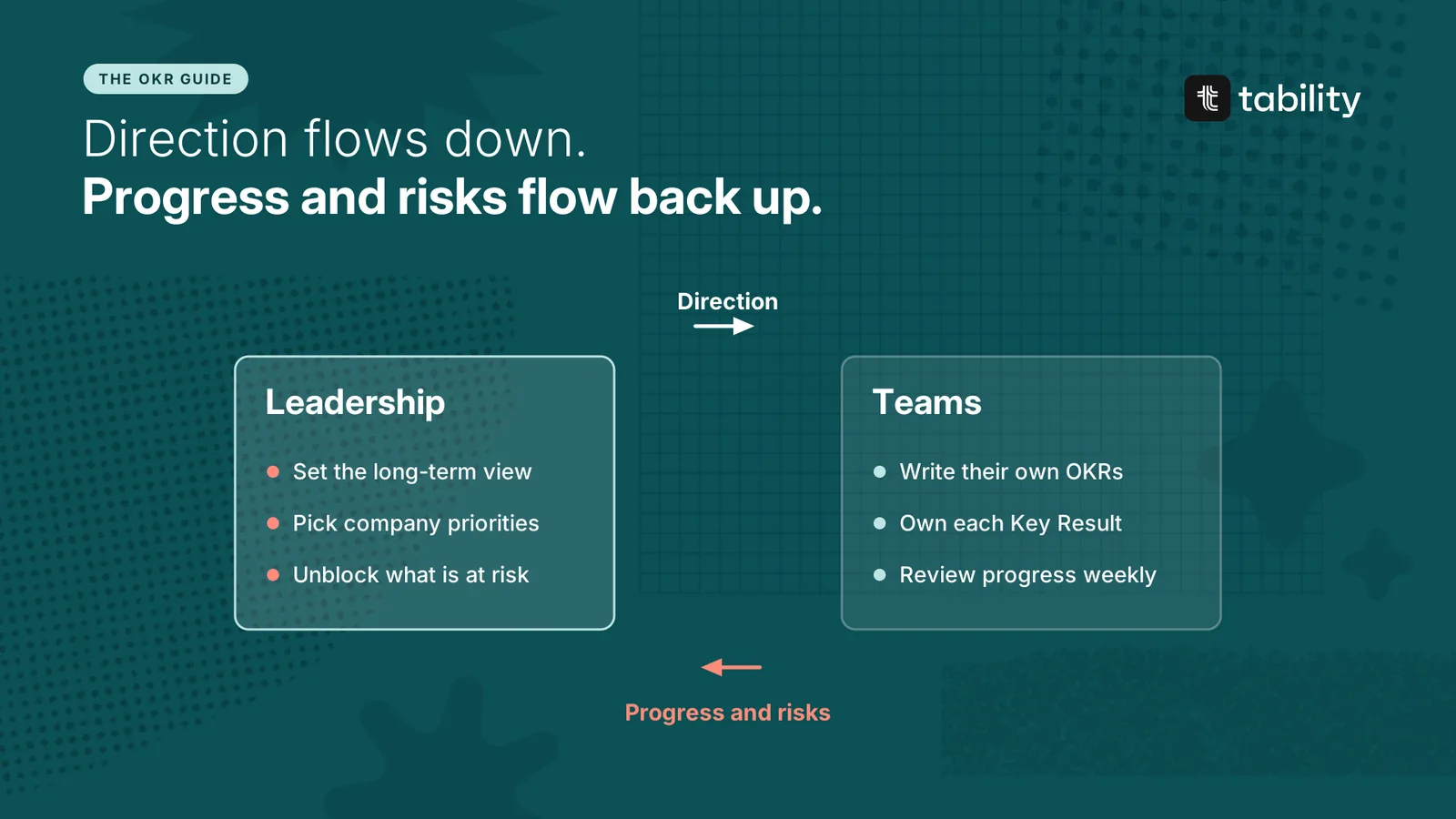
Leadership sets the long-term view and the company Objectives, and unblocks what teams escalate. Leaders also have to use the OKRs in their own meetings. If the leadership team never looks at them, nobody else will.
Teams write their own OKRs, choose their initiatives and run the weekly review.
Key Result owners are single named people. One person per Key Result, who keeps the update honest and raises the flag early.
An OKR champion keeps the process running: the calendar, the nudges, the quality of what gets written. In a small company this is a few hours a week for someone in operations. Chapter 5 covers the role.
What about agents? They are left out of this picture on purpose. Everything in Parts 1 to 5 works with people alone. Part 6 covers how agents can take on part of the process once the basics are running.
What makes the process hold
Six rules do most of the work. Each gets its own chapter later.
-
Direction first. Agree on where you are going before you debate metrics.
-
Few goals. Up to three Objectives per team.
-
Teams write their own OKRs. Align them, do not cascade them.
-
Check in every week.
-
Read the updates before you meet, and discuss only what is at risk.
-
Score on the scale the rest of your company uses. Aim to hit your targets.
The full list is in OKR best practices.