Your first round of OKR planning starts from a strategy and a blank page. Later rounds are harder to do well, because last quarter's plan is sitting there, ready to be copied.
Planning a new quarter means going back to first principles. Where are we now? Where do we need to be? What are the most important problems between the two? Last quarter informs the answers, and so do three other things.
The method is the same as in How to set OKRs. This chapter covers what is different the second time round.
Start from where you are
Before anyone proposes a goal, put four things on the table.
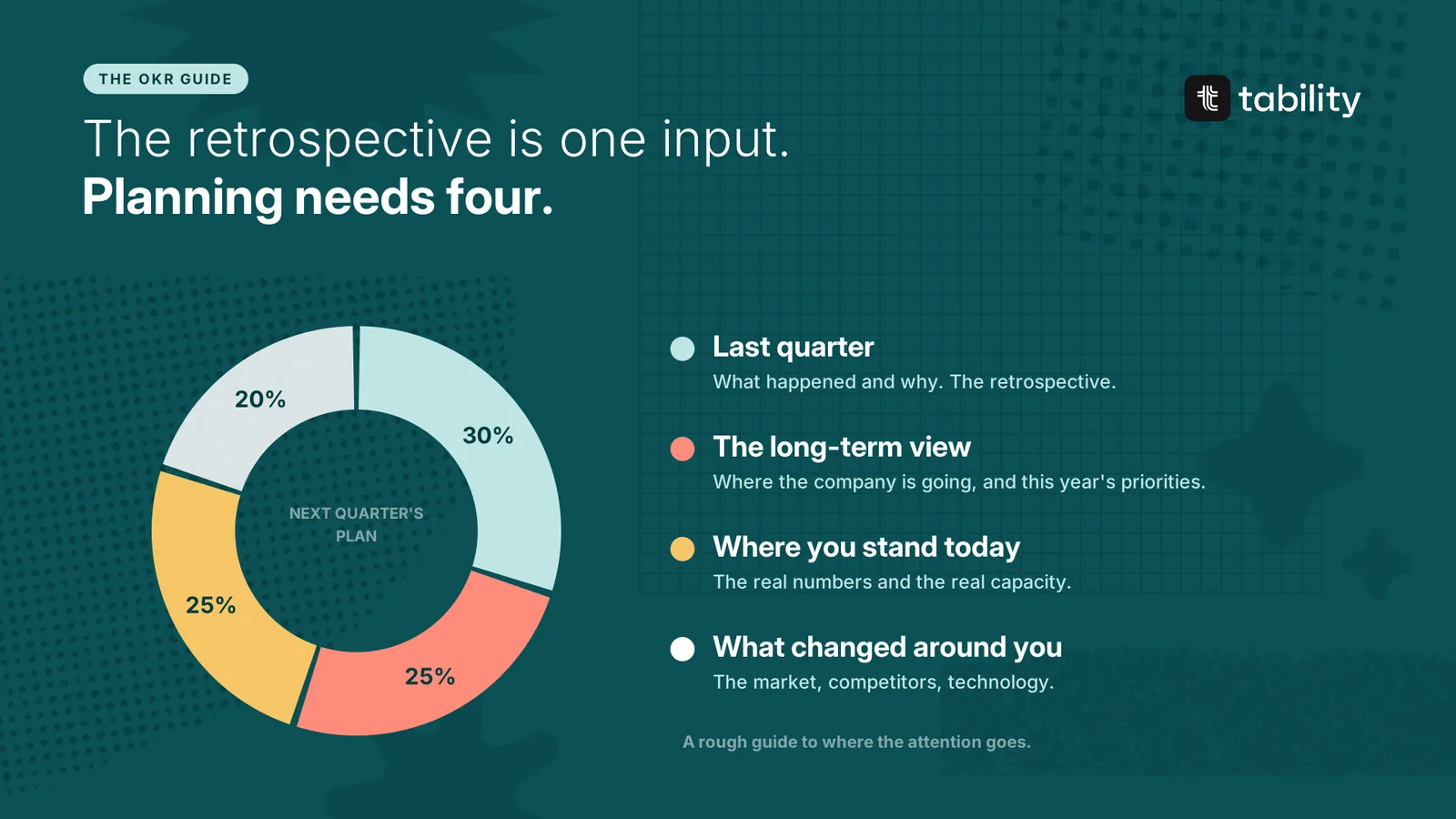
Last quarter. The closed Key Results and the shared account from the retrospective: what was achieved, which bets worked and why.
The long-term view. Reread the three-to-five-year view and this year's priorities. Ask whether they still hold. Most quarters they do, and saying so out loud keeps the new plan pointed at them.
Where you stand today. Plan from the real position. If activation was meant to reach 50% and ended at 41%, the new plan starts at 41%. The same goes for capacity: plan for the team you have, including the person who left in week 9.
What changed around you. Some quarters move the ground under the strategy. A pandemic empties your customers' offices. AI tools change what your product is compared with. A well-funded competitor launches at half your price. When something like that happens, a goal carried over from last quarter may be aimed at a problem that no longer matters most. Ask the question every quarter, including the quarters where the answer is "nothing much".
Then follow the steps from chapter 6: list the problems worth solving, rank them and draw the line. Last quarter's Objectives go through that ranking with everything else.
Extend, copy or start over
Once the problems are ranked, look at how last quarter's Objectives fit. Take them one at a time. Each one goes one of three ways.
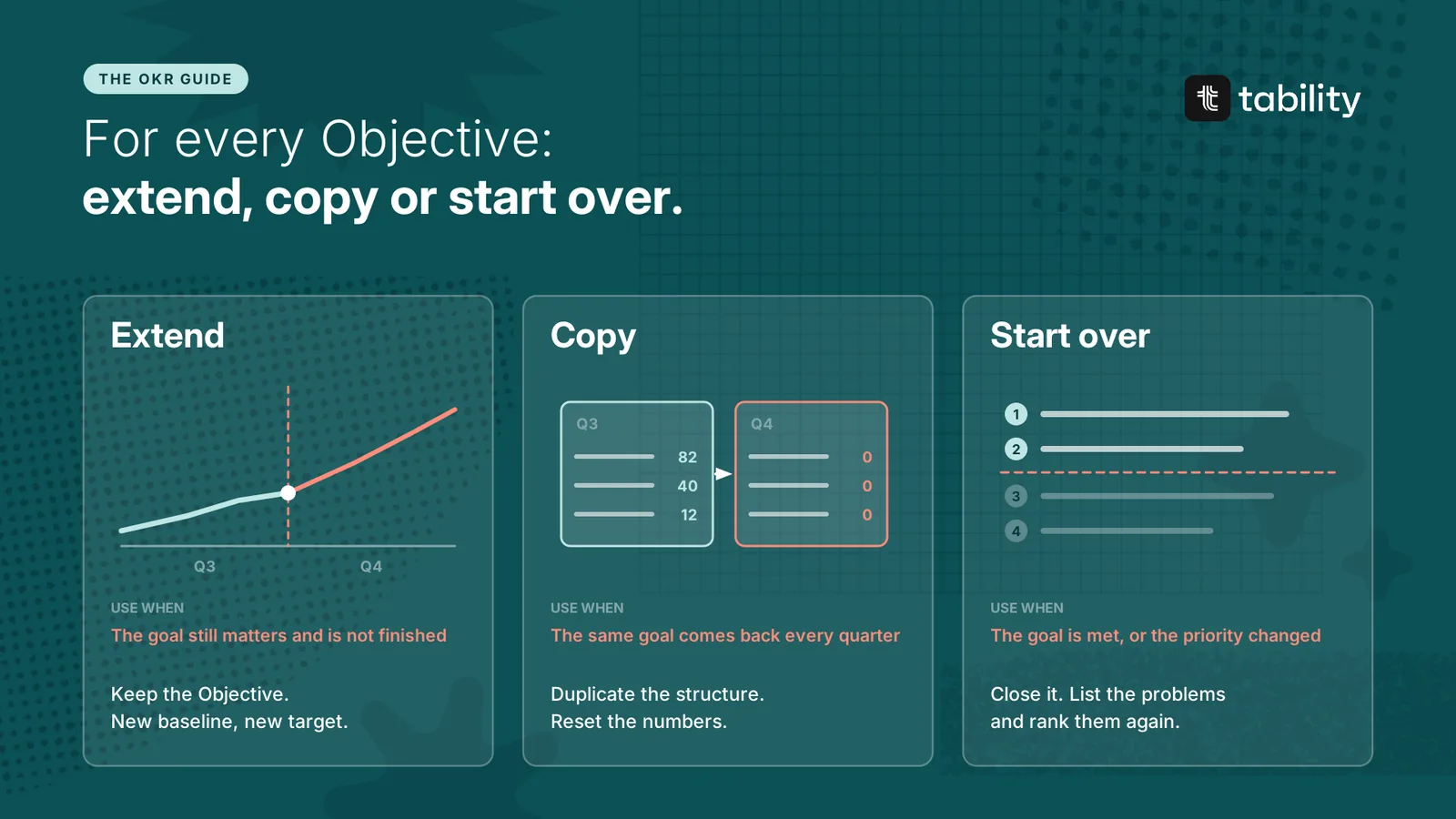
| Option | Use it when | What you do |
|---|---|---|
| Extend | The goal still matters and is not finished | Keep the Objective. Set a new baseline and a new target |
| Copy | The same goal comes back every quarter | Duplicate the structure. Reset the numbers |
| Start over | The goal is met, or the priority has changed | Close it. List the problems and rank them again |
Extend
Extend an Objective when the problem behind it is still one of the most important ones and the quarter did not finish the job.
The Objective stays. The Key Results are written again. The baseline is where you ended, and the target is what you now believe is reachable. Win rate ended at 24% against a target of 30%, so the extended Key Result runs from 24% to a new target, with a new first bet based on what the closing note said.
Two cautions.
-
Extending is a decision. A goal should never roll into the next quarter because nobody closed it. Put the extended Objective through the same ranking as everything else.
-
Look hard at the second extension. An Objective in its third quarter with little movement is telling you the approach is wrong or the goal is too big. Split it or rethink it.
Copy
Some goals have the same shape every quarter: a sales number, a hiring plan, a number of customer interviews. Copy the Objective and its Key Results, reset the values to zero or to the new baseline, and adjust the targets.
Copying saves time and it is the easiest way to plan badly. Before you keep a copied Key Result, ask whether it still needs the attention of a goal. If the number is stable and only needs watching, it has become a KPI and belongs on the dashboard.
Start over
Start over when an Objective was achieved or when the priority behind it has changed. Close it, then run the first steps of planning for the space it leaves: list the problems, rank them and draw the line.
An achieved Objective often leaves a metric that still has to be held. Activation reached 51% and nobody wants it to slide back. Move it to the KPI dashboard with a healthy range, and bring it back as a Key Result only if it leaves that range.
A worked example
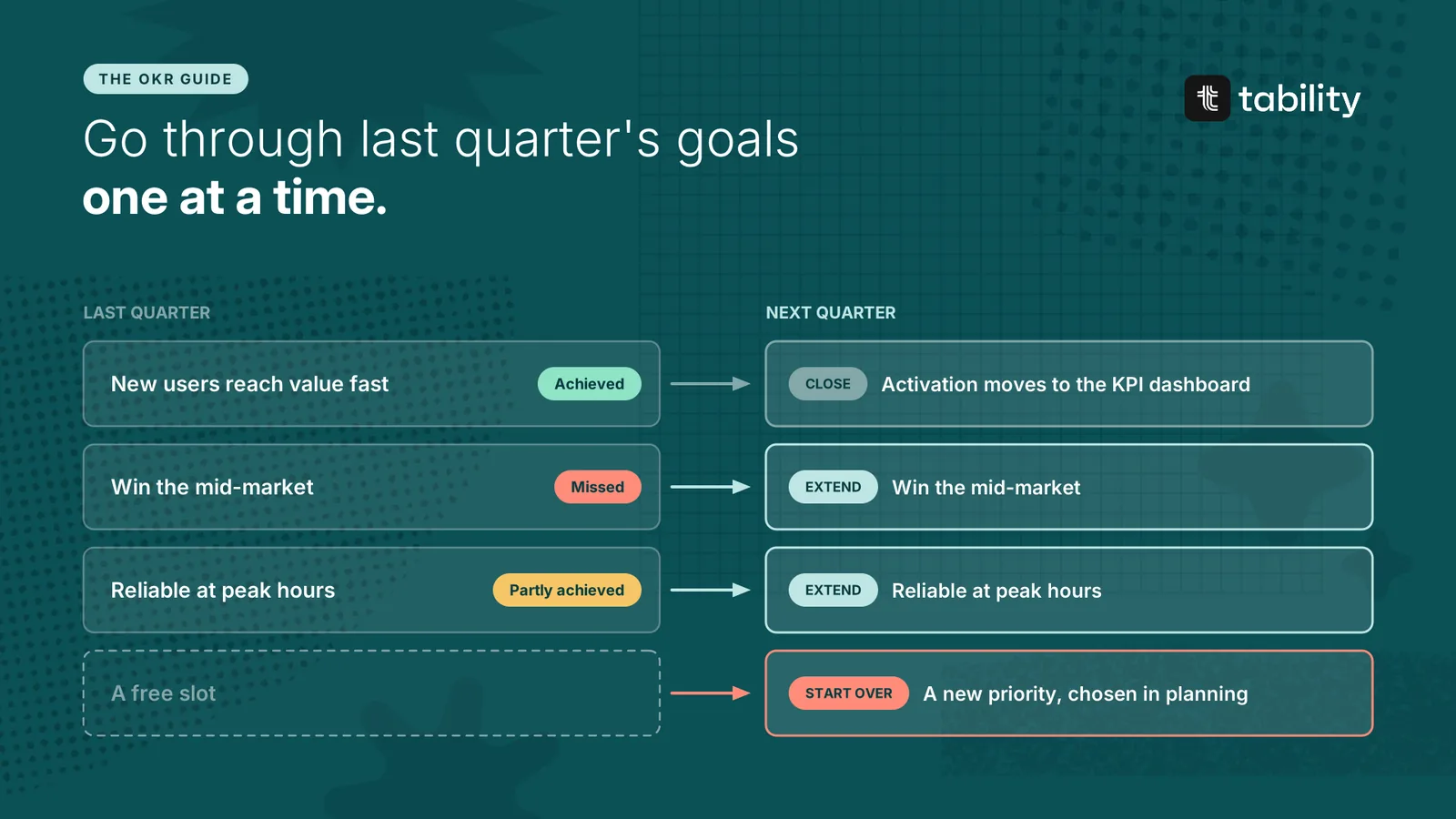
The company had three priorities last quarter.
-
New users reach value fast was achieved. It is closed, and activation moves to the KPI dashboard.
-
Win the mid-market was missed, and it still matters. It is extended, with the pricing tier as the first bet.
-
Reliable at peak hours was partly achieved. It is extended with the same target.
That leaves one free slot. It goes to a new priority chosen through the usual ranking, and it should not be handed to whichever request arrived last.
Leave room for something new
If all three of a team's Objectives are extensions or copies, the plan is last quarter's plan. Keep at least one slot open for a problem that was not on the list before, unless there is a clear reason to spend the whole quarter finishing what was started.
Run it in two weeks
The timetable is the same as in chapter 6, and it overlaps with closing.
| When | What happens |
|---|---|
| Before week 12 | Leadership restates the company priorities |
| Week 12 | Retrospective. Then extend, copy or start over, rank the problems and draw the line |
| Week 13 | Teams write the OKRs and read each other's drafts |
| Week 1 | Publish, next to last quarter's results. First check-in |
Apply the three changes from the retrospective as you go. If one of them was "set baselines before the quarter starts", week 13 is when that happens.
Publish with a quarterly business review
The new OKRs go out in week 1 together with a short account of the quarter that just ended. People read the plan as a response to what happened.
That account is the quarterly business review, or QBR. The monthly review asks what needs to change in the next four weeks. The quarterly review records what was achieved, what was learned and what the next quarter looks like as a result.
It has six sections: results, results by priority, what worked, what did not, what was learned and what changes next quarter.
Example: quarterly business review, Q3
Results. 24 Key Results: 14 achieved, 6 partly achieved, 4 missed.
By company priority
| Priority | Result | Headline |
|---|---|---|
| New users reach value fast | Achieved | Activation went from 32% to 51%. Time to first value fell from 8 days to 3 |
| Win the mid-market | Missed | Win rate ended at 24% against 30%. Sales cycle ended at 44 days against 35 |
| Reliable at peak hours | Partly achieved | Peak load time fell from 4.2s to 2.2s against a target of 1.5s |
What worked. The setup checklist and sample data moved activation more than any other bet. Both shipped in the first five weeks, which left time to see the effect.
What did not. Sales enablement content had no visible effect on win rate. The blocker was pricing, and we confirmed that in week 8.
What we learned. Mid-market buyers need a tier between Team and Enterprise. Performance work takes longer to show up in the numbers than we planned for.
Next quarter. Extend "Win the mid-market", with the new pricing tier as the first bet. Extend "Reliable at peak hours" with the same target. Close "New users reach value fast" and move activation to the KPI dashboard. The free slot goes to a new priority.
For a general introduction to QBRs and a downloadable template, see What is a QBR and the QBR template.
Then the loop starts again
In week 1 the owners write their first check-in, and the weekly routine runs for another thirteen weeks. Each cycle should be a little easier than the one before: the goals are sharper, the check-ins are a habit and the retrospective has removed three things that got in the way.
Questions about OKR planning
What is OKR planning? The process of setting the next quarter's OKRs: agreeing on direction, deciding what happens to the current goals and writing the new ones.
How long should OKR planning take? Two weeks for a team, starting two weeks before the quarter begins.
Should OKRs roll over to the next quarter? Only by decision. Close every Key Result at the end of the quarter, then extend the Objective if it is still one of the most important problems.
How many Objectives can be carried over? There is no fixed number. If every Objective is carried over, check whether the goals are too big or the plan has stopped responding to what you learned.
What is the difference between annual and quarterly OKRs? Company priorities are set for the year and say where the company needs to be. Quarterly OKRs are how each team moves towards them in the next 13 weeks.