An OKR cycle has three phases: set the goals, track them, close them. The end of one cycle overlaps with the start of the next, and how you handle that handover decides whether the next plan is a fresh look at the business or a copy of the last one.
This chapter starts with the overview: what happens between two quarters and what goes into a new plan. Then it covers closing, step by step. The next two chapters go deeper on the retrospective and on planning.
What goes into the next plan
The tempting approach is to open last quarter's OKRs, adjust the targets and carry on. That gives you a plan built on the recent past and nothing else.
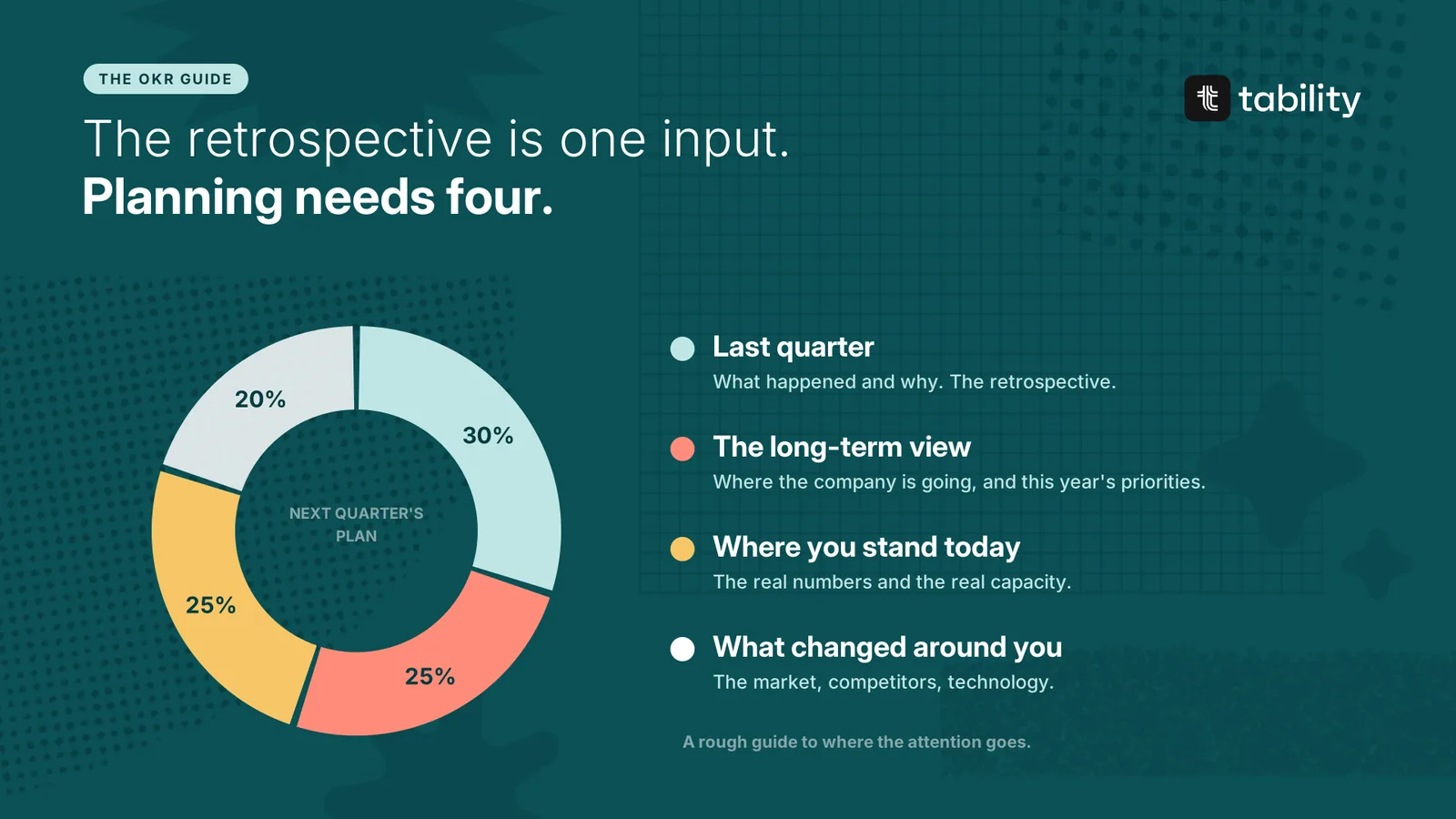
A new quarter is planned from four inputs.
-
Last quarter. What you set out to do, what happened and why. The retrospective gets everyone to the same understanding of it.
-
The long-term view. Where the company is trying to get to, and this year's priorities. Reread them before discussing any new goal.
-
Where you stand today. The real numbers and the real capacity. Plan from the position you are in, which may differ from the one the last plan assumed.
-
What changed around you. A new competitor, a shift in the market, a change in technology. Some quarters end in a different world from the one they started in, and the strategy has to move with it.
The percentages are a rough guide to how much attention each one deserves. What matters is the mix. The retrospective is an important input, and it is one of four.
With all four on the table, the team goes back to first principles: given where we are and where we need to be, what are the most important problems to solve in the next 13 weeks? Planning answers that question.
The last two weeks do two jobs
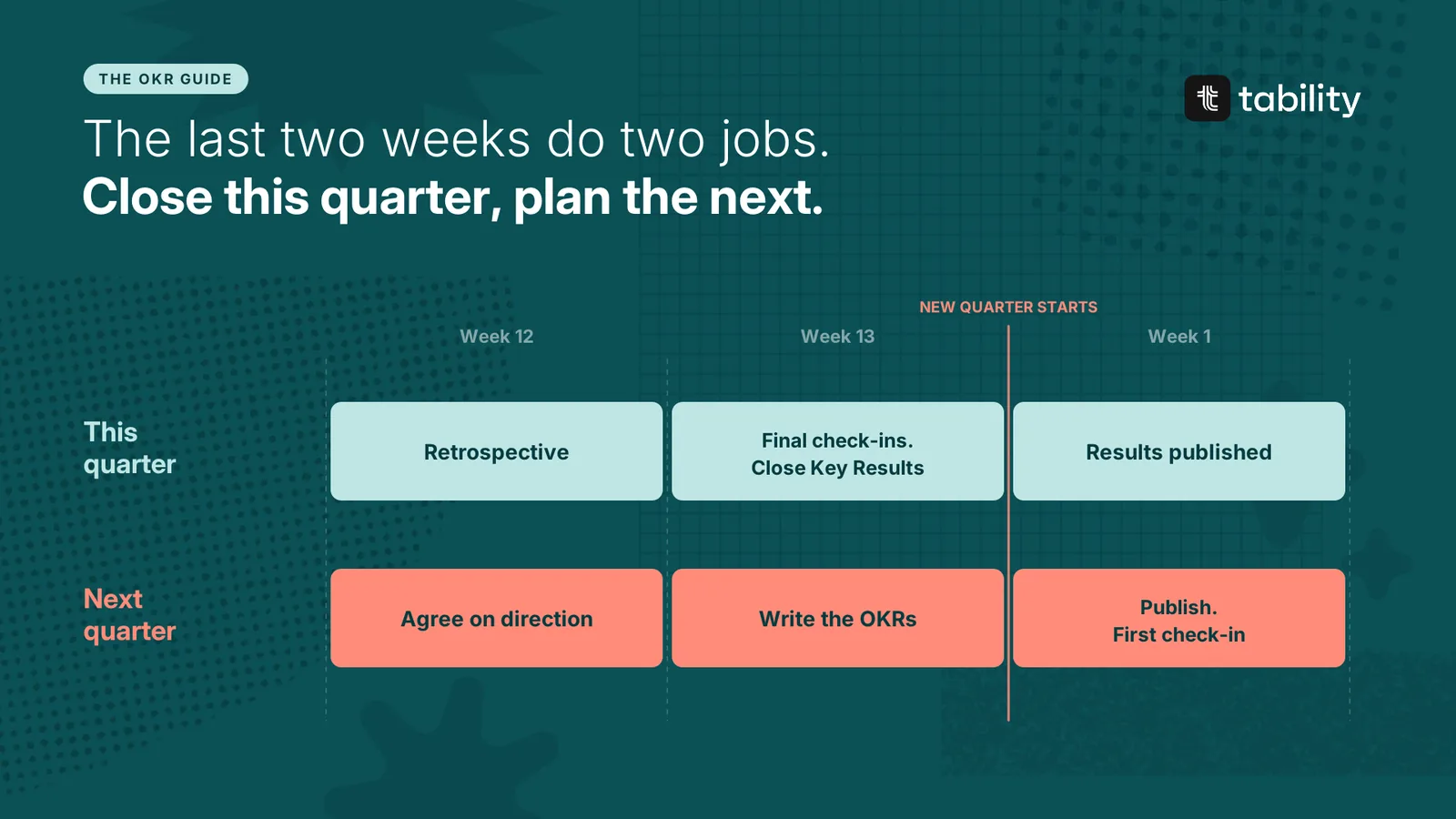
Planning takes two weeks and has to finish before the new quarter starts. So the end of one cycle overlaps with the start of the next.
| When | This quarter | Next quarter |
|---|---|---|
| Week 12 | Retrospective | Agree on direction |
| Week 13 | Final check-ins. Close every Key Result | Write the OKRs |
| Week 1 | Results published | New OKRs published. First check-in |
The retrospective runs in week 12, before the final numbers are in. That is fine. After twelve weeks of check-ins, the outcome of most Key Results is no longer in doubt, and the lessons are needed for planning.
Step 1: Record the final number
In the last check-in of the quarter, each owner records the final value of their Key Result. Take it from the same source as every other week, on the last working day.
Some numbers arrive late. Monthly churn or a survey score may not be known until a week into the new quarter. Close with the latest value, mark it as provisional and update it once when the real number lands.
Step 2: Call the outcome
Every Key Result ends in one of three states.
| Outcome | Meaning |
|---|---|
| Achieved | The target was met |
| Partly achieved | The number moved a meaningful distance and fell short |
| Missed | Little or no movement |
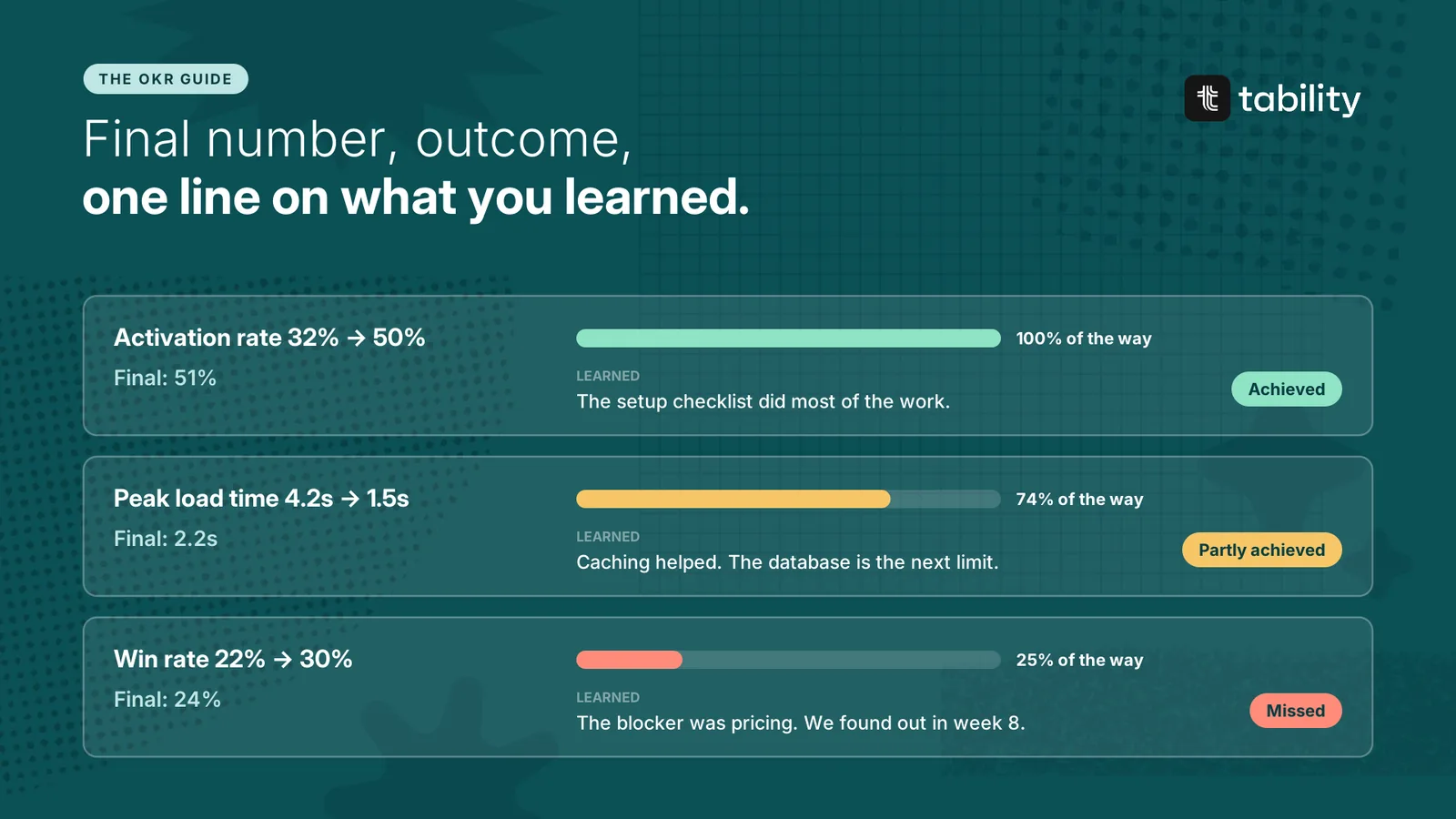
Keep the percentage next to the label. It is the distance covered from the starting value to the target. Activation went from 32% to 51% against a target of 50%, so it was achieved. Win rate went from 22% to 24% against a target of 30%, which is a quarter of the way and a miss.
Be strict about "achieved". Ninety-two per cent of the way is a good quarter and it is still partly achieved. If near misses get rounded up, targets stop meaning anything, which is the problem with the 0.7 scale.
Key Results without a number are closed at the last stage that was fully reached.
Step 3: Write the closing note
One to three sentences per Key Result: what happened, why, and what you would do differently.
Win rate 22% → 30%. Final: 24%. Missed. Enablement content shipped in week 3 and had no visible effect. The real blocker was mid-market pricing, which we confirmed in week 8. Next time we would test the pricing assumption in the first two weeks.
Write the note for someone planning a similar goal a year from now. They will not have the context, so name the bet, the result and the lesson.
Achieved Key Results need a note too. "We hit it" teaches nothing. "The setup checklist did most of the work, and sample data added little" tells the next team where to start.
Step 4: Close the initiatives
Go through the initiatives under each Key Result and mark each one as shipped, dropped or still in progress. Work that is still in progress does not carry over automatically. It goes back into planning and has to earn its place against the new goals.
Step 5: Close on time
Close every Key Result in week 13, whatever state it is in. Then publish the results in the first week of the new quarter, next to the new OKRs.
Rules for closing
Do not move the target. A target lowered in week 12 turns a miss into a success on paper and makes the record useless.
Do not keep it open. "Two more weeks and we will hit it" pushes one quarter into the next. Close it as partly achieved. If the goal still matters, it can be extended in planning with a new target.
Close misses as misses. A missed Key Result with a clear closing note is worth more than a vague success. The note is how the company gets something back for the quarter it spent.
Keep results away from pay. The reasons are the same as for weekly scores. People who are paid on outcomes set targets they cannot miss.
Do not rank teams. A team that hit every target may have aimed low. A team that missed two may have taken on the hardest problem in the company.
Questions about closing OKRs
What is an OKR cycle? The period over which a set of OKRs runs, usually a quarter. It has three phases: setting the goals, tracking them every week and closing them at the end.
How long is an OKR cycle? Thirteen weeks for most teams. Company priorities are usually set for a year and reviewed each quarter.
When should you close your OKRs? In the last week of the quarter. Late data can be updated once afterwards.
What happens to OKRs that were not finished? They are closed as partly achieved or missed. During planning, the team decides whether to extend the goal, drop it or replace it.