OKRs were designed for a world where building things was slow and expensive. That world is gone. This chapter looks at which parts of the framework depended on that assumption, which parts did not, and what to change in how you run OKRs in 2027.
What planning was for when building was slow
For most of the history of OKRs, the scarce resource in a company was the capacity to build. A feature took a team a quarter. A campaign took a month. Every project had a real cost, so companies planned carefully, because a wrong choice burned capacity they could not get back.
Slow building had a side effect that nobody designed. Leaders could keep up. A team shipped a handful of things each month, and a manager could look at every one of them in a demo, a review or a stand-up. If a team drifted from what mattered, someone noticed within a few weeks.
Goals helped, but supervision was the safety net. Plenty of companies ran with vague goals for years and got away with it, because inspection caught most of the drift.
What AI changed
AI made building cheap. A person working with Claude, ChatGPT or a coding agent can produce a prototype, an analysis, a campaign or a working feature in hours. Two things follow.
More work gets started. When a project costs a day, people start more of them. The number of things in flight across a company multiplies.
Review cannot keep up. The amount of output went up. The attention of the people who used to check it did not. A leader who could once look at everything their teams shipped now sees a sample, and often a random one.
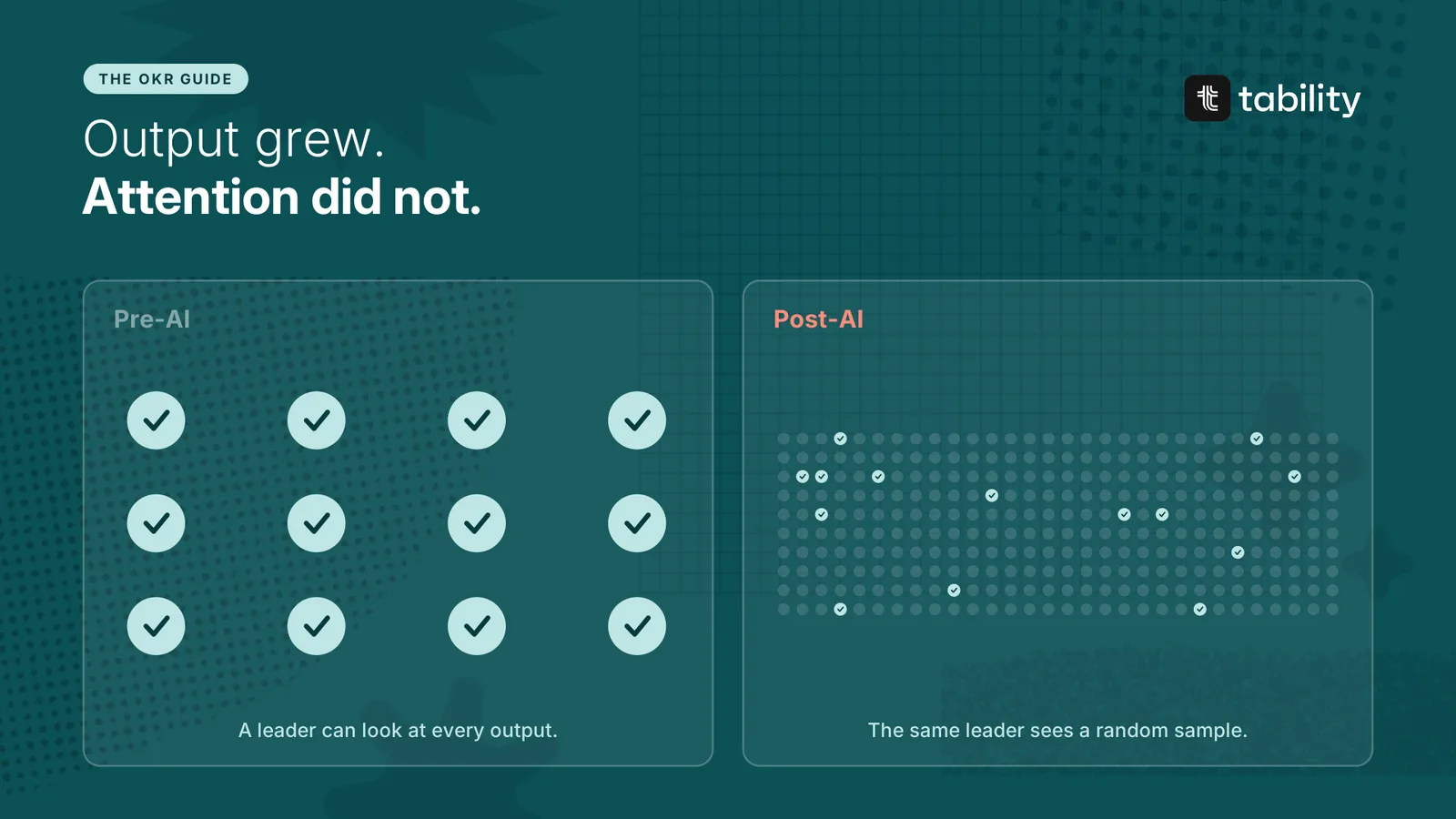
Put those together and the economics of work flip. The cost of a project has fallen sharply. The cost of misalignment has risen, because a team pointed slightly off course now produces a great deal of misdirected work before anyone looks.
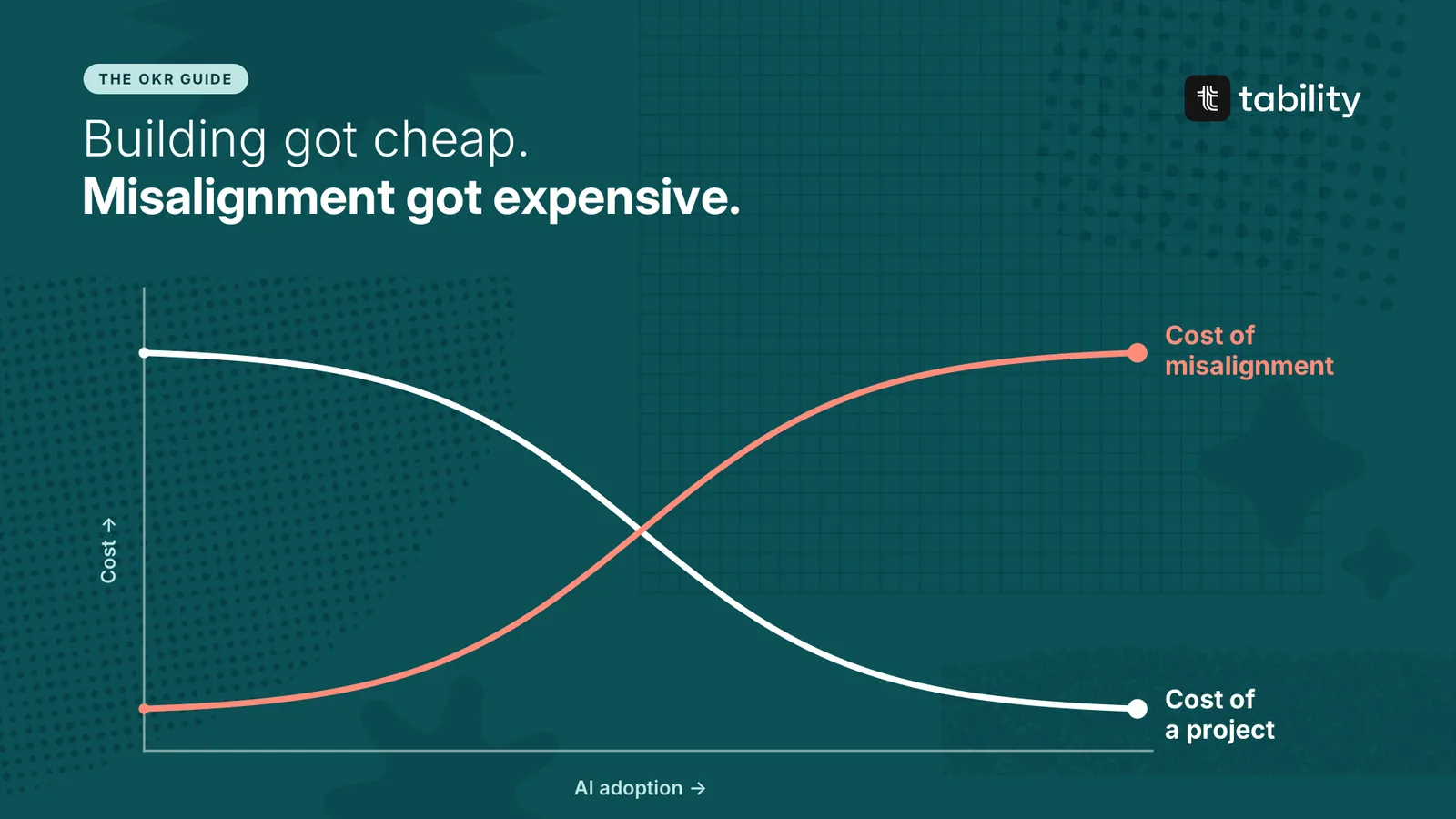
The constraint moved from building to deciding
The scarce resource is now attention and judgement. "Can we build it?" used to be the hard question. The answer today is nearly always yes, and by Friday.
The hard questions are the two that come before and after the build:
-
Should we? Does this piece of work serve where the company is trying to go?
-
Did it work? Now that it shipped, did anything improve?
Those happen to be the two questions OKRs were built to answer. The Objective tells you whether a piece of work is worth starting. The Key Results tell you whether it paid off. The middle part, the building, is the part AI took over.
So the framework holds. What changed is how much weight it carries. OKRs used to be a useful layer on top of supervision. In a company where supervision no longer scales, they are the main way direction reaches the work.
Why you need a lighthouse
A lighthouse does not steer any ship. It gives every ship the same fixed point, and each captain works out their own course from it.
That is the job of your top-level goals now. You cannot inspect every decision made by every person on every team. You can make the destination so clear that they make good decisions without you.
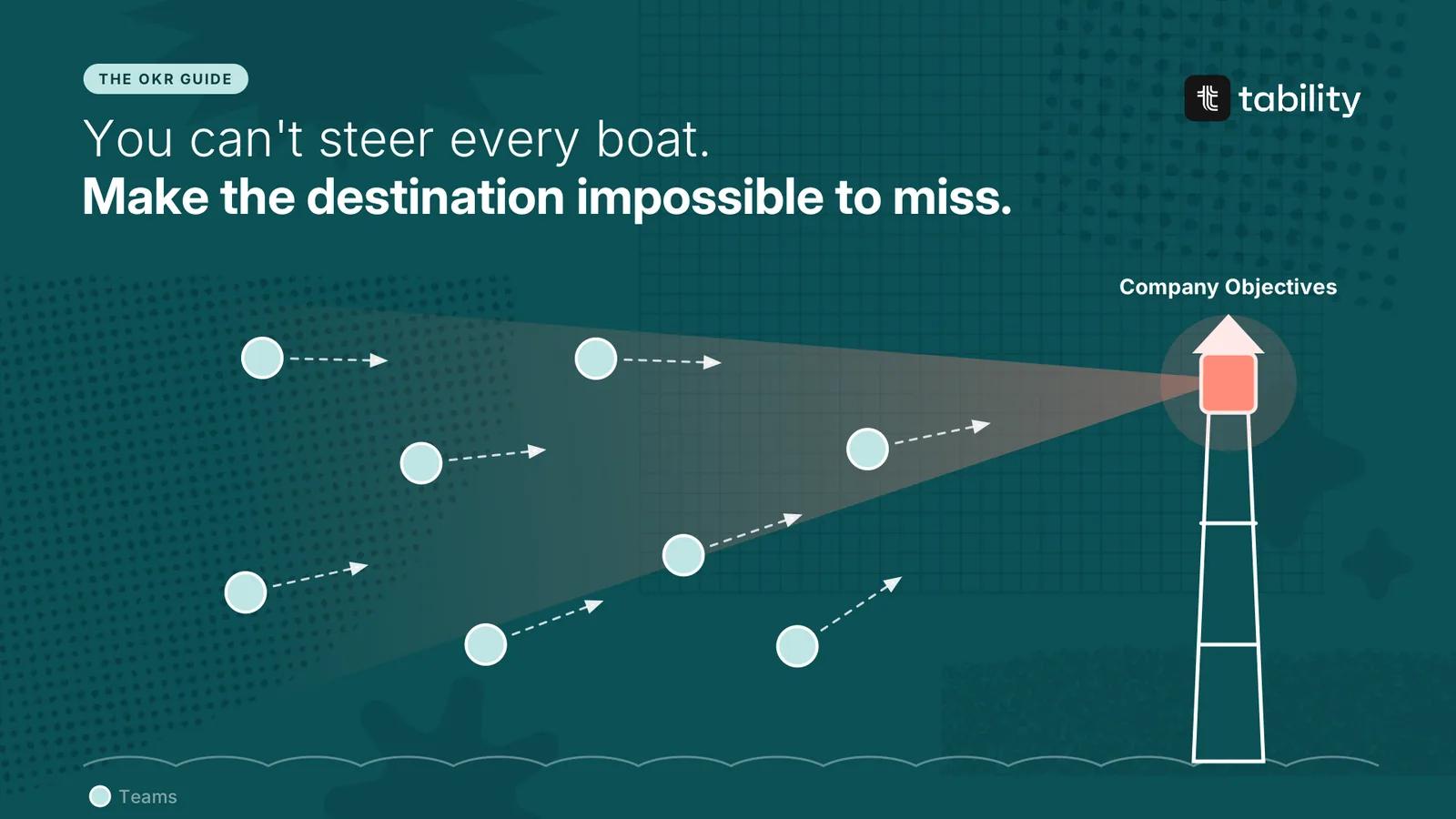
For goals to work as a lighthouse they need four properties:
-
Few. Two or three company Objectives. A list of ten gives nobody a fixed point.
-
Plain. Written so a new hire reads them the same way the CEO does.
-
Visible. In the place where work is assigned and discussed, and not in a slide from the January kick-off.
-
Current. Updated every week, so people trust that what they see reflects reality.
What changes in how you run OKRs
| Pre-AI | Post-AI | |
|---|---|---|
| Direction | Helpful context | The main control a leader has |
| Planning effort | Spent scoping the work | Spent choosing the outcome |
| Initiatives | A few large projects, planned up front | Many small bets, started and stopped weekly |
| Key Results | Checked at the end of the quarter | The only reliable signal that the output worked |
| Check-ins | Useful | Essential, because there is more to keep track of |
| Reviews | Walk through every goal | Read everything, discuss what is at risk |
Five practical shifts come out of that table.
1. Spend your planning time on direction. Teams used to spend weeks debating metrics and scoping projects. The scoping matters less when a project can be rebuilt in a day. Agreement on where you are going matters more. Get the Objectives right, accept Key Results that are good enough, and adjust as you learn.
2. Treat initiatives as cheap bets. You can now run five experiments in the time one used to take. That only helps if you also stop the ones that fail. Give each initiative a few weeks to move its Key Result, then scale it, change it or drop it.
3. Hold on to the weekly check-in. More output means more to keep track of, so the weekly update on each Key Result matters more than it used to. It is the one moment where the owner stops and asks whether all that shipping changed anything. See the chapter on OKR check-ins.
4. Review by exception. Nobody can discuss everything. People read the updates before they meet, skip what is green, and spend the time on the Key Results that are yellow or red. Without that meeting the OKRs go unread, and unread OKRs are useless.
5. Decide later how much to hand to agents. Everything in this guide up to Part 5 works with people alone. If you want agents to take on part of the process, Part 6 covers where they fit and how to keep people reviewing the result.
What stays the same
Most of what made OKRs work before still applies.
-
A short list of goals. Cheap building makes it tempting to chase everything. Focus is worth more when you can do anything.
-
Outcomes over outputs. Output is now close to free, so counting it tells you nothing. A Key Result has to measure an effect on customers or the business.
-
A weekly rhythm. Thirteen weeks is still thirteen weeks. Checking progress every week is still what gives you time to react.
-
Alignment over cascading. Leadership sets the direction and teams choose how to contribute. See cascading vs. aligning OKRs.
-
A person owns each Key Result. One person stays accountable for the outcome, reads the updates and makes the call when it slips.
Are OKRs still relevant?
Yes, and more than they were. The parts of OKRs that people disliked were the admin: writing goals from a blank page, chasing updates, building the report for leadership. AI already helps with the first of those. AI can draft a first set of OKRs from a paragraph of strategy, which gets you past the blank page.
What is left is the part that was always the point: a small number of people agreeing on where to go, and looking honestly every week at whether they are getting there.
What to do this quarter
-
Cut your company Objectives to three or fewer and rewrite them in plain language.
-
Check that every team can see them where they plan their work.
-
Move check-ins to weekly if they are not already.
-
Keep the review meeting, read the updates beforehand, and discuss what is at risk.
-
Ask of every new project: which Key Result is this a bet on?
If you are new to the framework, start with what OKRs are.