OKR rollouts tend to fail for dull reasons. Nobody owns the process, every team writes eight goals, the updates stop in week four, and by week ten the OKRs are a document nobody opens.
The goals themselves are rarely the problem. This chapter is an OKR implementation plan built around that fact. Its aim for your first quarter is modest: get the weekly habit to stick. Better goals follow once the habit is there.
Three decisions before you start
1. Why are you doing this? Write one sentence naming the problem. "Teams are busy but we cannot tell if it is the right work." "We find out about missed targets at the end of the quarter." If you cannot name the problem, you will not know whether OKRs solved it.
2. Who runs it? Someone has to own the process. See the OKR champion section below.
3. Where do you start? Company-level OKRs come first in every case. After that it depends on size:
-
Under 50 people: bring every team in at once. The company is small enough that a pilot only delays things.
-
Larger than that: start with the leadership team and two or three teams that want to try it. Run one full quarter, fix what was awkward, then expand.
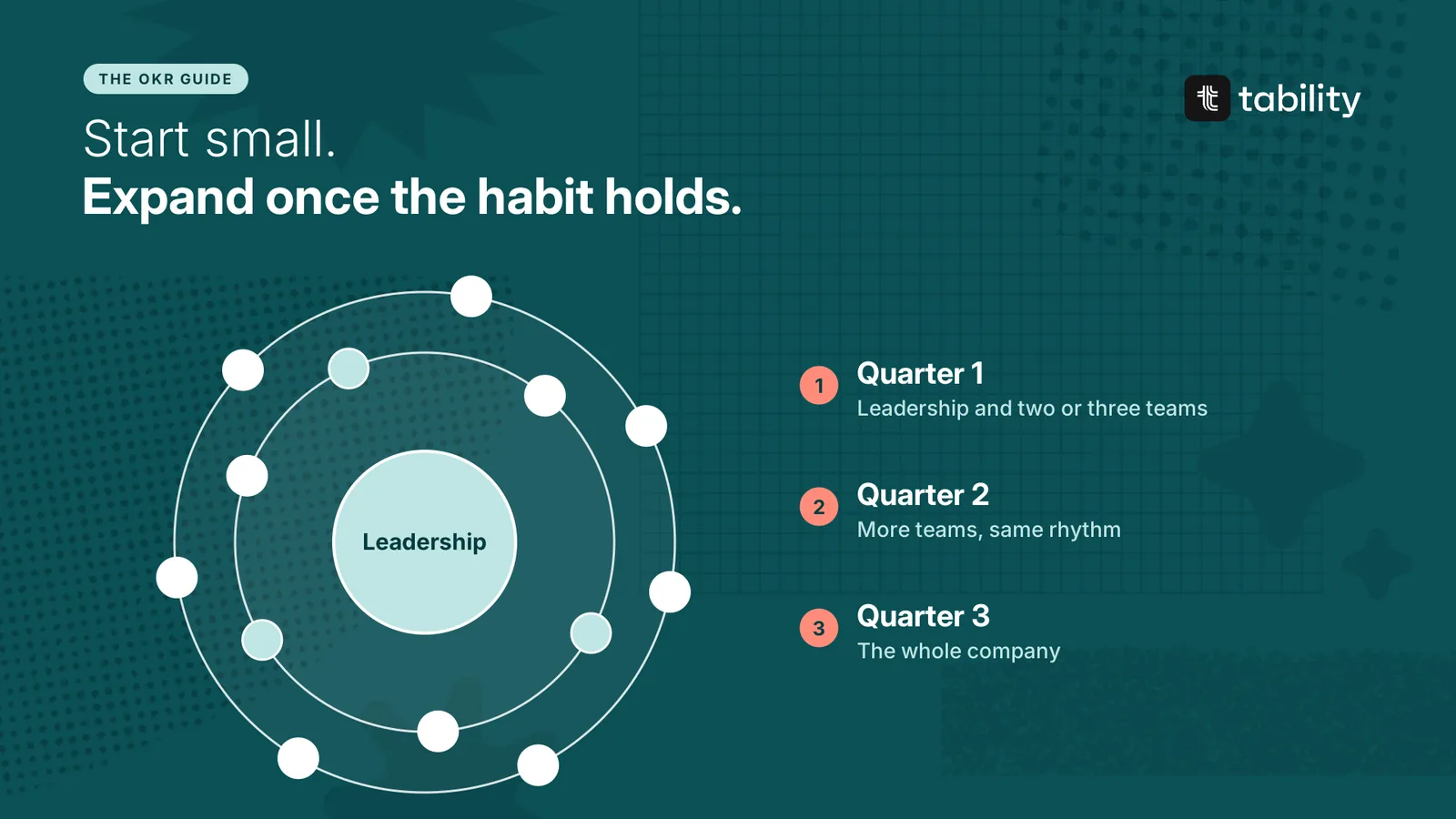
A pilot works because the first quarter is always messy. It is easier to be messy with thirty people than with three hundred, and the pilot teams become the people who explain it to everyone else.
What is an OKR champion?
An OKR champion is the person who keeps the process running. They do not write other people's goals and they are not accountable for the results. Their job is the rhythm:
-
Set the calendar for planning, check-ins and reviews
-
Help teams turn vague goals into measurable ones
-
Notice when updates stop and find out why
-
Keep the rules consistent across teams
-
Collect what went wrong and adjust the process each quarter
In a company of fifty, this takes a few hours a week and usually sits with a chief of staff, an operations lead or a founder. Past a few hundred people, add a champion in each department and keep one person coordinating.
Where are you starting from?
Teams move through four stages on the way to working with outcomes. Know which one you are in, and aim for the next one.
-
No shared goals. Work is driven by requests and roadmaps.
-
Goals without measures. You have priorities, but no agreed way to tell if they were met.
-
Measured goals, not tracked. Objectives and Key Results exist and are looked at once a quarter.
-
Goals tracked every week. Progress is visible, problems surface early, and plans change because of what the numbers show.
Most companies starting with OKRs are at stage one or two. The first quarter should get you to stage three and build the habit that leads to stage four. Trying to jump from one to four in a single quarter is how rollouts collapse.
The first-quarter timeline
Here are the OKR implementation steps, week by week.
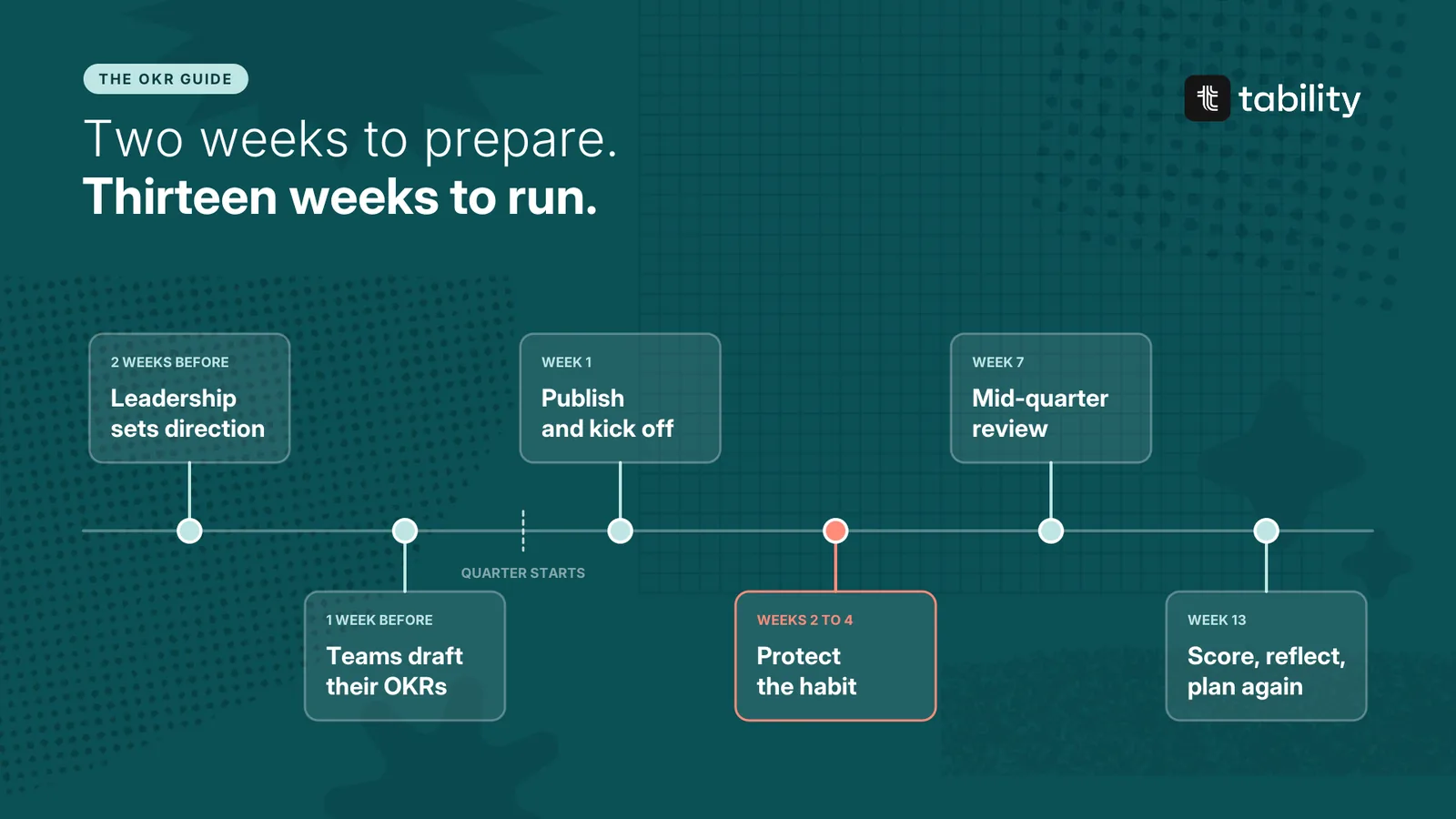
Two weeks before the quarter: leadership sets direction. A two-hour session. Write the long-term view in a paragraph, then pick two or three company Objectives for the year and what they mean for this quarter. The method is in the OKR process.
One week before: teams draft. Each team writes up to three Objectives with two to four Key Results. Hold one session where teams read each other's drafts. You are checking that the goals point the same way. Wording can be fixed later. If you are stuck on a blank page, start from the OKR Starter Kit or the OKR templates.
Week 1: publish and kick off. Put the OKRs where everyone can see them. Name one owner per Key Result. Pick the check-in day. Connect your data sources where you can, so the numbers stay current.
Weeks 2 to 4: protect the habit. This is the stretch that decides whether the rollout survives. Every Key Result gets an update every week, and every team holds its review. The champion chases the gaps. You will find Key Results that turn out to be unmeasurable or badly worded. Fix them now. In your first quarter, editing a goal in the first three weeks is fine. After that, leave them alone.
Week 7: mid-quarter review. Leadership and team leads look at everything that is at risk. Drop initiatives that are not moving their Key Result and start new ones.
Weeks 8 to 12: keep going. The novelty has worn off, which makes this the real test. Start a list of what you would do differently.
Week 13: score, reflect, plan again. Score each Key Result, run a retrospective, and use what you learned to write the next set.
What to expect from your first quarter
Your first set of OKRs will be wrong. Some will be too vague, some will be projects in disguise, and you will have too many. That is normal, and it is not what you are being graded on.
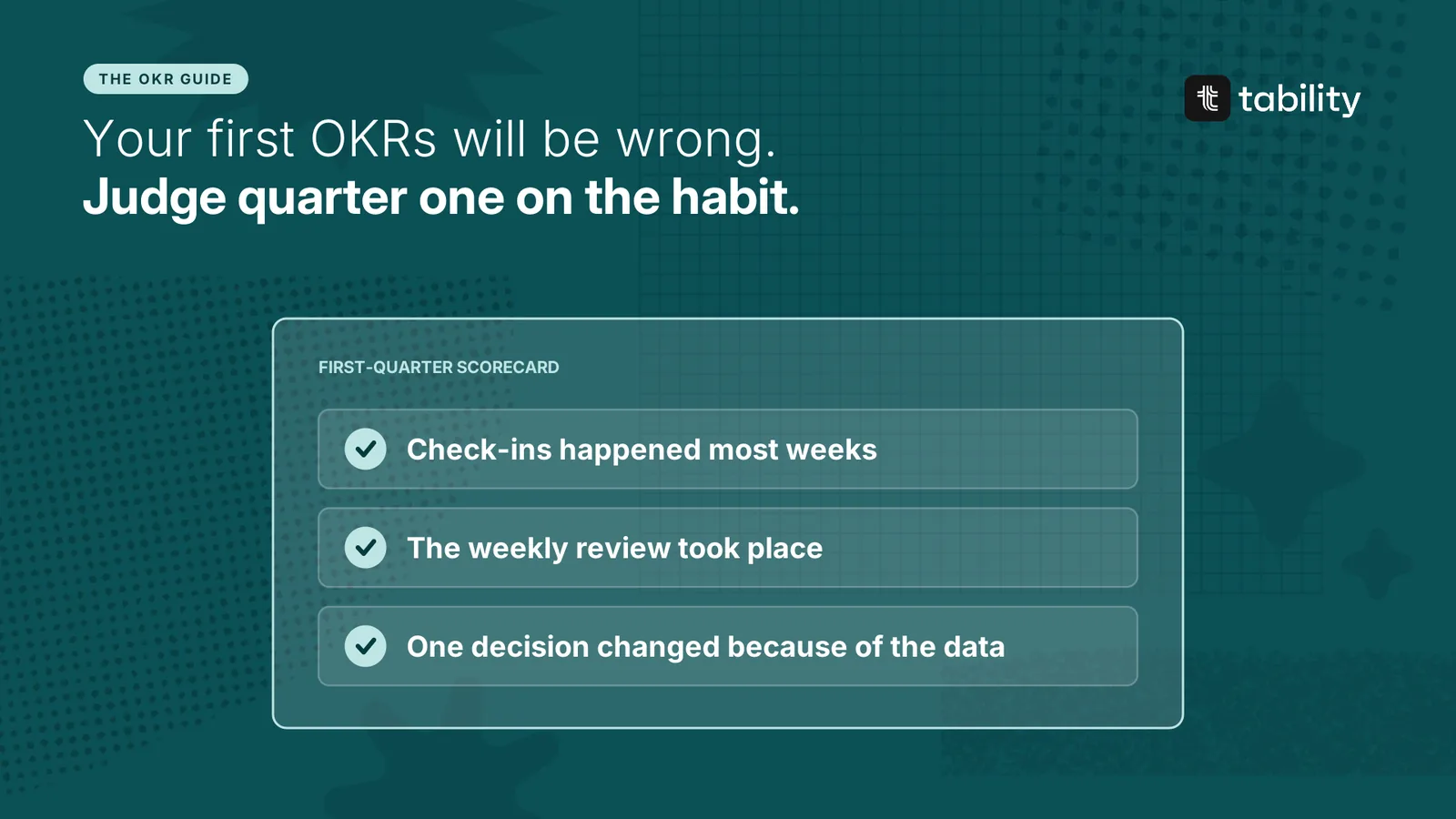
Judge the first quarter on three things:
-
Check-ins happened most weeks. If updates were written in at least eight weeks out of ten, the habit is forming.
-
The weekly review took place. Fifteen minutes, on the calendar, with the team.
-
At least one decision changed because of the data. A project stopped, a priority moved, a problem caught early. One is enough to prove the system works.
If you get those three, quarter two will take care of the quality of the goals.
Mistakes that sink an OKR rollout
Leadership does not use them. If the leadership meeting never opens the OKRs, everyone learns that they do not matter. This is the most common cause of failure.
Too many goals. Eight Objectives per team means no priorities. Hold the line at three.
Tying OKRs to bonuses. People will set targets they are sure to hit and stop reporting bad news.
Cascading from the top. Handing each team a slice of the company goal removes their judgement and stalls everyone below the first delay. Let teams write their own, then align them.
Individual OKRs. They become task lists. Stop at team level.
Set and forget. OKRs with no weekly check-in are a planning document. See the weekly ritual.
Writing updates nobody reads. Check-ins only work if someone looks at them. Keep the weekly review, read the updates beforehand, and act on what they show.
How to implement OKRs at scale
The process is the same in a company of five thousand as in a company of fifty. Four things need more care as you grow.
-
One rhythm for everyone. Same quarter dates, same check-in day, same scoring scale. Teams can differ in their goals, never in the calendar.
-
Champions in each department. One coordinator cannot coach forty teams.
-
Visible dependencies. Once teams rely on each other's goals, you need a way to see those links and the risks that travel along them.
-
Leadership reviews by exception. Nobody can read four hundred Key Results. The monthly review should surface only what is off track, which is another reason the weekly confidence update matters.
Expand in waves. Add a group of teams each quarter, and let each wave learn from the one before.
Do you need OKR software?
Not on day one. A shared document is enough for one team trying OKRs for one quarter.
You will outgrow it as soon as several teams are involved, because a document cannot remind people, draft updates from your data, show trends or tell a leader which five Key Results need attention. Those are the things that keep the habit alive. When you get there, our guide to the best OKR software compares the options, and Tability is built around the weekly check-in described in this guide.
Questions about implementing OKRs
How long does it take to implement OKRs? Two weeks to prepare and one quarter to run your first cycle. Expect two or three quarters before the goals themselves are consistently good.
Should we pilot OKRs or roll out to everyone? Under 50 people, roll out to everyone. Above that, pilot with leadership and two or three teams for one quarter.
Who should own the OKR process? An OKR champion, usually someone in operations or a chief of staff. Each Key Result still has its own owner in the team.
What is the biggest reason OKR implementations fail? The goals stop being looked at. Leadership does not use them and nobody checks in weekly.
Can we start mid-quarter? Yes. Run a short first cycle to the end of the current quarter and treat it as practice.