

If you're here, you probably want two things: a clear way to set team goals that don't go stale, and examples you can actually steal. This guide gives you both.
What makes a good team goal?
Team goals are shared outcomes a group of people commits to achieving together within a defined timeframe. They sit between company-level strategy and individual responsibilities helping you translate "where the business is going" into "what our team will deliver in the next quarter."
A good team goal has three things:
- A clear outcome (not just an activity)
- A measurable target
- A deadline
"Improve onboarding" is technically a goal, but it lacks the quality required to make it usable by a team. The context and scope are vague and the team will struggle to know where to start. A better way to write that goal would be:
"Reduce time-to-first-value for new customers from 14 days to 7 days by end of Q3".
Now we know exactly what we need to tackle, and it’ll be much easier to find the right initiatives for it.
ℹ️ Tip: Use the SMART goal setting method for a fool-proof way to write goals like this.
The difference matters because vague goals quietly let everyone off the hook. Specific ones force a conversation about tradeoffs, ownership, and what you'll actually stop doing.
Why team goals matter (beyond the obvious)
The usual answer is "alignment". That's true, but it understates the case. Here's what well-set team goals actually do:
They surface disagreements early. When you write a goal down with a number attached, you find out fast whether the team agrees on what success looks like. That conversation is uncomfortable in week 1 and catastrophic in week 10.
They make priorities visible. Most teams aren't slow because they're lazy. They're slow because they're trying to do nine things at once. A short list of team goals tells everyone what to say no to.
They turn strategy into something you can check on weekly. A visionary keynote is great for motivation, but it won’t help an engineer decide what to ship on Tuesday. Team goals help define success more precisely.
How to set team goals: a 5-step framework
Here's the process we'd recommend, and what most teams actually do at each step.
1. Start from a company outcome, not a team activity
Before writing a single team goal, look at what the business is trying to achieve this quarter. If your company is trying to expand into a new segment, your team's goals should ladder up to that – not just continue what you were doing last quarter.
The simplest test: can you write a sentence that connects your team goal to a company priority in under 20 words? If you can't, the goal isn't ready.
2. Limit yourself to 3-5 goals per team
This is the part teams resist most. 5 goals might feel too few when you have 12 things you "must" achieve.
But, every additional goal dilutes the others. Teams with 12 goals don't accomplish 12 things; they accomplish 3 things badly and 9 things partially. Saying no is hard, but you must reduce the surface area to the things that will make the quarter feel like a success.
3. Write each goal as an outcome, with a measurable target
Use this structure:
change [metric] from [current state] to [target state] by [date].
Examples:
- Increase activation rate from 38% to 50% by end of Q3
- Reduce average ticket resolution time from 48 hours to 24 hours by July 31
- Grow qualified pipeline from $1.2M to $2M by quarter-end
If you can't put a number on it, the goal isn't testable, and untestable goals never trigger the right course corrections.
4. Assign one owner per goal
Shared ownership sounds collaborative. In practice, it means nobody owns it.
Each team goal needs one person whose job it is to track progress, raise blockers, and make the call on tradeoffs. The team contributes but the owner is accountable. This is the single biggest fix for goals that drift.
5. Check in every week (for real)
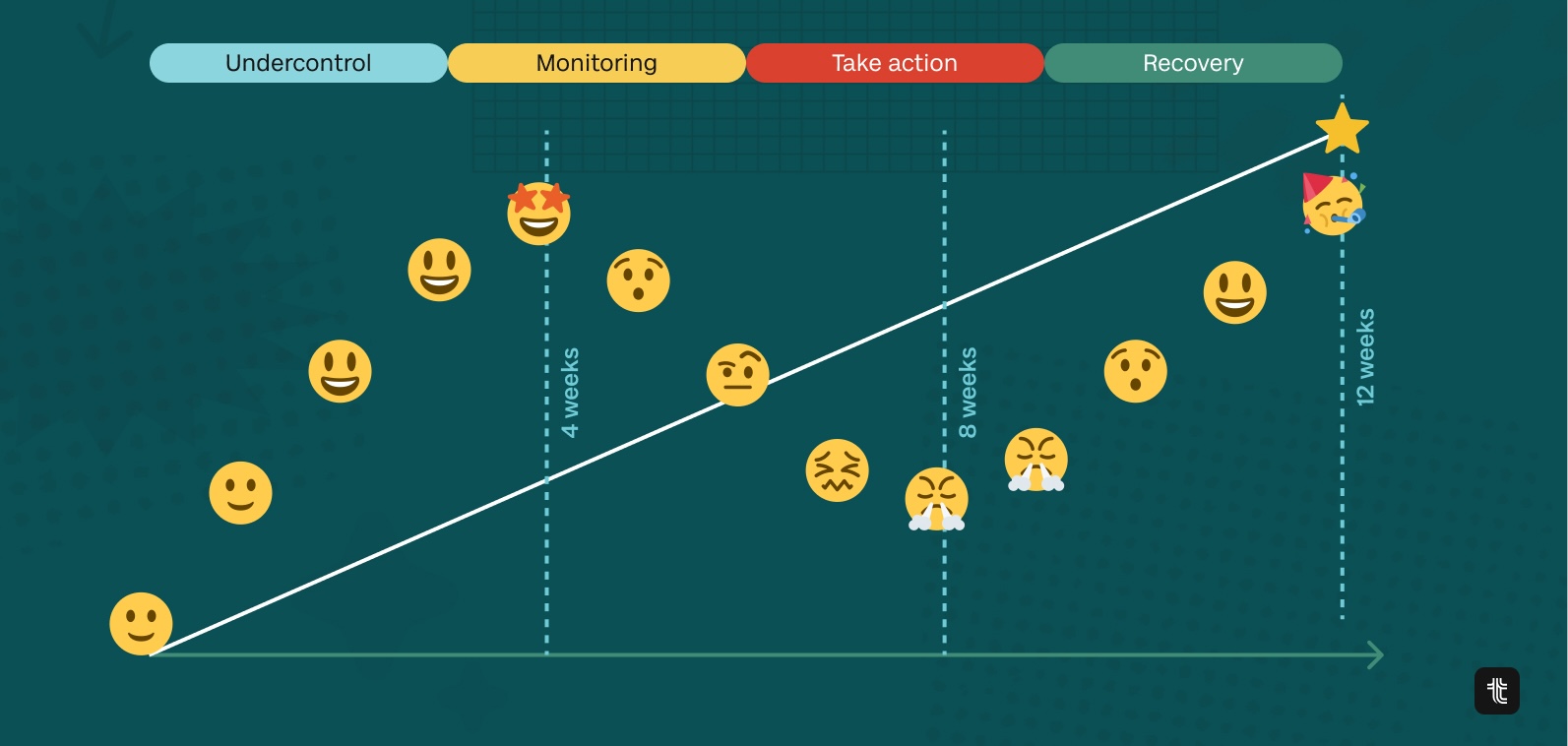
Quarterly review meetings are too late. By week four, you either know the goal is on track or you don't, and waiting six more weeks to find out is how the quarter slips away.
A weekly check-in, coupled with a 30min review meeting, will catch problems while you can still do something about them. Momentum beats accuracy. A team that discusses progress on its goals 10+ times in a quarter ends up further ahead than one that only looks at them twice.
12 team goals examples by function
These are real-world team goals shaped like ones our customers actually run. Steal them, adapt the numbers to your context, and use them as a starting point.
Marketing team goals
- Increase MQL-to-SQL conversion rate from 18% to 28% by end of Q3 (owned by demand gen lead)
- Grow organic traffic to high-intent pages from 12K to 25K monthly visits by December 31 (owned by SEO lead)
- Launch 2 new product positioning experiments and validate which moves intent score by 10+ points (owned by brand lead)
Sales team goals
- Increase win rate on qualified opportunities from 22% to 30% by quarter-end (owned by sales manager)
- Reduce average sales cycle for SMB segment from 32 days to 21 days by Q3 (owned by SMB team lead)
- Generate $850K in new pipeline from outbound by end of Q2 (owned by SDR manager)
Product team goals
- Ship the new onboarding flow and improve activation rate from 38% to 52% by end of Q3 (owned by PM, onboarding)
- Reduce time-to-first-value from 14 days to 7 days for new self-serve signups by July (owned by PM, growth)
Engineering team goals
- Reduce P1 incident frequency from 4 per month to under 1 per month by Q4 (owned by platform tech lead)
- Cut average API response time from 480ms to 200ms by end of Q3 (owned by backend lead)
Customer success team goals
- Increase 6-month retention rate from 84% to 90% by year-end (owned by head of CS)
- Reduce churn risk score across the top 50 accounts by 30% by Q3 (owned by CS team lead)
Common mistakes that quietly kill team goals
Here are a few bad patterns we see over and over.
Confusing activities with outcomes
"Launch the new feature" is an activity. "Get 500 customers using the new feature within 30 days of launch" is an outcome. Activities feel productive but don't tell you whether the work mattered.
Writing goals you already know you'll hit
If everyone on the team is confident the goal will be achieved on day one, the goal is too easy. A good team goal should feel slightly uncomfortable, somewhere between 60% and 80% confidence.
Letting goals go stale
This is the most common failure mode. A team writes great goals in January, the world changes by March, and the team keeps reporting against goals nobody believes in anymore. Update them. That's not failure, that's the system working.
Mixing team and individual goals
Individual performance goals (career development, skill-building) are important but they don't belong on the team goal list. Keep team goals focused on outcomes the team owns together.
How to track team goals without making it a chore
The fastest way to kill team goals is to make tracking them a 90-minute Friday ritual nobody wants to do.
What works instead is a lightweight weekly habit: each goal owner posts a short update. A one-sentence status, a number, a confidence score, somewhere visible to the team. No slides, no narrative, no theater. Just enough signal to know whether the goal is on track, at risk, or off track.
.jpg)
This is exactly what Tability is built for. A goal-tracking software designed around a weekly check-in habit, not quarterly review theater. Owners get a reminder, post a one-line update with a confidence rating, and the whole team can see where every goal stands in under a minute. No dashboards to maintain, no Monday spreadsheet wrangling.
The teams that get the most out of team goals aren't the ones that write the most elegant ones. They're the ones that revisit them often, adjust without drama, and treat goal-setting as a habit rather than an event.


.jpg)
.png)