

Most lean canvas content online is the same thing rehashed: nine boxes, a definition of each box, and a downloadable template. You fill it in over lunch, save the PDF, and never look at it again.
That is not the lean canvas failing. That is teams using it like a strategy doc when it is actually a hypothesis tracker. The whole point of the lean canvas is that it changes. If yours has not changed in six months, you are not using it. You are decorating it.
This guide walks through what a lean canvas actually is, what the nine boxes are really for, when to reach for it instead of the business model canvas, and the operating cadence that turns a one-page diagram into something a founding team uses every week.
The lean canvas, in plain terms
The lean canvas is a one-page business model designed for early-stage startups. Ash Maurya created it in 2010 as an adaptation of Alexander Osterwalder's business model canvas, with a sharper focus on problems, risk, and assumptions.
Where the business model canvas asks: 'how does an existing business work?', the lean canvas asks: 'is this new business idea worth pursuing?' Same nine-box layout, very different questions.
Four boxes are different from the original business model canvas. The lean canvas replaces 'key partners' with 'problem', 'key activities' with 'solution', 'key resources' with 'key metrics', and 'customer relationships' with 'unfair advantage'. Those four swaps tell you everything about its intent. It is not modelling an existing business. It is interrogating an unproven one.
Think of the business model canvas as a snapshot of a running engine. The lean canvas is a riskiness map. Each box is somewhere your idea might break.
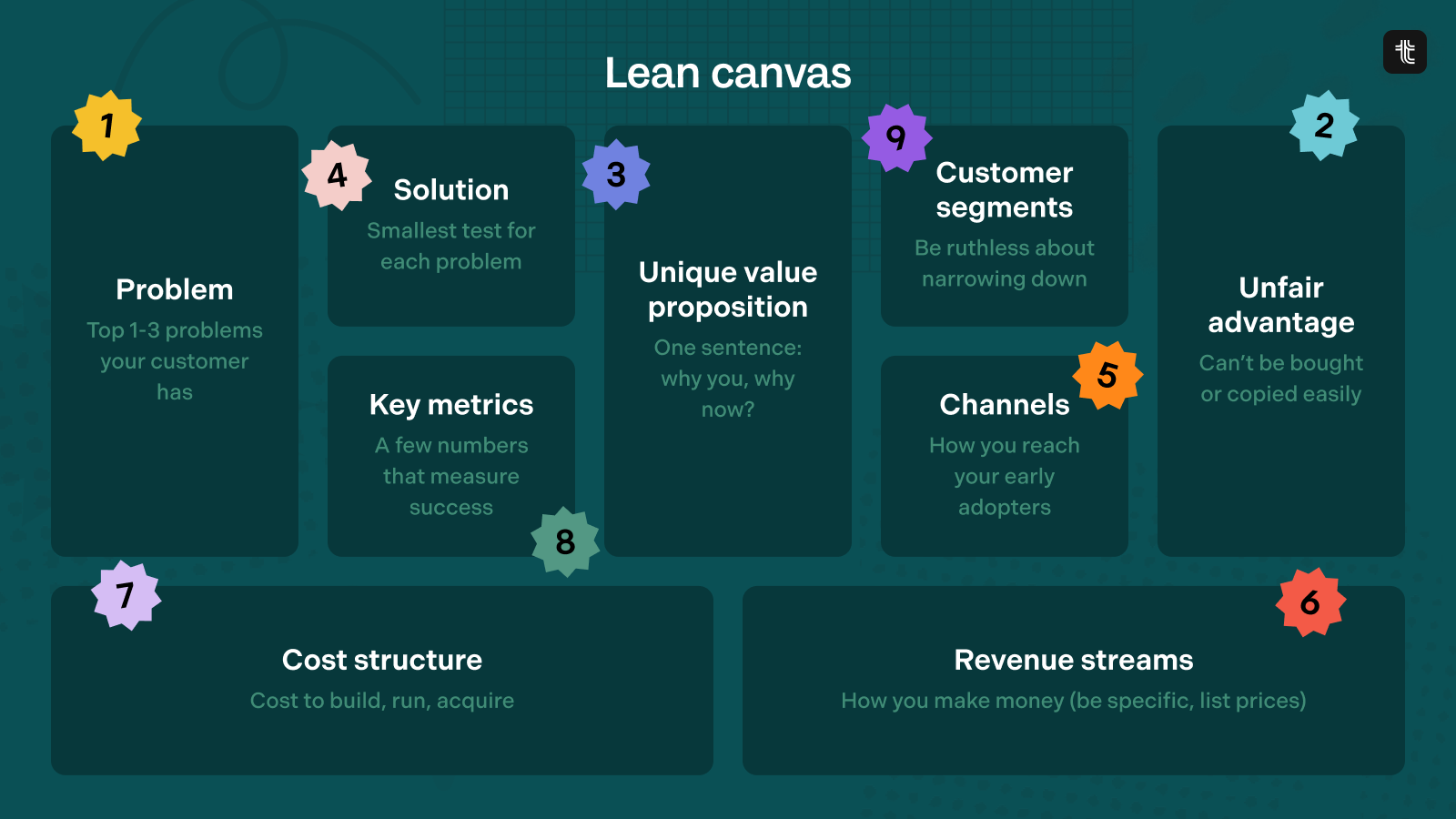
The nine boxes, and what each is really for
Every guide explains what goes in each box. Few explain what each box is for. Here is the operational read on all nine.
1. Problem
List the top 1 to 3 problems your target customer has. Be specific. 'Marketing is hard' is not a problem. 'Series A SaaS founders cannot tell which marketing channel is driving pipeline because attribution is broken across HubSpot and Mixpanel' is a problem.
Also note existing alternatives. What do people do today to solve this? If the answer is 'nothing', you do not have a market. You have a hobby.
2. Customer segments
Who has this problem? Be ruthless about narrowing. 'SMB founders' is not a segment. 'Bootstrapped B2B SaaS founders with 10 to 50 employees in North America' is a segment. The narrower you are, the easier everything downstream becomes.
Split out early adopters from the broader market. Early adopters feel the pain now, badly enough to try something half-finished. Everyone else is interesting later.
3. Unique value proposition
One sentence. Why your solution is different, and worth paying attention to. The test: can a target customer read it and instantly know whether it applies to them? If not, it is too vague.
Avoid feature lists. 'AI-powered analytics platform' tells me nothing. 'Replace your six-tool reporting stack with a single dashboard your CEO will actually open' is a UVP.
4. Solution
For each problem, the minimum thing you would build to test whether the problem is real. Not the full product. The smallest possible test. This box is deliberately tight because the lean canvas wants you to commit to as little as possible until you have learned something.
5. Channels
How you reach your early adopters. Free and paid. Be honest: if you do not have a way to get in front of your target customer, the rest of the canvas is theoretical. Channels are usually the most under-thought box in a first-draft canvas.
6. Revenue streams
How you make money. List specific prices, not 'subscription model'. If you do not know the price yet, write your best guess and label it as an assumption. Half the lean canvas is naming your assumptions out loud.
7. Cost structure
What it costs to build, run, and acquire. Customer acquisition cost is the line that matters most. If you cannot estimate it within an order of magnitude, that is the riskiest assumption in your business.
8. Key metrics
The handful of numbers that tell you whether the business is working. Pirate metrics (acquisition, activation, retention, revenue, referral) are a fine default. Pick the one or two that matter most at your stage. Most early-stage teams obsess over the wrong metric (vanity traffic) and ignore the one that matters (activation rate).
Worth pairing this thinking with leading and lagging indicators. Pick at least one leading indicator you can move this week.
9. Unfair advantage
What you have that competitors cannot easily copy. The Ash Maurya test: if a competitor could replicate it with money or time, it is not an unfair advantage. Real unfair advantages are usually intangible: a community, a personal network, deep insider knowledge, an exclusive deal, a patent that actually matters.
Most first-draft lean canvases leave this box empty. That is fine. It is one of the hardest boxes to fill honestly.
Lean canvas vs business model canvas: when to use which
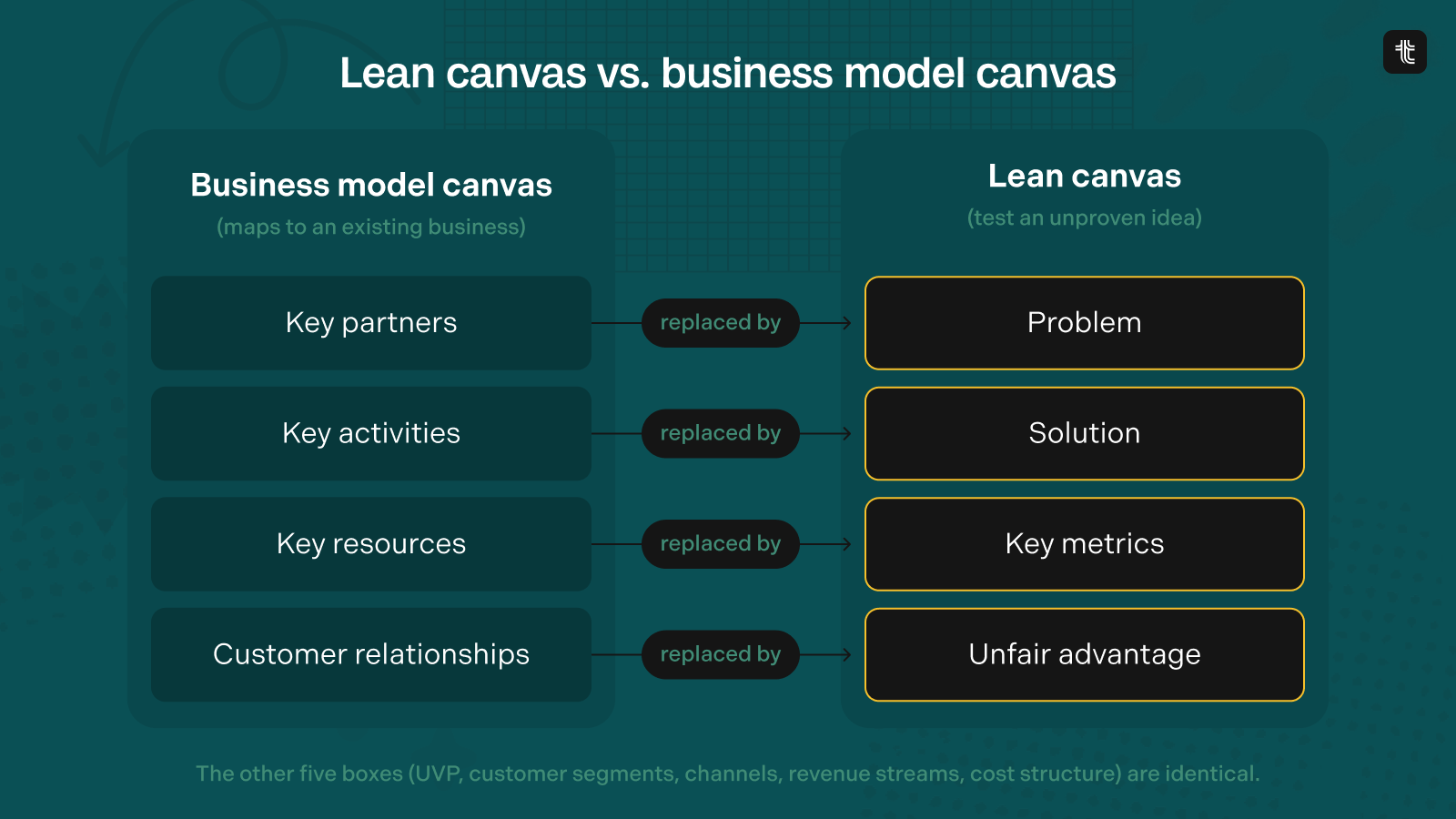
This comes up constantly. Here is the short version.
Use the lean canvas when you are pre-product, pre-PMF, or testing a new product line inside a larger company. You have more assumptions than facts. You need to find out what is real before you commit resources.
Use the business model canvas when you have a running business and you want to map how it operates. Partnerships, supply chains, established customer relationships. You are modelling reality, not testing a hypothesis.
Some teams maintain both. The lean canvas tracks the riskiest new bet. The business model canvas describes the core business. That is a fine setup if you can be disciplined about not letting the two collapse into one document.
If you are still deciding which to start with, the lean canvas is almost always the right first move. It forces honesty about what you do not know. The business model canvas can let you describe a business you do not actually have yet.
The mistake most teams make
To be frank, the most common mistake is treating the lean canvas as a deliverable. The team holds a workshop, fills in nine boxes, exports a PDF, sends it to the board, and considers the exercise complete. Three months later, the canvas is stale, the assumptions inside it have been quietly invalidated, and nobody has updated the document.
The lean canvas is not a deliverable. It is a working document. The first version you fill in is wrong. That is the entire design. Each box is a hypothesis you are committing to test. The act of filling in the canvas is not the work. The work is what comes after, when you take each assumption and figure out how to validate it.
If you cannot point to a specific thing that changed on your canvas in the last month, you have stopped using it.
Other common failure modes:
- Filling it in alone. The canvas works because it surfaces disagreement. Founder, head of product, and head of sales each have a different picture of who the customer is. Filling boxes together exposes that. Filling alone hides it.
- Skipping the problem box. Teams in love with their solution jump straight to box 3. The solution-first canvas is just a feature list with extra steps.
- Confusing 'unique value prop' with marketing copy. The UVP is for you, to test whether the offer is real. The website tagline can be different.
- Putting 'best in class' or 'AI-powered' in the unfair advantage box. Those are not advantages. Those are adjectives.
- Never showing it to a customer. Every box on a lean canvas is a guess about a real person. If you have not run the guesses past three to five real customers in your target segment, the canvas is unfalsified, which is worse than wrong.
How to turn a lean canvas into an operating system
A canvas that just sits in Notion is a poster. A canvas that drives weekly decisions is an operating system. Turning one into the other takes a deliberate cadence. This is the bit most lean canvas content skips, and it is where teams either get value or quietly abandon the practice.
Here is a five-step cadence that works.
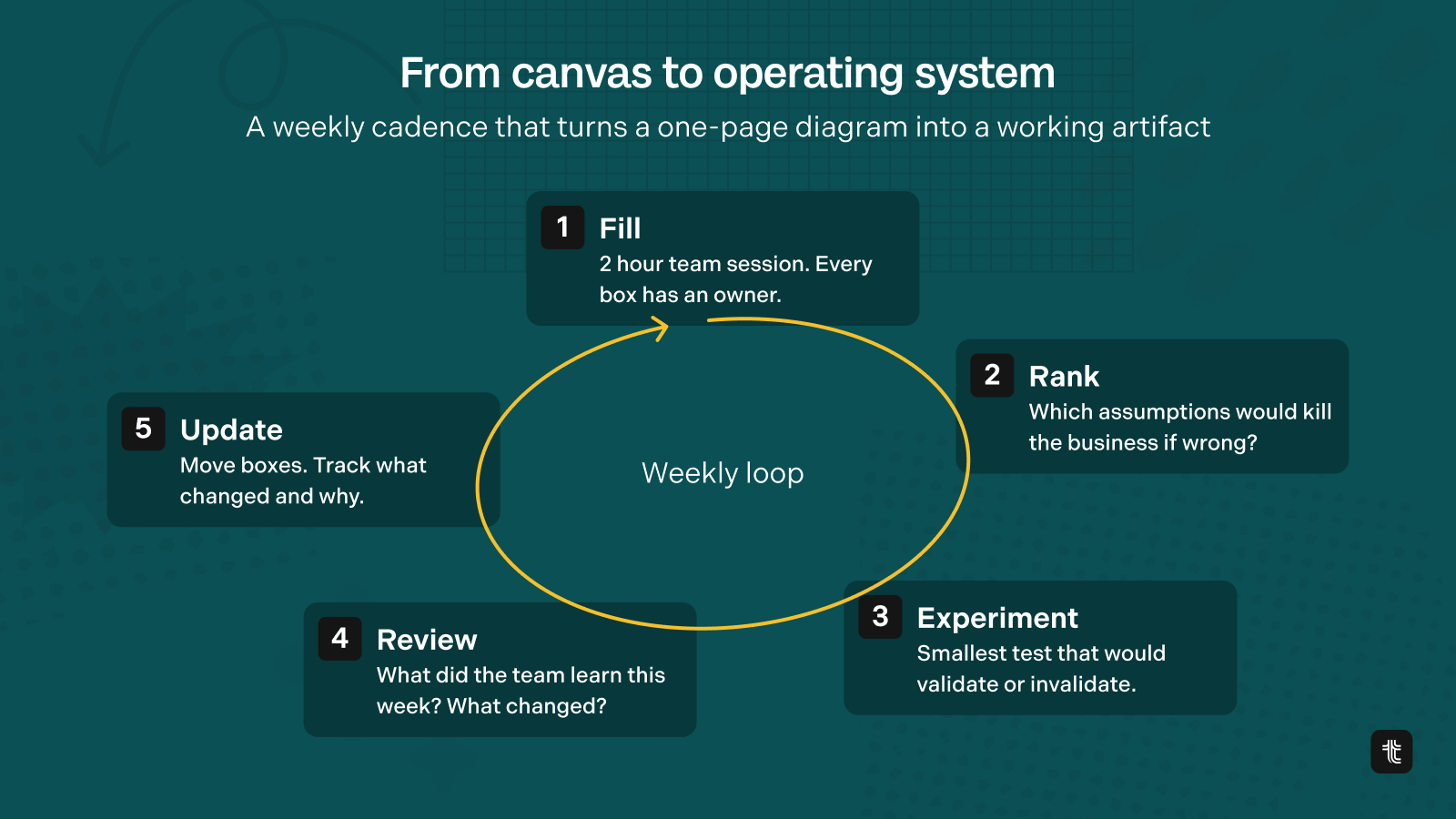
- Fill the canvas as a team. Two-hour working session. Founders, head of product, head of GTM if you have one. Every box has the name of the person who owns it written next to it. No owner means no accountability.
- Rank assumptions by risk. Not every box is equally important. Walk through each one and ask: 'if this is wrong, does the business die?' The boxes that get a 'yes' are your top assumptions. Most teams find three to four genuine 'business-dies' assumptions.
- Design experiments. For each top-risk assumption, write down the smallest test that would either invalidate it or build confidence. 'Talk to 10 target customers about the problem' is a fine first test. 'Build an MVP' is rarely the first test.
- Run a weekly review. Pull the canvas up every week. Walk through the top three assumptions. What did we learn? What changed? Does any box need to move? This is the discipline that separates teams who use the canvas from teams who decorate it.
- Update the canvas in public. Every change to the canvas should be visible to the team. Track what changed, why, and which experiment caused it. Over time, this becomes the most useful artefact of the early-stage business: a history of what you believed, what you learned, and what you changed your mind about.
This cadence is exactly the work that strategic operations owns inside larger companies. At a startup, the founders own it directly. Either way, the rhythm is what makes the canvas valuable.
If your team already runs OKRs, the lean canvas plugs into the same cadence. The canvas tells you what you are testing this quarter. The OKR framework tells you how to measure whether it is working. The weekly check-ins are when both get updated together.
ℹ️If you’re a startup looking to adopt OKRs, see our best OKR software list to see what tools can be best for your adoption.
Where Tability fits
The lean canvas is the diagnosis. The work after it is the part teams need help with: turning each assumption into an experiment, assigning it to someone, tracking what was learned, and updating the canvas based on the result.
Tools like Tability are designed for that loop. Each assumption becomes an outcome you can score from 0 to 100 based on confidence. Each experiment becomes an initiative with an owner. The weekly check-in is built in. The canvas stops being a stale PDF and starts being a live read on where the business is, what you are testing, and what you have learned.
This is the difference between teams that say 'we ran the lean canvas exercise once' and teams that say 'the lean canvas is how we run this company'.
If you want a tool to track the experiments and run the weekly cadence around them, sign up for Tability (free to start) or book 30 minutes and we will help you wire up your lean canvas to a weekly operating rhythm.

.jpg)

.png)