
Most vision statements are written once, printed on a poster, and never looked at again. Ask five people at the same company what their vision statement actually says and you’ll usually get five different, vague answers involving the words “innovative”, “world-class” and “synergy”. That’s not a vision problem. That’s a usage problem.
A good vision statement is short enough to remember and specific enough to argue with. If nobody could ever disagree with it, it’s not doing its job. This guide covers what a vision statement actually is, how long it should be (the real answer, not “as long as you need”), a handful of examples worth stealing from, and how to write one that survives contact with a Monday morning.
What is a vision statement?
A vision statement is a short description of what your company is trying to become, usually over a 3 to 10 year horizon. It answers one question: if everything goes right, what does the world look like?
It’s easy to confuse with a mission statement, so here’s the quick distinction: the mission is what you do today, the vision is what you’re building toward. Coca-Cola’s mission is about refreshing the world right now. Its vision is the future state that mission is meant to produce. We’ve written a full breakdown of the difference in our vision vs mission statement guide if you want the longer version.
For this article, we’re focused purely on the vision side: what it should say, how long it should be, and what makes one actually useful instead of decorative.
How long should a vision statement be?
One sentence. Two at most.
If your vision statement needs a paragraph to explain, it’s not a vision statement, it’s a strategy document wearing a vision statement’s name tag. The best ones are short enough that someone could repeat them back after hearing them once:
- Amazon: “To be Earth’s most customer-centric company.”
- IKEA: “To create a better everyday life for the many people.”
- Tesla: “To accelerate the world’s transition to sustainable energy.”
Each of these is under 15 words. None of them explain how. That’s intentional. The vision names the destination. The strategy, the OKRs, and the roadmap are what explain the how, and they change far more often than the vision does.
If you’re staring at a draft that’s ballooned into three sentences, that’s a sign you’re trying to cram strategy into a vision statement. Cut it back to the single sentence that survives, and move the rest into your strategic pillars or your next planning cycle.
Vision statement examples worth studying
Generic “become the global leader in X” statements are everywhere, and they’re forgettable because they could apply to literally any competitor in the category. The examples that hold up share one trait: they’re specific enough that a competitor couldn’t credibly copy and paste them.
A few worth studying:
- Patagonia: “We’re in business to save our home planet.” Specific stance, no hedging.
- LinkedIn: “Create economic opportunity for every member of the global workforce.” Names who benefits, not just what the company does.
- Nike: “Bring inspiration and innovation to every athlete in the world.” Then defines “athlete” broadly enough to include, in their words, anyone with a body.
Notice none of these mention revenue, market share, or being “the best”. Being the best is a comparison to competitors, and competitors change. A real vision describes a future state that would still make sense even if every competitor disappeared tomorrow.
Why most vision statements fail
Three reasons, and they compound:
- They’re written by committee and diluted until nobody disagrees. A vision that offends nobody usually says nothing. If your leadership team can’t point to a decision the vision statement would rule out, it’s too vague.
- They’re set once and never revisited. A vision written five years ago for a 20-person company rarely still fits at 200 people. Nobody schedules time to check.
- Nothing downstream connects to them. This is the big one. The vision sits in the onboarding deck, and the actual quarterly goals get set in a completely separate conversation that never references it. When there’s no link between the vision and what people are working on this quarter, the vision might as well not exist.
That third failure mode is the one worth fixing, because it’s the one within your control.
How to write a vision statement in 5 steps
- Start with the change, not the company. Don’t write “we will become the leading provider of X.” Write the change in the world you’re trying to cause. Providers come and go; the change is the point.
- Write ten drafts, then cut nine. Get the full, messy version out first. Then ruthlessly cut until you’re left with the sentence that still holds up without the other nine.
- Test it against a real decision. Take a genuine trade-off your company is facing right now. Would your draft vision statement help someone make that call? If it wouldn’t change anyone’s decision either way, keep cutting.
- Remove anything a competitor could say word for word. If a rival could paste your vision onto their own website with zero edits, it’s not specific enough yet.
- Set a review date, not a review someday. Put an actual date on the calendar, ideally tied to your annual planning cycle, to revisit whether the vision still fits.
The pattern in step 4 is easier to feel side by side:
Turning your vision statement into something that actually gets used
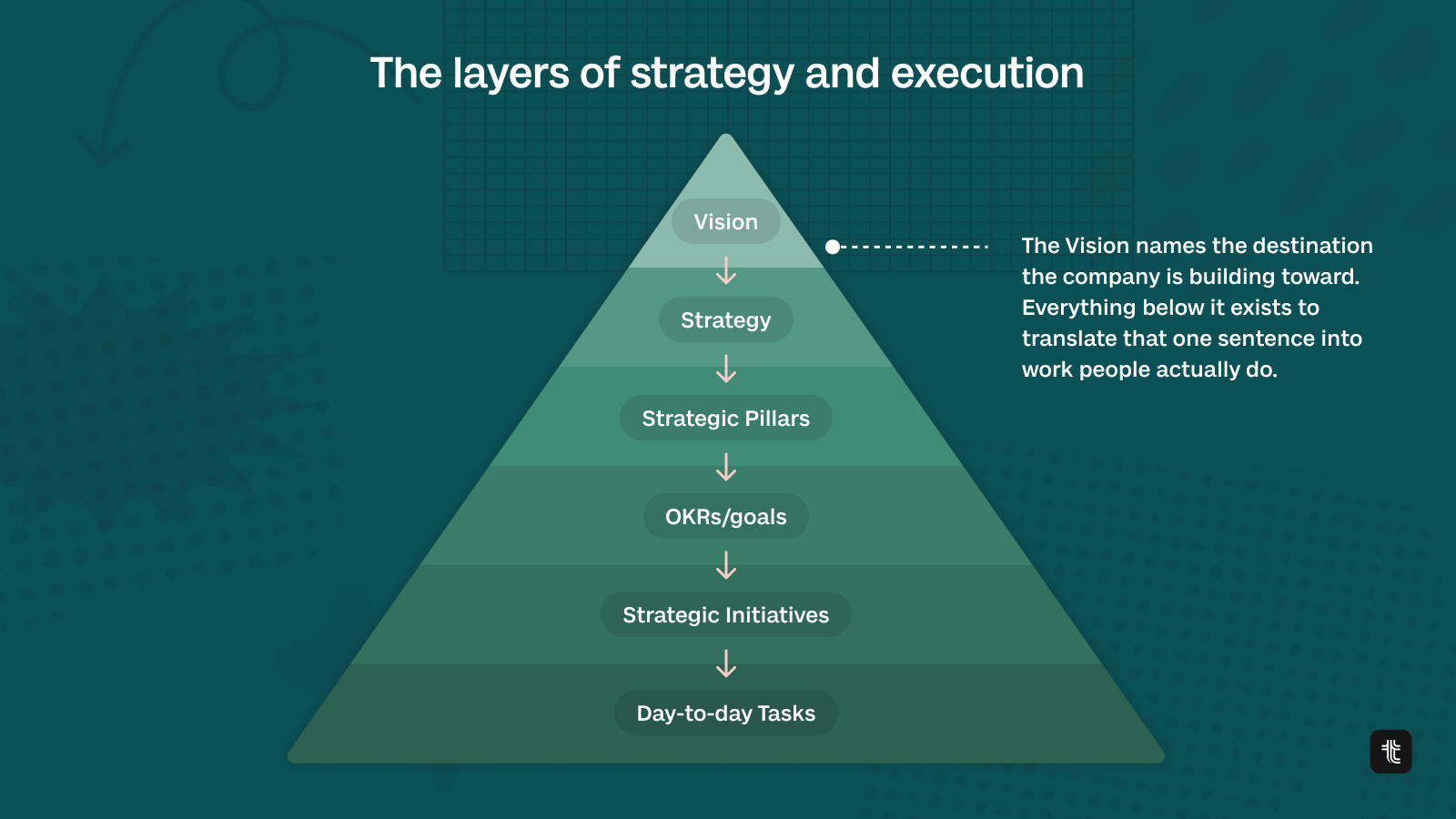
A vision statement written once a year and referenced never is a wasted exercise. The gap between having a vision and living by it gets closed with an operating cadence: the vision sets the direction, strategic pillars break it into a handful of multi-year themes, and OKRs translate those themes into what your teams are actually accountable for this quarter. Without that chain, the vision stays a poster. With it, someone reviewing this quarter’s key results can trace a straight line back to the one-sentence future the company is building toward.
Zoomed out, it’s the same cascade as our strategic pillars guide: Vision → Strategy → Pillars → OKRs/goals → Initiatives → Day-to-day tasks.
This is exactly the kind of connective work that StratOps exists to own: making sure the vision, the strategy, and the quarterly goals are actually talking to each other instead of living in separate documents that nobody cross-references. Tools like Tability are built for this, giving teams a single place to hold the vision, cascade it into OKRs, and run the check-ins that keep the connection alive quarter over quarter.
If your vision statement currently lives in a slide nobody has opened since the offsite, that’s worth fixing before you write a new one. Sign up for Tability or book 30 minutes with us and we’ll help you connect your vision to the goals that are supposed to be chasing it.


.jpg)
.png)