Search "AI agents for business" and you get the same page twelve times: a ranked list of platforms, each with a logo, a pricing tier and a paragraph that sounds suspiciously like the vendor's homepage. Useful if you already know what you want. Not so useful if you're still working out what an AI agent should actually do for your business.
That's the question most leaders are stuck on. Not "which tool?" but "which job?" The teams getting real value from AI agents didn't start with a platform comparison. They started with a goal they weren't hitting, and asked whether an agent could own part of it.
This guide takes that route. We'll cover what AI agents for business actually are, where they tend to pay off first, the three kinds of options on the market, and how to pick (and manage) your first one without ending up with a pile of half-used bots nobody owns.
What are AI agents for business?
An AI agent is software that works towards an outcome on its own. It plans steps, uses tools and acts without someone typing a prompt for every move. BCG's overview of AI agents describes them as able to "observe, plan, and act autonomously", which is a decent short version.
For business use, add one more requirement: accountability. An agent that runs on its own but reports to nobody isn't a teammate. It's a liability with API access.
Three things tend to get lumped together under the "agent" label, and they're not the same 👇
- Chatbot: answers questions when asked, and stops when the chat closes. (We've broken down chatbot vs AI agent in more detail.)
- Automation or workflow: runs a fixed sequence when something triggers it. It doesn't decide anything.
- AI agent: works towards a goal, decides its own next steps and reports back on progress.
If you want the deeper version, we've covered what makes autonomous AI agents actually autonomous separately. For this guide, the practical definition is enough: an AI agent for business is one you can hand a goal to, and hold accountable for it.
Where AI agents for business pay off first
The best early candidates share three traits. The work is recurring, the result is measurable, and a person currently spends hours on it that they'd rather spend elsewhere. Here's what that looks like across a typical business:
| Function | A good first agent goal | What it should report back |
|---|---|---|
| Marketing and SEO | Grow organic traffic to key pages by a set amount this quarter | Pages refreshed, rankings moved, traffic trend |
| Sales operations | Keep pipeline data clean and flag stalled deals every week | Deals flagged, records fixed, follow-ups triggered |
| Customer support | Cut first-response time on common ticket types | Tickets resolved, escalations, response time |
| Finance and operations | Have the weekly metrics pack ready before Monday | Report delivered, anomalies spotted |
| Strategy and planning | Keep goal check-ins current across every team | Missing updates chased, at-risk goals surfaced |
Notice that every row starts with a goal, not a task. "Write blog posts" is a task. "Increase organic traffic from $16K to $25K" is a goal, and it's the one Tability uses in its own worked example: an Agent Manager that recruited four specialists (a competitor-gap strategist, a decayed-page refresh analyst, a striking-distance rankings analyst and a technical SEO specialist) to go after it.
To be frank, this is where most roundups fall down. They sort agents by feature. Businesses need to sort them by outcome.
The three kinds of AI agents for business
Before you compare any tools, it helps to know that "AI agent platform" covers three quite different products. They're not really competing for the same job.
1. Agents built into tools you already use
CRMs, helpdesks and marketing platforms now ship their own agents. They're quick to switch on and they know their own data well. The catch is that each one only sees its own corner of the business, and reports inside its own tool.
Best for: a single, contained job inside one system, like triaging support tickets.
2. Agent builders and frameworks
No-code builders and developer frameworks let you design an agent from scratch: its steps, its tools, its prompts. Most "best AI agents for business" lists are really lists of these. They're powerful, and they're also a project. Someone has to build, maintain and monitor every agent you make.
Best for: teams with technical capacity who want full control over how an agent works.
3. Goal-owning agents managed like teammates
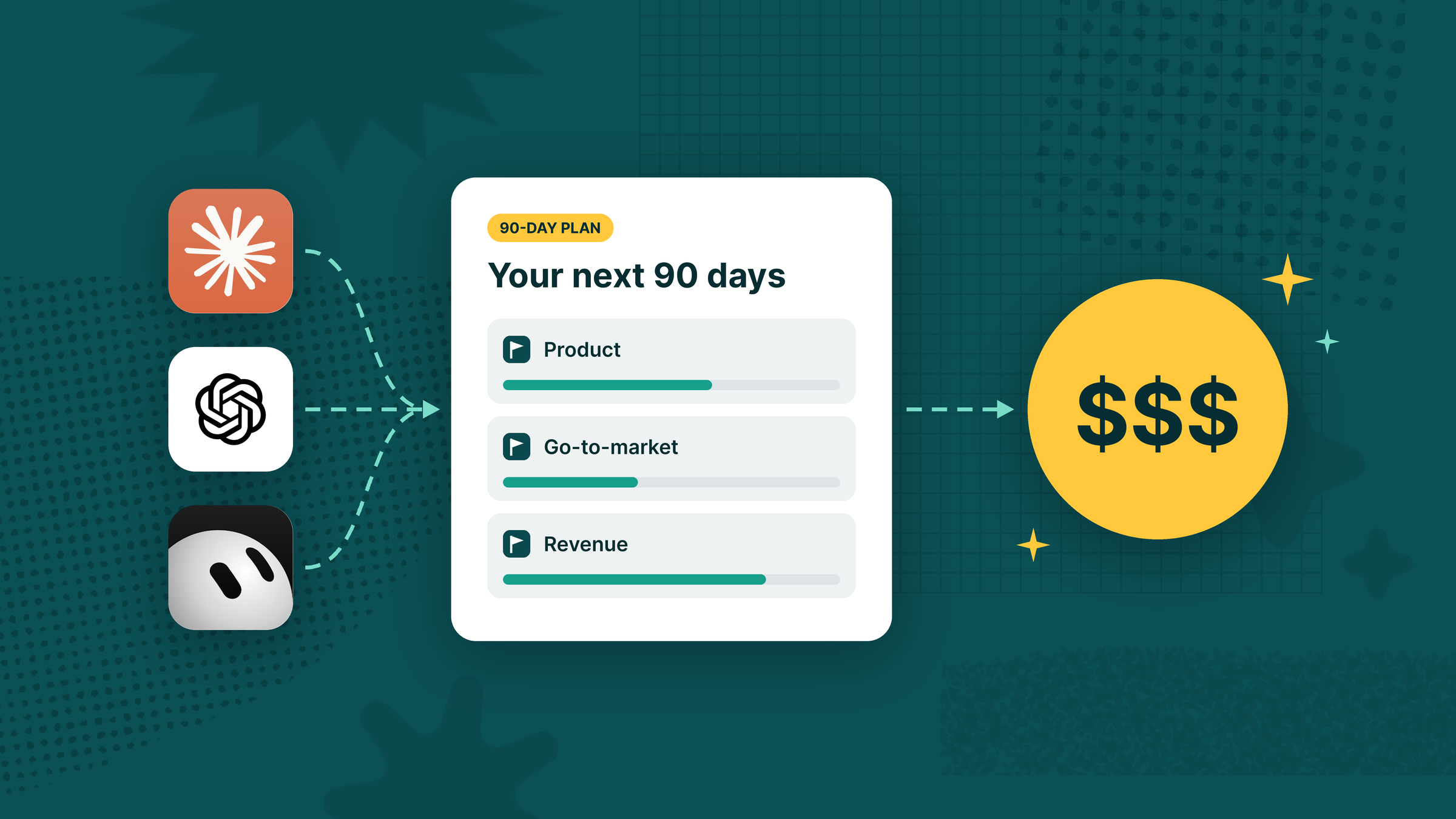
The newer category. Here the agent is built around a goal, has a seat in the org chart, reports progress through check-ins and can take direction from anyone on the team. The thinking happens in whichever model you prefer (Claude, OpenAI and others). The management layer is where it's held to account.
Best for: businesses that want agents working on real targets, with the same visibility they'd expect from a human hire.
Most businesses will end up using all three. The mistake is expecting the first two to give you the visibility of the third. If you're comparing specific products, our guide to AI agent software covers the four questions worth asking any vendor.
How to choose your first AI agent for business
You don't need a strategy offsite for this. You need one goal and a bit of discipline.
- Start from a goal you're already missing. Look at this quarter's OKRs. Which key result is off track because nobody has the hours? That's your candidate.
- Check it's measurable. If you can't say what "done" looks like as a number, the agent can't either, and you won't be able to tell whether it's worth what it costs.
- Give it a named owner. One person who reviews its updates and steers it. Not a committee.
- Set a reporting cadence. Weekly check-ins work for most goals. The agent should tell you what shipped, what's blocked and what's next, without you having to ask.
- Start small, then scale by goal. One agent, one goal, one quarter. If it works, add the next goal. Don't pile ten more agents onto the same one.
This is the same discipline good teams already apply to human work, and that's the point. If your business already runs a strategy-execution cadence through StratOps, agents slot straight into it. If it doesn't, adding agents will expose that gap very quickly.
The part most businesses skip: managing their AI agents
Here's the uncomfortable bit. Switching agents on is easy. Knowing what they're all doing six months later is not.
Without a management layer you get agent sprawl: overlapping bots, unclear owners and token bills nobody can tie to a result. We've written about how AI agents can quietly pull a company off strategy when nobody's steering. Three things are worth managing on purpose:
- Ownership: every agent has a goal and a person it answers to.
- Visibility: humans and agents in one place, so you can see who owns what and how it's tracking.
- Value: cost tied to results, so you know which agents are earning their keep and which ones aren't.
That's the whole case for AI workforce management as a discipline, and it matters more the bigger you get. Larger organisations have extra governance questions on top, which we cover in our guide to enterprise AI agents.
How Tability handles AI agents for business
This is where Tability comes in. Tability is an OKR platform, so it already handles the hard part of managing goals: owners, check-ins, dashboards and reporting. The Agent Manager extends that to AI agents.
Assign a goal to an Agent Manager and it breaks the goal into key results, recruits specialist agents for each part of the plan and rolls their progress into a status report. Anyone on the team can comment on an agent's check-in to steer it, even an agent they don't run themselves. The agents do their work through the models you already use, so you're not tied to a single vendor.
A couple of honest caveats. An Agency (an Agent Manager plus its team) is currently capped at six agents, one manager plus five specialists, while we learn how far this scales. And Tability isn't an agent builder. If you want to hand-code an agent's internals, you'll use a framework for that, then bring the agent into Tability to manage it.
We run a lot of our own marketing this way. The first draft of this article was written by Pablo, our SEO agent, working against a content goal in Tability and handing the draft to a human for review. If you're curious how far that goes, here's how our self-hiring agent teams work.
Start with one goal, not twelve platforms
The ranked lists will keep coming. Every month there'll be a new "best AI agents for business" roundup with a slightly different top three. Ignore them until you know which goal you're hiring for. Once you do, the choice gets a lot simpler, and you'll be able to tell within a quarter whether the agent was worth it.
If you want to see what a goal-owning agent looks like on your own targets, Tability is the easiest place to start. Sign up free or book 30 minutes with us and we'll help you pick the first goal worth handing over.

.jpg)
.png)