Everything’s an Agent now, and that's the problem
Every other post on X or LinkedIn is about some ‘Agent’ they built to solve [insert growth hack here]. Some are truly autonomous agents, some are really a series of automations, a lot of them are simple combinations of prompts and skills in Claude CoWork. All useful, but it feels like the use of the word ‘Agent’ has become a bit of a blanket definition.
On one hand, it’s because the tech is changing so fast. A year ago, we thought OpenClaw was what an Agent is. A few months ago, scheduled prompts in Claude Work kind of did the same thing. On the other, people all have different levels of exposure and expertise with AI tools right now. Everyone really has a different experience and definition for the word ‘Agent.’
It’s even clearer when you start to look at the SaaS product landscape.
Open three different AI product pages this week and you'll find three different definitions of ‘agent’.
- One is a button that says generate x and it creates a generic AI output, like a summary or brainstorming ideas, producing an outline, etc. (These are the companies that put a “AI-powered” label on their homepage, which is the AI-era equivalent of labelling yourself a Boomer.)
- One is an ‘AI (insert someone’s job)' that is a chat window that will answer questions about your workspace data. Sometimes it might even have the ability to write/create some things in your workspace as well.
- Another one is something that goes and does the work, alone, on a schedule, and reports back when it's done. Usually it’s connected to Claude Work, ChatGPT, Grok or other AI model and acts as a orchestrator or interface to run those Agents remotely.
From where we stand here at Tability, we’re noticing there is a huge gap between those definitions of ‘Agents’ and where we are. They aren’t the same thing and we want to make that distinction clear here today.
What ‘Agent’ means in software
There are two separate confusions stacked on top of each other, and most explanations only deal with one of them.
The first is on the vendor side. A lot of software companies have taken an existing chat feature, pointed it at your data, and rebranded it an ‘agent’ or an ‘AI chief of staff’. It answers questions well. It might even draft things for you. But it's a better search bar, not a coworker. It only exists when someone opens the chat window and asks it something.
The second confusion runs the other way, and it's the sharper one. If an agent is really just AI reasoning over your data, why not skip the middleman and use Claude or ChatGPT directly? It's a fair question, and most tools calling themselves agents don't have a good answer to it. The honest test is simple: does it do anything when nobody's talking to it? If the answer is no, it's a chatbot with a costume on. (More on that distinction in AI agent vs AI assistant.)
What we think makes something an Agent
Look, tomorrow things may (or will) change again. We’re all just trying to keep up too. But how it stands today, we see a real distinction between:
Strip away the marketing and there are really only two types of AI agents worth caring about: the ones that wait for a prompt, and the ones that don't. Everything else is a variation on those two.
A real agent passes three tests:
- It owns a goal, not a conversation. Real work has a target: an OKR, a key result, a number that needs to move. A conversation doesn't have an end state, it just keeps going until someone stops typing.
- It works on its own schedule, without being prompted. Nobody has to open a window and ask. It's already running, checking, pulling data, doing the next piece of work.
- It doesn't disappear when the chat closes. It reports back through check-ins, updates, and comments, something the rest of the team can actually see and react to, whether or not they're the person who set it up.
Fail all three and you've got a chatbot. Pass all three and you've got something worth calling an agent.
Can’t you just do this in Claude or ChatGPT?
Fair question, and the honest answer is: for a single task, sure. Ask Claude or ChatGPT to draft something, summarize something, or think through a decision, and you'll get a good answer in that session.
Where it breaks down is anything that has to keep running after you close the tab. Claude and ChatGPT are built for one person working one problem in one session. They don't hold a goal open across a week, they don't work unprompted, and nobody else on the team can see or steer what they're doing without your login. That's not a knock on the models, it's just not the job they're built for.
What an agent adds on top is the coordination layer a raw chat session doesn't give you: a goal that stays open across time, work that happens without a prompt, and check-ins the rest of the team can see, comment on, and redirect, whether or not they're the person who set it up in the first place.
We're not the only ones who see it this way. When we posted about Agent Manager on LinkedIn, one reply summed up the whole problem better than we did: this is the same visibility-without-interruption wall teams solved with project management tools two decades ago, and as commenter Kurt Wellington put it, “we're just rebuilding that logic for agents now.”
The three terms, one line each
.png)
Before going deeper on each one, here's the short version:
- Agent: an AI system tied to a real goal, working on its own schedule, reporting back through check-ins the team can see — not a chatbot waiting for a prompt.
- Agent Manager: an agent that takes a goal, breaks it into measurable key results, and recruits the specialist agents needed to execute them.
- Agency: the recruited team itself — one Agent Manager plus its specialist agents, built around a single goal.
Agent Manager: the role nobody put on the org chart
At Tability, we call this role an Agent Manager: an agent that exists to own a goal it can't hit with headcount alone. It gets recruited, by a person, or increasingly, spun up on its own, to take a real business goal, break it down into measurable key results, and then recruit a team of specialist agents to actually execute against them: pulling data, running analysis, drafting reports, flagging risk, whatever the goal calls for.
That's a genuinely new shape on the org chart. It's not a manager of people, and it's not a chatbot either. It's closer to a foreman: something whose entire job is making sure a goal gets properly staffed and the work actually gets done, then reporting back on how it went. For a closer look at how this plays out day to day, see what an Agent Manager does in Tability.
Agency: a team of agents, not a firm you hire
This is where the vocabulary gets genuinely confusing, so it's worth being precise. At Tability, we call it an Agency: a recruited team of specialist agents, built around one goal, run by one Agent Manager. Much like a real specialist agency, hiring one genuinely feels like bringing on a small team built around a single job to be done, except every member of the team is an agent, not a person on a retainer.
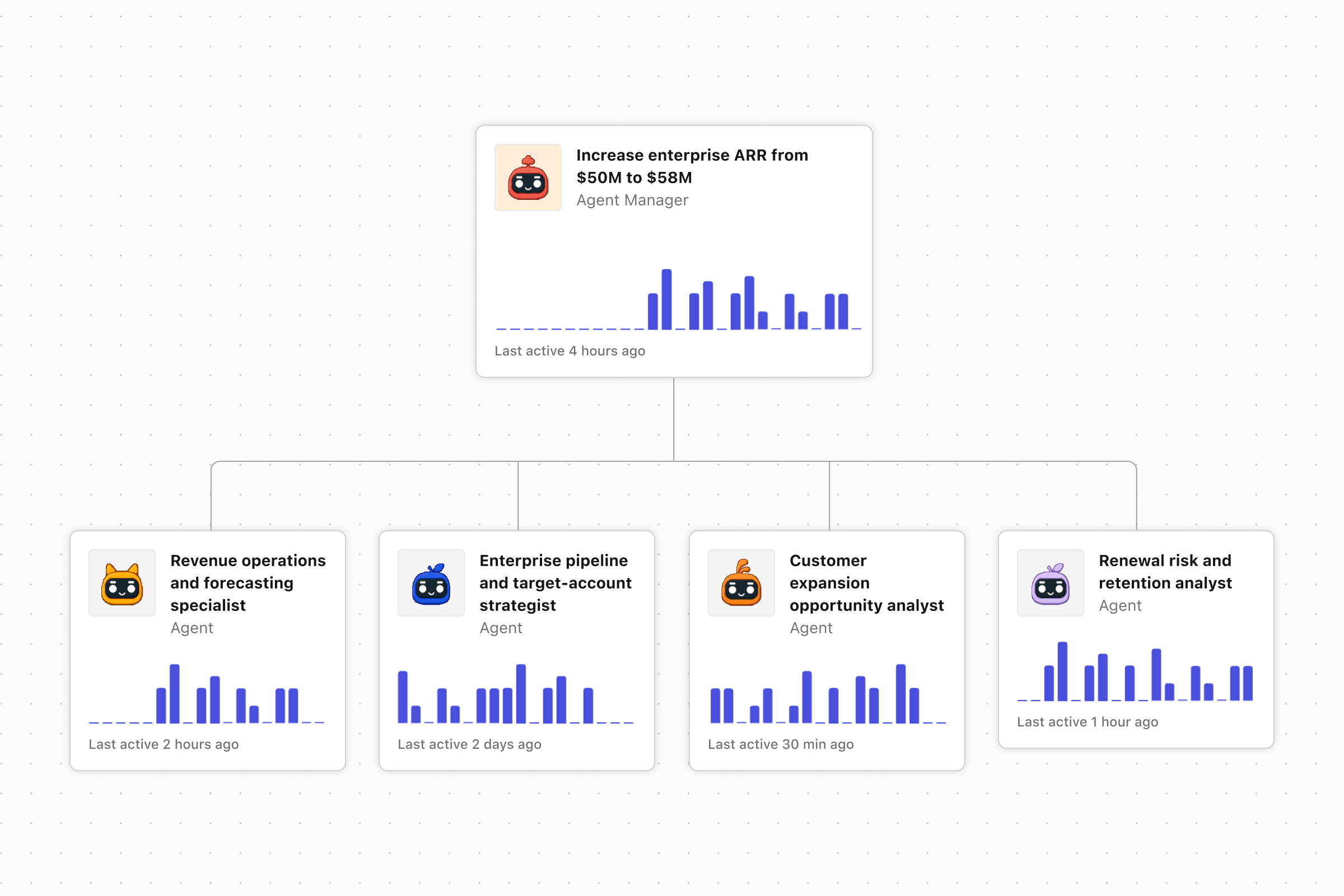
One goal, one Agent Manager, one recruited Agency, reporting back to the whole team.
Where Tability fits
This is also, transparently, where our own product has moved. In Tability, an agent is tied to a real OKR, not a chat thread. It runs on its own schedule, recruits specialist agents into an Agency as the goal grows, and reports back through check-ins the whole team can see, comment on, or redirect, the same as they would with a human teammate. It's also part of why Tability ranks #1 for AI features in the OKR software benchmark, ahead of WorkBoard and Profit.co.
One Tability customer recently recruited 20 agents across four growth goals by creating just four Agent Managers, spending their time reviewing outputs and steering direction, not managing headcount — the same pattern we run on ourselves; see how self-hiring agent teams work in practice. That's the shape of the org chart this is heading toward: fewer new hires, more Agencies.
If this pattern feels familiar, it should. It's roughly what happened when StratOps showed up a few years ago: a new function nobody had budgeted for, created because the old org chart couldn't describe the work that actually needed doing.
Start deploying your Agencies today
If your team is already fielding questions about ‘AI agents’ and nobody's agreed on what the word means yet, that's usually the first sign you need a shared definition before you need a tool.
Sign up free and see how agent ownership actually works inside a real goal, or book 30 minutes with us and we'll walk through what an Agency could look like for your team. Tability or not, it's worth getting the vocabulary straight before it ends up on someone's job description.

.jpg)