Every enterprise has run an AI agent pilot by now. Most of them are quietly parked in a slide deck labelled ‘phase two’. The demo worked fine. The agent answered questions, drafted a document, maybe even booked a meeting. Then someone asked the question that actually matters: who's accountable if it gets something wrong, and how would we know? Nobody had a good answer, so the pilot stayed a pilot.
That's not a technology problem. The models are good enough.
MIT's 2025 research on enterprise AI pilots found the same pattern at scale: 95% never show up in the profit and loss statement, and the gap traces back to how the organisation absorbs the tool, not the model underneath it. It's a governance and ownership problem, and it shows up the moment an AI agent moves from ‘a fun demo for the innovation team’ to ‘something that touches revenue, customers or headcount decisions’.
Enterprises don't actually need agents that can chat convincingly. They need agents that can own an outcome, report on it honestly, and get pulled up if they drift, the same standard applied to any employee.
That's what separates a genuine enterprise AI agent from a consumer chatbot wearing an agent costume, and it's the bit most vendors selling ‘enterprise AI agents’ quietly skip past.
What makes an agent ‘enterprise’ anyway
For a single person experimenting, an AI agent can just mean a chat assistant that takes a few actions when prompted. That's fine at that scale. The moment more than one team, or one budget, is involved, three new requirements show up, and they have nothing to do with model quality:
- Someone is accountable for what the agent commits to. Not the vendor, not ‘the AI team’. A named owner, the same way a project has a lead.
- There's an audit trail of what it did and why. If an agent sends an email, changes a record or makes a recommendation, you can see the reasoning after the fact, not just the output.
- It plugs into how the business already tracks progress, goals, initiatives, OKRs, rather than running as a shadow system nobody outside the pilot team can see.
The enterprise AI agents that survive past the pilot stage are the ones built around those three requirements from day one. The ones that don't clear that bar tend to work beautifully in a demo and then quietly stop getting used six weeks later, not because they failed, but because nobody could say who was responsible for them.
Why most agent platforms don't clear that bar
Two patterns show up again and again when enterprises evaluate AI agent platforms, and both miss the ownership problem in different ways.
The first is the developer-framework route: LangGraph, CrewAI, or a custom stack built on top of an LLM API.
These are genuinely powerful and give engineering teams full control over what an agent can do. But control isn't the same as accountability. Nothing in these frameworks ships with a concept of ‘who owns this agent's goal’ or ‘how is it tracking’. Your engineering team has to build that layer themselves, on top of everything else they're building, and most don't get around to it.
The second is the chat-wrapped assistant: a genuinely useful tool that answers questions and takes a few actions, but only when someone prompts it.
It doesn't have a seat on the org chart, doesn't work on its own schedule, and isn't accountable for a result the way a person or a properly deployed agent is. Marketing calls it an agent. It's an assistant, and there's nothing wrong with that, except when it's sold as the answer to a governance problem it was never built to solve.
Gartner has a name for that second pattern: agent washing, the rebranding of existing chatbots and automation tools as agents without any real agentic capability underneath. Gartner estimates only around 130 of the thousands of vendors calling themselves agentic actually are, and predicts more than 40% of agentic AI projects will be cancelled by the end of 2027 for exactly the reasons above: escalating costs, unclear business value, and risk controls that were never built.
A goal-owning agent is the only one of the three that clears all five bars without engineering effort.
What a goal-owning agent actually looks like
The practical alternative isn't more prompting discipline. It's changing what the agent is built around. Instead of assigning an agent a task, you assign it a goal and a seat, then let it recruit the specialists it actually needs.
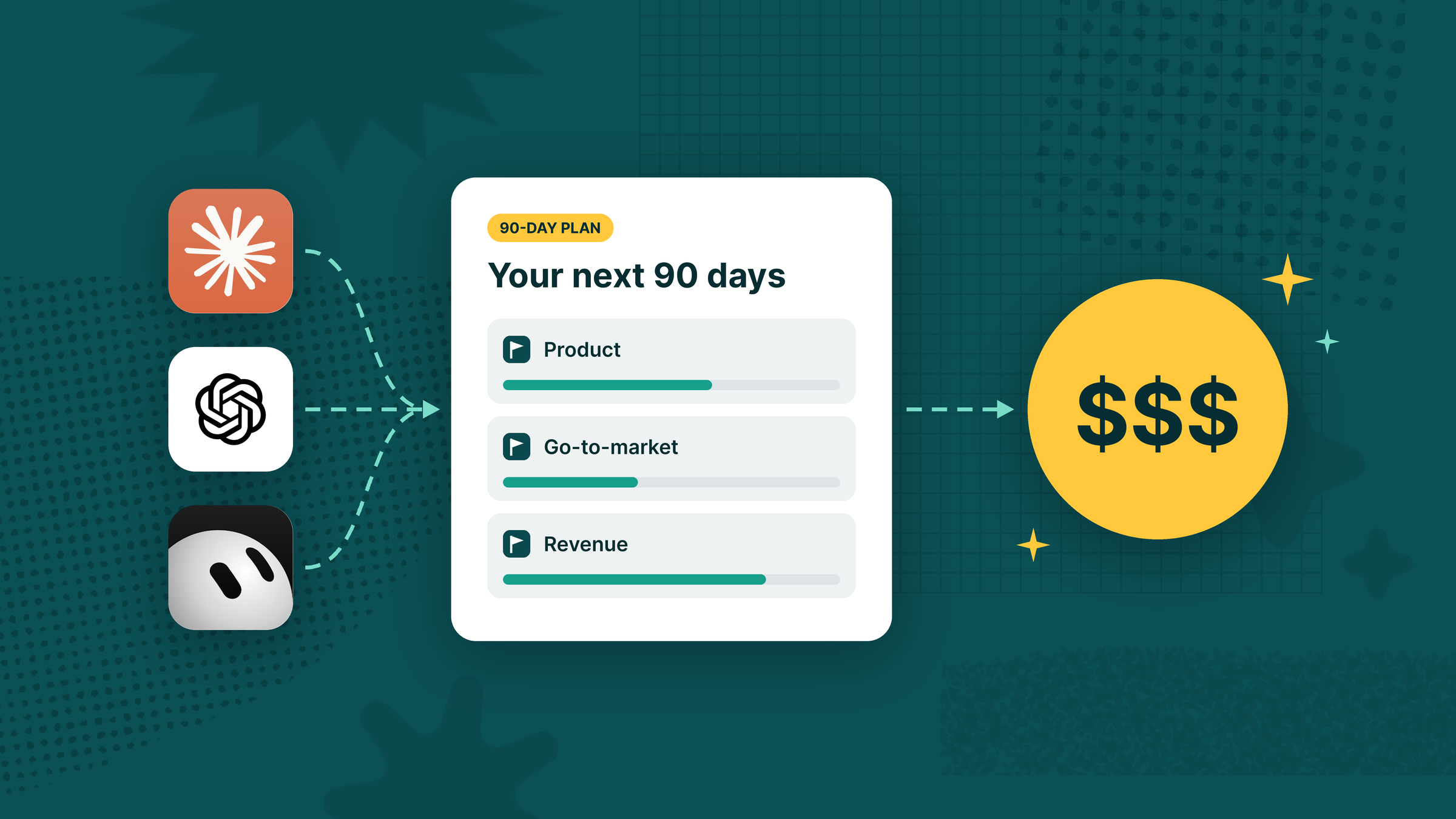
This is how Tability's Agent Manager model works. You give an Agent Manager ownership of a goal, the same way you'd hand a goal to a new hire. It breaks that goal into a plan, recruits exactly the specialist agents that plan calls for (built and run in whichever tool your team already uses: Claude, OpenAI, or others), and reports progress on a fixed cadence rather than only when someone remembers to ask. A human reviews outputs and progress, not headcount, the same way a manager reviews a team's work without micromanaging every task.
That's the practical difference between an agent and an Agency: a single assistant answers what it's asked, while an Agency, a goal-owning manager plus the specialist team it recruits, keeps working on the goal whether or not anyone's watching, and can be held to the same account as anyone else on the team.
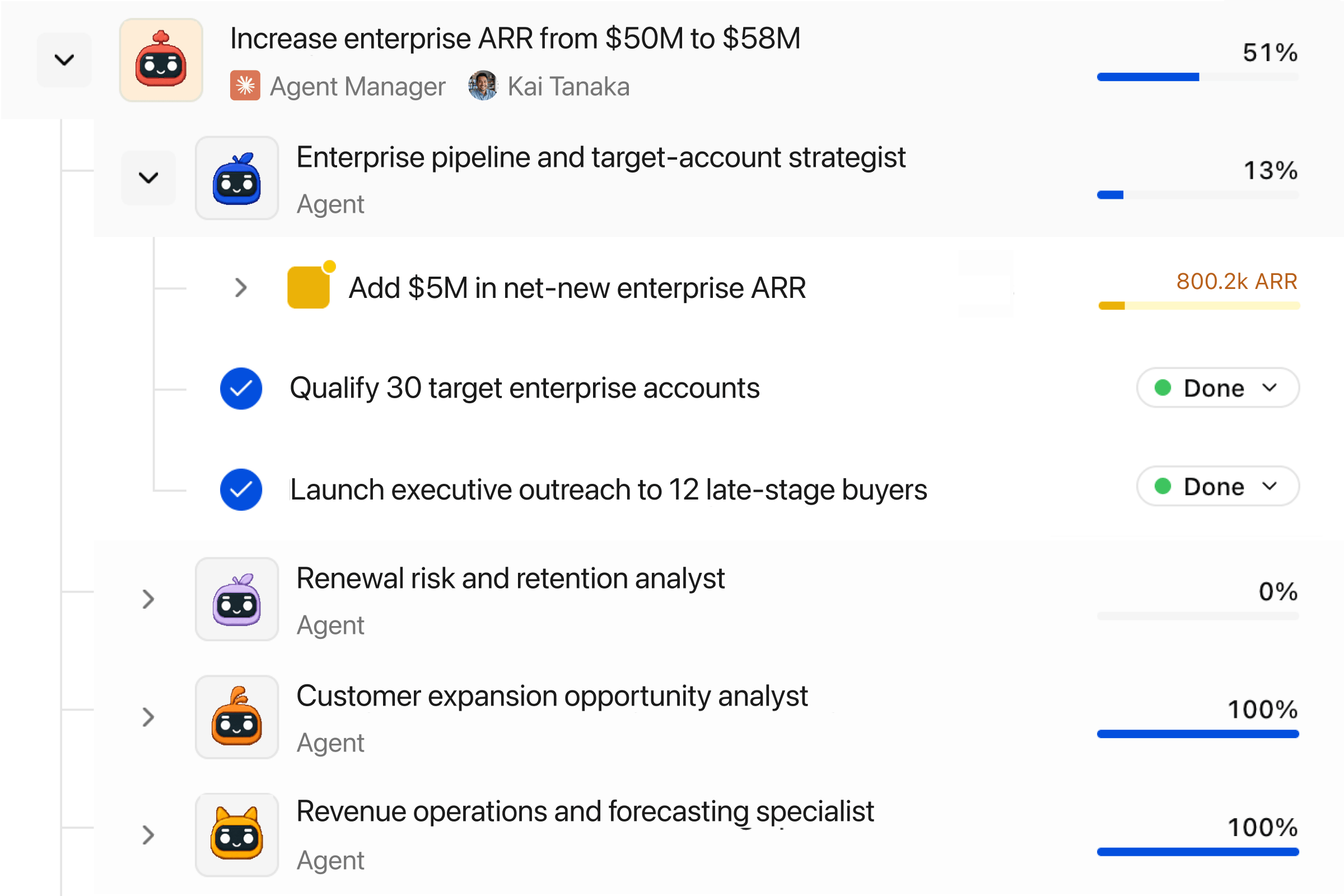
That's the practical difference between an agent and an Agency: a single assistant answers what it's asked, while an Agency, a goal-owning manager plus the specialist team it recruits, keeps working on the goal whether or not anyone's watching, and can be held to the same account as anyone else on the team.
A worked example: An enterprise ops team
Take a 400-person company with a Q3 key result to cut new-customer onboarding time from 21 days to 10. Under the chat-assistant model, someone on the ops team might ask an AI assistant to summarise onboarding bottlenecks once a week, read the summary, and manually decide what to do about it. Useful, but the thinking and the follow-through still sit entirely with a person who already has a full calendar.
Under the goal-owning model, an Agent Manager is recruited straight onto that key result. It reviews the onboarding pipeline data on a fixed cadence, recruits a research agent to interview churned trial accounts and a drafting agent to propose process fixes, and posts a check-in against the key result every week whether or not anyone asks it to. The ops lead reviews what it proposes and approves or redirects it, the same way they'd review a report from a direct report, not the way they'd babysit a chat window.
The difference isn't how smart either approach is. It's that one of them has an owner, a cadence and a paper trail the moment leadership asks how the number is tracking, and the other has whatever notes someone remembered to keep.
A short checklist before you scale past the pilot
Before signing off on an enterprise AI agent rollout, five questions cut through most of the vendor pitches:
- Does it have a named owner, accountable the same way a person would be?
- Does it report on a fixed cadence, not just when someone remembers to ask?
- Can you see what every agent in the fleet is doing, not just the one you're currently testing?
- Does it plug into the goals and initiatives you already track, or does it need its own separate system?
- Would you actually trust it with a number your team is judged on, or only with busywork nobody minds getting wrong?
If the honest answer to more than one of those is no, that's not a reason to abandon AI agents. It's a reason to be more specific about what 'enterprise-ready' actually requires before the next pilot starts.
Where Tability fits
Tability was ranked #1 for AI features in The OKR Software Benchmark (4.6/5), ahead of WorkBoard and Profit.co, largely because the Agent Manager model treats accountability as a first-class feature rather than an afterthought bolted onto a chat interface.
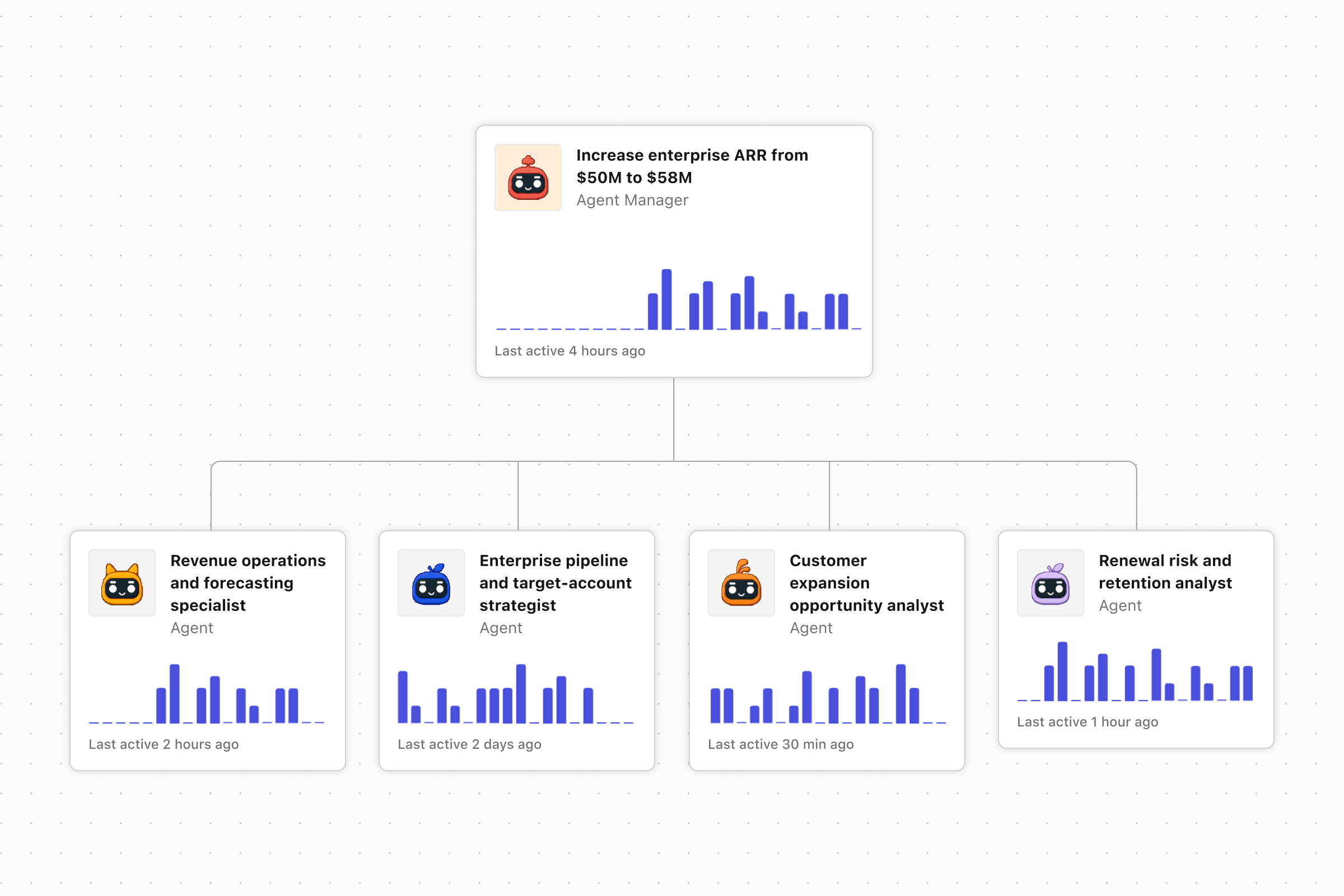
It also means AI agents aren't a separate initiative sitting outside how the business already runs. If your team already tracks goals through a StratOps cadence, an Agent Manager reports into the same weekly check-in rhythm as everyone else, instead of adding a parallel reporting system nobody has time to check.
The next step
Enterprise AI agents don't need to be smarter to clear the pilot-to-production wall. They need an owner, a reporting cadence, and a place to plug into the goals your business already tracks. That's the whole design behind Tability's Agent Manager.
Sign up and see how it works with a real goal, or book 30 minutes with us and we'll walk through what an Agent Manager would look like for your team. Tability or not, it's worth having a real answer to the ownership question before your next agent pilot.


.jpg)
.png)