The human–agent workforce is here. Even enterprise companies now expect employees to run small teams of AI agents—or to work alongside them as if they were colleagues. Done well, this expands each person’s surface area: more coverage, faster cycles, fewer repetitive tasks. Done poorly, it creates chaos—shadow automations, unclear ownership, and spend that’s hard to defend.
Quickly, AI Agents will take over and ruin your company.
What’s changing isn’t just the tooling; it’s the operating model. A single marketer might supervise a handful of agents that draft briefs, tag content, and update the CMS. A support manager might rely on deflection and triage agents that work 24/7. An engineering lead may have bots that file bugs, run tests, and summarise incidents. In other words, one human can now coordinate a portfolio of “digital workers” that push work forward between meetings—if the organisation can keep that work visible and accountable.
The hard part is scale. Agents pop up across notebooks, SaaS tools, and internal scripts faster than naming conventions or governance can keep up. Definitions for success vary by team, model versions change underneath you, and evidence of value gets scattered across logs and dashboards. Meanwhile, leaders are asking reasonable questions: what’s running, who owns it, how does it change our metrics, and what are we paying for?
This article sets out a practical view of the landscape and dives into the three issues holding teams back: sprawl and fragmentation, outputs without outcomes (including effectiveness and ROI), and ownership gaps that allow quality to drift. Name these clearly, and you can turn a collection of clever automations into an operating advantage.
What is a human–agent workforce?
A human–agent workforce is a team model where people work alongside software agents (“digital workers”) to achieve shared outcomes. Humans keep accountability and judgement. Agents execute defined tasks, generate updates, and act within guardrails. The point isn’t replacing people; it’s combining human context with machine speed and scale.
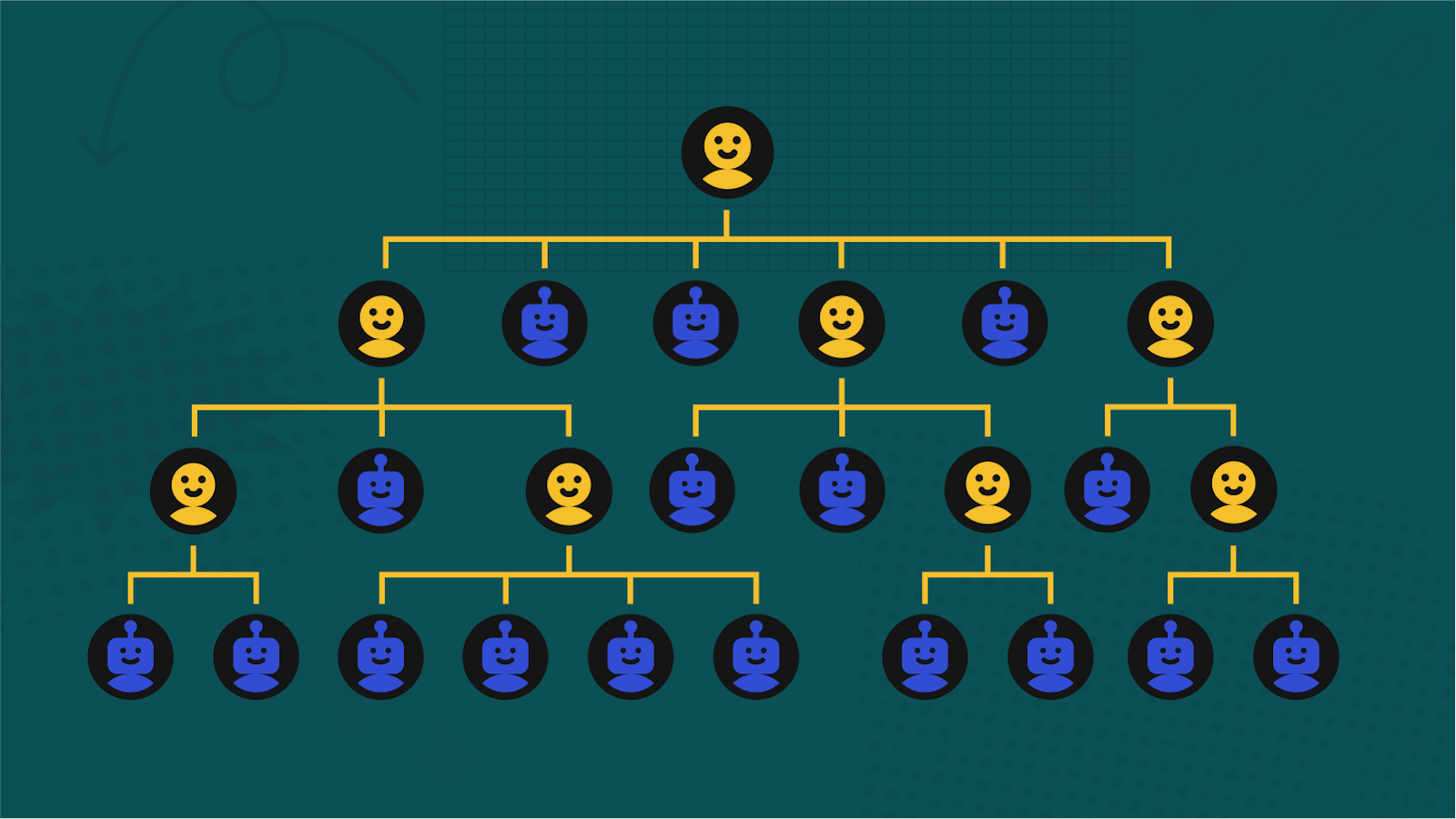
Agents typically operate in three modes:
- Assistive (copilot): the agent suggests; a human decides.
- Collaborative (peer-like): the agent owns a slice of the workflow, handing off at clear checkpoints.
- Delegated (autonomous within limits): the agent acts on triggers and reports back; a human stays “on the loop”.
Common agent use cases (already happening)
- Customer support: tier-1 deflection, triage, knowledge base updates, post-interaction summaries.
- Sales and GTM: lead enrichment, outbound sequencing, meeting scheduling, CRM hygiene.
- Marketing: brief generation, content ops, taxonomy and metadata clean-up, translations and repurposing.
- Product and engineering: bug triage, QA test runs, incident timelines, backlog grooming.
- Data and ops: ETL checks, report building, anomaly detection, inventory alerts.
- Finance: reconciliations, close checklists, variance explanations, invoice matching.
- People ops: onboarding flows, policy Q&A, survey synthesis, learning nudges.
🤖Also see: Best AI Agents in 2025
In essence, one person can supervise a small “team” of agents that handle repeatable work with near-zero intervention—so long as the organisation keeps that work visible, owned, and aligned to outcomes.
The biggest issues we face (and why they matter)
1) Shadow automations sprawl across the organisation
Teams spin up agents everywhere—Notebooks, Zapier, internal scripts, vendor tools. Imagine you have a company of 2,500 people, each of them with three to four agents doing various activities. We quickly get into 10-20 thousand entities working and producing outputs in the name of your company.
Simply put, it’s hard enough to understand what all your humans are working on, let alone the exponential number of agents they manage will be working on too.
This sprawl of agents becomes really hard to get a handle on. If you don’t you expose yourself to compliance and data vulnerabilities, duplicate work, a decrease in product quality, losing control over output, etc.
Why it matters
- Duplicate and conflicting work: parallel agents make different decisions, leading to inconsistent experiences and messy data.
- Quality degradation: an unvetted agent can quietly affect user journeys, copy, or pricing logic.
- Hidden cost centres: model/API charges, vendor fees, and usage spikes occur outside planned budgets.
- Operational fragility: critical agents often live in one person’s personal workspace—creating single points of failure when they’re on leave or change roles.
- Regulatory exposure: unsanctioned automations may handle personal data without proper controls, risking non-compliance.
- Strategic drift: because agents are optimised locally, their work may not advance company-level outcomes.
2) Outputs without outcomes
Agents generate streams of tickets, drafts, messages, logs, and dashboards. The output looks impressive. But when review time comes, leaders can’t tell if anything actually moved—conversion, CSAT, MTTR, cycle time, revenue quality.
Agents are great at scaling output but don’t understand how to tie those things to real results. So what that we sent a million cold emails? If it didn’t turn into leads or dollars, it means nothing.
Companies of yesterday face this same problem with their human employees. It’s very easy to follow a task list and have your employees execute on them. Measuring the impact of the work is another story. It’s why teams adopt methodologies and processes like OKRs to help make sense of the work that they do and understand who’s doing what and why.
Why it matters
- Budget pressure: executives will scrutinise AI spend if outcomes aren’t evident.
- Decision paralysis: without credible attribution, you can’t decide to scale, fix, or retire an agent.
- Team morale: people feel overshadowed by “bot volume” while meaningful progress remains ambiguous.
- Misaligned incentives: teams chase output metrics (emails sent, drafts produced) rather than business results (qualified pipeline, retention, reliability).
- Reporting gaps: quarterly reviews devolve into anecdotes because evidence is scattered across tools and logs.
3) No real proof of effectiveness or ROI
Everyone agrees a task “feels faster,” but there’s no standard, trusted way to calculate value against costs as usage scales. Teams quote hours saved without baselines. Model and vendor costs climb quietly as more agents come online or increase run frequency.
Without measuring against real business outcomes, how can you really understand if what that Agent does is really worth the money we spend on it? Better yet, how do we compare them against each other?
By having a way to measure ROI on Agents, ensuring that the money we put into it is making us more as a business, you’re able to make real decisions about what resources get spent where on Agentic workers.
ℹ️Not sure what metrics to track? Check out our free Business Metrics Cheat Sheet
Why it matters
- Investment clarity: without ROI, you can’t prioritise which agents deserve budget or headcount trade-offs.
- Vendor rationalisation: redundant agents and overlapping tools persist because there’s no apples-to-apples comparison.
- Governance and trust: finance, security, and executives need consistent metrics to stay supportive and to pass audits.
- Strategy alignment: if ROI isn’t tied to objectives, teams optimise for local convenience instead of company impact.
- Scalability: lack of proof slows enterprise rollout and renewals; promising automations get sunset because value is unproven.
What we can do about it (in brief)
You don’t need a big-bang initiative to regain control. Four habits create visibility, accountability, and evidence so you can scale with confidence:
Make agent use visible and accountable
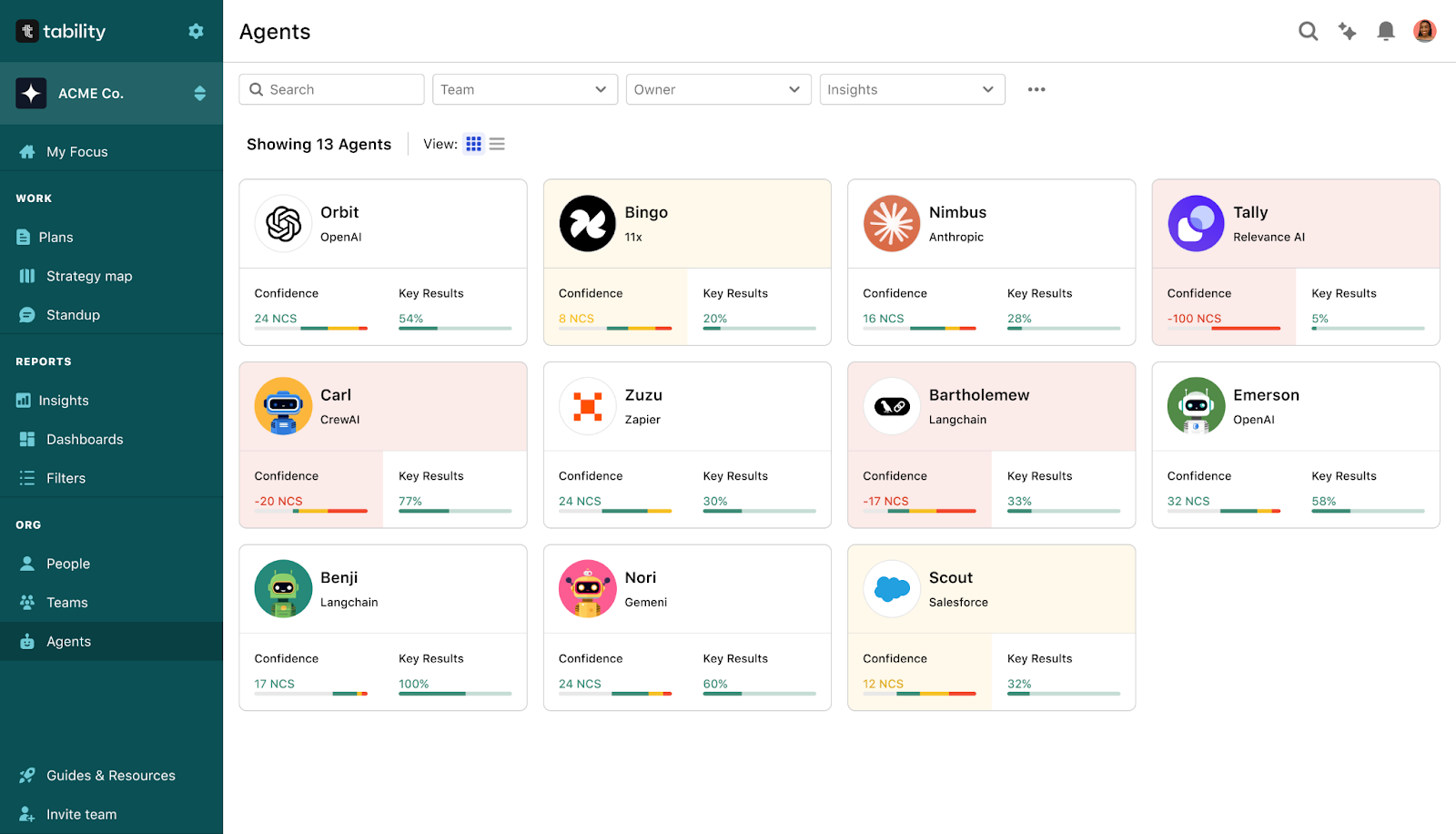
Keep a single register of agents with owner, purpose, environment (sandbox/stage/production), data access, and last update. Put every agent on a team with a named human owner and change history so you can answer “who changed what, when, and why”.
Make sure you have a central place where you can track your Agent use. Even if it’s just a spreadsheet and a talking point during your weekly meetings. Make sure that they are in the conversation and not out there doing things unmonitored.
Don’t forget to assign “owners” or associated teams. This gives managers and leadership a clear view of who to talk to when things are going wrong with an Agent.
Tie agents to outcomes with evidence
Link each agent to specific objectives and key results. Define expected contribution, baselines, and targets up front, and require artefacts with updates (logs, verified events, samples) so that outputs translates to measurable progress.
Simply put: Does the Agent’s output help us achieve our goal?
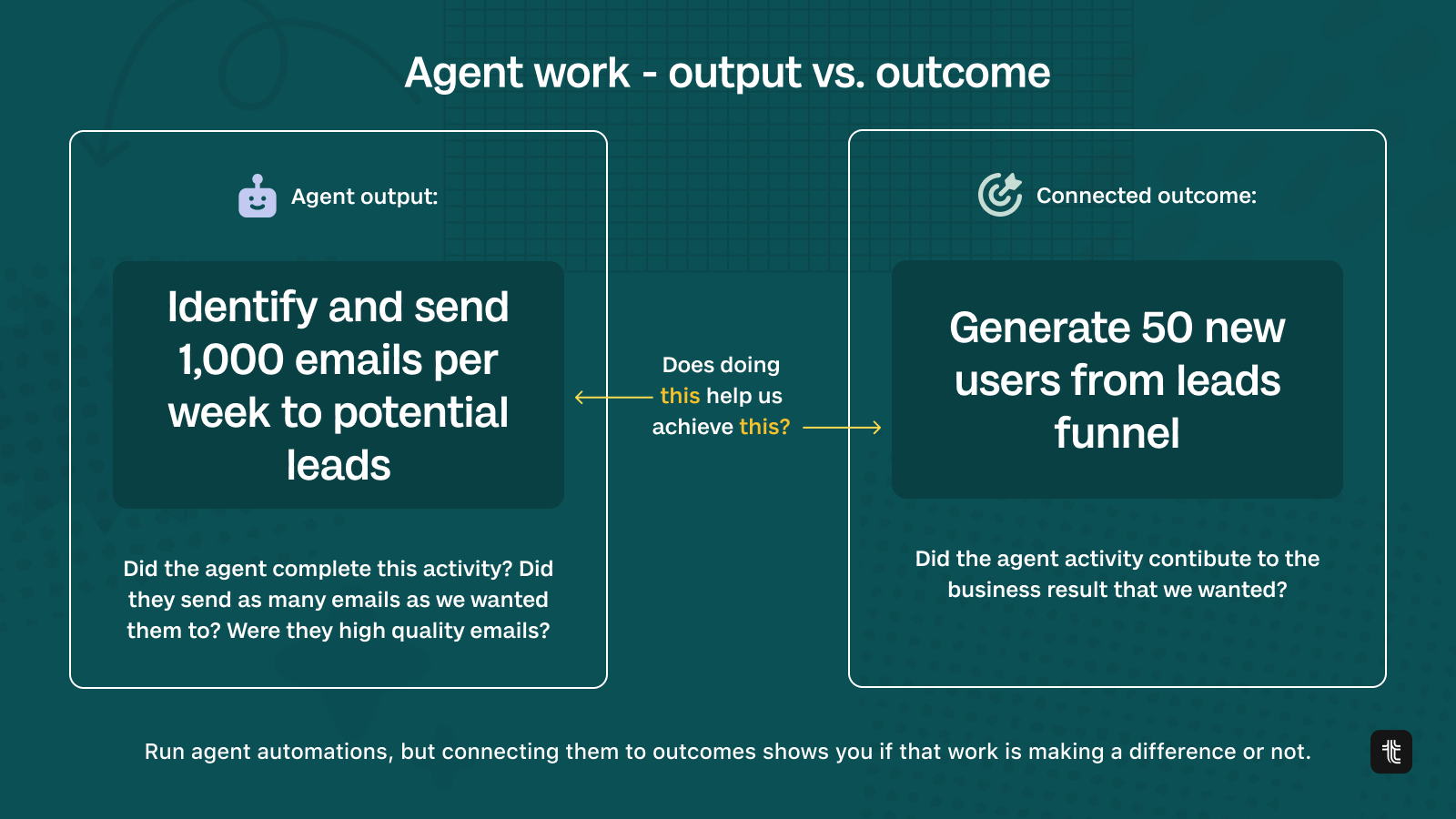
When the work is connected to the results (this applies to humans too btw!) it gives you an extra reference point to try and problem solve from.
In the OKR world, this relationship is often referred to as Output vs. Outcomes.
- Outputs: the things you produce or do (e.g., tickets filed, emails sent, drafts written). Often referred to as projects, tasks, or initiatives.
- Outcomes: The change those outputs create in the business (e.g., higher conversion, lower MTTR, more qualified pipeline). In business, often labeled as key results (in OKRs) or goals.
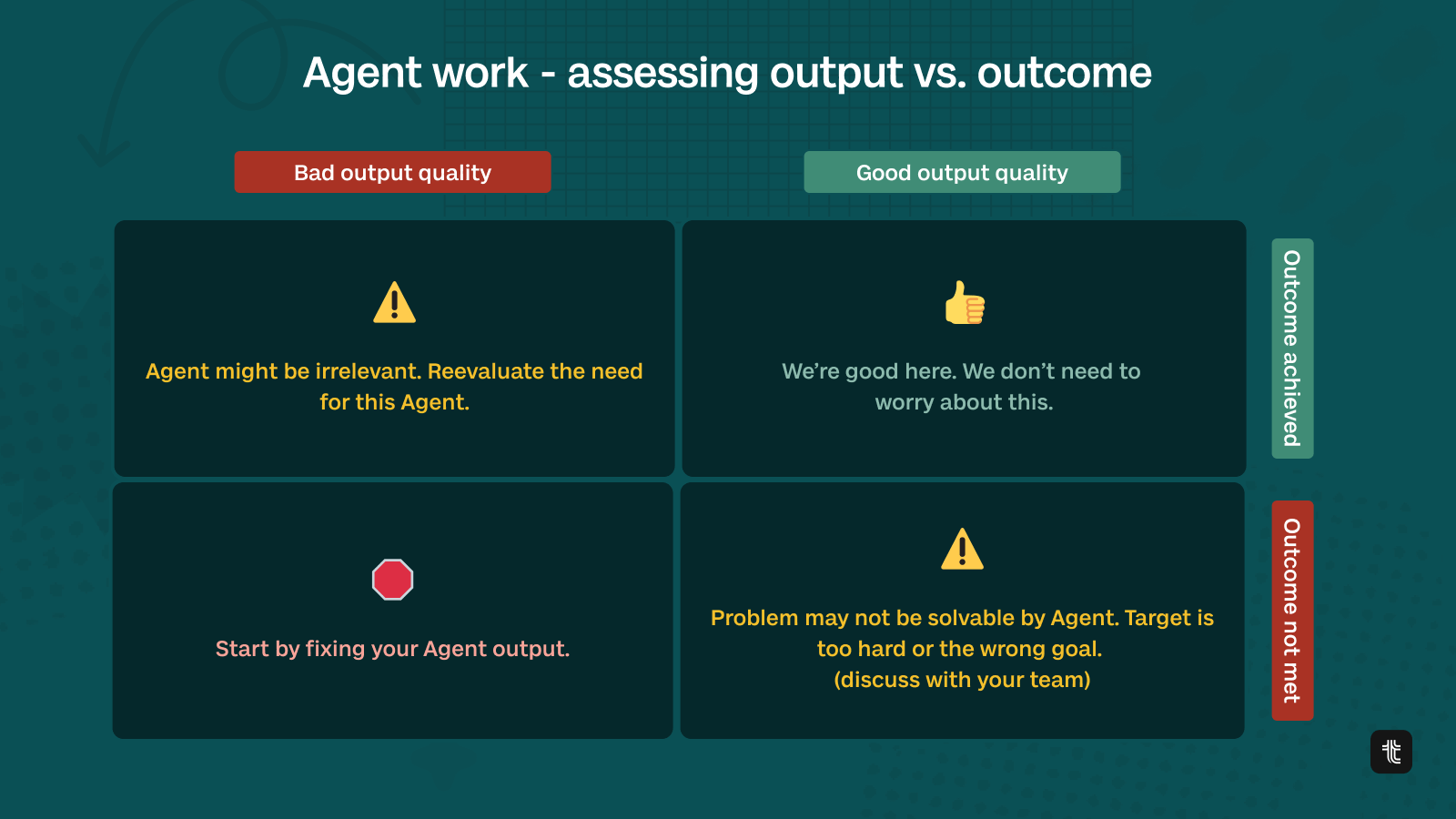
You can take a look at any agent and their associated outcome or Key Results and make an assessment based on those two points. If your Key Result is in the green, and your Agent is accomplishing the tasks you gave it, then nothing to worry about. If one of those things turns red, you can start to ask questions:
- Agent is doing it’s work but Key Results are in the red: Is this agent working on the right tasks? Should we rethink our strategy? Maybe something else is causing us to be in the red.
- Agent is not completing the task it should, but your Key Result is on track: Agent work is not the reason why we’re on track and perhaps we can optimise or use these resources elsewhere.
- Agents not doing the work, KR is off track: Back to the drawing board 💀
Conclusion
The promise of a human–agent workforce is real: broader coverage, faster cycles, and less repetitive work. But without intent and structure, you’ll get sprawl and fragmentation, lots of output with little to show for it, and fuzzy ownership when things go wrong. Naming these three issues clearly—and showing concrete examples of how they appear day to day—gives leaders a common language to diagnose what’s happening across the organisation.
From here, the task is to bring order without slowing progress. Make agent use visible and accountable, connect work to outcomes you can measure, and define who owns what when behaviour drifts. Treat agents like teammates in your operating rhythm—review them, retire them, and scale the ones that move the needle. Teams that act on these basics will turn automation hype into dependable delivery and credible results.
.png)

.jpg)

%20(1).png)