Check-ins record where things stand. The review meeting turns them into decisions, and it shows owners that their updates are read. Without it, the weekly habit fades within a month or two.
Run it every week, keep it to thirty minutes and spend the time on the Key Results that are at risk.
What the meeting is for
The meeting has one job: decide what changes this week so that goals at risk get back on track.
Nobody presents status in the meeting. Status was written in the check-ins and read beforehand, so the thirty minutes are free for the conversations that need people in the same room.
Before the meeting
Three things have happened by the time people sit down.
-
Every owner has checked in. The facilitator looks an hour before and chases anything missing.
-
Everyone has read the check-ins. It takes about ten minutes.
-
Items are flagged for discussion. A red, a yellow, a green that someone does not believe, or a dependency between two Key Results.
If people arrive without having read, start with five silent minutes of reading. It is slower than a pre-read and much faster than a status round.
Review by exception
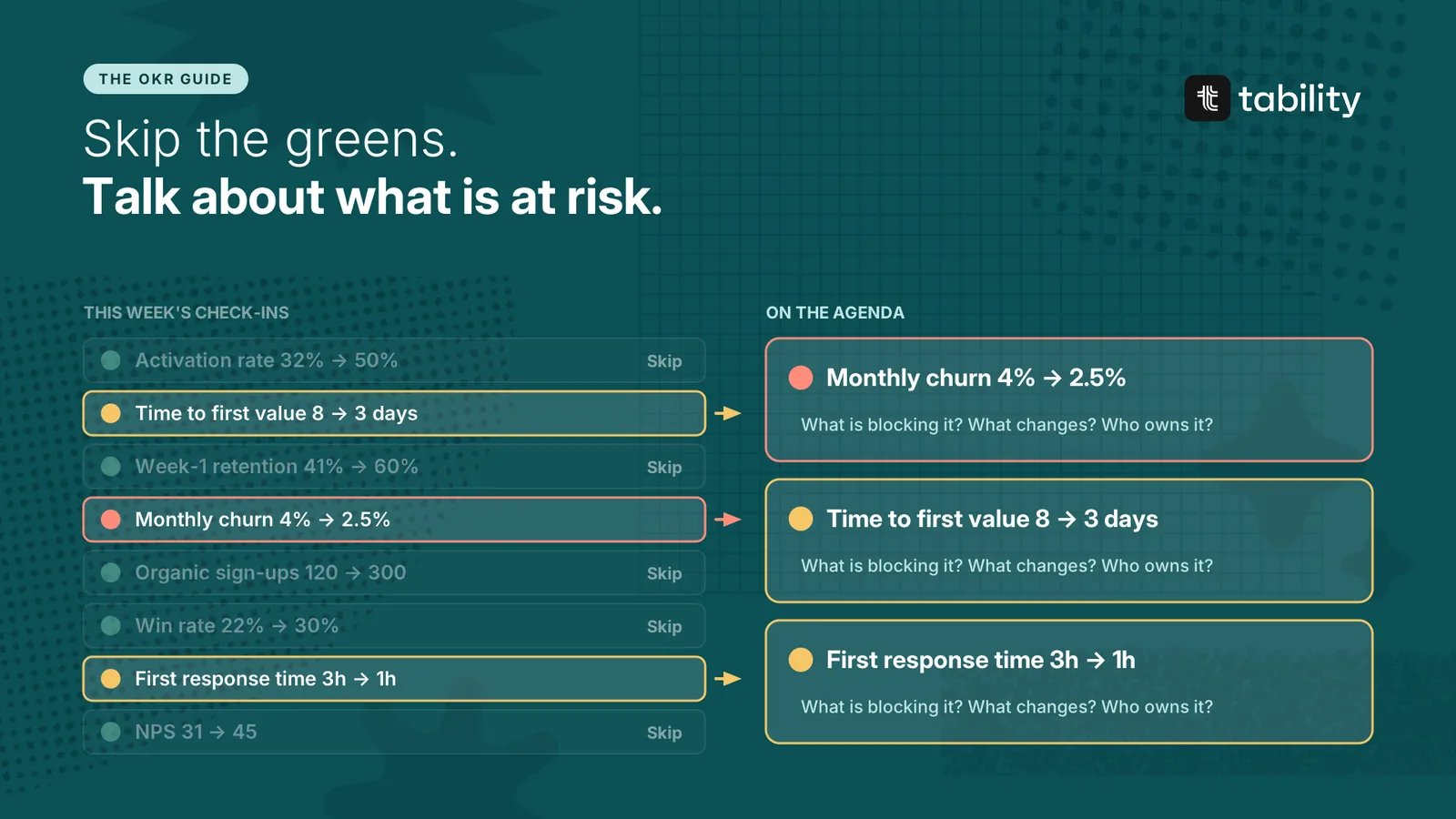
Skip the greens. The owner has said the Key Result is on track and explained why. Reading it aloud adds nothing.
Raise the reds, then the yellows. For each one, the team answers three questions.
-
What is blocking it?
-
What changes this week?
-
Who does what, by when?
Challenge a green you do not believe. If the note describes problems and the status says green, flag it before the meeting. Unchallenged greens are how a quarter ends with a surprise.
A thirty-minute agenda
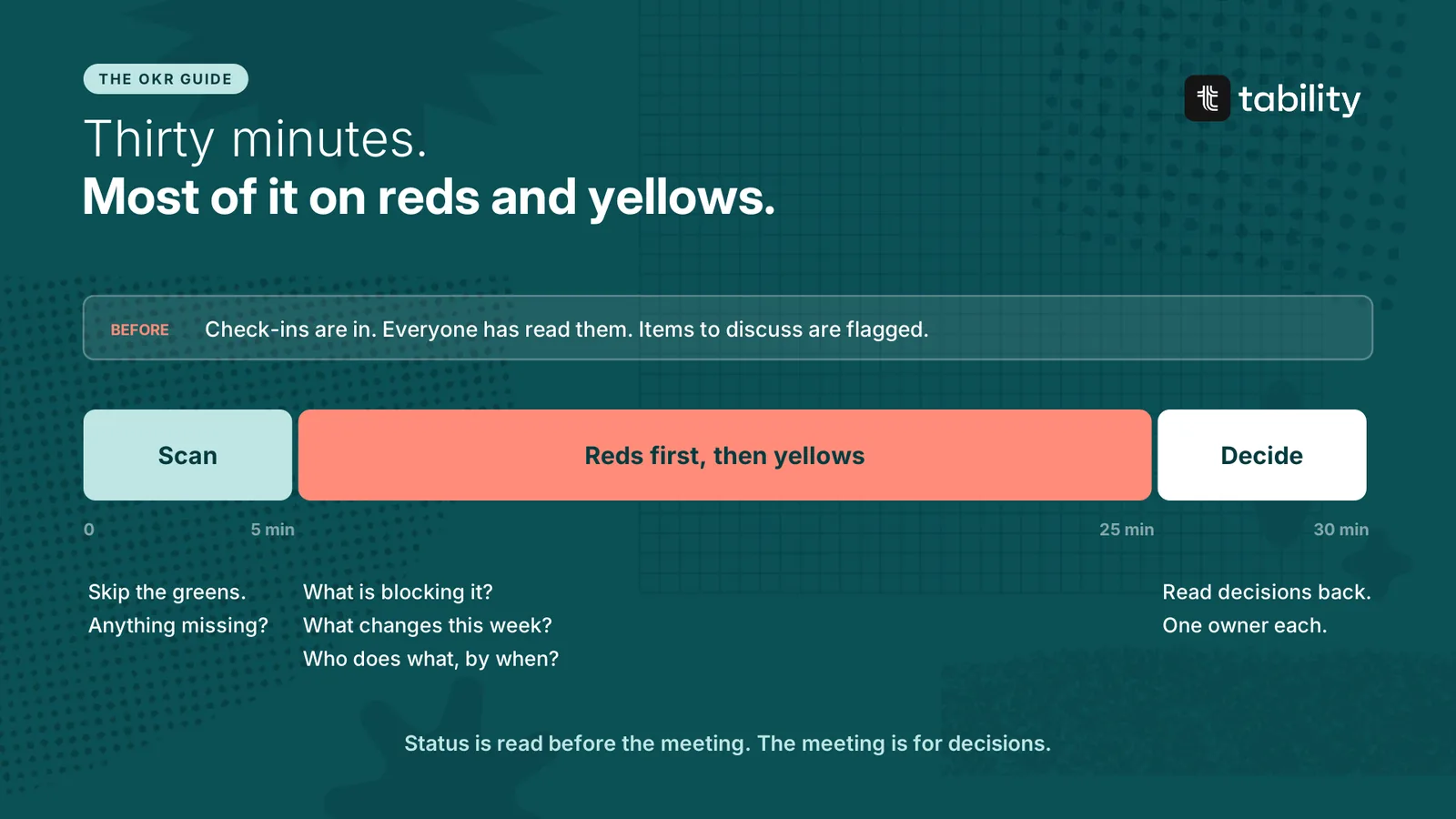
| Time | What happens |
|---|---|
| 0 to 5 minutes | Scan the board. Confirm which items are on the agenda and check that nothing is missing |
| 5 to 25 minutes | Reds first, then yellows. A few minutes each |
| 25 to 30 minutes | Read the decisions back. Each one has an owner and a date |
When one item needs more than five minutes, the people involved continue after the meeting. The rest of the team gets its time back.
What comes out of it
Decisions. There are five kinds.
-
Change a bet. Stop an initiative that is not moving the number and start a different one.
-
Move help. Shift a person or some budget towards the goal at risk.
-
Remove a blocker. Someone with the authority makes the call that has been holding things up.
-
Change the scope or the target. Rare, early in the quarter and in the open.
-
Accept the miss. Agree the goal will not be reached and stop spending on it.
Write each decision down next to the Key Result it concerns. Next week's check-in then starts from what was agreed.
Who is in the room
The team and its lead. The lead or the OKR champion facilitates, which means keeping time and making sure each item ends with a decision. People from other teams join for the item that concerns them and leave afterwards.
The monthly leadership review
Leadership runs the same meeting one level up, in weeks 4, 8 and 12. Leaders read every team's check-ins beforehand and discuss the exceptions across the company.
-
Key Results that are red.
-
Key Results that have been yellow twice.
-
Dependencies between teams.
-
How confidence is trending overall.
Forty-five minutes to an hour is enough. The rules are the same: read first, skip the greens, end with decisions.
The pre-read for this meeting is the monthly business review, covered in the next chapter.
When everything is green
Take five minutes and give the time back.
If everything is green every week, ask two questions. Are the targets ambitious enough? Are the statuses honest? A quarter with no yellow at any point is unusual.
What goes wrong
-
The status round. Everyone reads their update aloud. The meeting takes an hour and decides nothing.
-
Solving it in the room. Twenty-five minutes on one problem while six people watch.
-
Nobody read beforehand. The first half is spent catching up.
-
No decisions recorded. The same red comes back next week with the same discussion.
-
The interrogation. Reds are treated as failures, and the following week there are none.
Questions about OKR review meetings
How often should you review OKRs? Every week for a team. Every month for leadership.
How long should an OKR review meeting be? Thirty minutes for a team. Up to an hour for leadership.
Can the review be part of an existing team meeting? Yes, if the time is protected. Put it first on the agenda so it does not get squeezed out.
What is the difference between an OKR review and a retrospective? The review happens every week and changes this week's plan. The retrospective happens once, at the end of the quarter, and changes the next one. Part 5 of this guide covers it.
For every meeting in the OKR cycle, including planning and retrospectives, see OKR meetings.