The earlier chapters describe the ideal case: a company with a clear strategy that flows down into quarterly goals. Many teams do not start there. What they have is a roadmap, a long list of projects with dates, and nobody has written down what all those projects are supposed to add up to.
If that is you, sitting in a room trying to invent top-level goals from nothing is a painful way to begin. There is an easier route. Start from the projects you already have and work backwards to the direction behind them.
Roadmap vs OKRs: what is the difference?
| Roadmap | OKRs | |
|---|---|---|
| Made of | Projects and dates | Outcomes and measures |
| Answers | What will we build, and when? | What should change, and how will we know? |
| Success means | Shipped on time | The number moved |
| When plans change | The roadmap slips | The goal stays and the projects change |
You need both. A roadmap without OKRs is a list of work with no way to tell if it mattered. OKRs without a roadmap are goals with no plan. The roadmap becomes your list of initiatives, as described in OKRs vs. initiatives.
Why working backwards works
Your roadmap already contains your strategy. It is just implicit. Every project made the list because someone believed it mattered, and those beliefs follow patterns. Find the patterns and you have found what the company is trying to achieve, in its own words, without a strategy offsite.
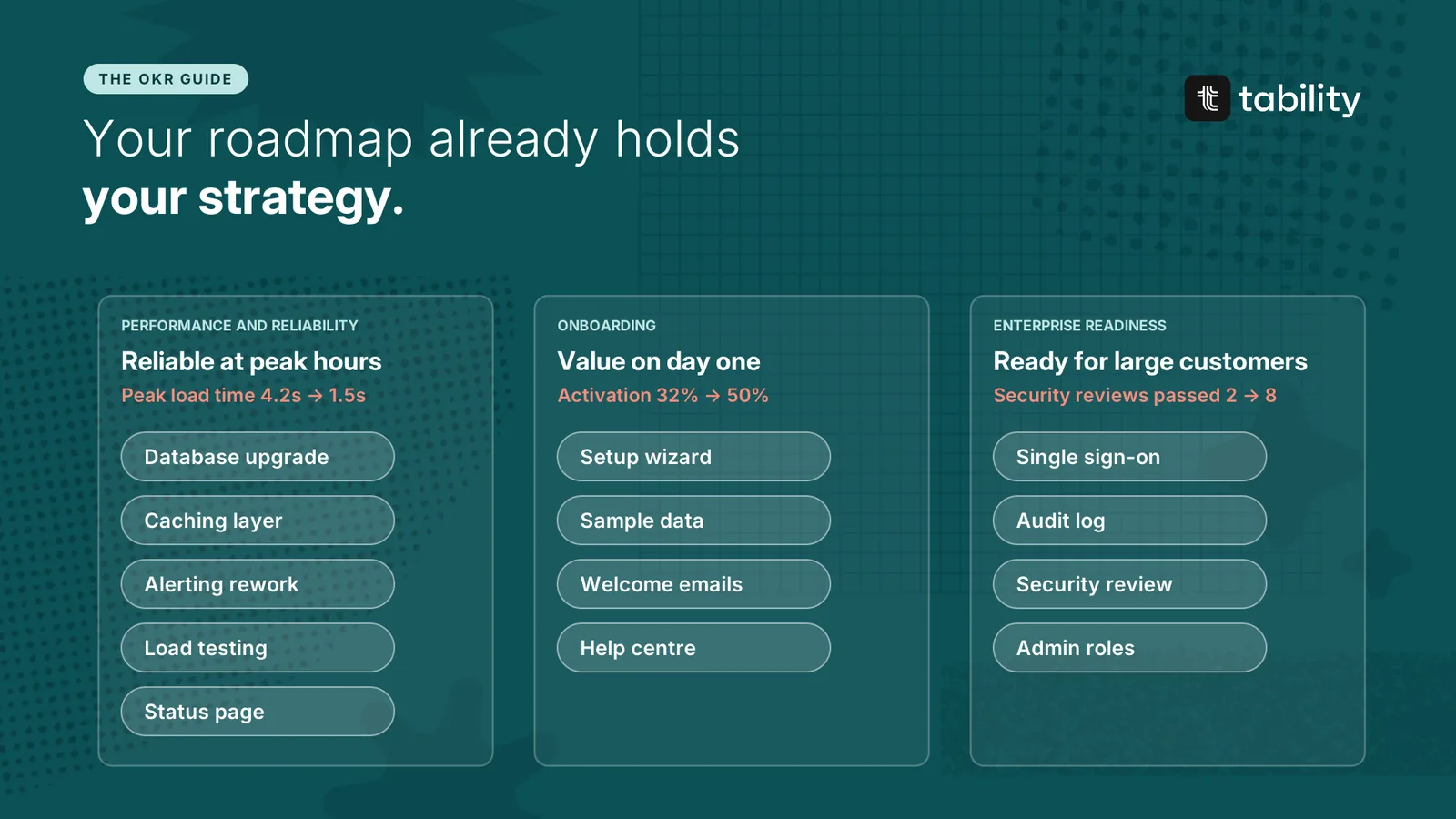
Step 1: Put every project on the table
List everything in flight and everything planned for the next quarter. Include the work nobody calls a project: the migration that has been running for a year, the weekly reports, the favour for the sales team.
One line each. You want the full picture of where time is going.
Step 2: Group the projects by theme
Sort the list into groups of projects that are trying to do the same kind of thing. Do it with the team, on a wall or a shared board.
You might find that six projects are about speed and stability, four are about getting new users started, and three are about selling to larger companies. Name each group in two or three words: "Performance and reliability", "Onboarding", "Enterprise readiness".
Aim for three themes. If you end up with seven, some of them are the same theme, or the team is spread too thin, which is worth knowing.
Step 3: Ask what each theme is for
A theme is a topic. To turn it into a goal, ask why it matters until you reach something a customer or the business would notice.
Take "Performance and reliability". Why are we doing these projects? Because the product slows down at peak times. Why does that matter? Because customers cannot rely on it during their busiest hours, and two large accounts have complained. That gives you an Objective:
Customers can rely on us during their busiest hours.
That sentence is the direction the projects were pointing at all along. Writing it down lets everyone on the team aim at the same thing. See how to write OKRs for what makes a good Objective.
Step 4: Find the numbers that would prove it
For each Objective, ask how you would know it had been achieved. Those are your Key Results.
-
Peak-hour page load time falls from 4.2 seconds to under 1.5
-
Incidents affecting customers drop from 9 a quarter to 2
-
Support tickets about slowness fall from 140 a month to 40
You will often find that nobody knows the current value. That is useful to discover. It means the team has been doing the work without a way to tell whether it helped. Getting the baseline becomes the first task. How to write good Key Results covers the types and how to set targets.
Step 5: Look at what is left over
Some projects will not fit any theme. Each one is in one of three situations.
-
Business as usual. Necessary work that keeps things running. It stays, and it is tracked through KPIs.
-
A goal you have not named. Several orphans that share a purpose may point to a missing Objective.
-
Work with no reason behind it. A project nobody can connect to an outcome is a candidate to stop.
This is often the most valuable ten minutes of the exercise.
Step 6: Turn around and plan forwards
You now have Objectives and Key Results. Look at the roadmap again, this time from the top.
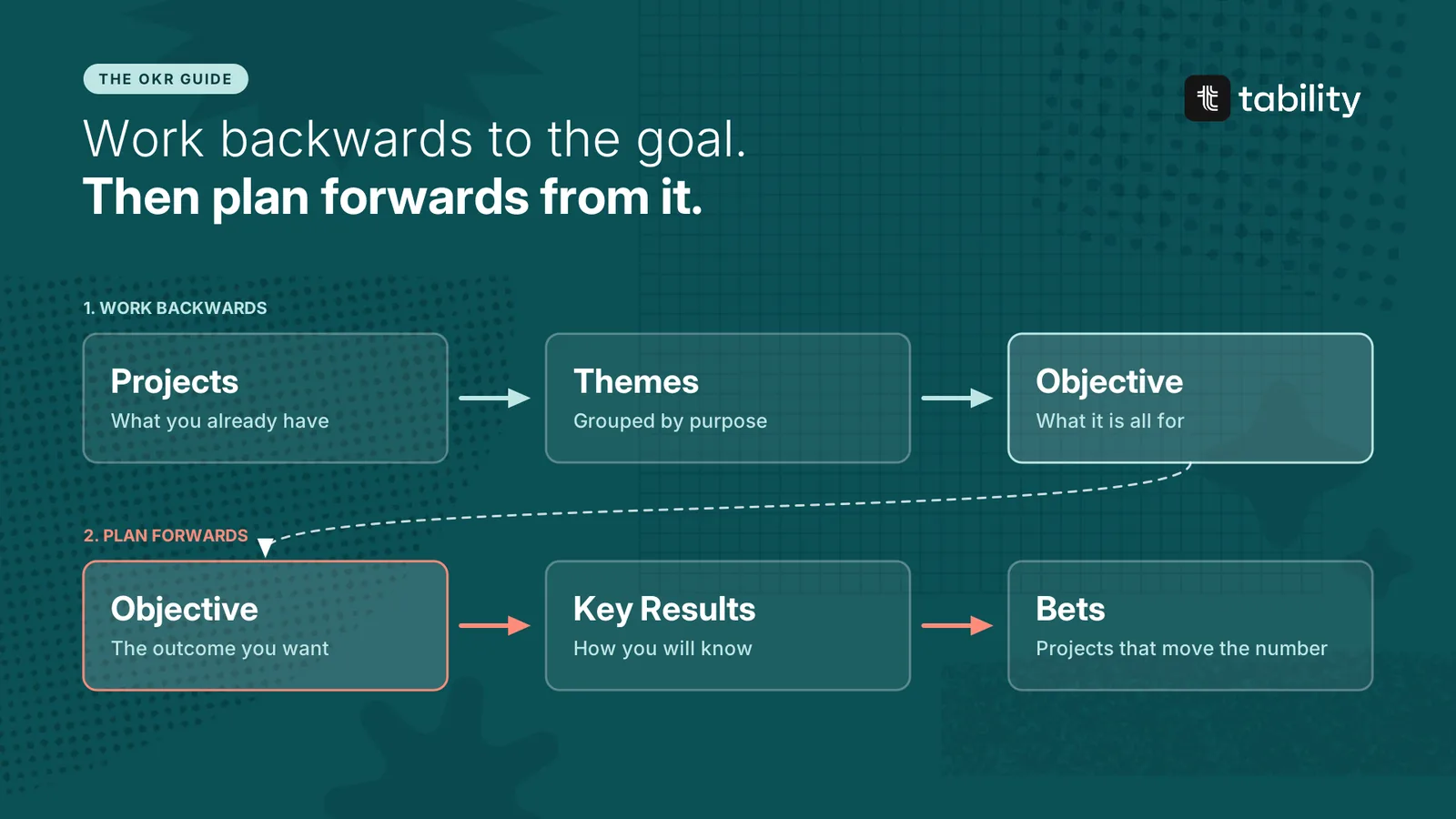
For each Key Result, ask which projects are most likely to move it. Some will clearly help. Some turn out to have little to do with the number they were filed under. And there will be gaps, where a Key Result matters and nothing on the roadmap would move it.
Reorder the roadmap around that. The projects become bets on the Key Results. You commit to the outcomes for the quarter and stay flexible on the projects, reviewing each week which ones are working.
A worked example
| Step | What the team had | What it became |
|---|---|---|
| Projects | Database upgrade, caching layer, alerting rework, status page, load testing, on-call rota | – |
| Theme | – | Performance and reliability |
| Objective | – | Customers can rely on us during their busiest hours |
| Key Results | – | Peak load time 4.2s → 1.5s. Customer-facing incidents 9 → 2 |
| Re-plan | Six projects of equal priority | Caching and database first, since they move load time most. Status page deferred. A new bet added on the slowest report page |
What changes after the first quarter
Working backwards is a way to get started. After one quarter you have Objectives, real baselines and a feel for which bets pay off.
From the second quarter, plan from the top: decide what should change first, then choose the work. How to set OKRs covers that process.
Mistakes to avoid
Relabelling the roadmap. "Ship the caching layer by March" written under the heading Key Result is still a project. If your Key Results are all deliverables, go back to step 3.
Keeping every project. If nothing was dropped or deferred, the exercise did not change anything.
Too many themes. More than three Objectives per team means no focus.
Skipping the baseline. A target with no starting value cannot be scored.
Questions about roadmaps and OKRs
Do OKRs replace the roadmap? No. OKRs say what should change. The roadmap is the current list of bets for getting there, and it gets reviewed far more often than it used to.
Can a project be a Key Result? No. A project is an initiative. The Key Result is what the project is meant to change.
What if a project supports two Objectives? Put it under the one it affects most. If many projects straddle two Objectives, the Objectives may be one goal.
How long does this take? A two-hour session per team for steps 1 to 5, and another hour for step 6.