Most organisations are good at planning. They book the off-site, fill the whiteboards, build the slides. Then six months later, they run the same exercise again because nothing from the last one actually happened.
That's not a strategy problem. It's an execution problem. And it starts the moment strategic planning stops at the document and doesn't connect to what people actually do on Monday morning.
This guide covers what strategic planning really is, how it works in practice, the most common places it breaks down, and how to make sure your plan doesn't gather dust.
What is strategic planning?
Strategic planning is the process by which an organisation defines its long-term business goals, sets priorities, and allocates resources to achieve its goals. It bridges the gap between where you are today and where you want to be in three to five years, or sometimes 12 months for faster-moving organisations.
At its core, strategic planning answers three questions:
- Where are we now?
- Where do we want to go?
- How do we get there?
What distinguishes strategic planning from ordinary goal-setting is scope and intentionality. A strategic plan isn't a list of things to do. It's a set of choices about where to focus limited resources, which trade-offs to make, and what success looks like across the organisation.
The process is also cyclical, not linear. A strategy is only useful until the environment changes. For most organisations today, that means treating strategic planning as an ongoing practice rather than a once-a-year event.
Why strategic planning matters
Without a strategic plan, organisations default to firefighting. Teams are busy, but they're not coordinated. Resources scatter across competing priorities. Smart people work hard on the wrong things.
A well-executed strategic plan does four things:
- Creates alignment across teams so everyone knows what matters most and why
- Forces clarity about trade-offs: what you won't do is as important as what you will
- Gives leadership a decision-making framework when circumstances change mid-year
- Connects individual work to organisational outcomes so people understand how their role contributes
In practice, this means fewer 'why are we doing this?' conversations, faster decisions, and a better-informed team.
The Balanced Scorecard Institute found that 9 out of 10 organisations fail to execute their strategy. The bottleneck is almost never the plan itself. It's the operating layer underneath it.
The 5 stages of strategic planning
Most strategic planning frameworks follow a similar cycle regardless of what name they go by. Here's how each stage works in practice.
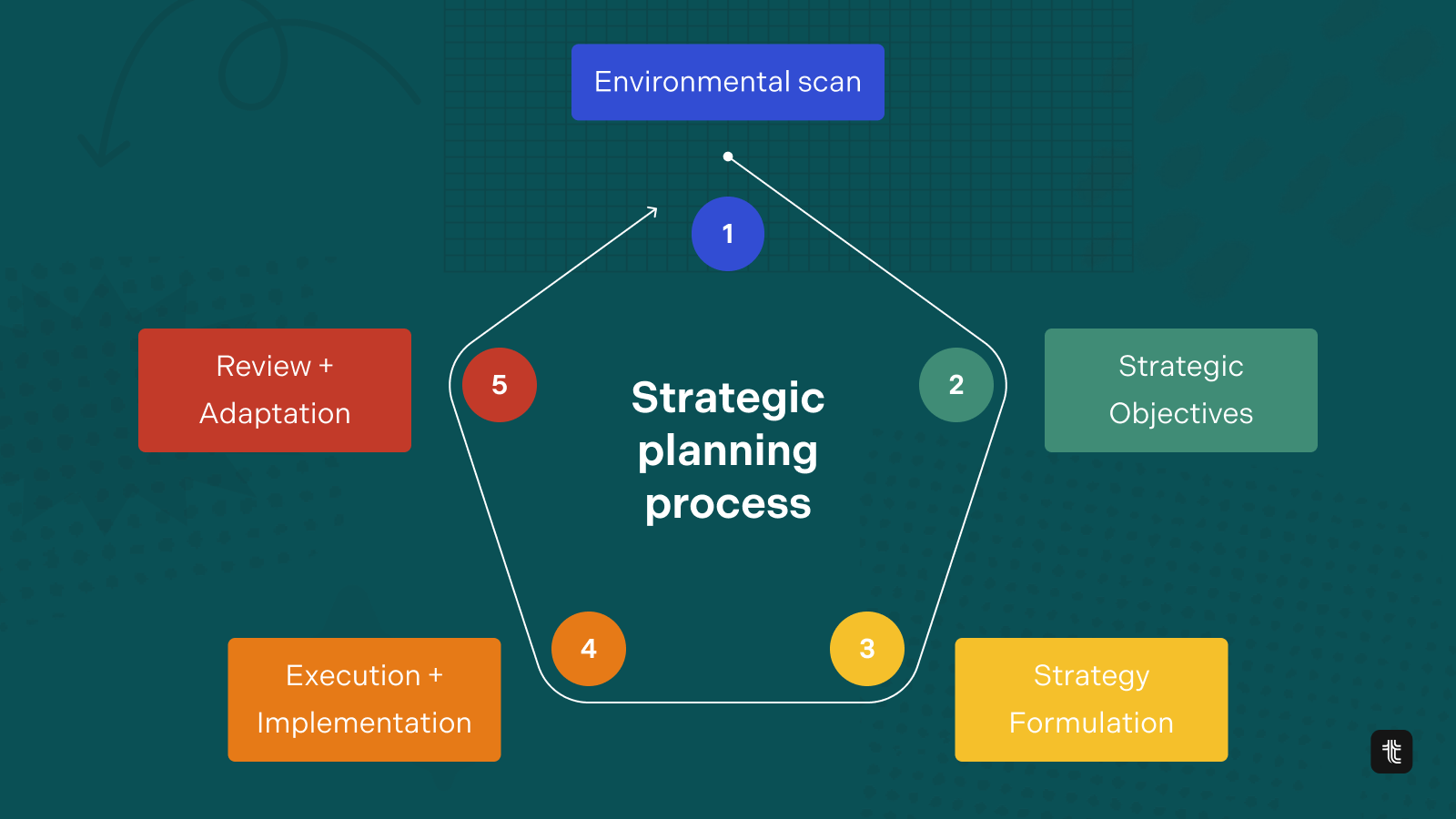
1. Environmental scan
Before setting direction, you need to understand where you stand. This stage involves analysing your internal strengths and weaknesses alongside the external opportunities and threats in your market.
Common tools at this stage include SWOT analysis (Strengths, Weaknesses, Opportunities, Threats) and PEST analysis (Political, Economic, Social, Technological). The goal isn't to produce a comprehensive report; it's to surface the three to five most important realities that need to shape your strategy.
The environmental scan also includes competitive analysis: who's winning in your market, what they're doing differently, and where you have a genuine right to win.
2. Defining strategic objectives
Once you understand your environment, you set direction. This is where you define your mission (why the organisation exists), your vision (where you're going), and the strategic objectives that describe what success looks like in concrete terms.
This is also where OKRs (Objectives and Key Results) become essential. OKRs translate high-level strategic intent into specific, measurable outcomes for teams and individuals. Rather than asking 'are we executing our strategy?', OKRs let you ask 'did we hit the outcomes we committed to?' That's a much more useful question.
🍎 compare OKR software to find which works best for you.
3. Strategy formulation
Strategy formulation is where you decide how to win. Which markets? Which products? Which capabilities need to be built? What needs to be stopped?
Good strategy isn't a list of priorities. It's a coherent set of choices. Your strategic pillars (the three to five major themes that organise your work) should emerge from this stage and provide the logic thread that connects your vision to your annual plans.
4. Execution and implementation
This is where most plans break down. The strategy looks clean on paper, but converting decisions into action with clear ownership, milestones, and accountability is where things fall apart.
Effective execution requires four things:
- Translating strategic objectives into team and individual priorities (the cascade)
- Assigning clear ownership for each strategic initiative
- Building a regular cadence of progress check-ins so issues surface early
- Creating a culture where teams report reality, not what leadership wants to hear
This is the domain of StratOps (strategic operations) teams: the function that sits between strategy-setting and daily execution, keeping the plan connected to what people actually work on. If you're building or joining this function, our StratOps guide goes deeper on what it owns.
This is also the stage where tooling matters most. Strategic planning cannot live only in a document. It needs an operating layer that keeps strategy visible in the flow of day-to-day work.
ℹ️ Using an OKR software makes sure your strategy is connected closey to the execution layer.
5. Review and adaptation
Strategy without review is just a hope. Regular review cycles (quarterly at minimum) let you assess whether you're making real progress, what's changed in the external environment, and whether the strategy itself needs updating.
This isn't about declaring failure. It's about staying calibrated. Organisations that execute well treat their strategy as a living document: one that is informed by new information, adjusted when the environment shifts, and never mistaken for a mandate that doesn't need revisiting.
Common mistakes in strategic planning
Confusing activity with progress
Many organisations track inputs (projects launched, meetings held, reports filed) rather than outcomes: market share gained, churn reduced, revenue grown. A strategic plan built on activity metrics is a plan designed to feel good rather than to work.
Treating planning as an annual event
Annual planning cycles made sense in slower markets. In most organisations today, the environment changes faster than an annual rhythm allows for. Quarterly reviews of an annual plan are the practical minimum.
Leaving execution to chance
The planning process produces a document. Documents don't execute themselves. Without explicit mechanisms for accountability, prioritisation, and regular reporting, even the best plan becomes decoration within 60 days.
Over-planning, under-communicating
Research suggests that more than 90% of employees don't understand their company's strategy. If the people responsible for executing the plan don't know what it says, the plan cannot work. Communication isn't optional in strategic planning; it's part of the process.
Strategic planning tools by stage
Different tools serve different parts of the process. Here's a quick reference:
The best tools aren't the ones with the most features. They're the ones your team will actually use consistently, especially during the execution and review stages where discipline matters most.
How Tability connects strategic planning to execution
Most organisations run their strategic plan in one tool (a presentation deck, a shared document, a spreadsheet) and their actual work in another. The plan sits in a different place from the output, and nobody maintains the connection between them.
This is the gap that causes strategies to fail. Not lack of ambition, not wrong priorities. Disconnection.
Tability is built specifically for the operating layer that sits between planning and execution. Teams use it to:
- Set OKRs that map directly to strategic objectives
- Track progress with regular check-ins rather than waiting for quarterly reviews
- Surface risks and blockers before they derail the plan
- Give leadership clear visibility across the organisation without weekly status meetings
If you're serious about strategic planning that actually sticks, the work doesn't end when the document is done. That's where it starts.
Sign up for a free Tability account or book 30 minutes with the team and we'll help you build an OKR structure that links your strategy to what teams do every week.
Sign up for a free Tability account or book 30 minutes with the team and we'll help you build an OKR structure that links your strategy to what teams do every week.

.jpg)

.png)