A RAG status is a traffic-light rating — red, amber or green — that tells people at a glance whether a project, goal or initiative is on track. It's one of the oldest tools in project management and strategy reporting.
The catch is that a RAG status is subjective. The owner picks the colour, so how useful it is depends less on the framework and more on the culture around it. You've probably seen the classic failure: everything stays green all quarter, and then in the last week everyone admits they've been struggling for a month. Nobody lied, exactly. Staying green one more week just felt safer than raising a hand.
It doesn't have to work like that, but it helps to understand what causes it. This guide covers what each colour should mean, why most RAG reports stop being useful, and the few rules — and the bit of culture — that make them work again.
What RAG stands for
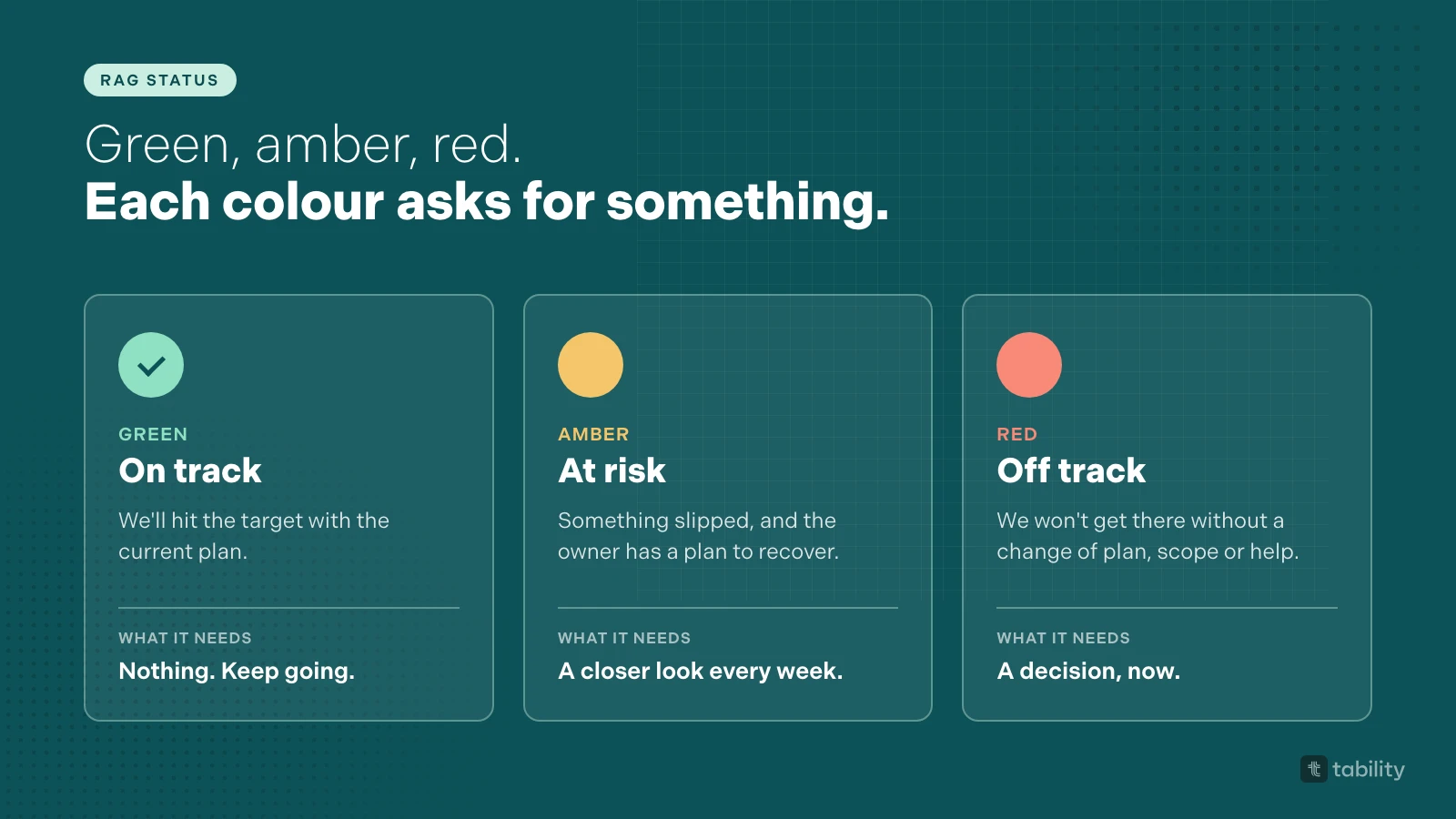
RAG stands for red, amber, green. Some teams say RYG or "traffic lights" — it's the same idea. Each colour answers one question: will we get there, and does anyone need to act?
The point of the scale is what happens next. A RAG status isn't a grade for the team — it tells everyone where attention should go. Green needs nothing, amber needs a closer look, red needs a decision.
Where RAG status shows up
You'll find RAG ratings almost anywhere work gets reported upwards:
- Project status reports, where each workstream or milestone gets a colour. See our guide to writing a status report.
- OKR check-ins, where each key result gets a confidence level every week. See how to track OKRs with a weekly check-in.
- Quarterly business reviews, where leadership scans dozens of initiatives in one sitting. More on that in what a QBR is.
- Portfolio and programme dashboards, where a PMO needs to spot the three projects in trouble out of forty.
The appeal is obvious. A busy leader can scan a page of colours in ten seconds. The problem is that ten seconds is also all it takes for a colour to mislead them.
Why most RAG reports stop being useful
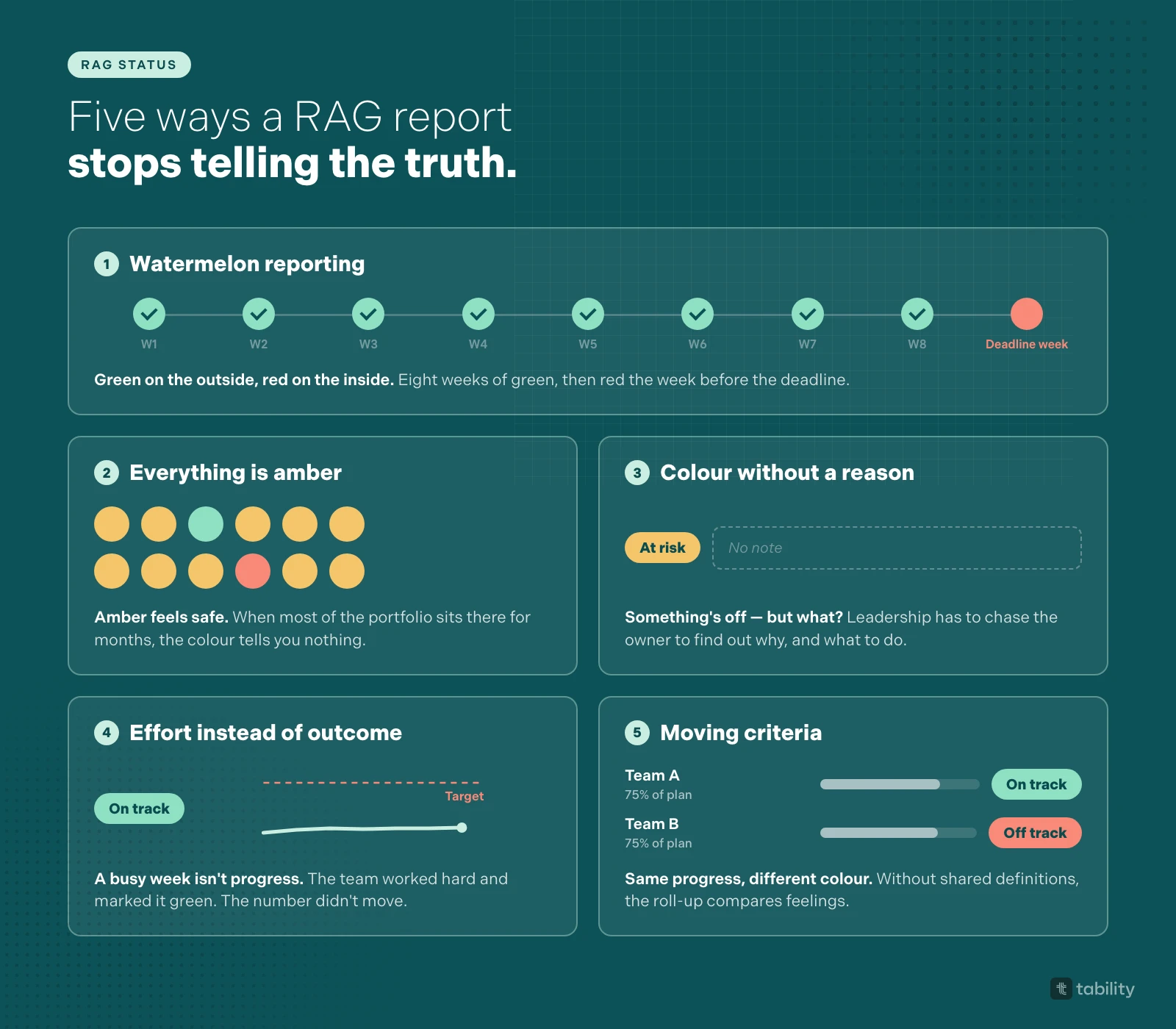
RAG reporting fails in a handful of predictable ways. If you've sat through a status meeting, you'll recognise most of them.
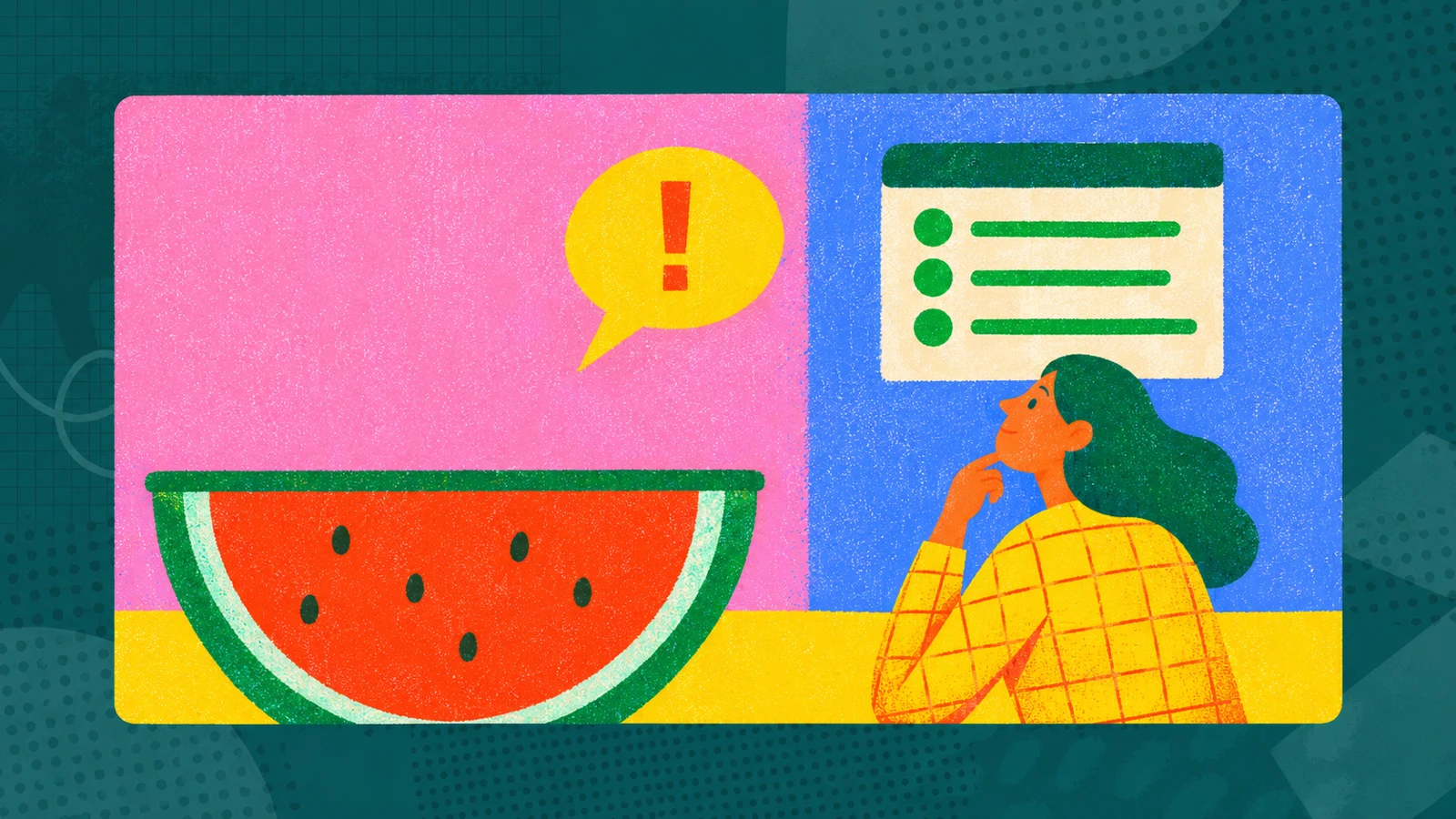
Watermelon reporting. Green on the outside, red on the inside. The project has been green for eight weeks and turns red the week before the deadline. Usually nobody hid anything — the owner was hopeful, and there was no cost to staying green one more week.
Everything is amber. Amber feels safe. It signals you're aware of risk without committing to a problem. When half the portfolio sits at amber for months, the colour carries no information at all.
Colour without a reason. "Amber" on its own tells leadership something is off, but not what, why, or what they should do. So they chase the owner, and the report saved nobody any time.
Effort instead of outcome. A team that worked hard all week marks itself green even though the number didn't move. Effort matters, but the colour should be about whether the result is coming.
Moving criteria. If one team's amber is another team's red, the roll-up is meaningless. Without shared definitions, you're comparing feelings.
How to make a RAG status mean something
Here's the thing — the colour was never the useful part. The useful part is the conversation it triggers. These rules keep that conversation honest.
Define the colours before the work starts. Write down what green, amber and red mean for your team, and share it. For a numeric target, that might be: green if you're at 90% or more of where the plan says you should be, amber between 70% and 90%, red below 70%. For a milestone, it might be days of slippage.
Rate the future, not the past. The question isn't "how did this week go?" It's "will we get there?" A goal can have a bad week and still be green. A goal can hit every weekly target and be red because the hard part hasn't started.
Never let amber or red stand alone. Every amber or red needs three things: what changed, what the owner is doing about it, and what they need. If there's no ask, say so — that's useful too.
Update it every week. A colour set at the monthly review is already stale. A weekly rhythm means a goal can't drift from green to red without anyone noticing in between.
RAG status and psychological safety
Every rule above depends on one thing: people need to feel safe saying a goal is off track. If going red gets someone hauled into a meeting to justify themselves, they'll find a way not to go red.
That shows up in two ways. Either everything stays green and you learn too late that things weren't looking good. Or everything drifts to amber and stays there — six, eight weeks in a row — so nobody ever has to admit there's a real problem.
The fix starts with how leaders react. Thank the people who flag problems early. An early red is the system working, not a failure. But culture takes time, so add two simple checks that keep the colours honest in the meantime.
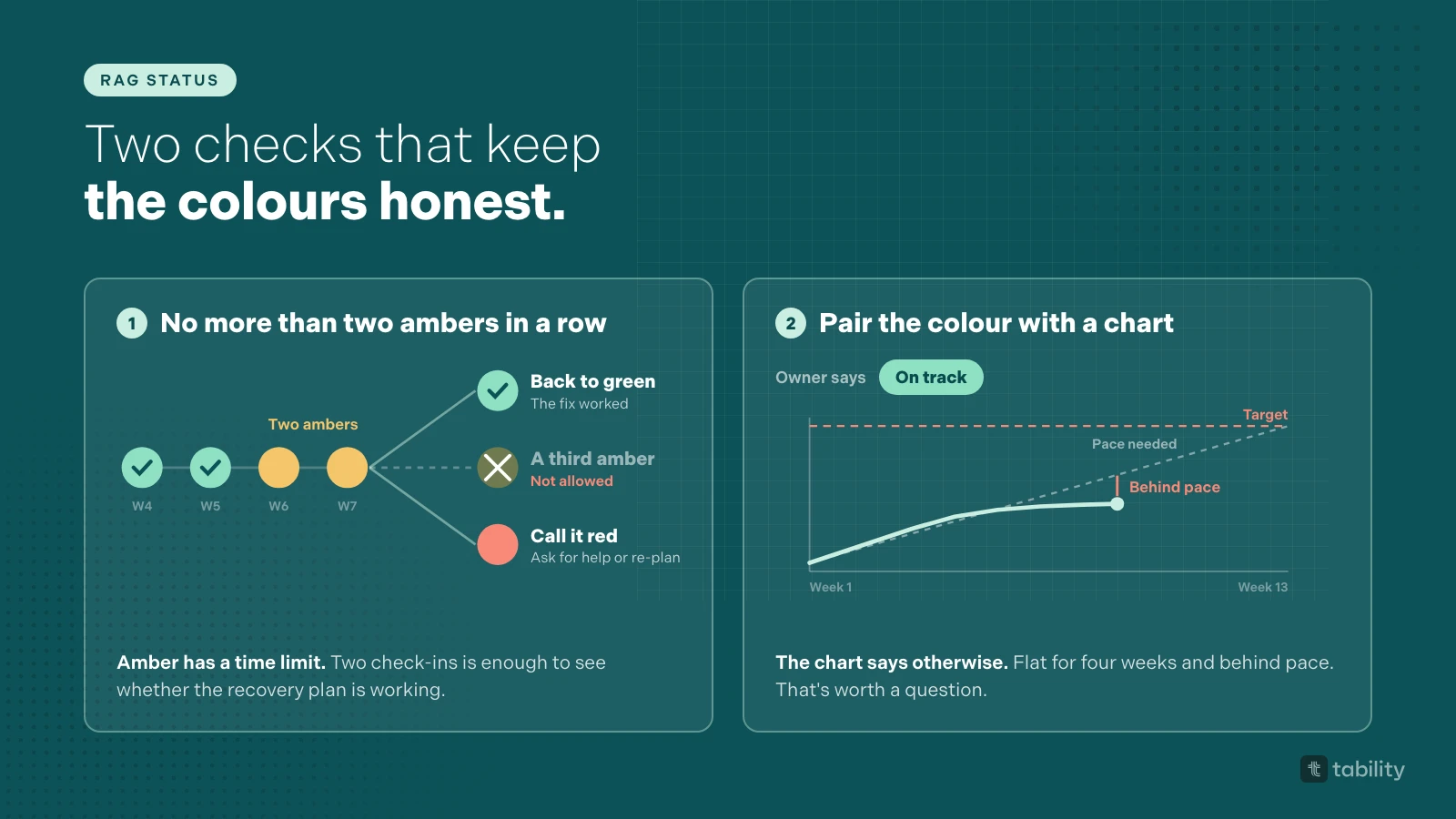
No more than two ambers in a row. Amber means "I have a plan to fix this". Two check-ins is enough to see whether the plan is working. At the third, the goal has to move: back to green, or to red with a clear ask. We cover this rule in more detail in how to score your OKRs.
Pair the colour with a chart. If the goal has a number, plot it against the pace you need to hit the target. When someone says green but the line has been flat for a month, it shows up in the meeting without anyone having to call it out. The owner can still overrule the chart — a launch next week might fix everything — but then the note should say so.
RAG variations worth knowing
A few common twists on the three colours:
- Blue or grey for done. Often called RAGB. It stops completed work from sitting in green and inflating the picture.
- Numeric thresholds. Tie each colour to a percentage of plan, as above. Less room for optimism, but only works for goals with a clean number.
- Confidence levels. Many OKR teams use "on track", "at risk" and "off track" instead of colours. It's the same scale, with words that make it obvious the rating is about the future.
If you track confidence across many goals, you can also turn it into one number. Tability's Net Confidence Score is the percentage of goals on track minus the percentage off track. It gives you a trend line for the whole portfolio instead of a wall of colours.
RAG status in Tability
That's why Tability builds the RAG status into the check-in itself. Every week, each owner updates their number and picks a confidence level — on track, at risk or off track — with a short note on what's happening. The colour and the reason arrive together.
From there, dashboards and reports are generated from the check-ins rather than assembled by hand, so leadership sees the reds as soon as they appear instead of at the end of the month. You can even let agents draft the status updates for your team.
For the bigger picture on reporting, see our weekly status report template and the guide to writing an OKR status update.
Frequently asked questions
What does RAG stand for?
RAG stands for red, amber, green. It's a traffic-light rating used in project and strategy reporting to show whether work is on track (green), at risk (amber) or off track (red).
What is a RAG status in project management?
In project management, a RAG status rates a project, workstream or milestone against its plan. Green means it's expected to finish on time and within scope, amber means it has slipped but has a recovery plan, and red means it needs a decision or help to get back on track.
What does amber mean in a RAG status?
Amber means at risk. Something has slipped, but the owner believes they can recover with the current plan. An amber status should always come with what changed and what's being done about it.
Should we use RAG status or percentages?
Use both. The percentage tells you where you are today. The RAG status tells you whether you expect to get there. A goal at 40% can be green if the plan was always back-loaded, and a goal at 80% can be red if the remaining 20% is the hard part.
Start with one honest colour
Pick one goal your team cares about this quarter. Agree what green, amber and red mean for it, then check in on it every week with a colour and a sentence. You'll learn more from that one honest signal than from a page of green.
If you want the colours and the reasons in one place without the Friday chase, try Tability and set up your first check-in today.