Ask ten managers to write a SMART objective and you'll get ten technically correct answers. Specific? Check. Measurable? Check. Time-bound? Check. Now ask those same ten managers what happened to that objective six weeks later, and the room goes quiet.
That's the real story of SMART objectives. The framework is very good at making sure a goal is well-written. It has almost nothing to say about what happens after you write it down, which is exactly the part most objectives fail at.
So let's take it in order: what a SMART objective actually is, where the acronym came from, and then the harder question: why 'well-written' and 'gets done' are not the same thing.
What does SMART stand for?
SMART is a checklist for writing a goal that can't wriggle out of being specific. The five letters:
- Specific: names exactly what will change, for whom, and by how much. Not 'improve customer satisfaction', but 'reduce average support ticket resolution time'.
- Measurable: has a number attached, so two people looking at it later agree on whether it happened.
- Achievable: is realistic given the team's actual capacity and resources, not an aspirational stretch dressed up as a plan.
- Relevant: connects to something the business or team actually cares about this quarter, not just something that's easy to measure.
- Time-bound: has a deadline. Without one, 'increase revenue' just sits there forever, technically in progress.
The acronym is usually traced back to George T. Doran, who published 'There's a S.M.A.R.T. way to write management's goals and objectives' in Management Review back in 1981. Worth noting: Doran wrote it for managers setting corporate objectives, not for New Year's resolutions. The framework was always meant for the workplace, aimed at replacing vague annual objectives ('do better in sales next year') with something a manager could actually hold someone to.
Over the decades, a few of the letters have picked up alternate meanings depending on who's teaching the workshop. 'Achievable' sometimes shows up as 'Attainable'. 'Relevant' occasionally becomes 'Realistic', which then bumps 'Achievable' out entirely. None of these variants change what the framework does. They're all still checking the same thing: does this sentence describe a specific, provable, sensibly-scoped, on-topic goal with a deadline attached.
SMART objectives, SMART goals, SMART criteria: is there a difference?
Not really, and it's not worth losing sleep over. 'Objective' is the more formal, corporate-planning word Doran actually used. 'Goal' is the everyday synonym most people reach for. 'Criteria' refers to the five checks themselves, not the goal they're being applied to. If what you've written passes the five checks above, call it whatever your team already calls it.
If you're after the theory covered here, that's fine, but if you'd rather skip ahead to ready-made SMART goals for work or a fill-in-the-blanks SMART goals template, we've already written both.
Where SMART objectives actually fall short
Here's the problem: SMART tells you whether a sentence is well-formed. It says nothing about whether anyone will act on it.
A SMART objective can pass every single check on the list and still die quietly in a planning deck. Nothing in the framework says who owns it once the meeting ends. Nothing says how often someone checks whether it's on track. Nothing says what happens when it starts to slip, which is exactly the moment that matters most and the one SMART has nothing to say about.
To be frank, this isn't a flaw in Doran's original idea. He was solving a narrower problem: getting managers to stop writing objectives so vague that nobody could tell, six months later, whether they'd been hit. SMART solves that problem well. It was never designed to be a tracking system, an accountability structure, or a cadence, and treating it like one is where most teams quietly go wrong.
| Question | A SMART objective (as written) | The same objective, tracked |
|---|---|---|
| Who owns it? | Not required by the framework | One named owner, always |
| How often is it checked? | Not specified | Weekly or fortnightly, on a fixed day |
| What happens when it slips? | No built-in signal | Flagged the same week, not at the deadline |
| Where does it live? | A doc, a slide, a spreadsheet cell | A live Key Result other people can see |
The table above is the actual gap. SMART gets you a well-written sentence. It doesn't get you a system for keeping that sentence honest three months later.
Turning a SMART objective into something that actually gets tracked
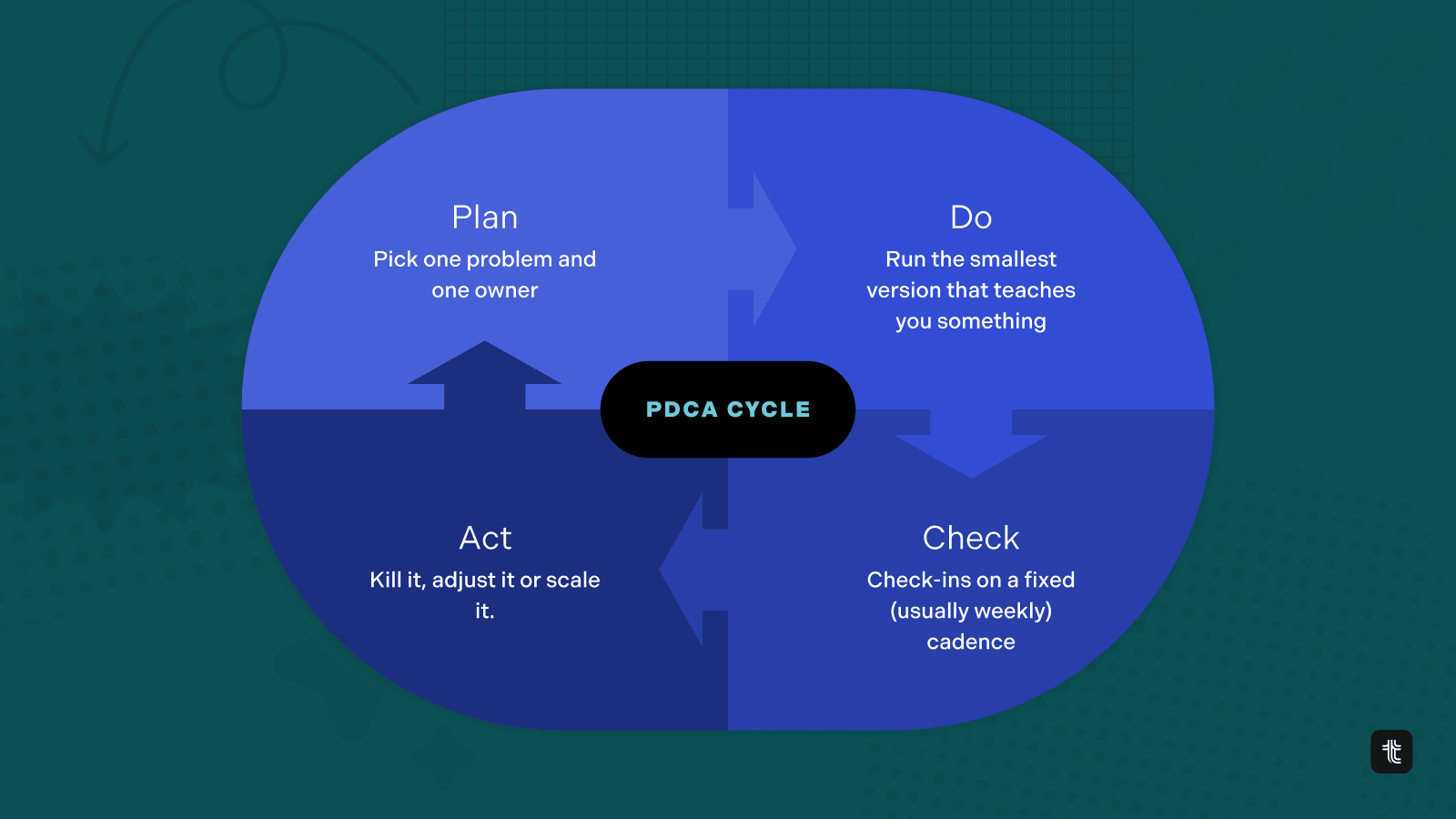
This is where OKRs earn their keep. An OKR takes a SMART-style objective and pairs it with one or two measurable Key Results, then puts both on a fixed cadence, usually a weekly check-in, that forces someone to update progress and say out loud whether it's still on track. The objective doesn't change. What changes is that it now has a heartbeat.
In practice, this is usually the job of StratOps: the function responsible for making sure a goal that looked great in a planning document actually gets a weekly pulse, a single named owner, and a real decision when it stalls, instead of a status update nobody reads. Without that function, even the most carefully worded SMART objective tends to go quiet the same way ours did in that meeting room.
Tools like Tability are built around exactly this gap: you write the SMART objective once, attach it to a Key Result, assign one owner, and run the weekly check-in that decides whether it's still on track, without bolting a separate project tracker onto the side just to keep everyone honest.
A worked example
Take a fairly typical SMART objective: 'Increase organic blog traffic from 40,000 to 60,000 monthly visits by the end of Q3, by publishing two SEO articles per week.'
Run it through the checklist and it passes cleanly. Specific (organic blog traffic, this blog). Measurable (40,000 to 60,000). Achievable (assuming the team has capacity for two posts a week). Relevant (assuming organic traffic actually matters this quarter). Time-bound (end of Q3).
Now track it. The Key Result becomes 'monthly organic visits', updated weekly instead of guessed at in September. The content lead owns it, by name, not 'the marketing team'. Every Monday, the number gets logged and compared to where it needs to be by the end of Q3. If August rolls around and traffic is stuck at 45,000, that's visible in week 32, not discovered in a scramble during the Q3 wrap-up. Same SMART objective. Completely different odds of actually landing.
Common mistakes when writing SMART objectives
- Measurable but meaningless. Tracking an output ('publish 10 blog posts') instead of the outcome it's meant to produce ('increase organic traffic'). The number moves. Nothing that matters does.
- No named owner. 'The team' is not an owner. If a problem shows up, everyone assumes someone else is handling it.
- Time-bound only at the deadline. One date, three months out, with nothing in between. That's a countdown, not a cadence.
- Written once, revisited never. Plenty of SMART objectives are drafted carefully in a planning session and never opened again until the retro.
- 'Achievable' nobody actually checked. The word gets ticked off by habit, without anyone comparing the target to the team's real capacity that quarter.
Where this leaves you
Those ten managers from the start weren't bad at writing goals. SMART did its job: every one of those objectives was specific, measurable and time-bound. What none of them had was a reason to open the document again before the deadline.
That's the part worth fixing, and it's not a wording problem. If you're trying to build the habit of actually tracking SMART objectives, not just writing them well, Tability is a straightforward way to get started. Sign up free or book 30 minutes with us and we'll help you set up the cadence that keeps a good objective from going quiet.