It’s the week before Christmas. Everyone’s looking forward to a well-deserved break. You’re tying up loose ends, trying not to kick off anything too new, and—let’s be real—sneaking in a bit of last-minute gift shopping between meetings.
It’s a relaxed, joyful time… but there’s also that quiet “January is coming” feeling. Every year, we get the time off (and we absolutely should), and then we come back in early January feeling like we’re sprinting before we’ve even found our shoes.
If you want to start work on January 2nd with focus, you don’t need a big planning overhaul or a two-day offsite. You just need a bit of OKR prep—some forward thinking and a quick look back—so your goals are clear, ownership is locked in, and the first week back feels calm and decisive.
Here are five OKR conversations worth having this week to set your team up for a strong Q1.
1) Run an OKR retrospective
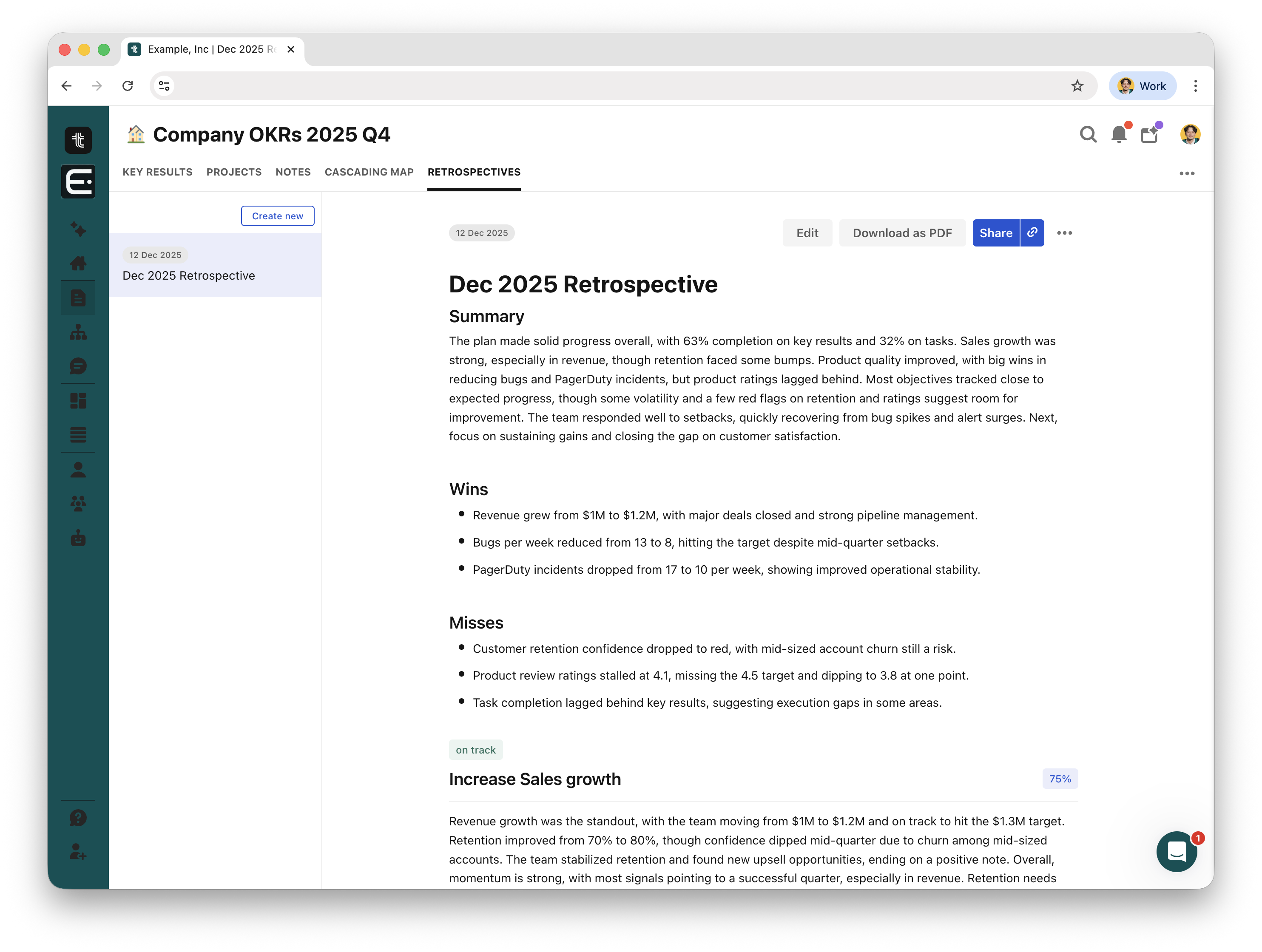
Before you write a single Q1 OKR, take 30–45 minutes to look back by running an OKR retrospective. Not to rehash every metric or replay every decision—just to capture the handful of lessons that will absolutely show up again in January if you don’t name them now. This is where you spot the “silent killers” of OKRs: KRs that were impossible to update, goals that were really just project lists, and ownership that was vague enough that everything felt like someone else’s job. A quick retro turns all of that into something useful: a few clear rules you’ll carry into Q1 so your next set of OKRs starts clean and stays believable.
ℹ️ 5 innovative retrospective meeting ideas to energise your team
The goal
Turn your last cycle into a few clear rules for Q1: what to repeat, what to stop doing, and what to change about how you set and run OKRs.
Quick agenda (30–45 min)
- 5 min: Re-state what you thought success meant this cycle (Objectives + top KRs)
- 10 min: What moved? What didn’t? (focus on outcomes, not effort)
- 10 min: What broke the system? (KR quality, ownership, resourcing, dependencies, cadence)
- 5–10 min: Decide 3–5 “rules for Q1” (non-negotiables)
Prompts to use in the room
- “Which Objective created real business impact—and what specifically caused it?”
- “Which KR did we stop trusting halfway through the quarter?”
- “Where did we confuse activity with impact?”
- “Which OKR had unclear ownership or too many cooks?”
- “What was the biggest source of friction in weekly updates?”
- “If we ran this quarter again, what would we change on day one?”
Common failure patterns to watch for (and fix)
- Activity KRs (“Ship X”, “Launch Y”) instead of impact
Lag-only KRs (you find out you failed at the end) - Too many KRs per Objective (everything matters → nothing matters)
- No real owner(shared ownership = no ownership)
Cadence mismatch (weekly check-ins, but monthly reality)
Output (keep it lightweight)
End the retro with a short list you can copy/paste into your Q1 planning doc:
- Start: (e.g., “baseline every KR”, “add one leading indicator per Objective”)\
- Stop: (e.g., “project KRs”, “more than 4 KRs per Objective”)
- Continue: (e.g., “2-week mid-quarter KR reset”, “one ownerper KR”)
2) The Q1 “north star” alignment chat
Before you start wordsmithing Objectives and debating KR targets, you need one thing: alignment on what Q1 is actually about. This conversation is where you turn a messy pile of ideas (“we should improve retention”, “we need to ship X”, “sales needs Y”) into a small set of outcomes the business is truly betting on. It also prevents the most common January failure mode: everyone coming back with their own mental model of priorities, then writing OKRs that look aligned on paper but pull teams in different directions in practice.
📚 Useful resource: Top-down vs Bottom-up OKRs
The goal
Agree on the 3–4 outcomes that matter most in Q1, and make the trade-offs explicit so OKRs don’t turn into a wish list.
Quick agenda (30–45 min)
- 5 min: What’s the business context for Q1? (constraints, opportunities, yearly targets, strategic pillars, non-negotiables)
- 10 min: List the candidate “must-win” outcomes (no solutions yet)
- 10 min: Force-rank to the top 3–4 outcomes
- 5–10 min: Write the “not doing” list (anti-OKRs)
- 5 min: Capture open questions/assumptions to validate in week 1 back
Prompts to use in the room
- “If we only win in one area in Q1, what should it be?”
- “What outcome would make leadership say: ‘Yep, Q1 was a success’?”
- “What are we currently over-investing in that doesn’t move the needle?”
- “What can’t slip, even if everything else does?”
- “What assumptions are we making that could break this plan?”
Common failure patterns to watch for (and fix)
- Mixing outcomes and projects (“launch X” is a solution, not a north star)
- Too many priorities (if you have 7, you have none)
- No explicit trade-offs (everything stays “important”)
- Ignoring constraints (capacity, hiring, tech debt, compliance, seasonality)
- Hand-wavy success (no clear definition of “winning”)
Output (keep it lightweight)
Leave this meeting with two things you can paste directly into Q1 OKR planning:
- Q1 north star statement (3–5 sentences): what matters most and why
- Anti-OKRs (3–7 bullets): what you’re not focusing on in Q1 (even if it’s tempting)
3) The Objective drafting session
Once you’ve aligned on the Q1 north star, you can finally write Objectives without guessing what leadership really wants. This session is where priorities turn into clear, outcome-based statements that teams can rally around. Done well, Objectives become the “why” that makes trade-offs easy later: when new work shows up in January (it will), you can quickly decide whether it supports an Objective or it’s just noise wearing a priority hat.
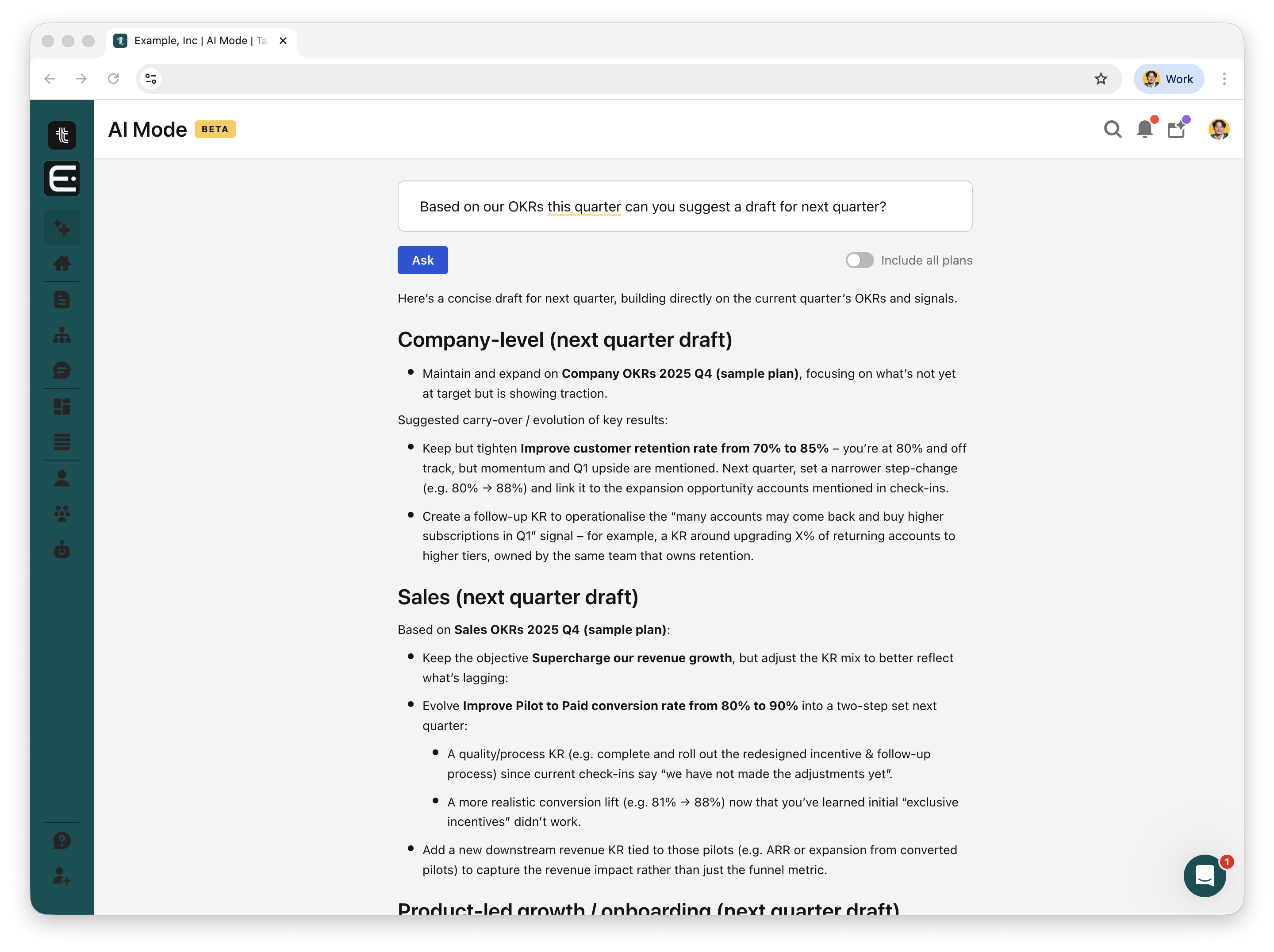
ℹ️Tip: Use the goal-setting features in Tability to draft OKRs in seconds. If you aren’t a Tability user, you can also access a free version of our OKR generator to create a working draft in seconds..
The goal
Draft a small set of clear, outcome-based Objectives for Q1 that are easy to understand, easy to explain, and hard to misinterpret.
Who’s involved
- Facilitator: OKR lead / Chief of Staff / strategy ops (keeps language clean and consistent)
- Core attendees (5–10 people):
- Exec sponsor (or the functional leader accountable for Q1 outcomes)
- Functional leads who will own Objectives (Product, Eng, GTM, CS, etc.)
- A metrics/data partner (optional but helpful for grounding language in reality)
- Optional: A strong IC or PM per function to help keep Objectives understandable (not executive jargon)
Quick agenda (45–60 min)
- 5 min: Re-read the Q1 north star + anti-OKRs (set boundaries)
- 10 min: Draft candidate Objectives (silent writing works best)
- 15 min: Group and consolidate (merge duplicates, remove projects)
- 10–15 min: Pressure-test each Objective (clarity + outcome focus)
- 5–10 min: Finalise the shortlist (usually 3–5 Objectives total)
Prompts to use in the room
- “If we hit this Objective, what changes in the business?”
- “Is this describing an outcome… or a plan?”
- “Would a new hire understand this Objective in 10 seconds?”
- “What does success look like by end of Q1—without referencing a project?”
- “Which team is best positioned to own this Objective?”
Common failure patterns to watch for (and fix)
- Project-shaped Objectives (“Launch X”, “Implement Y”)
- Too many Objectives (spreads focus thin and creates OKR sprawl)
- Vague language (“Improve”, “Enhance”, “Optimise” with no clear meaning)
- Overlapping Objectives (same intent, different wording → confusion later)
- Team-based Objectives (“Marketing Objective”) instead of business outcomes
Output (keep it lightweight)
Leave with:
- 3–5 Objectives max written in plain language
- A named owner for each Objective (even if KRs come later)
- A quick note for each Objective: “why this matters in Q1” (1 sentence)
4) The cadence + ownership lock-in
You can have great Objectives and perfectly worded KRs… and still have your OKRs die by mid-January. Not because the goals were wrong, but because the system around them never got locked in: ownership was fuzzy, updates were inconsistent, and reviews didn’t lead to decisions. This final conversation is the glue. It turns your OKRs from “a set of goals” into an operating rhythm your team can actually maintain when everyone’s busy.
The goal
Make Q1 OKRs runnable: assign clear ownership, agree on a lightweight update cadence, and define what happens when things go off-track.
Who’s involved
- Facilitator: Chief of Staff / OKR lead (drives clarity, keeps it lightweight)
- Core attendees (5–10 people):
- Exec sponsor (or whoever will run the monthly OKR review)
- Objective owners + KR owners
- Team leads responsible for major dependencies
- Optional:
- Ops/Finance (if resourcing or budget trade-offs will come up often)
- Data/RevOps (if KRs rely on dashboards that need upkeep)
Quick agenda (30–45 min)
- 5 min: Confirm the final OKR set (Objectives + KRs + owners)
- 10 min: Lock in ownership rules (Owner, contributors, expectations)
- 10 min: Decide the weekly check-in format (what’s required, where it lives)
- 10 min: Define the monthly review (who attends, what decisions get made)
- 5 min: Set escalation triggers (what “red” means and what happens next)
Prompts to use in the room
- “Who is the single ownerfor each KR?”
- “What’s the minimum useful weekly update we’ll accept?”
- “Where do updates live so they’re easy to find?”
- “What decisions do we expect to make in monthly reviews?”
- “What’s the trigger for escalation, rescoping, or adding resources?”
- “Which dependencies need an explicit SLA to avoid silent delays?”
Common failure patterns to watch for (and fix)
- Shared ownership (everyone owns it → no one owns it)
- Update burden too high (people avoid it, then leaders stop trusting it)
- Cadence without decisions (reviews become status theatre)
- No escalation path (KRs stay red for weeks with no intervention)
- Updates scattered everywhere (Slack, docs, spreadsheets—nothing is reliable)
Output (keep it lightweight)
Leave with a simple “operating contract” for Q1:
- Owners:
- Objective owner per Objective
- One ownerper KR
- Weekly check-in (15 min async + 15 min sync, optional):
- Progress update (number)
- Confidence (green/yellow/red)
- 1–2 sentences: what changed + what’s blocked
- Monthly OKR review (45–60 min):
- Decisions: rescope, re-prioritise, add/remove resources, unblock dependencies
- Escalation triggers:
- Red 2 weeks in a row → must propose a fix (scope, plan, or resources)
Blocked >7 days → escalate to dependency owner / exec sponsor
- Red 2 weeks in a row → must propose a fix (scope, plan, or resources)
Wrap-up: come back in January with momentum (not meetings)
If you do nothing else this week, have these five conversations. They’re short, they’re practical, and they eliminate the “January scramble” where everyone tries to remember what matters while new work floods in. By the time you’re back on January 2nd, you’re not starting planning—you’re executing against goals that already make sense.
A quick week-before-Christmas checklist
✅ Run the OKR retro and capture your “start/stop/continue” rules
✅ Align on the Q1 north star (and write the anti-OKRs)
✅ Draft 3–5 Objectives
✅ Pressure-test KRs for measurability + usefulness
✅ Lock in owners, cadence, and escalation rules
Tability makes it simple
If you’re doing this in docs and spreadsheets, the conversations are still valuable—but you’ll spend extra time chasing context, wrangling versions, and manually driving follow-through. Tability reduces that overhead so you can focus on the decisions.
- Create retrospectives on your OKRs so you have a clear history of the quarter—highlights, changes, and discussion points—ready before you even walk into the retro session.
- Draft goals in seconds with AI by using previous OKRs to automatically generate a strong starting plan for the coming quarter. Tip: Try our free OKR Generator
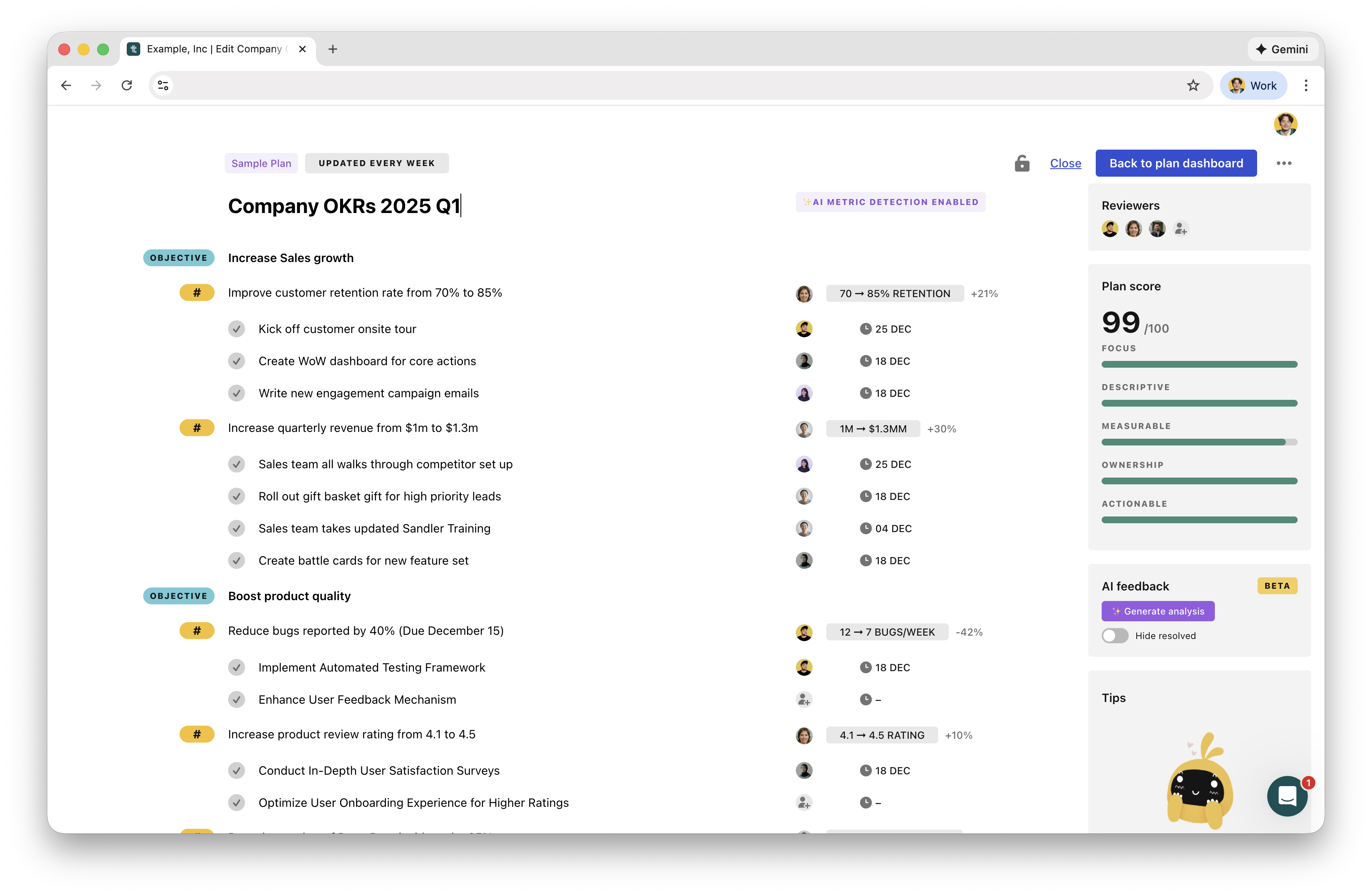
- Invite owners and stakeholders as reviewers on OKR drafts so they can contribute comments and edits in one place (no messy doc threads or “which version is latest?”).
- Assign owners and let Tability drive the cadence by prompting check-ins and reinforcing good habits automatically—so the system stays alive when January gets busy.
- Automate your entire tracking process by having AI-generated check-ins to supplement and start conversations on a weekly cadence with your teams.
The result is simple: fewer planning headaches, faster alignment, and OKRs that stay trustworthy all quarter long.


.jpg)
.png)