Most teams treat OKR planning like tax season. Once a quarter everyone blocks out a day, runs a workshop, leaves with a shiny spreadsheet, and then forgets about it until the next quarter. Three months later the OKRs are stale, half-abandoned, and mostly irrelevant to what anyone is actually working on.
The problem isn't that teams don't know how to write OKRs. It's that they treat OKR planning as an event instead of a cycle. Good OKRs come from a repeating rhythm: annual direction setting, quarterly goal writing, weekly check-ins that catch drift early.
This guide walks through the full OKR planning cycle, how to run each step, the mistakes that kill momentum, and a few templates to get you started.
What OKR planning actually is
OKR planning is the process of translating a company's strategic priorities into measurable Objectives and Key Results, then building the rhythm that keeps those OKRs alive between planning sessions.
In practice, this means three activities, not one:
- Setting direction (annual): Where are we going this year? What strategic bets matter?
- Writing OKRs (quarterly): What are the three to five things we'll concretely push forward this quarter?
- Tracking progress (weekly): Are we on track? What's changed? What needs attention?
Most content about OKR planning focuses only on the middle one. That's where most teams fail. Writing OKRs without the direction-setting that sits above them and the tracking cadence that sits below them gives you three months of wasted effort.
The OKR planning cycle: Annual, quarterly, weekly
The OKR planning cycle has three loops running at different speeds. They nest inside each other.
Annual: direction setting
Once a year leadership steps back and sets the company-level direction. This usually happens four to six weeks before the new fiscal year starts. The output is not OKRs. It's a short list of strategic priorities, usually three to five, that every team will rally behind.
This is the moment to ask the hard questions. What are we betting on? What are we not doing this year? Where does the company need to be by December?
Teams that skip this step end up with quarterly OKRs that drift. Every quarter feels like a reset because there's no anchor keeping them pointed in the same direction.
Quarterly: writing OKRs
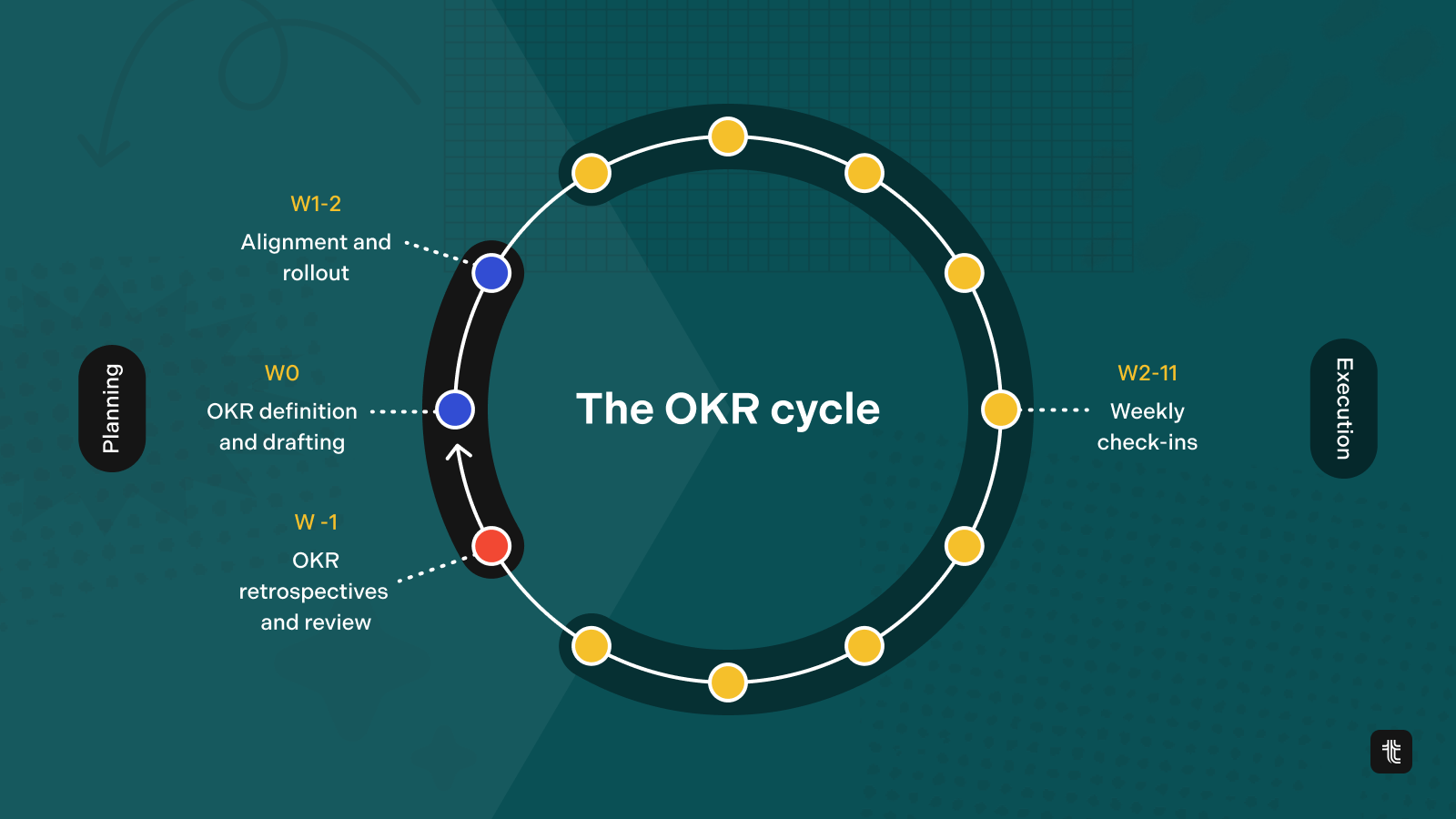
Two to three weeks before each new quarter, teams draft their OKRs. The best cadence I've seen runs like this:
- Week -3: leadership drafts company OKRs
- Week -2: teams draft their OKRs, aligned to company OKRs
- Week -1: cross-functional review and alignment, adjustments made
- Week 0: OKRs are published and live
This is where most templates live. It's also where most teams spend 80% of their planning effort. If you want a quick walkthrough of how to write OKRs before your next session, that's the place to start. Worth doing well, but not worth optimising at the expense of the other two loops.
Weekly: tracking progress
Every week each OKR owner posts a check-in. Current value, confidence rating, what's on track, what's blocked. If you want a simple version of this that works on day one, weekly check-ins are the easiest place to start. Aggregate them across the team and leadership can see, at a glance, which OKRs are flowing and which ones need intervention.
This is the loop most teams don't run. It's also the single biggest predictor of whether OKRs will survive the quarter. If you're not checking in weekly, your OKRs are already dying.
OKR implementation timeline
How to run an OKR planning session
When teams say 'OKR planning' they usually mean the quarterly writing session. Here's how to run one that doesn't waste a day.
Before the session (one week out)
- Share the company OKRs. These must exist before team planning starts.
- Ask each person or team lead to draft two or three candidate objectives.
- Collect drafts into a shared doc so the session isn't starting from scratch.
During the session (90 to 120 minutes is plenty)
- Review last quarter's OKRs. What scored well, what didn't, what did we learn?
- Review company OKRs. Any questions before we write team-level ones?
- Review the candidate objectives. Group, cut, merge, and prioritise.
- For the top three, write the key results together. Each KR should be measurable and outcome-focused, not a to-do list.
- Assign owners. Every OKR has one name next to it.
After the session
- Publish the OKRs somewhere everyone can see them.
- Set up the weekly check-in cadence from day one.
- Schedule the mid-quarter review (week 6) on the calendar now.
If you need more than two hours, something is wrong with your pre-work. If you need less than an hour, you didn't dig into the tradeoffs.
The mistakes that kill OKR planning
A few patterns come up again and again.
- Planning in isolation. A team writes OKRs without seeing the company ones, or company OKRs are written without hearing from teams. The result is misalignment that only surfaces mid-quarter. Some teams use strategic pillars to maintain a consistent theme across team goals.
- Treating OKRs as to-do lists. 'Launch feature X' is not a key result. It's an initiative. A KR measures the outcome: 'increase activation rate from 40% to 55%'. Keep the what (objective) and the measure (KR) separate from the how (initiatives).
- Setting too many. Three OKRs per team, five key results per objective, maximum. Any more and focus evaporates. Every additional OKR halves the likelihood of any one of them succeeding.
- Skipping the mid-quarter review. Week six is the right time to check if the quarter's OKRs still make sense. Sometimes they don't, and adjusting early is infinitely better than realising in week eleven. There are a few of these OKR meetings you should schedule, to maintain urgency and focus on the big picture.
- No tracking cadence. This is the big one. OKRs without a weekly rhythm are just a document. The planning session was a waste of time if no one looks at the OKRs until the next one.
OKR planning templates to get you started
Rather than reinventing the wheel, most teams use a simple template for their OKRs. You can browse a set of OKR tracking templates to borrow from, or start with the skeleton below.
- Objective: a short, qualitative statement of what you want to achieve. One sentence. Ambitious but clear.
- Key Result 1: a measurable outcome. From X to Y by the end of the quarter
- Key Result 2: same.
- Key Result 3: same.
- Owner: one person accountable.
- Initiatives: the projects that will move the KRs. These sit under the OKR, not inside it.
If you're savvy with AI, it's pretty easy these days to use a LLM or use Tability's AI-powered editor to help you write goals in a prompt based chat.
For the planning session itself, a simple agenda template:
- Retrospective on last quarter: 20 minutes
- Review company OKRs: 10 minutes
- Prioritise team objectives: 30 minutes
- Draft key results together: 40 minutes
- Owners and next steps: 10 minutes
Ninety minutes. Done.
Where Tability fits in OKR planning
Most OKR tools pick a lane. Planning, tracking, or reporting. The gap between those lanes is where OKRs go to die, because the team that ran a great planning session has to hand off to a different tool to actually track the goals, then a third tool to report on them. Tability covers the full cycle from the first objective you draft to the retrospective at the end of the quarter.
Planning with AI
Writing OKRs from scratch is the part nobody enjoys. Tability AI mode takes the half-baked objectives people bring to the whiteboard and helps sharpen them into proper key results. Paste the rough draft, answer a few questions, land on measurable outcomes. You can feed in strategy docs and company context so the OKRs you write are grounded in what the business actually cares about. What used to take two hours of wordsmithing takes twenty minutes.
ℹ️ Also see: How to write OKRs with AI (and actually track them)
Tracking, the part that matters most
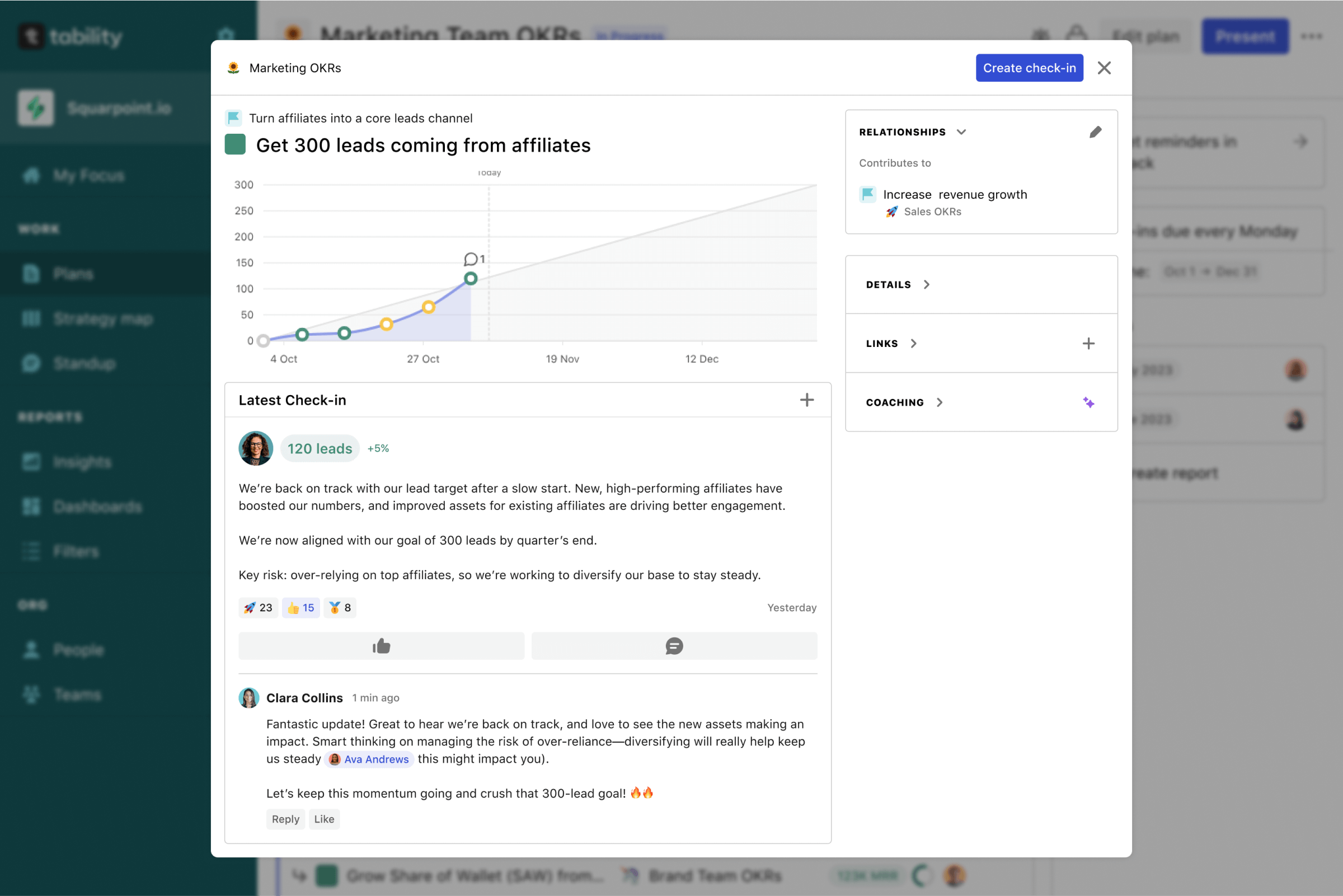
Tracking is where most OKR processes fall apart, and it's the part Tability was built for. Weekly check-ins, confidence scoring, aggregate views across every team, initiatives linked to the outcomes they're supposed to move. If your OKRs aren't being checked on regularly, they aren't OKRs. They're notes in a doc.
Reporting without the fire drill
Someone always has to stitch the weekly update together, build the board slide, chase owners for status. The Tability MCP server lets you query your OKRs from Claude or ChatGPT directly, so pulling a monthly rollup is one question away. Scheduled prompts take it further: set up the exact report you want once, have it delivered every Monday forever. No more last-minute scramble before the leadership review.
ℹ️ Get automated OKR reports in your inbox every morning.
Meetings and retrospectives
When the quarter wraps, the retrospective is easier because every check-in, confidence score, and initiative update is already logged. You don't have to reconstruct what happened from chat threads.
Planning, tracking, reporting, retrospectives. Same tool, same data, no handoffs.
Start planning OKRs that stick
If you're setting up OKR planning for your team for the first time, or trying to rescue a process that's already drifting, Tability is the easiest way to start. Sign up free or book 30 minutes with us and we'll help you figure out a cadence that actually sticks.


.jpg)

.png)