
Most teams treat OKR meetings like any other status update. They gather everyone in a room, go around the table, and ask "how's your OKR going?" The answers are vague. The conversation stalls. Twenty minutes later, nothing has changed.
OKR meetings aren't supposed to be status updates. They're decision-making forums. And if yours feel like the former, it's usually because you're running the wrong type of meeting at the wrong time.
There are four distinct OKR meetings, each with a different purpose, a different audience, and a different agenda. Get them right and your OKRs process actually works. Conflate them and you get meetings nobody wants to attend.
Why most OKR meetings miss the point
The problem isn't that teams don't meet enough. Most teams over-meet and under-decide. OKR meetings fail because they're run as just reporting exercises rather than planning exercises.
When someone says "we're at 60% on this key result," the room needs to answer:
- Is that good?
- Is that on track?
- What needs to change?
Most OKR meetings skip those questions entirely and move on.
Good OKR meetings are uncomfortable in the right way. They surface blockers. They force prioritisation decisions. They redistribute attention to what's actually at risk. That discomfort is a feature, not a bug.
The four OKR meetings every team needs
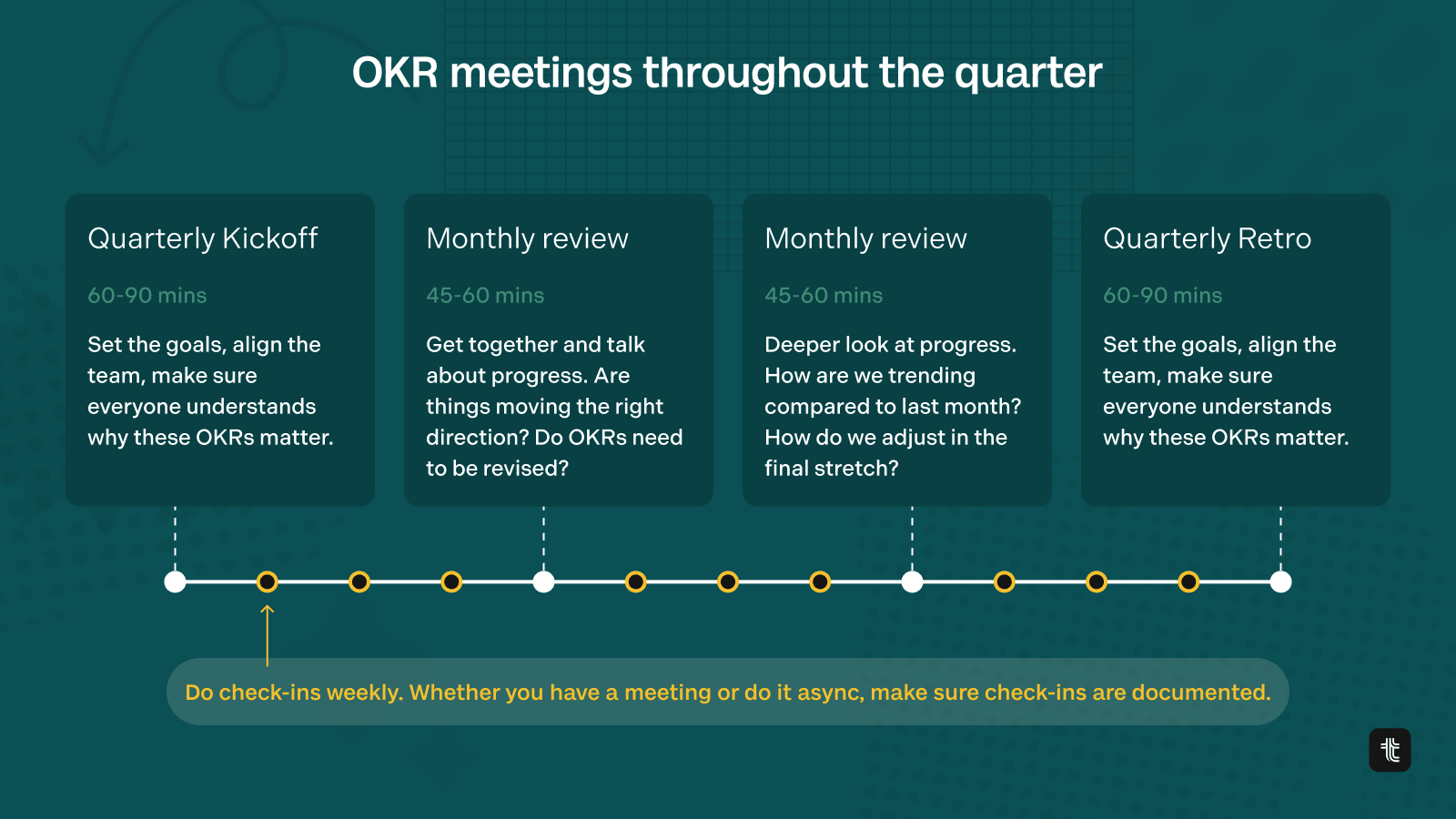
OKRs run on a cycle. Quarterly goals need quarterly planning, monthly pulse-checks, and weekly accountability. This helps teams maintain focus on what needs to be done over a long period time and keeps team engagement high. Each meeting serves a different function in that cycle:
- Quarterly kickoff (once per quarter): Set the goals, align the team, make sure everyone understands why these OKRs matter.
- Weekly check-in (every week): Brief and operational. What moved? What's blocked? What do we need to decide this week?
- Monthly review (once per month): Deeper look at progress. Are we on track for the quarter? Do any OKRs need to be revised?
- Quarterly retrospective (once per quarter): Close out the quarter. What did we achieve? What did we miss? What do we do differently next quarter?
Most teams run the weekly check-in reasonably well and skip everything else. That's why their OKR process feels like busywork by week six.
The quarterly OKR kickoff meeting
When: First week of each quarter
Duration: 60-90 minutes
Who: The full team
The kickoff is where you introduce the quarter's OKRs, not just announce them. There's a difference. Announcing is "here are our OKRs for Q2." Introducing is "here's why we chose these OKRs, how they connect to the company strategy, and what success looks like at the end of the quarter.
A kickoff agenda that works:
- Context (15 mins): Where did we land last quarter? What did we learn that shaped this quarter's goals?
- OKR walkthrough (30 mins): Go through each objective and its key results. For each KR, explain: what does hitting this actually look like? Why this number, not a different one?
- Questions and alignment (20 mins): Let the team challenge the goals. This is where you catch misalignment before it becomes a mid-quarter problem.
- Ownership and cadence (10 mins): Who owns each KR? How will you track progress? When do you check in?
The goal of the kickoff isn't to get approval. It's to make sure every person in the room can explain the OKRs back to you in their own words.
The weekly OKR check-in
When: Same time each week, every week
Duration: 15-30 minutes
Who: The team responsible for the OKRs
The weekly check-in is the heartbeat of your OKR process. It's short, structured, and focused on movement. Not feelings about movement.
The format should be the same every week, so there's no setup cost. Everyone knows what they're walking into.
A weekly check-in agenda:
- Score update (5 mins): Each KR owner reports the current score. Not a narrative, just the number and a confidence rating (on track / at risk / off track).
- Blockers and decisions (15 mins): What's preventing progress? What decisions need to be made this week? This is the only part of the check-in that requires active discussion.
- Next actions (5 mins): What specifically is happening before next week's check-in?
Check-in meetings work best when teams submit progress updates before the meeting, not during it. When everyone's score and blocker is visible before you gather, the live time goes to decisions, not data collection.
⚠️ Important! Make sure that weekly check-ins are not just a meeting, but also written down. For many teams this becomes too cumbersome to do on a weekly cadence, so going async for check-ins is a great option. Use a OKR software like Tability to help drive that cadence and keep of record of progress that you can look back on in your monthly and quarterly reviews.
The monthly OKR review
When: End of each month (months 1 and 2 of the quarter)
Duration: 45-60 minutes
Who: Team leads and relevant stakeholders
The monthly review sits between the granularity of the weekly check-in and the big-picture view of the quarterly retrospective. Its job is to catch problems early enough to fix them.
By the end of month one, you have real signal. Some KRs are tracking well. Others have stalled. A few are already clearly unachievable as written. The monthly review is where you make the call.
A monthly review agenda:
- Progress by KR (20 mins): Walk through each key result. Actual score vs expected score at this point in the quarter. What's the trend?
- OKR health check (15 mins): Which KRs are at risk? What would it take to get them back on track? Are any KRs no longer relevant given what's changed?
- Adjustments (10 mins): Make any necessary changes. This might mean updating a KR's target (with justification), deprioritising an initiative, or escalating a blocker the team can't resolve on their own.
One important point: adjusting a KR mid-quarter is not failure. It's good judgement. The goal is to keep the quarter's work meaningful, not to protect a number you set with incomplete information.
The quarterly OKR retrospective
When: Last week of the quarter
Duration: 60-90 minutes
Who: Full team
The retrospective closes the loop. It turns the quarter's experience into better decision-making next quarter.
Most teams skip this meeting or rush it. That's a mistake. The retrospective is where your OKR process gets better and where business accountability becomes real. Without it, you're just running the same quarter over and over.
A retrospective agenda:
- Results review (20 mins): Final scores for all KRs. Which did we hit? Which did we miss? No editorialising yet, just the facts.
- What worked (15 mins): Where did we make real progress? What processes, decisions, or behaviours drove that?
- What didn't (15 mins): Where did we fall short? Was it execution, goal-setting, resource constraints, or something external?
- Next quarter inputs (15 mins): What should we do differently? What should we carry forward? Are there OKRs we should kill, or continue because they're multi-quarter goals?
The output of the retrospective should directly inform the next kickoff. If those two meetings don't talk to each other, you're running OKRs in isolation rather than as a system.
How to build your OKR meeting cadence
The four meetings work together as a system. Here's what a full quarter looks like:
- Week 1: Quarterly kickoff
- Weeks 2-12: Weekly check-ins (every week, no exceptions)
- End of month 1: Monthly review
- End of month 2: Monthly review
- Week 13: Quarterly retrospective, followed by next quarter's kickoff
The common mistake is treating these as optional. Teams skip the monthly review because the quarter is "going fine." They skip the retrospective because "we'll debrief next quarter." By the time they realise something went wrong, it's too late to fix it.
The other common mistake is over-meeting. More OKR meetings don't mean better OKRs. The four meetings above are sufficient. If your team needs more check-ins than this, the problem usually isn't meeting frequency. It's goal clarity.
Running OKR meetings without the overhead
One reason OKR meetings feel heavy is that the data isn't ready when you sit down. You spend the first ten minutes collecting updates from people who haven't had time to prepare. The meeting runs long. Nobody leaves with clear decisions.
The fix is separating the update from the discussion. When team members submit their OKR progress before the meeting (with a score, a confidence rating, and a brief note on blockers), the live time is spent on what actually needs human conversation.
Tability is built for exactly this. Teams use it to run async check-ins throughout the week, and come to their OKR meeting with progress already visible to everyone. The conversation starts at "here's what's at risk and why" rather than "let me find the spreadsheet." It takes the reporting out of the room, so the room can focus on decisions.
If you're setting up an OKR cadence for your team, Tability makes it easy to run async check-ins, track scores, and keep the full team aligned without the meeting overhead.
Sign up free or book a demo to see how it works for your team.


.jpg)