
We just published the OKR Starter Kit — a set of pre-built OKRs and a dead-simple process to help teams run their first cycle without overthinking it.
You can find it here: The OKR Starter Kit
A quick note before we dive in: this kit is for teams that want to quickly experience what OKRs are about. It's not a replacement for a proper goal-setting process tailored to your business. But going through a cycle, even a scrappy one, will make it much easier to understand how to set better goals next time, whether you do that on your own or work with an OKR expert.
Think of it as a way to build your muscle before you optimize the workout.
(New to the framework entirely? Read our guide to what OKRs are first, then come back here.)
The problem with getting started
I've talked to hundreds of teams about OKRs over the years. The ones that struggle usually get stuck in the same place: the starting line.
The data backs this up:
- ~70% of organizations report initial difficulties when implementing OKRs (American Management Association)
- 71% of teams believe they haven't yet mastered OKRs (Global State of OKRs 2023 report)
- 52% of organizations have been using OKRs for less than three years — meaning most are still figuring it out
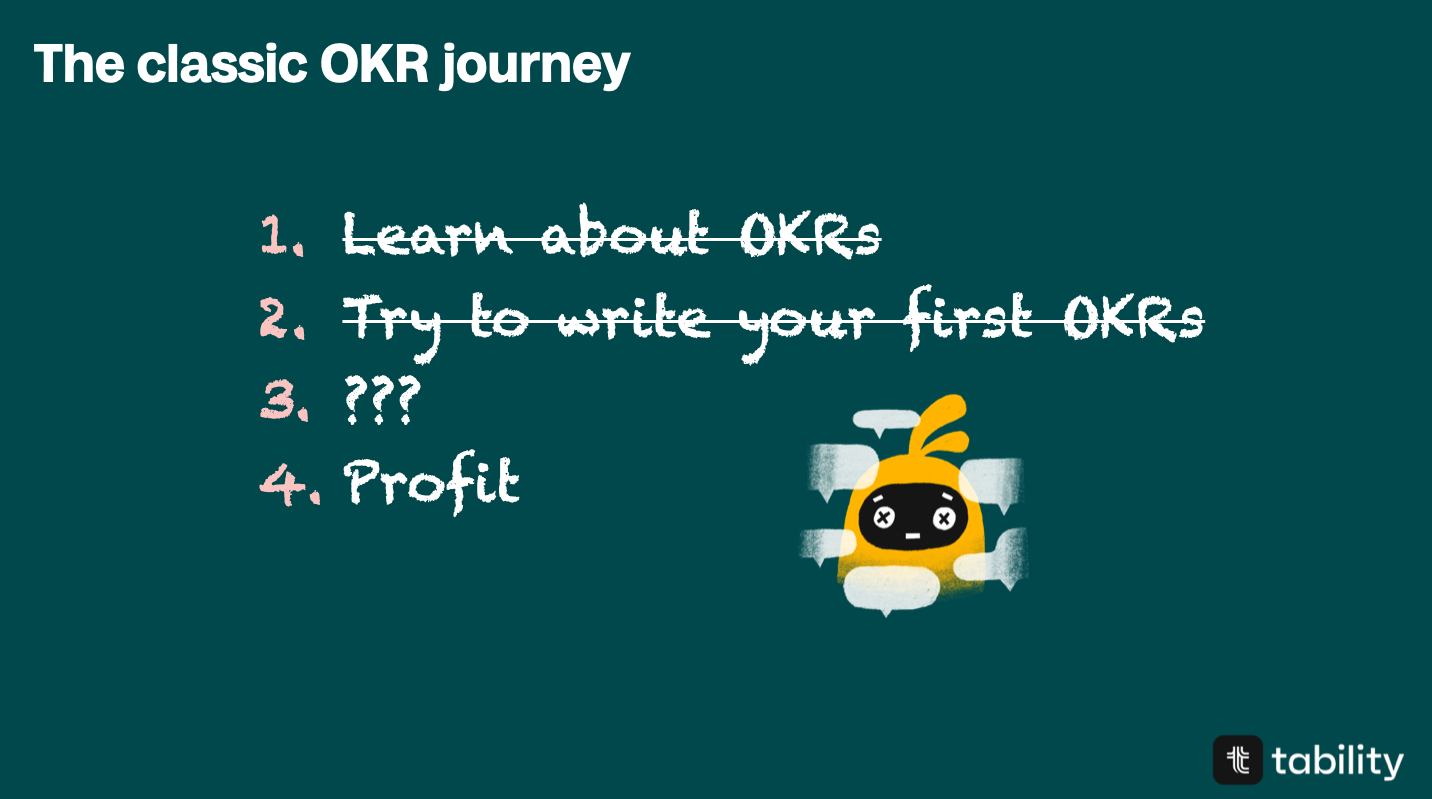
The pattern is consistent: teams read the books, watch the videos, and understand the theory. But when it comes time to actually write their first OKRs, they freeze.
What should our objectives be? Are these key results measurable enough? Should we align top-down or bottom-up? How many OKRs is too many? Is this KR a project?
The result is one of two things: either they spend weeks workshopping the "perfect" OKRs and burn out before the quarter even starts, or they give up and go back to the way things were.
Both outcomes miss the point entirely.
OKRs are a practice, not a document
Here's the thing most OKR guides won't tell you: your first set of OKRs will be wrong. They'll be too vague, or too ambitious, or focused on the wrong things. That's fine. That's expected.
The value of OKRs doesn't come from having perfect goals. It comes from the weekly habit of checking progress, having honest conversations about what's working, and adjusting course when things aren't moving.
You can't learn that from a workshop. You learn it by doing it — badly at first, then better each cycle.
That's why we built the Starter Kit. We wanted to remove the blank page problem entirely and give teams something they can run with immediately.
What's in the kit
The OKR Starter Kit has three parts:
1. Pre-built OKRs you can import today
We created three templates based on the most common situations we see:
- Product-Market Fit: for teams still figuring out what to build and for whom
- Revenue Growth & Customer Happiness: for teams with customers, focused on growth and retention
- Fundraising Milestone: for teams working toward a traction milestone for their next raise
Each template is a Google Sheet you can duplicate, tweak if needed, and import directly into Tability using our magic import feature.
It will take you 5 minutes to create a new Tability account and import the template.
2. A weekly rhythm that actually works
OKRs without a cadence are just a document that collects dust. The kit includes a simple weekly structure:
- Monday (30 min): Review progress, surface risks, decide what matters this week
- Friday (30 min): Demo what shipped, share learnings, close the loop
That's it. One hour a week.
We even included a link to add both meetings to your calendar with one click.
3. Clear guidance on what good looks like
The kit spells out what makes OKRs work and what kills them. Things like:
- Committing to weekly check-ins (this is the actual work)
- Assigning one owner per key result, not a team
- Writing real check-ins instead of "still working on this" or blank updates
- Running one full cycle before changing anything
We also included a list of warning signs. Things like using OKRs to evaluate individual performance, or having one person update everyone’s OKRs. If you see those patterns, fix them before you touch the goals themselves.
Who this is for
The Starter Kit is for teams that are new to OKRs and want to get moving without spending weeks on planning.
It's especially useful if:
- You've tried OKRs before but couldn't make them stick
- You're a founder, Chief of Staff, or team lead that needs to get started quickly
- You want something prescriptive: tell me what to do, not just how it works
If you already have a mature OKR process with custom objectives tailored to your business, this probably isn't for you. But if you're staring at a blank page wondering where to start, this is exactly what you need.
The philosophy behind it
Momentum beats accuracy.
It's better to run a flawed OKR cycle and learn from it than to spend months crafting perfect goals that never get tracked. The teams that succeed with OKRs aren't the ones with the best-written key results. They're the ones that show up every week, check in honestly, and improve over time.
The Starter Kit is built on that philosophy. We're not trying to give you the perfect OKRs for your business. We're trying to get you through your first cycle so you can figure out what actually matters.
Your second cycle will be significantly better than your first. But you have to finish the first one to get there.
What to do now
- Go to the OKR Starter Kit
- Pick the template that matches your situation
- Import it into Tability
- Add the weekly meetings to your calendar
- Run one full cycle before changing anything
That's it. You're officially running OKRs.
If you have questions or feedback, I'd love to hear from you – find me on LinkedIn or reach out to our team at [email protected].


.jpg)