Most companies finish their strategy offsite with a polished deck and a clear set of three-year ambitions. Then January arrives, and everyone goes back to doing more or less what they were doing before. The strategy never officially disappears. It just fails to land.
The Annual Operating Plan is supposed to be the thing that closes that gap. In practice, most AOPs end up as glorified budget documents. That's the wrong job.
This guide covers what an AOP actually is, how to build one that translates strategy into something executable, and how to connect it to your quarterly OKR framework so progress compounds throughout the year instead of evaporating in Q2.
What is an annual operating plan?
An annual operating plan (AOP) is a document that translates your long-term strategy into concrete goals, priorities, and resource commitments for the next 12 months. It answers a simple question: given where we want to be in three to five years, what specifically needs to happen this year to get there?
A good AOP sits at the intersection of strategy and operations. It's not a financial forecast (though it informs one). It's not a project plan (though it shapes them). It's the document that makes your strategic planning real: what will we do, who will own it, and what does success look like by the end of December?
This is where StratOps, the function that bridges strategy and execution, earns its keep. The AOP isn't a finance deliverable. It's a StratOps deliverable that finance happens to contribute to.
AOP vs budget: two different jobs
The AOP and the budget often get conflated because they're produced around the same time and involve some of the same data. They're doing very different jobs.
The budget answers: "How will we allocate money to support operations?" It's primarily a financial planning instrument, owned by finance, focused on revenue, costs, and cash flow.
The AOP answers: "What strategic bets are we placing this year, and how will we know if they're working?" It's a strategic operating document, focused on goals, outcomes, and priorities.
The budget is a constraint. The AOP is a direction. You need both, but treating them as the same thing is how strategies end up sitting in shared drives untouched until the December retrospective.
What goes in an annual operating plan?
The structure varies by company size and maturity, but a solid AOP typically covers:
- Strategic context. A brief summary of the long-term strategy this year's plan is advancing. One to two paragraphs, not a repeat of the strategy deck.
- Annual goals. The three to five things that must happen this year for the strategy to stay on track. Specific, measurable, and tied to the longer-term ambitions.
- Functional priorities. How each team (product, marketing, engineering, sales, CS) contributes to the annual goals. Not exhaustive plans — the top two or three bets per function.
- Resource commitments. Where the organisation is allocating headcount, budget, and capacity. If you're not putting resources against it, it's not really a priority.
- Key metrics. The leading indicators you'll watch throughout the year to know if you're on track, before annual goals are won or lost.
- Dependencies and risks. The cross-functional handoffs that need to work, and the assumptions that could be wrong.
How to build your AOP in five steps
Step 1: Start with the strategy, not the spreadsheet. Before anyone opens a budget model, get the leadership team aligned on what the next three to five years requires. The AOP should be a consequence of the strategy, not the other way around.
Step 2: Set annual goals that create real accountability. Three to five goals, each with a clear owner and a measurable outcome by end of year. These are not aspirations — they're commitments.
Step 3: Cascade to functional priorities. Give each team lead the annual goals and ask: what does your team need to do differently this year to contribute? The output is two or three functional priorities per team, not a laundry list.
Step 4: Check that resources match priorities. If you've named a priority but haven't resourced it, you haven't actually made a decision. Reconcile gaps between the AOP and the budget before locking the plan.
Step 5: Define the operating cadence. An AOP without a cadence is just a document. Decide now: when will you review progress? Who runs the monthly or quarterly business review? How will you escalate if things are off track?
How to connect your AOP to your quarterly OKRs
This is where most companies drop the ball. The AOP sits in a shared drive, quarterly OKRs get set in a separate process, and by March no one is sure how they connect.
The fix is to treat the AOP as the source of truth for your OKR cascade. Each annual goal in the AOP should have a corresponding set of quarterly OKRs that advance it. The key results in Q1 are not random team priorities — they're the first leg of the journey toward your annual goal.
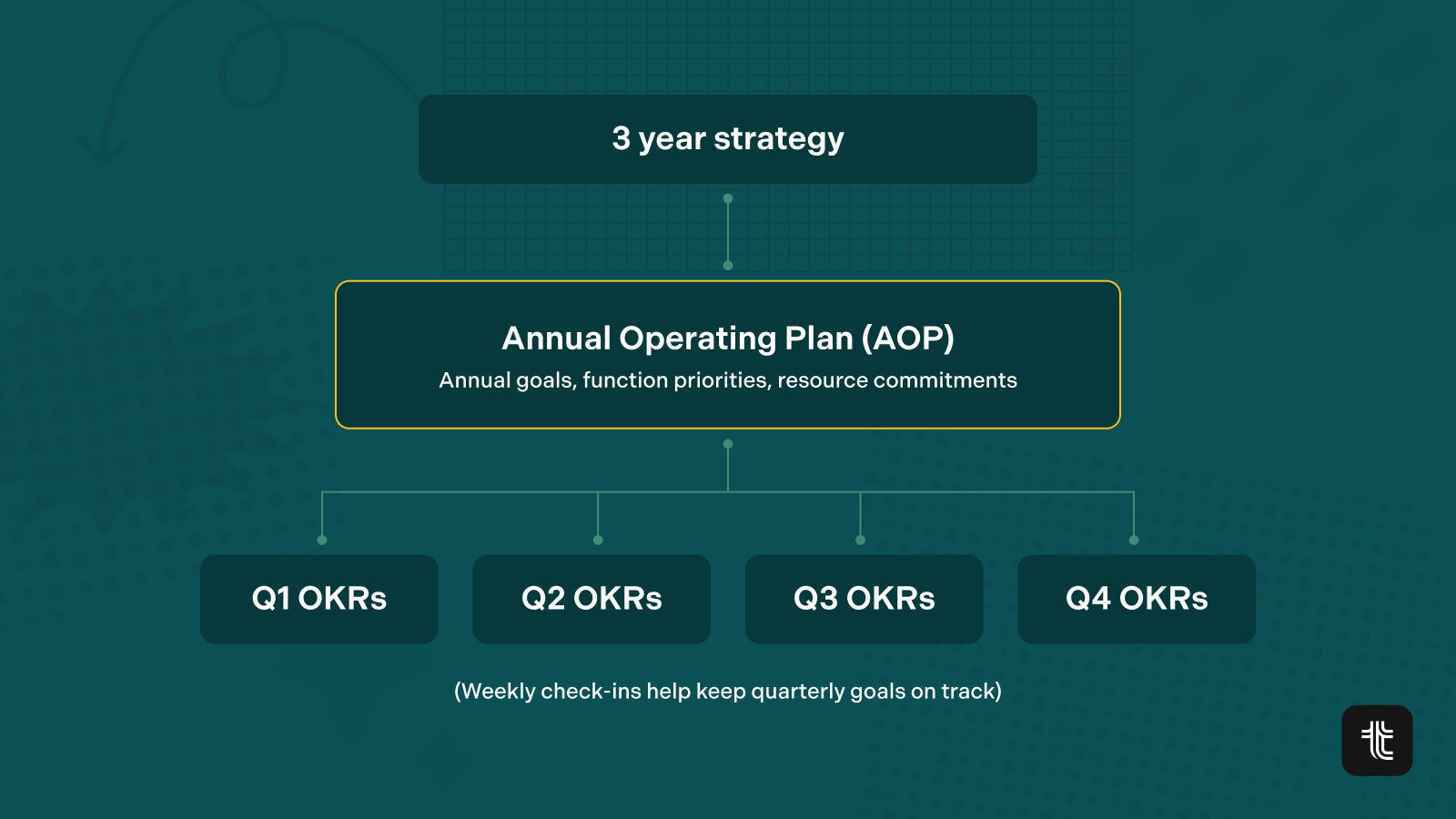
In practice, this means:
- Annual goals from the AOP become the Objectives in your OKR framework for the year
- Each quarter, teams set Key Results that advance their Objective, building momentum from Q1 to Q4
- At the end of each quarter, teams review what was learned and reset for the next
This is the cadence that StratOps, the function that connects strategy to execution, is designed to run. The AOP isn't a once-a-year event. It's the anchor for a continuous operating loop that keeps teams moving in the same direction all year.
Common AOP mistakes (and how to avoid them)
Treating the AOP as a budget repackage. If your AOP is just a narrative wrapper around your financial plan, it's not doing the job. The budget is an input to the AOP, not the other way around.
Setting too many goals. Seven annual goals is not a plan. It's a list. Three to five forces the trade-offs that strategy actually requires.
No ownership. Goals without named owners don't get done. Each annual goal needs a single person accountable for it by December.
Writing the AOP in January and ignoring it until November. If the AOP doesn't feed into quarterly reviews and weekly check-ins, it has no operating value. Build the review cadence into the plan from day one.
Keeping the AOP inside the leadership team. If teams can't see the annual goals and understand how their work connects, you'll have execution without alignment. Share the AOP, or at least the goals, across the organisation.
Where Tability fits in the AOP process
Tability is designed for exactly this kind of work. You can set your annual goals in Tability, cascade them into quarterly OKRs by team, and run weekly check-ins against them throughout the year. Every review — monthly, quarterly, annual — draws from the same source of truth.
The result is an AOP that doesn't gather dust. It becomes a live operating document that the whole organisation can see, update, and act on. Teams know what matters, leaders know what's on track, and the strategy isn't a mystery until the December retrospective.
Sign up free or book 30 minutes with us and we'll help you figure out what this looks like for your team. Tability or not!


.jpg)
.png)