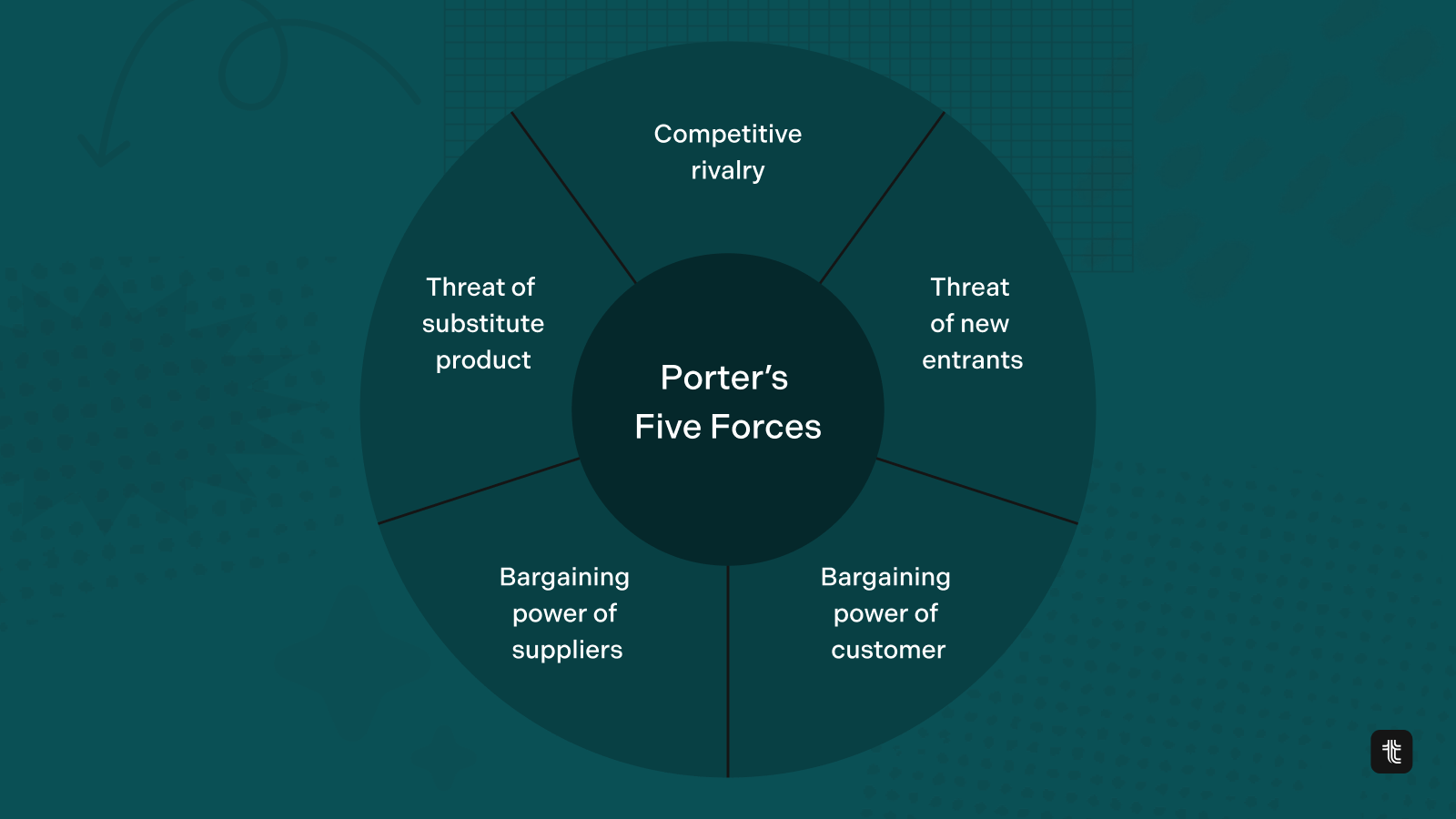
Ask a room full of MBAs to draw Porter's Five Forces from memory and most of them can do it in about ten seconds. Ask them when they last used it to make a real decision and the room goes quiet. The framework survives in every strategy textbook and every consulting slide deck, but in practice it usually gets built once, dropped into a strategy offsite, and never opened again.
That's not a knock on the framework itself. Porter's Five Forces is still one of the sharpest tools available for understanding why an industry makes money (or doesn't), and why your competitors behave the way they do. The problem is what happens after the workshop. Most teams treat it as a one-time diagnosis rather than something you check on a schedule, the same fate that eventually catches up with SWOT analysis, the BCG matrix, and pretty much every other analysis built for a single strategy day and then filed away.
This guide covers what the five forces actually are, where the model came from, how to run the analysis properly, and, more importantly, how to stop it gathering dust the moment the workshop ends.
What is Porter's Five Forces?
Porter's Five Forces is a model for analysing how competitive an industry is, and how much of the profit available in that industry is genuinely there to be captured, rather than squeezed out by suppliers, customers, rivals, or new arrivals. Michael Porter, a Harvard Business School economist, introduced the model in a 1979 Harvard Business Review article titled 'How Competitive Forces Shape Strategy', then expanded on it a year later in his book Competitive Strategy.
The insight underneath the framework is straightforward: a company's profitability isn't only a function of how well it executes. It's shaped by the structure of the industry it's competing in. A brilliantly run business in a brutal industry (thin margins, powerful suppliers, low switching costs, constant new entrants) will usually underperform a mediocre business in a genuinely attractive one. Five Forces is a way of working out which situation you're actually in before you decide how to compete.
The five forces, explained
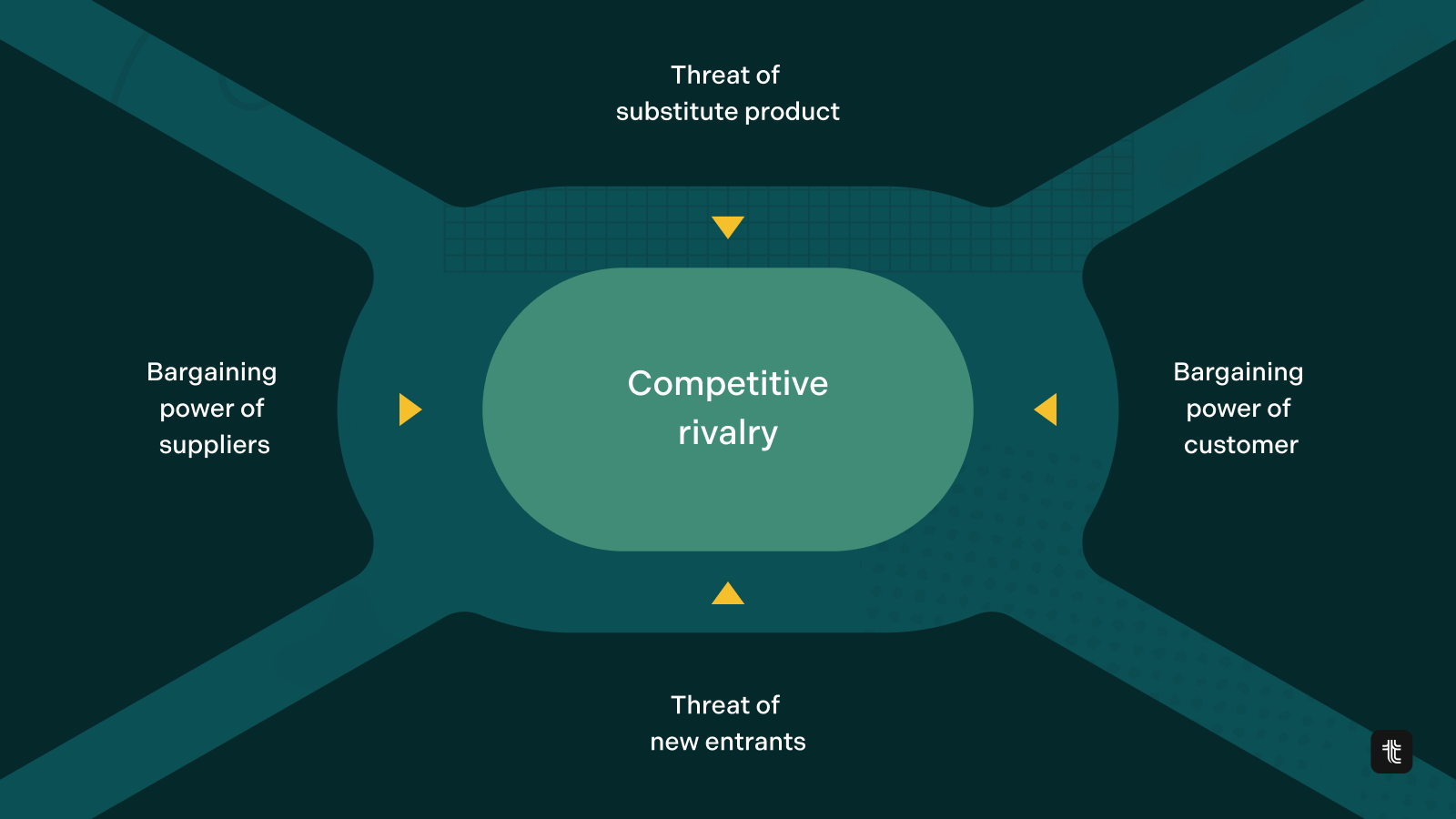
Porter grouped the pressure on any industry into five categories. Notably, only one of them is about your direct competitors. The other four are easy to overlook if you're used to thinking about 'competition' as only the other companies chasing the same customers.
- Threat of new entrants: how easily can a new player show up and take market share? Determined by barriers like capital requirements, brand loyalty, regulation, economies of scale, and access to distribution.
- Bargaining power of suppliers: can the businesses you buy from dictate price and terms? High when suppliers are concentrated, switching costs are steep, or there's no real substitute input.
- Bargaining power of buyers: can your customers push your prices down or demand more for the same money? High when buyers are concentrated, price-sensitive, or can switch with little friction.
- Threat of substitutes: not your direct competitors, but different products or services solving the same underlying problem in a different way (video conferencing as a substitute for business travel, for example).
- Rivalry among existing competitors: the intensity of competition already inside the industry, shaped by the number of players, growth rate, how differentiated the offerings are, and how hard it is to exit.
Add these five up and you get a rough read on industry attractiveness. High pressure across most of them means margins get squeezed from every direction. Low pressure means there's genuine room to capture value, assuming you execute well.
How to actually run a Five Forces analysis
- Define the industry precisely, not the company. The most common mistake is defining the industry too broadly ('software') instead of the specific competitive arena you're actually in ('mid-market project management software for services businesses'). Too broad and every force reads as moderate and meaningless.
- Score each force with evidence, not vibes. Use concrete signals: the number of credible new entrants in the last two years, customer concentration (what percentage of revenue sits with your top five accounts), supplier concentration, real switching costs, and substitute adoption rates.
- Identify which force is actually applying the pressure. Rarely do all five matter equally. Most industries have one or two forces doing almost all of the damage (or creating almost all of the opportunity), and the rest sit at a low simmer.
- Translate the finding into a decision, not a slide. A pricing move, a partnership, a product bet, a decision not to enter a segment. If the analysis doesn't change a decision, it wasn't worth doing.
- Put a date on redoing it. Markets shift. A force that was weak eighteen months ago (say, threat of new entrants before an efficient new category of AI-native competitor showed up) isn't guaranteed to stay weak.
Where the framework quietly breaks down
Five Forces has a real weakness, and it's less about the model itself than about how it gets used. Three things go wrong in nearly every organisation that runs this analysis:
- It gets scored once, in a workshop, and never revisited. The industry structure that mattered in Q1 doesn't automatically still apply in Q4.
- It sits with the exec team or strategy function, disconnected from the OKRs and initiatives the rest of the company is actually working on. Nobody owns keeping it current.
- It gets treated as a standalone artefact instead of one input among several, alongside a SWOT analysis, a value chain analysis of your own operations (also one of Porter's frameworks, just aimed inward instead of at the industry), and whatever the McKinsey 7S framework tells you about internal alignment.
Porter also never claimed the five forces were the whole picture. The model is intentionally quiet on complementary products, government regulation as a direct force, and the network effects that now define a lot of software categories. Treat it as a structured starting point, not a complete map of everything that can affect your margins.
Turning Five Forces into an operating input, not a one-off slide
The fix for the first problem (scored once, then forgotten) isn't a better slide template. It's putting Five Forces on the same cadence as everything else you track.
In practice that means re-scoring the five forces on a fixed schedule, at the same time you review OKRs. If bargaining power of suppliers just jumped from low to medium because a key vendor got acquired, that's not a footnote. It's an input into next quarter's goals. If a substitute is gaining adoption faster than expected, that becomes an initiative on the roadmap, not a slide nobody reopens.
Tools like Tability make this easy in practice: keep the five-forces scoring next to your quarterly StratOps review, and a shift in one of the forces shows up as a check-in comment attached to the relevant objective, instead of sitting forgotten in a shared drive somewhere.
Porter's Five Forces vs SWOT analysis
These two get confused constantly, mostly because teams run them back to back in the same workshop. They're not interchangeable, and they're not really answering the same question.
A SWOT analysis usually zooms in one level, onto your own organisation, once Five Forces has told you something about the industry you're actually playing in.
A worked example
Say a 40-person project-management SaaS company is deciding whether to launch a new module aimed at enterprise IT teams. A quick Five Forces pass might read like this:
- Threat of new entrants: low. Enterprise IT procurement runs on long sales cycles and requires security certifications that take months to obtain.
- Supplier power: low. Core infrastructure dependencies are commoditised.
- Buyer power: high. Enterprise buyers are few, large, and used to negotiating hard.
- Threat of substitutes: medium. Enterprise teams often build an internal tool instead of buying one.
- Rivalry: high. Several well-funded competitors already sell into this exact segment.
The read: two forces (buyer power and rivalry) are doing most of the damage, while one (new entrants) is genuinely favourable. That's a different call from 'this market is unattractive, don't bother' and a different call from 'this is easy money'. It's a case for competing on a specific wedge, security-first packaging, say, rather than a head-on price fight against better-funded rivals.
Common mistakes
- Defining the industry too broadly (or too narrowly) for the analysis to mean anything.
- Scoring forces on opinion instead of evidence, then treating the workshop whiteboard photo as the final analysis.
- Confusing threat of substitutes with rivalry (substitutes solve the same problem a different way; rivals solve it the same way you do).
- Running the analysis once and filing it, instead of putting a review date on the calendar.
- Not assigning an owner. If nobody's responsible for re-scoring it, nobody will.
Where to go from here
If you're already running a quarterly OKR cadence and want your competitive analysis to actually stay current instead of ageing out in a slide deck, Tability is built for exactly that.
Sign up free or book 30 minutes with us and we'll show you what it looks like to keep frameworks like this one alive quarter over quarter.


.jpg)
.png)