
Most companies have a strategy. Most companies also have quarterly goals. What they rarely have is a serious way to connect the two. The three-year plan lives in a deck on someone’s laptop. Quarterly goals live in a spreadsheet. And by week three of the quarter, nobody’s sure how the two relate anymore.
Hoshin Kanri is a framework that tries to fix that. It’s a Japanese strategic planning method, born at Toyota in the 1960s, that forces every team goal to trace back to the company’s long-term direction. Done well, it turns strategy from an annual offsite artefact into something that actually shapes how teams spend their time every week.
Done badly, it turns into another layer of paperwork. We’ll cover both ends of that spectrum in this guide.
Hoshin Kanri overview
Hoshin Kanri is a Japanese term that translates roughly to ‘direction management’, or ‘the management of the compass needle’. The idea is that an organisation only moves in one direction at a time, and everyone should know what that direction is.
In practice, Hoshin Kanri is a top-down, bottom-up planning method. Leadership sets a small number of long-term strategic goals, usually three to five. Those goals cascade down to annual breakthrough objectives, then to team-level tactics, then to weekly metrics. At each level, the owners negotiate with the level above, which is where the bottom-up part comes in.
The whole thing runs on a cycle of plan, do, check, adjust. It’s rigorous. It’s slower to set up than OKRs. And it rewards teams who are willing to sit in long planning conversations in exchange for clarity the rest of the year.
Four ideas sit at the core:
- A small number of strategic ‘vital few’ priorities, not dozens
- Clear ownership at every level, with no shared goals
- The X-matrix as a single-page visual of the whole plan
- A regular cadence of reviews, usually monthly
The X-matrix, explained
The X-matrix is the reason people either love or hate Hoshin Kanri. It’s a single page that maps four things at once: long-term objectives, annual objectives, top-level improvement priorities, and the metrics that will tell you it’s working.

Picture a tilted X shape with four quadrants:
- Top quadrant: annual objectives, the 12-month goals
- Right quadrant: top-level improvement priorities, the projects and initiatives
- Bottom quadrant: the metrics you’ll track, the KPIs and targets
- Left quadrant: the long-term breakthrough objectives, the three- to five-year strategic goals
Around the edges, you note the teams and owners responsible for each row.
The X-matrix works because it forces every project and every metric to trace back to a strategic objective on the opposite side. If a project doesn’t connect to an objective, it shouldn’t be on the page. If a metric doesn’t connect to a project, it shouldn’t be on the page.
That’s the test. If you can’t draw a line from a project back to the strategy, cut it.
📝 Here's a really great Hoshin Kanri X-Matrix template to use.
Hoshin Kanri vs OKRs: similarities and differences
A lot of teams come to Hoshin Kanri after OKRs have stopped working. It’s worth understanding what’s actually different.
Both frameworks share the same basic intent: link daily work to long-term strategy, and make progress visible. Both use goals and metrics. Both rely on cadence to stay alive.
Where they diverge:
- Horizon: OKRs operate in quarterly cycles. Hoshin Kanri operates on a three- to five-year strategic horizon with annual cascades. Hoshin is built for slower-moving strategy. OKRs are built for faster feedback loops.
- Number of goals: OKRs allow teams to run three to five objectives with multiple key results each. Hoshin Kanri is brutal about focus. Three to five breakthrough objectives at the top of the organisation, and teams pick one or two to contribute to. That’s it.
- Process weight: OKRs are relatively light to set up. Hoshin Kanri is heavy. There’s a formal negotiation step called ‘catchball’, where goals are passed between leadership and teams until everyone agrees. It’s slower, but commitment is higher on the other side.
- Visual artefact: OKRs live in a spreadsheet or tool. Hoshin Kanri lives on the X-matrix.
- Cultural fit: OKRs came out of Silicon Valley and fit fast-moving software companies well. Hoshin Kanri came out of Japanese manufacturing and fits organisations where getting direction right matters more than iteration speed.
Neither is better. They’re answers to different questions.
Here’s the side-by-side:
Hoshin Kanri vs the balanced scorecard
One more comparison worth making: the balanced scorecard. Both frameworks came out of the same 1980s–90s wave of structured strategy thinking, and teams researching Hoshin Kanri often end up weighing it against BSC as well.
The short version: they solve different problems. The balanced scorecard is a measurement framework. It tells you what to measure, across four perspectives — financial, customer, internal process, and learning and growth — so that no single dimension dominates the scoreboard. Hoshin Kanri is a deployment framework. It tells you how to cascade a small number of breakthrough objectives from the top of the organisation down to weekly team activity.
They can genuinely coexist. Mature teams often use the balanced scorecard’s four perspectives to decide which metrics belong at the bottom of the X-matrix, and Hoshin Kanri to deploy the breakthrough objectives that will move those metrics. If you want a closer look at how the four perspectives play out in practice, our balanced scorecard examples article walks through several real-world versions.
When to choose Hoshin Kanri over OKRs
Teams should consider Hoshin Kanri over OKRs when:
- Strategy is genuinely multi-year, and quarterly pivots would be distracting
- The organisation is large enough that alignment across teams is harder than execution within teams
- Leadership wants a single-page view of the whole strategic plan
- You operate in a slower-cycle industry like manufacturing, healthcare, infrastructure, or regulated sectors
Teams should stick with OKRs when:
- The business changes too fast to commit to a three-year breakthrough
- Teams need frequent feedback loops to learn
- Simplicity is worth more than completeness
- You’re smaller than about 100 people and direct conversation still works
Some companies run both. They use Hoshin Kanri at the executive level for the long-horizon strategy, and OKRs at the team level for quarterly execution. We’ve seen this work in scale-ups past a few hundred people.
How to run a Hoshin Kanri planning cycle: the 7 steps
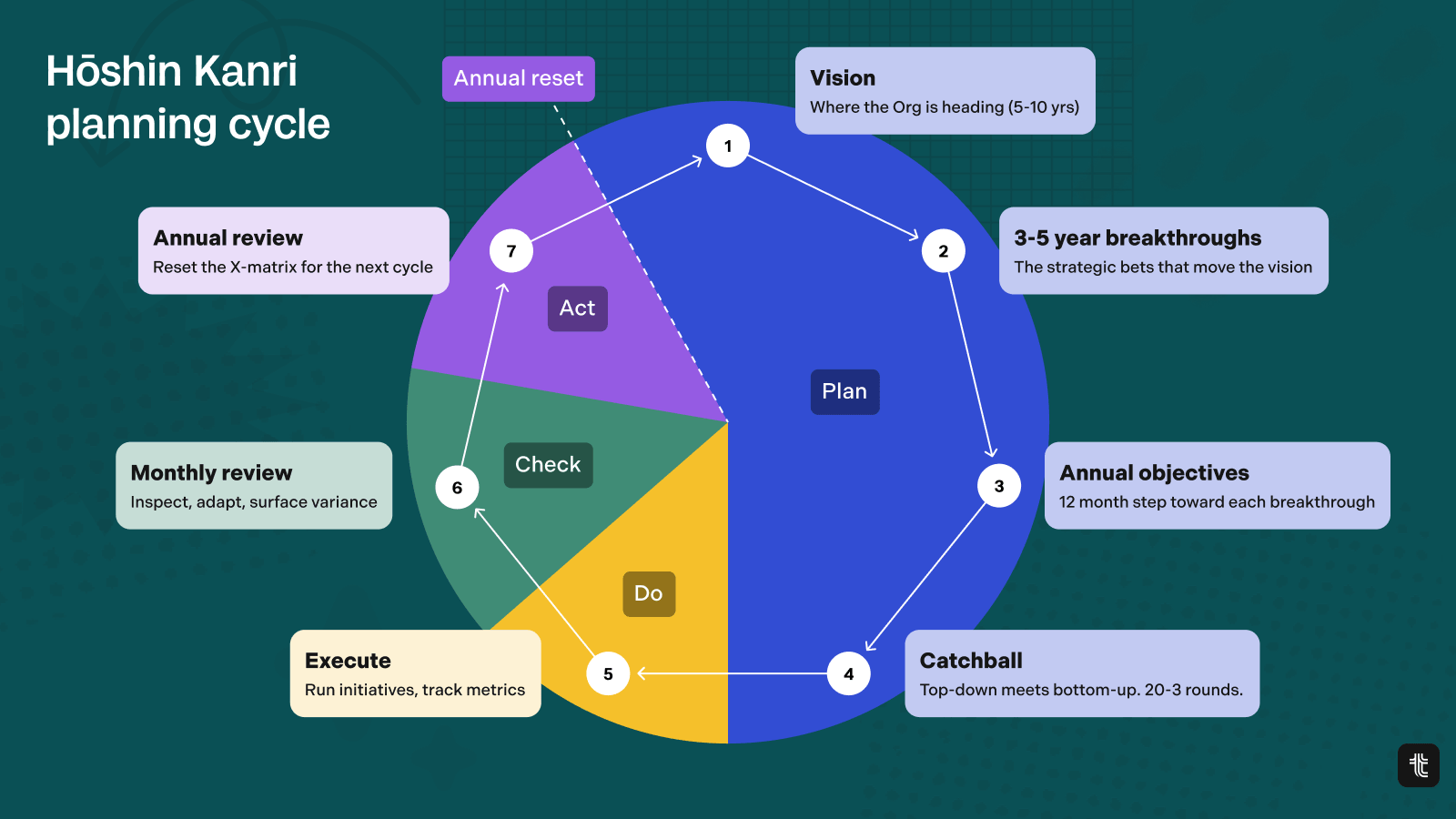
Classical Hoshin Kanri breaks the cycle into seven steps. They map cleanly onto the PDCA loop: steps 1 to 4 are Plan, step 5 is Do, step 6 is Check, step 7 is Act. The first full cycle takes weeks. Subsequent cycles take days, because the structure carries over.
Step 1: Establish the organisational vision (plan)
Before any objectives are set, the executive team has to agree on where the organisation is heading over the long term — usually five to ten years out. This isn’t a breakthrough list yet. It’s the frame that breakthroughs will be derived from. Things like ‘become the leading provider of X in Y’, or ‘shift the majority of revenue to Z’.
If the vision isn’t written down somewhere everyone can point to, the rest of the cycle runs on vibes.
Step 2: Develop 3–5 year breakthrough objectives (plan)
Leadership distils the vision into three to five breakthrough objectives. These are the strategic bets that will move the organisation toward the vision. Ambitious enough that achieving them meaningfully changes the company. Focused enough that any leader can recite them from memory.
If a breakthrough looks similar to last year’s annual goal, it’s not a breakthrough.
Step 3: Develop annual objectives (plan)
Each breakthrough is translated into what a 12-month step toward it looks like. These are the annual objectives. A single breakthrough usually spawns one or two annual objectives per year, and those annual objectives carry the targets and metrics the organisation will be judged on.
This is where an OKR software starts to earn its keep. Keeping every annual objective traceable back to the breakthrough it serves — and visible to everyone — is exactly the job that breaks down in a shared spreadsheet once more than a dozen teams are involved. Tability was built for this specific shape of problem.
👉See our list of best OKR software.
Step 4: Deploy annual objectives with catchball (plan)
Leadership proposes annual objectives. Teams receive them, suggest their own metrics and initiatives, and send revisions back up the chain. The negotiation is called ‘catchball’, and it’s the most distinctive part of Hoshin Kanri.
Two or three rounds is normal. Expect it to feel slow. Commitment after catchball is substantially higher than after a top-down OKR cascade, which is the whole payoff.
Step 5: Execute the annual objectives (do)
Teams run their initiatives on an annual timeline with quarterly and monthly review points built in. Metrics are tracked continuously. A lot of the discipline here looks like a well-run strategic planning process, just on a longer horizon.
This is the step where tooling matters most. Owners, deadlines, and check-ins need to live somewhere other than an annual slide deck. Tability’s weekly check-in cadence was designed for this kind of rolling execution so the reviews that follow actually have data to chew on, rather than a pre-meeting scramble to find numbers.
Step 6: Monthly review (check)
Monthly team reviews inspect metric progress and flag anything veering off track. The goal isn’t to punish misses; it’s to surface variance early enough to react. Monthly reviews should be short, structured, and run on data that was already collected during step 5.
Teams running Tability have the weekly check-in stream feeding straight into this review, which cuts prep time from hours to minutes and keeps the meeting focused on decisions rather than status.
Step 7: Annual review (act)
Once a year, the whole X-matrix gets reviewed. What worked? What didn’t? What has changed in the environment? The annual review feeds directly into the next Plan cycle, closing the PDCA loop. Some teams roll it into a strategy offsite; others run it as a standalone exercise.
Skip this step and Hoshin Kanri quietly rots into ‘the annual goals we set last January’. The framework only works if the reviews are religiously kept.
Running Hoshin Kanri in Tability
Tability wasn’t originally built for Hoshin Kanri. It was built for OKRs. But the underlying mechanics — cascading objectives, weekly check-ins, automated reporting, and full audit trails — are exactly what a Hoshin cycle needs once you’re past the planning whiteboard.
Here’s how the 7 steps map across:
- Vision and breakthrough objectives (steps 1–2) become top-level strategic plans. One plan per breakthrough, with a three to five year date range. Every team can see them, which means the long-term direction is never more than one click away.
- Annual objectives (step 3) become objectives inside each plan, with a 12-month horizon. They inherit the breakthrough they serve, so the trace between long-term strategy and annual work is built into the structure.
- Catchball (step 4) runs as comment threads on each objective. Leadership proposes, teams counter-propose, history is preserved. When the annual cycle resets, the previous year’s catchball conversations are still there for context.
- Metrics and KPIs (step 5) become outcomes, with quantified targets and owners. Outcomes can auto-update from integrations like HubSpot, Salesforce, and your analytics stack, so execution-tracking isn’t a manual chore.
- Initiatives and projects sit under outcomes, tied to a team and an owner, with weekly check-ins prompted automatically.
- Monthly and annual reviews (steps 6–7) are driven by the check-in history. Weekly check-ins roll into a monthly summary; the annual review pulls from the full year of signal.
The X-matrix itself doesn’t have a native view in Tability yet. Most teams running Hoshin generate one as a quarterly reporting artefact from a plan export. If you need a living X-matrix, keep it in a doc and treat Tability as the source of truth for the metrics and initiatives underneath. That split works: the X-matrix is a communication artefact, the tracked data is where the cycle actually lives.
This is the kind of setup Tability was designed for: long-horizon strategy that stays connected to the weekly work, without the overhead of a six-figure enterprise platform. It’s a close cousin of how StratOps teams bridge strategy and execution, which is worth a read if you’re structuring the function internally.
Try Hoshin Kanri with less overhead
Hoshin Kanri isn’t a quick-fix framework. It asks leadership to slow down, commit to a small number of strategic breakthroughs, and hold the line through months of execution. That’s uncomfortable. It’s also exactly why it works for the teams that stick with it.
If you’re thinking about running Hoshin Kanri, or any structured strategy-to-execution method, Tability is the easiest place to track it. Sign up free or book 30 minutes with us and we’ll help you map your breakthrough objectives to the teams that need to deliver them.
.png)

.jpg)