
Most managers learn the GROW model in a coaching workshop, use it for a week, and then forget it. They remember it as 'that thing with the four letters' and put it back on the shelf next to all the other frameworks HR keeps emailing about.
That is a waste. Because GROW is not really a coaching script. It is the underlying thinking pattern behind every good operating conversation your company runs. Your weekly check-in meetings are a GROW conversation. Your quarterly strategy review is a GROW conversation. Even the retrospective your engineering team did last sprint, that was a GROW conversation too.
The reason GROW gets typecast as a 1:1 coaching tool is that Sir John Whitmore, the executive coach who popularised it, originally pitched it to managers as a way to stop telling their reports what to do. The intent was bigger than that. GROW is the cleanest four-step pattern we have for moving any group from 'we have a goal' to 'we have a clear next action' without skipping the awkward middle bit where you actually look at reality.
Here is what GROW is, why most teams misuse it, and where it actually belongs in your operating cadence.
What does GROW stand for?
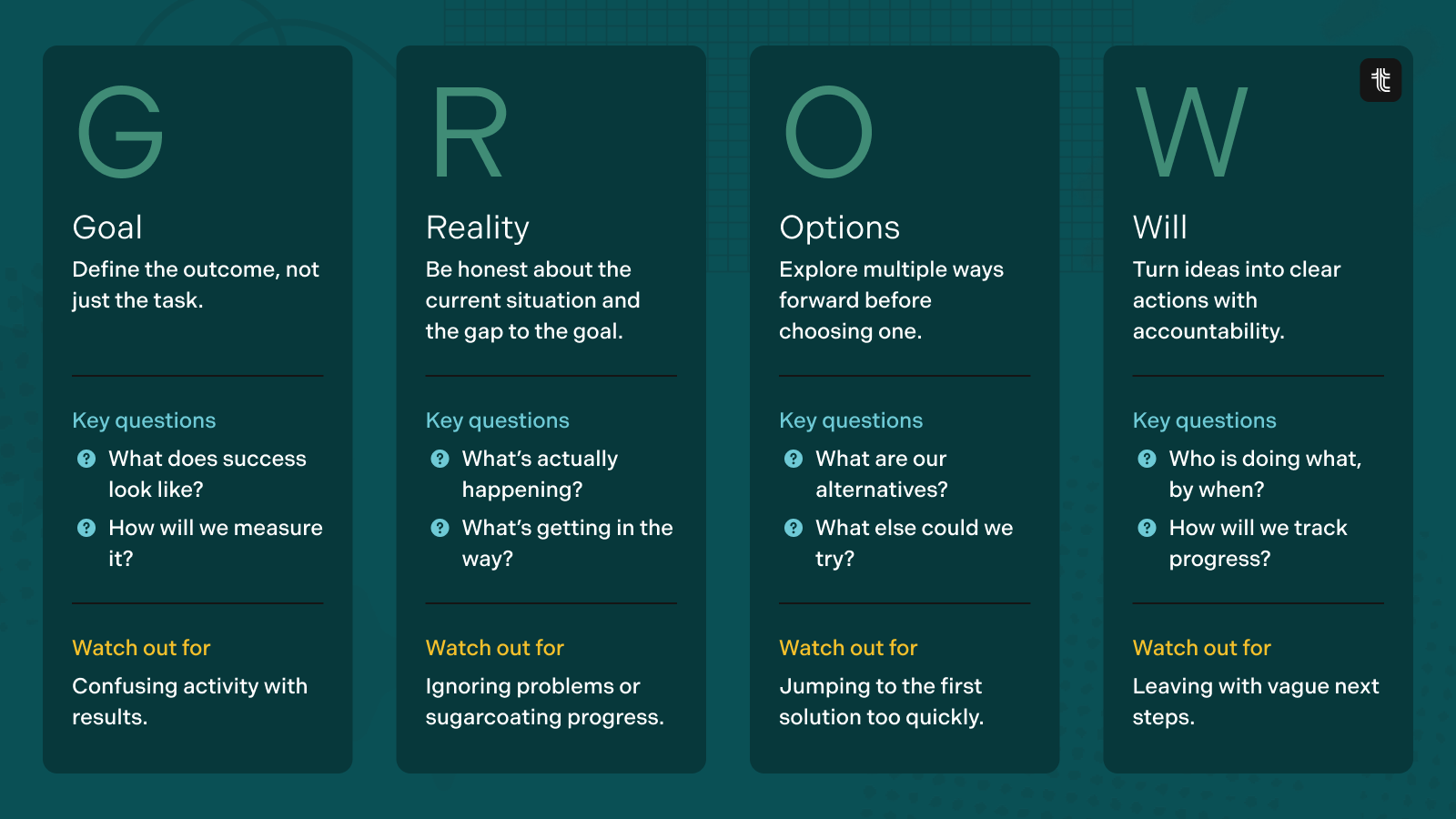
GROW is an acronym for the four phases of a structured goal conversation:
- Goal: What outcome are we working towards?
- Reality: Where are we right now, honestly?
- Options: What could we do about it?
- Will (or Way forward): What will we actually commit to next?
The acronym was developed by performance coaches Graham Alexander, Alan Fine, and Sir John Whitmore in the 1980s, then popularised in Whitmore's 1992 book 'Coaching for Performance'. Whitmore was a former racing driver turned executive coach who borrowed the idea from sports psychology: a great coach does not give the athlete answers, they ask better questions so the athlete finds the answers themselves.
That is the original move and it still matters. But the structure outlasts the coaching context. In practice, every operating review with any structure at all goes through some version of these four steps. The question is whether you walk through them deliberately or trip through them by accident.
The four phases, properly used
G is for Goal: define the outcome, not the activity
The first phase looks simple and almost always gets botched. Most teams pick an activity ('we want to ship feature X this quarter') and call it a goal. That is not a goal. That is a thing on a backlog.
A goal in GROW terms is an outcome statement. What changes in the world if we are successful? 'We want our largest enterprise customer to renew without a procurement review' is a goal. 'We want to ship feature X' is the thing that might or might not get us there.
This is the same trap teams fall into with OKRs, which is why we keep banging on about how to write key results that measure outcomes, not output. The GROW model and the OKR framework are pulling at the same thread.
R is for Reality: confront where you actually are
Reality is where every operating review goes wrong. It is the awkward middle. Nobody wants to spend ten minutes saying 'we are way behind', so most teams skim through with 'we are tracking okay' and move on to the Options phase, where they get to be optimistic again.
Do not skip Reality. This is the only phase that gives the rest of the conversation any value. If you cannot describe the gap between where you said you would be and where you actually are, your Options will be guesses and your commitments will be theatre.
Real Reality questions sound like: 'What is actually happening?' 'What have we tried?' 'What is in the way?' 'What would someone outside this team think if they looked at the data?'
If your team has a tendency to be fake positive in check-ins, the Reality phase is where you fix it. Force the honest version onto the table before you let anyone propose a solution.
O is for Options: brainstorm wide before narrowing
Once Reality is on the table, Options is the divergent thinking phase. The point is to generate more than one path, including the obvious bad ones, so you can compare them.
The most common mistake here is collapsing immediately to the first viable option. Someone says 'we should hire another rep', everyone nods, and the conversation ends. You have skipped the comparison.
Better questions: 'What else could we try?' 'What would we do if we could not hire anyone?' 'What would an experienced peer do here?' 'What would happen if we did nothing?'
Three to five options is usually the right range. Less than that and you have not really diverged. More than that and you are wasting time.
W is for Will: commit, with accountability
The final phase is where most operating reviews secretly fail. The team arrives at a good option and then everyone leaves the room with a fuzzy sense that 'we agreed to look into it'. A week later, nobody has done anything, and the next review starts from the same Reality.
Will is where you make the option concrete. What is the next action? Who owns it? By when? What would tell us this is working? What would tell us it is not?
This is also where you decide what counts as a check-in. If you have committed to an action, when do we check in on it, and against what threshold? Without those, you do not actually have a commitment, you have a wish.
Where the GROW model actually fits in your operating cadence
The reason GROW has stuck around since the 1980s is that the loop works at every scale. The conversation looks different but the four phases are the same.
1:1 coaching conversations (the original use case)
This is the textbook setting. Manager and direct report, an hour, a single thorny problem. The manager's job is to ask the GROW questions, not to answer them. The point is not for the manager to solve the problem, it is for the report to think through it more rigorously than they would alone.
This is still the easiest place to practise GROW. If you only use it for one thing, use it here.
Team check-ins (the weekly operating rhythm)
A good weekly check-in is a compressed GROW loop. You look at the goal, look at where the numbers actually are, decide what to change, and commit to specific actions before the next check-in. Five minutes per outcome, not an hour.
This is what most teams botch. They walk through their OKRs as a status report (Reality only, sort of), skip the Options phase because it feels like 'more work', and end the meeting without any specific Will. Next week, same thing.
Run check-ins as deliberate GROW loops and they actually move the work.
Quarterly strategy and execution reviews
At the leadership level, GROW becomes a half-day or full-day conversation. Goal: what are the company's actual objectives for this quarter and the next? Reality: are we on track, and what does the data say? Options: what could we change, including hard ones like cutting bets, repricing, or restructuring? Will: what are the three things the leadership team commits to changing before the next review?
This is the layer most companies skip entirely. They do strategy in January, execution in February through December, and call the gap 'leadership'. The gap is where strategic operations lives, and GROW is the conversation pattern that closes it. Treating StratOps as the cadence that runs these reviews, not a one-off offsite, is the difference between a deck and a result.
Retrospectives and post-mortems
Retros are GROW in reverse. Goal: what were we trying to achieve? Reality: what actually happened? Options: what could we have done differently, and what could we change next time? Will: which one of those changes will we commit to in the next cycle?
Engineering teams have been doing this for years. The rest of the org should copy them. Retrospectives are a missing superpower and GROW is the structure that makes them work.
The mistakes that quietly kill the model
Three patterns kill GROW conversations in the real world. Watch for them.
- Treating GROW as a checklist instead of a loop. Walking through G, R, O, W in order and ticking them off is not the point. The point is the thinking. If you got to Will and the action is wrong, you go back to Reality. That is what makes it a loop.
- Skipping Reality. Already covered, but it bears repeating. If you cannot say out loud what is actually happening, the rest of the conversation is decoration.
- Letting the Will be soft. 'We will think about it' is not a Will. 'Sarah will draft three vendor options by Friday and post them in the channel' is. Soft Wills are how good plans die.
Bringing GROW into your operating system
The trick to making GROW stick is to stop treating it as a one-off coaching technique and bake it into the rhythm your company already runs. Your weekly check-in, your monthly review, your quarterly strategy meeting. Each one is a GROW loop. Make the four phases explicit and the conversations sharpen up almost overnight.
That is also where tools start to matter. The Reality phase needs data ready to look at, not a meeting where someone says 'I will find that number and send it later'. The Options phase needs a place to capture the alternatives. The Will phase needs the commitment, the owner, and the next check-in date written down somewhere everyone can see.
Tools like Tability are built for this.
You set the goal as a key result with a measurable outcome, the check-in surfaces the Reality automatically (current value versus target), and every check-in captures the commitment for the next cycle.
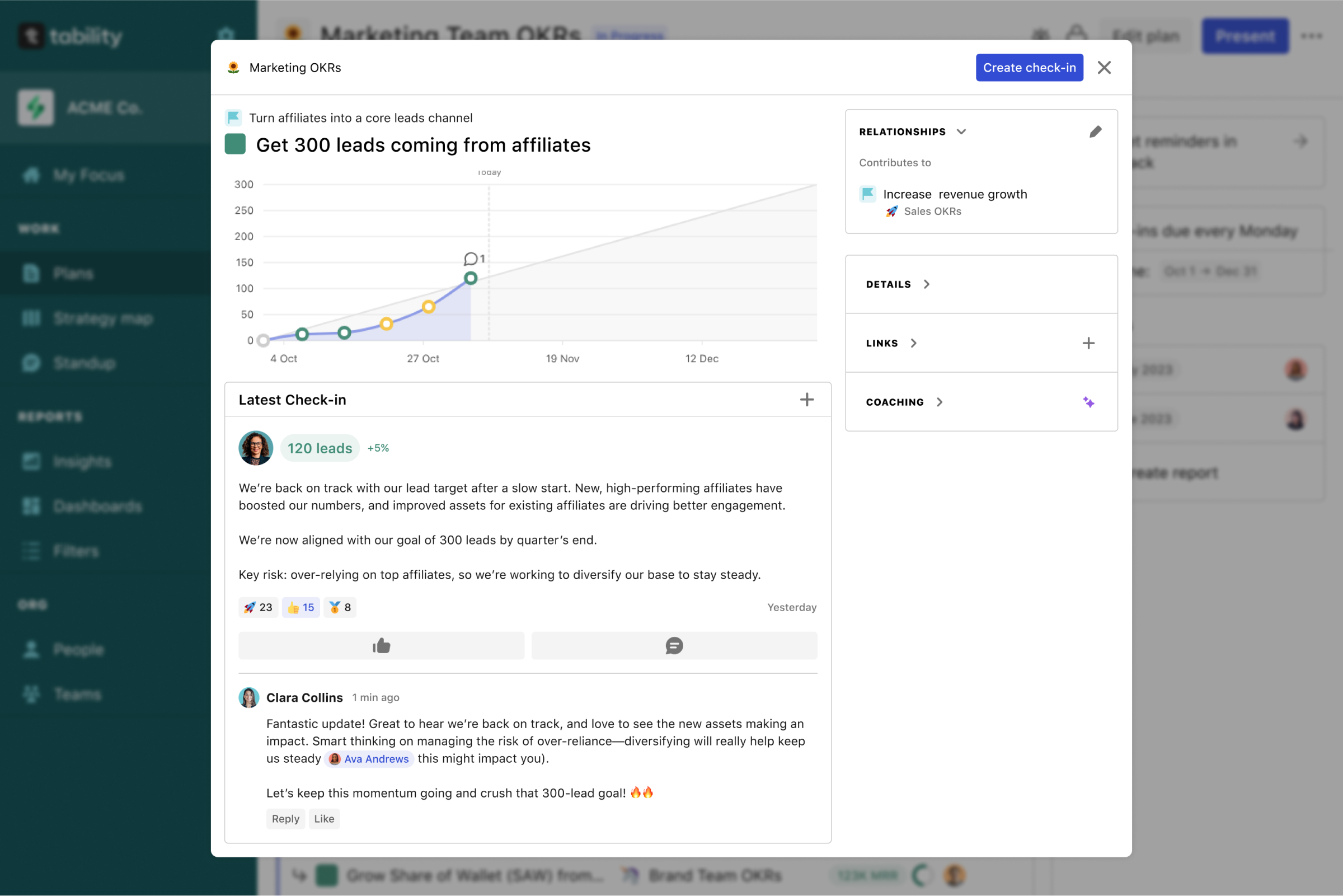
The GROW loop is the structure. Tability is just the place where the loop lives so it does not collapse the moment the meeting ends.
The bottom line
GROW is not a coaching script. It is the operating pattern for any conversation where someone has a goal and is not yet sure how to reach it.
Use it in 1:1s. Use it in weekly check-ins. Use it in your quarterly strategy review. Run it as a loop, not a checklist. Do not skip Reality. Make the Will concrete enough that next week's review can measure it.
Do all four and most of the meetings on your calendar get genuinely better.
Try it on your own cadence
If you are trying to bring more structure into your team's operating cadence, weekly check-ins, retros, strategy reviews, Tability gives you a single place to track outcomes, run GROW conversations against real data, and make the commitments stick.
Sign up free or book 30 minutes with us and we will help you map it to your team's rhythm.

.jpg)
.png)