
Most strategy conversations start too close to home. Teams debate internal priorities, resource allocation, hiring plans.
What they often skip is the bigger picture: the forces outside the business that quietly determine whether the strategy works at all.
That's what PEST analysis is for. It's a structured way to map the external environment before you commit to a strategic direction. Political shifts, economic pressures, social trends, and technological changes don't care about your roadmap. PEST analysis makes sure your strategy accounts for them.
This guide covers what PEST analysis is, how to run one properly, worked examples across industries, and (most importantly) how to make sure the insights actually change something.
What is a PEST analysis?
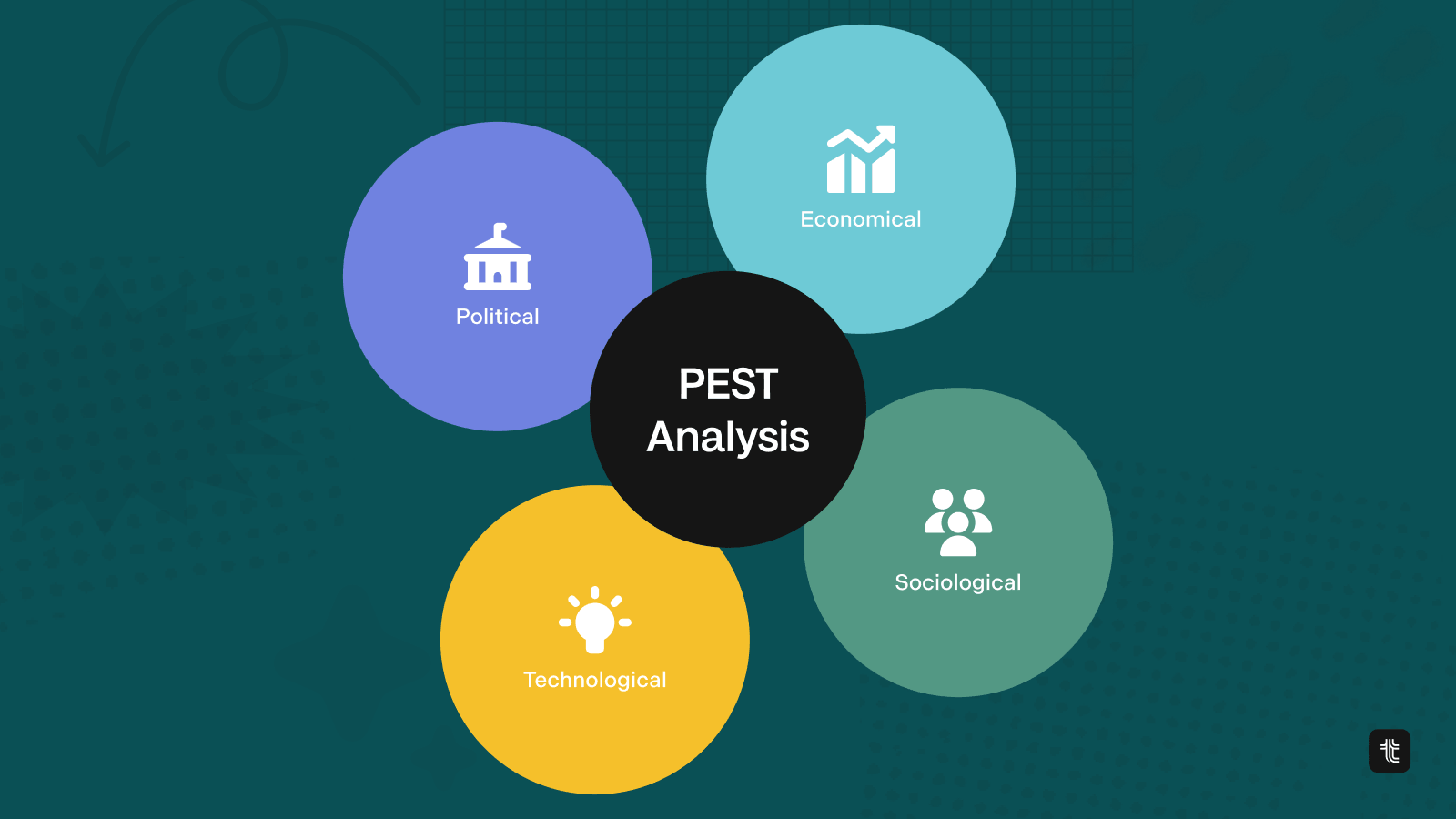
PEST analysis is a strategic planning framework that helps organisations identify and evaluate the external macro-environmental factors most likely to affect their business.
PEST stands for: Political, Economic, Social, and Technological.
Together, these four categories cover most of the major forces operating outside any organisation's control. The goal isn't to predict the future. It's to stress-test your strategy against the conditions you're actually operating in, before you commit to a direction that could become irrelevant in six months.
PEST analysis is most useful at the start of a strategic management process: when you're setting annual or quarterly direction, evaluating a new market, or responding to a significant external shift. It's a diagnostic tool, not a strategy in itself.
Breaking down the four PEST factors
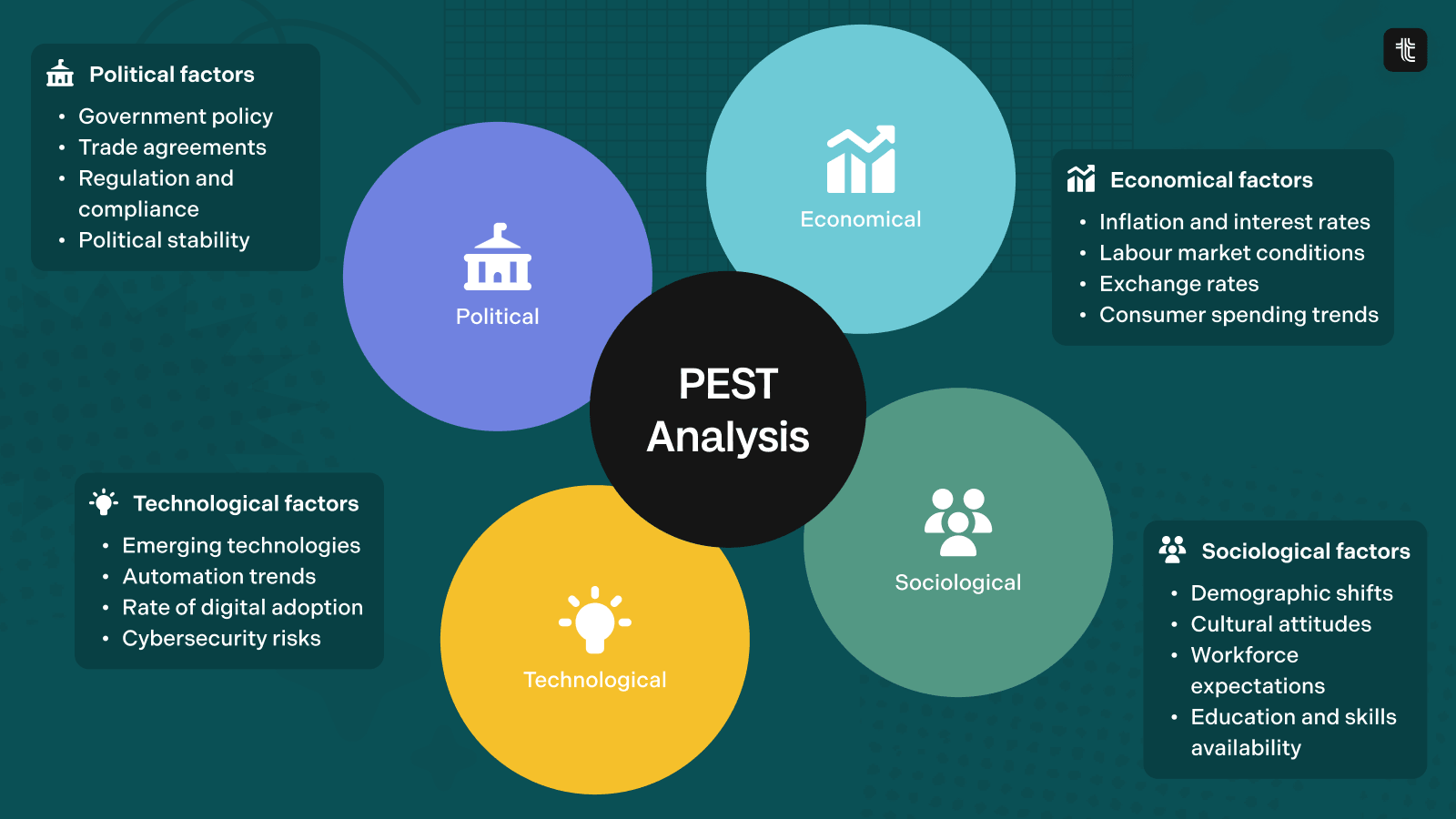
Each of the four PEST categories captures a different slice of the external environment.
Political factors
Political factors cover government policy, regulation, trade agreements, political stability, and anything driven by the decisions of those in power.
Examples include: new data privacy legislation, changes to import tariffs, shifts in government spending priorities, and election outcomes that change regulatory direction.
Economic factors
Economic factors cover inflation, interest rates, unemployment, exchange rates, consumer spending, and the broader economic cycle.
Examples include: rising costs of capital affecting investment decisions, labour market tightness driving wage inflation, and shifts in purchasing power that change buyer behaviour.
Social factors
Social factors cover demographic trends, cultural shifts, changing consumer behaviours, education levels, and social attitudes.
Examples include: the shift to remote and hybrid work, growing expectations around sustainability, workforce age demographics affecting talent supply, and changing attitudes toward work-life balance.
Technological factors
Technological factors cover emerging technologies, automation, digitisation, R&D investment, and the rate of tech adoption across an industry.
Examples include: AI tooling reshaping knowledge work, cloud infrastructure reducing barriers to entry, new cybersecurity risks, and the pace at which competitors are adopting automation.
PEST vs PESTLE: which one should you use?
PESTLE (sometimes written PESTEL) extends the original framework with two additional categories: Legal and Environmental.
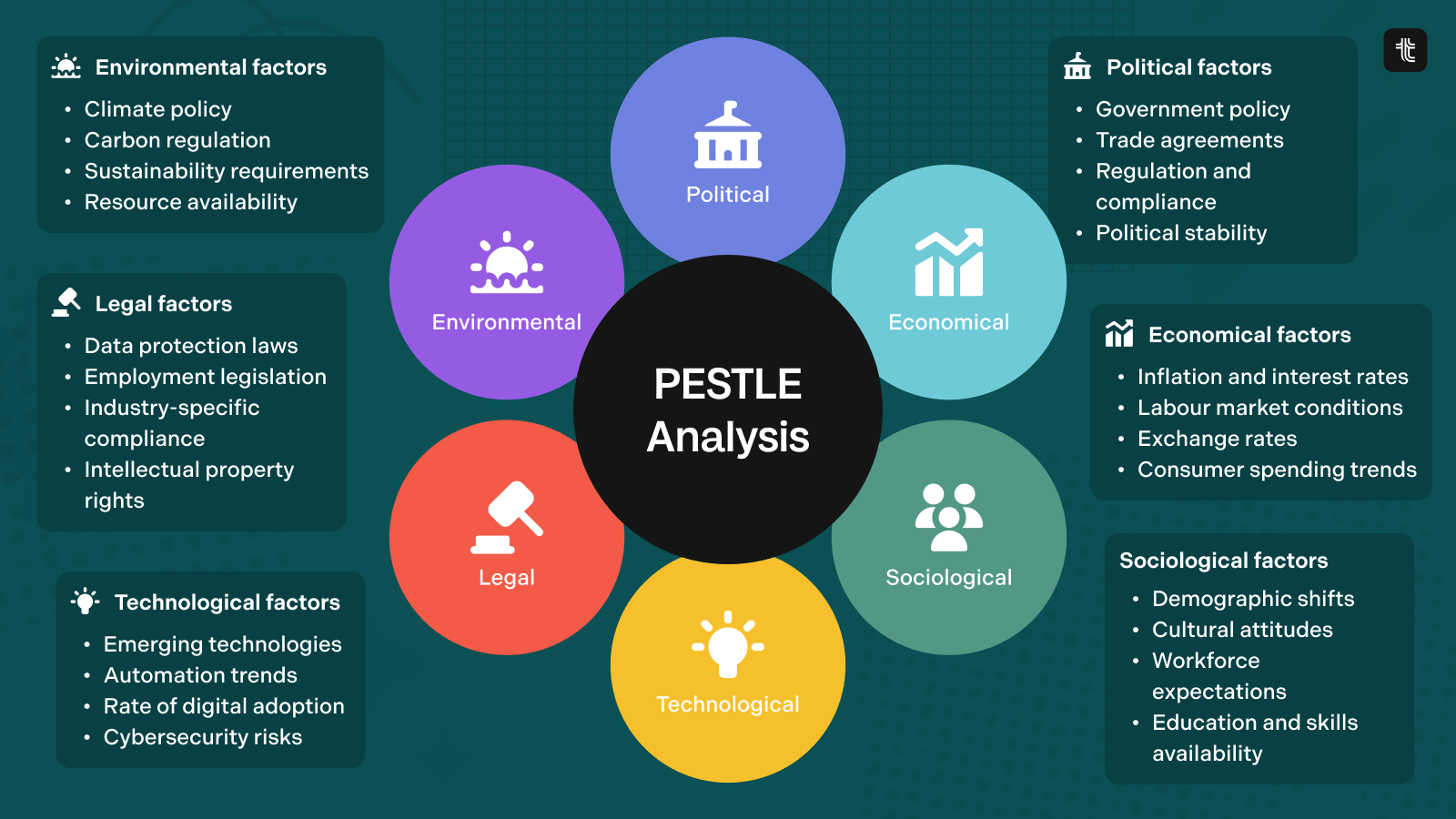
The distinction between Political and Legal is worth understanding. Political factors relate to government priorities and policy direction. Legal factors are more specific: the actual laws, regulations, and compliance requirements that govern how your business operates. For some industries, like financial services or healthcare, keeping these separate is genuinely valuable.
Environmental factors cover climate change, sustainability requirements, ecological concerns, and resource availability. For manufacturing, agriculture, logistics, or any business with a significant physical footprint, this category can be material to strategy.
For most businesses, especially software companies and knowledge-work organisations, PEST is sufficient. Add the L and E only if legal compliance and environmental risk are genuinely material to your strategic direction. Adding categories you won't seriously analyse just adds noise.
How to run a PEST analysis in four steps
PEST analysis isn't a one-person task done in an afternoon. Done well, it draws on input from people across the business who are closest to different parts of the external environment.
Step 1: Assemble the right people
Include voices from strategy, finance, product, legal, and any customer-facing roles. Each function sees different signals from the outside world. A finance lead spots economic shifts early; a salesperson hears regulatory concerns from customers before they appear in industry reports. The quality of your PEST analysis depends on the diversity of inputs.
Step 2: Brainstorm factors in each category
For each of the four categories, generate a list of external factors that could affect your business in the next one to three years. At this stage, quantity matters more than precision. Capture everything, then filter. You're looking for signals, not certainties.
Step 3: Prioritise by impact and likelihood
Not every factor carries equal weight. Once you have a list, score each factor against two dimensions: how likely it is to materialise, and how significant the impact would be if it did. Focus your attention on the high-likelihood, high-impact quadrant. Everything else is context, not priority.
Step 4: Connect findings to your strategic plan
This is where most teams stop short. PEST analysis only creates value if the insights actually change something: a priority, a risk mitigation plan, a strategic pillar, or a measurable goal. Map your key PEST factors to the strategic questions they raise, and translate those into actions your team can track. Without this step, the analysis stays on the slide and off the agenda.
PEST analysis examples across industries
Abstract frameworks are easier to work with when you can see them applied. Here's how PEST analysis looks in practice across three different contexts.
SaaS / Technology
A SaaS company might identify the following factors:
- Political: Tightening data privacy regulation (GDPR, state-level US privacy laws) increasing compliance overhead
- Economic: Rising cloud infrastructure costs as vendor pricing adjusts to higher interest rate environments
- Social: Growing expectations from enterprise buyers for AI-native features, not just AI bolt-ons
- Technological: Rapid advances in AI tooling compressing the time competitors need to ship equivalent features
Healthcare
A healthcare provider might be tracking:
- Political: Government funding cuts and regulatory reform affecting reimbursement rates
- Economic: Wage inflation driven by a structural shortage of skilled clinicians
- Social: Ageing population demographics increasing demand for chronic disease management
- Technological: Electronic health record integration requirements creating both compliance cost and new data opportunities
Manufacturing
A manufacturer might focus on:
- Political/Economic: Trade tariff uncertainty affecting raw material sourcing and cost predictability
- Economic: Energy price volatility compressing margins across the production cycle
- Social: Consumer preference shifts toward sustainably produced goods changing procurement requirements
- Technological: The pace of automation adoption among competitors requiring capital investment decisions
These examples share a common thread. The factors aren't just interesting context. Each one has direct implications for how the organisation should be setting its goals and allocating its resources.
Turning PEST findings into strategic goals
Here's where PEST earns its keep. And where most organisations leave value on the table.
A PEST analysis sitting in a slide deck, reviewed once a year at an offsite, accomplishes very little. The organisations that get real value from the framework are the ones who use the findings to directly inform their strategic initiatives and then actually track whether they're responding.
In practice, this means asking, for each high-impact PEST factor: "What does this mean we should do differently, and how will we know if we're making progress?"
A regulatory change might create a new strategic goal around compliance readiness. A shift in customer attitudes might accelerate a product pivot. A technology trend might prompt investment in capability-building. Each insight should have a named owner and a measurable outcome attached to it, or it will simply be noted and forgotten.
This is where tools like Tability are specifically designed to help. You can create OKRs that respond directly to your PEST findings, assign them to the right people, and run regular check-ins to make sure the organisation is actually adapting to the external environment rather than just analysing it.
The gap between 'we did the PEST analysis' and 'our strategy reflects what we found' is bigger than most leadership teams realise. The analysis is the easy part. Closing that gap is the whole point.
If you're using PEST analysis to sharpen your strategy, the next step is making sure those insights drive clear, measurable goals, not just good slide content. Tability makes it straightforward to set strategic outcomes, track progress, and keep your team aligned as the external environment shifts. Try Tability free or book a quick call to see how it works for your team.


.jpg)

.png)