
First off, plans hardly ever go to plan. We really should just call it educated guessing.
Even the best-laid strategies miss more often than they hit—60–90% of strategic plans never even fully launch.
The point isn’t to force the original plan; it’s to keep the intent intact while adapting the path. Markets shift, dependencies bite, and new work displaces the old. What separates teams that compound results from those that stall is a simple operating system that makes it easy to see what’s moving, make trade-offs quickly, and change course without losing momentum.
That’s what strategic implementation gives you: clear vision statement, measurable outcomes, named owners, and a light cadence of reviews and escalations. In this guide, we’ll show you how to turn intent into weekly work, pinpoint where progress is stalling, and pivot early—so resources stay pointed at what actually moves the needle.
This guide shows leaders (CEOs, Chiefs of Staff, strategy ops leads) exactly how to translate strategy into weekly work. You’ll get a step-by-step playbook, common pitfalls, and a pragmatic 30-60-90 day rollout plan — so strategy becomes a habit, not a slide deck.
What is strategy implementation?
Strategy implementation is the disciplined process of turning strategic intent into outcomes through clear roles, funded priorities, and recurring execution rituals. It sits between strategy formulation and day-to-day delivery:
- Formulate → decide the direction (vision, strategic pillars, bets)
- Plan → choose outcomes and fund the work (OKRs, portfolio, budget)
- Implement → align people, cadence, and decisions to hit targets
- Learn → review signals, adapt assumptions, and reset
Unlike project delivery (which ships outputs) or status reporting (which describes the past), implementation actively steers to outcomes. It uses live signals to make trade-offs — re-scoping, re-sequencing, or stopping work — so resources stay pointed at what moves the needle.
In practice, a minimal system includes three things: focus (Vision and strategic pillars), outcomes (goals and OKRs cascaded to teams), and cadence (short weekly check-ins, monthly reviews, and quarterly resets). Add clear owners and alert thresholds, and you’ve got a loop that turns strategy into weekly habits.
Why strategy implementation fails (and how to fix it)
Below are common patterns. Each one includes the symptom → root cause → quick fix → metric to watch.
Constant priority churn
- Symptom: teams start new work before finishing the last priority.
- Root cause: no guardrails or shared focus.
- Quick fix: define 3–5 strategic pillars and constrain initiatives to them; cap active work-in-progress.
- Metric: % initiatives mapped to pillars; WIP per team.
“Budget says yes, roadmap says no”
- Symptom: funded goals without capacity to deliver.
- Root cause: no portfolio/capacity planning before committing.
- Quick fix: run capacity planning and a single prioritisation forum before finalising OKRs.
- Metric: planned vs actual capacity; slip rate.
Vague ownership
- Symptom: slow decisions, orphaned outcomes.
- Root cause: unclear roles at each governance level.
- Quick fix: publish a simple RACI per step and assign goal owners and KPI leads.
- Metric: decision lead time; % goals with named owner.
Weak cadence
- Symptom: “surprise red” at quarter end.
- Root cause: reviews are too infrequent and too broad.
- Quick fix: weekly team check-ins, monthly business reviews, OKR reviews, quarterly strategy refresh.
- Metric: % goals with on-time updates; time to escalation.
Change fatigue
- Symptom: disengagement with yet-another process.
- Root cause: heavy governance and unclear “why”.
- Quick fix: small rituals, clear narrative, visible wins; train champions not auditors.
- Metric: check-in compliance; eNPS pulse.
Data fragmentation
- Symptom: status reports stitched in slides.
- Root cause: goals and metrics live in many tools.
- Quick fix: choose a single system of record for OKRs, metrics, and check-ins; integrate sources.
- Metric: time to prepare the MBR; % automated metrics.
ℹ️ Related: From vision to implementation: Breaking down strategy vs. tactics
A step-by-step strategy implementation playbook
Each step lists owner, inputs, outputs, and a “60-minute workshop” you can run this week.
1) Clarify intent with strategic pillars
Start by shrinking the problem. Name three to five strategic pillars that describe where you intend to win and what you won’t do. Good pillars act like guardrails: they focus investment, shape trade-offs, and reduce priority churn. Give each pillar a short description, success definition, and one or two explicit non-goals.
- Owner: ELT sponsor + chief of staff
- Inputs: vision, market thesis, board/CEO narrative
- Outputs: 3–5 pillar one-pagers with success definitions and non-goals
- 60-minute workshop: “If we only did three things this year…” → convert into pillars and non-goals
2) Translate big vision into tangible goals
Turn intent into outcomes with a simple hierarchy: pillar → objective → measurable key results. Keep objectives outcome-oriented; reserve initiatives for how you’ll get there. Every KR needs a baseline, target, owner, cadence, and data source—even if you must stand up the data first.
📖 See: Our OKR implementation Masterclass for an in-depth guide on how to get your OKR rollout right.
- Owner: chief of staff + strategy lead
- Inputs: pillars, baseline metrics, constraints
- Outputs: company OKRs; team drafts; alignment map (pillar → objective → KRs → initiatives)
- 60-minute workshop: draft 1–2 objectives per pillar; 2–4 KRs each with baselines/targets
3) Align resources and budget to outcomes
Outcomes without capacity are wishes. Pressure-test headcount, vendor spend, and sequencing before public commitments. Map each initiative to a pillar and KR, estimate effort, and check whether delivery teams actually have the hours. Cut scope or defer early if not.
- Owner: CFO + PMO
- Inputs: prioritised initiatives, headcount plan, vendor costs
- Outputs: capacity plan, funded roadmap, hiring plan
- 60-minute workshop: impact × effort stack-rank; reconcile capacity gaps; explicitly kill/Defer items
4) Set governance and decision rights
Decisions stall when ownership is fuzzy. Publish a simple RACI and list the top recurring decisions (e.g., roadmap change > $X, pivot a must-win bet). Assign a single decider, set who must be consulted, and make escalation paths fast and boringly clear.
- Owner: ELT sponsor
- Inputs: org structure, program scope
- Outputs: RACI, decision rights matrix, escalation paths with SLAs
- 60-minute workshop: identify top 10 decisions; assign one named decider for each
5) Prioritise the portfolio and build the roadmap
There will always be more ideas than capacity. Rank initiatives with a lightweight model, expose dependencies, and mark “must-win” bets that get protected time. Build a quarter-by-quarter view so teams see what lands when—and what moves if a new priority appears. Add exit/kill criteria.
- Owner: PMO
- Inputs: initiative backlog, dependencies, risks
- Outputs: quarterly roadmap, dependency map, risk register with owners
- 60-minute workshop: portfolio review to retire at least one low-impact item and free capacity
6) Establish an operating cadence
Cadence is the engine of implementation. Keep it light and frequent: weekly team check-ins to update KRs and flag risks; a monthly business review to rebalance resources; and a quarterly refresh to reset goals. Time-box meetings, standardise agendas, pull data from source tools.
- Owner: chief of staff
- Inputs: calendars, KPI list, governance moments
- Outputs: weekly check-ins, MBR, QBR, executive standup with standard agendas
- 60-minute workshop: schedule rituals, define required inputs, and assign owners
7) Manage change and communication
People adopt what they understand. Explain why now, why this, and how you’ll know it’s working. Tailor messages by audience, nominate champions in each function, and showcase quick wins early. Coaching beats policing.
- Owner: chief of staff + comms/HR
- Inputs: stakeholder map, messaging framework, enablement needs
- Outputs: comms plan (audience, message, channel, frequency), enablement sessions, champions network
- 60-minute workshop: draft the two-paragraph narrative and publish it with FAQs
8) Execute, track, and escalate issues
Agree on a shared status language (on track / at risk / off track) and rules for when to escalate. Tie risks to specific KRs so impact is obvious. When something slips, choose to re-scope, re-sequence, re-staff, or stop—and document the choice. Default to truth, not “green by default.”
- Owner: PMO + team leads
- Inputs: OKRs, metrics, status taxonomy, risk log
- Outputs: weekly updates, alerts, issue tracker with clear owners and due dates
- 60-minute workshop: set alert thresholds on top KRs; rehearse one escalation end-to-end
9) Learn and adapt
Implementation is a loop, not a line. After major milestones, run short after-action reviews to capture what worked, what didn’t, and what to change next cycle. In the QBR, compare assumptions to outcomes, update targets, and adjust the portfolio. Celebrate well-reasoned kills and pivots.
- Owner: ELT sponsor + chief of staff
- Inputs: KPI trends, assumption log, AAR notes
- Outputs: QBR decisions, updated targets, refreshed roadmap and playbook
- 60-minute workshop: run one AAR on a must-win deliverable; feed actions into the next quarter
Metrics that matter
Implementation without metrics is just activity. Having a deep understanding of why things are working or not working is just as important as the activity itself.
Mix leading and lagging indicators
When it comes to measuring your success, there are two types of metrics: leading vs lagging indicators.
- Leading: inputs you can influence now (activation rate, SQLs, cycle time).
- Lagging: results that confirm the impact (NRR, churn %, SLA breaches).
It’s critical to understand the differences to ensure that you’re covering all of your bases, and that you know how to act on them when you are able to make an educated assumption about the results.
Set alert thresholds and actions
Define what “at risk” means before the quarter starts (e.g., “If weekly SQLs < 50 for two consecutive weeks, spin up a cross-functional taskforce”). Pair each threshold with a default action: re-scope, re-sequence, re-staff, or stop.
Shared status language
Adopt a simple taxonomy—on track / at risk / off track—and apply it to KRs in weekly check-ins. Roll these up in the MBR to make resource rebalancing a data-led decision, not a debate.
Example metric sets (by function)
Product & growth
- Leading: activation rate, time-to-first-value, weekly SQLs, feature adoption, trial→paid conversion
- Lagging: net revenue retention (NRR), gross churn %, P90 onboarding time, CAC payback
Operations
- Leading: cycle time, on-time handoffs, first-contact resolution, defects caught pre-release
- Lagging: cost per ticket/order, SLA breaches, P1 incident frequency
People
- Leading: check-in compliance, new-hire time to first PR/closed ticket, training completion
- Lagging: regrettable attrition, time to productivity, engagement/eNPS
ℹ️Check out our library of OKR examples, organised by team and function.
Tooling: what to look for in strategy implementation software
Must-haves
- Goal hierarchy & alignment (pillars → OKRs → initiatives)
- Check-ins with status taxonomy and history
- Assign ownership and organize by teams in a Strategy Map
- Metric tracking with baselines/targets and dashboards
- Automated reminders & alerts
- Executive roll-ups and portfolio views
- Integrations (Slack, Notion, Jira, Sheets/CSV, BI)
- Access controls & audit trail
Nice-to-haves
- AI summaries and risk detection
- API & exports
- Templates gallery (OKRs, cadences, reports)
The most complete platform for strategy implementation
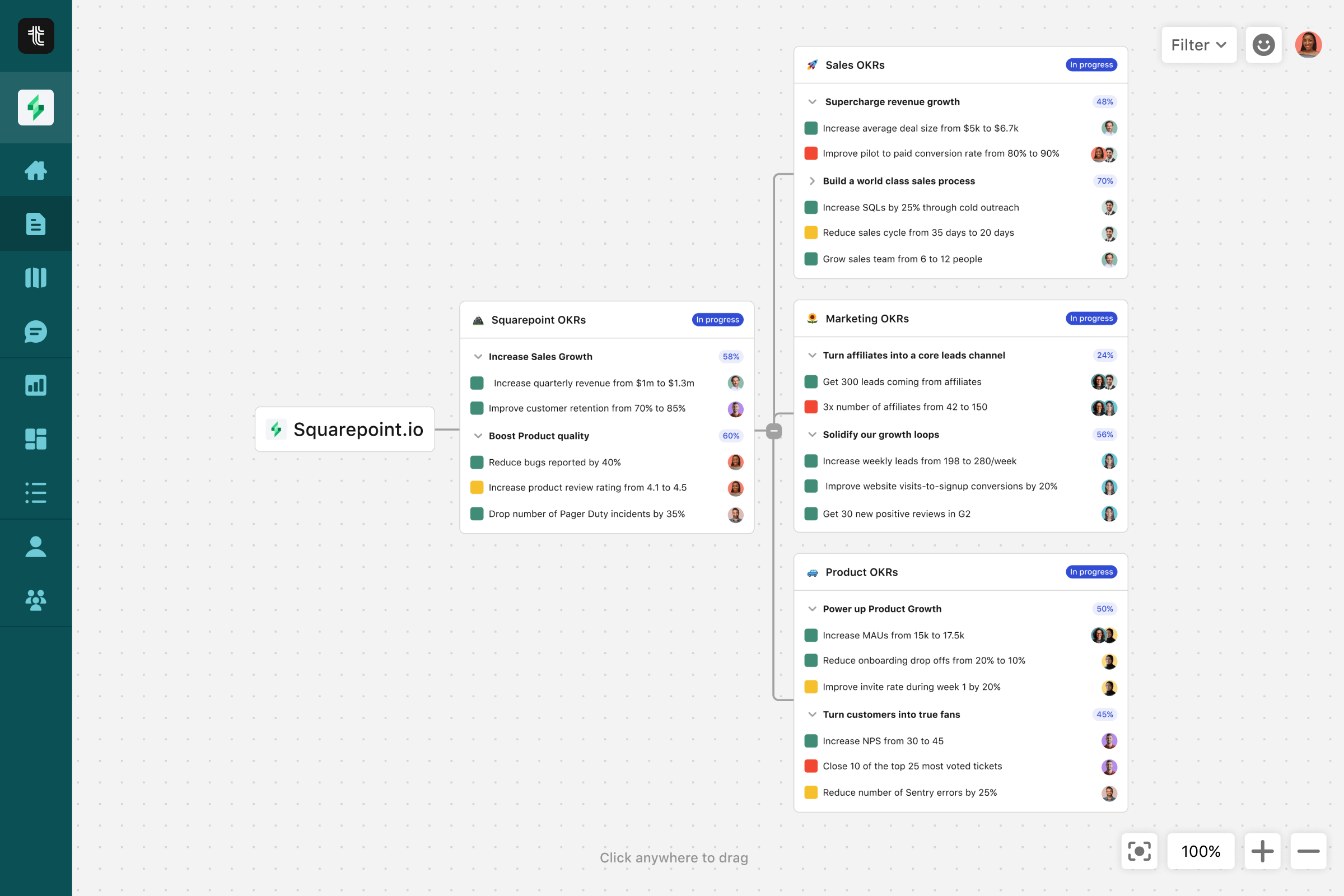
Tability provides alignment trees, automated check-ins, metric updates, risk alerts, and executive roll-ups, with integrations to the tools you already use. It keeps strategy, outcomes, and updates in one place — so leaders review signals, not slides.
30-60-90 day rollout plan
Days 1–30 (foundation)
- Confirm pillars and non-goals; draft 3–5 company OKRs
- Publish RACI; pick your tool; load baselines
- Schedule weekly check-ins, MBR, QBR; pilot with two teams
Days 31–60 (expansion)
- Cascade OKRs to key teams; finalise roadmap and funding
- Start automated check-ins; run your first MBR
- Kill/defer low-impact work to free capacity
Days 61–90 (adaption)
- Review early signals; adjust targets and resourcing
- Expand to remaining teams; run your first QBR
- Capture lessons and update the playbook
FAQs
Is strategy implementation the same as strategy execution?
They’re often used interchangeably. In this guide, implementation is the structured system (roles, cadence, funding) that enables execution week to week.
Who should own implementation?
An ELT sponsor sets direction; a Chief of Staff or PMO runs cadence and integration across teams; goal owners and KPI leads drive outcomes.
How long until we see traction?
You should see better signal within 30 days (on-time updates, faster decisions) and material outcome movement within 1–2 quarters.
How many OKRs per team?
Usually 1–3 objectives, 2–4 measurable KRs per objective. If everything is a priority, nothing is.
Do we need OKRs to implement strategy?
No — OGSM or balanced scorecard can work. The key is a clear outcomes hierarchy and a cadence to review it.
How do we implement with remote teams?
Asynchronously by default: short weekly check-ins in a shared tool, monthly reviews with live dashboards, and clear decision rights.
Conclusion: make strategy a weekly habit
Remember, plans hardly ever go to plan — they’re just educated guesses. The difference-maker isn’t a perfect plan; it’s a simple operating system that turns intent into weekly work and helps you pivot without losing momentum.
Keep the intent tight and let the path adapt: clear pillars, outcome-based OKRs, named owners, a light cadence (weekly check-ins, monthly reviews, quarterly resets), honest status, and fast escalations. That’s how strategy shows up in calendars, budgets, and decisions — not just in a deck.
When you’re ready to put this on rails, Tability gives you alignment trees, automated check-ins, metric updates, risk alerts, and executive roll-ups — so leaders review signals, not slides.
Good luck 🫡

.jpg)

.png)