
Most product teams don't struggle to build things. They struggle to build the right things.
The culprit is almost always the same: a product strategy that's really just a roadmap in disguise. A list of features, a timeline, maybe a few themes, dressed up as strategy but offering none of the clarity that strategy is supposed to provide.
Here's how to write one that actually works.
A product strategy is not a plan 🙅🏻♀️
This is the most important thing to get right before you write a single word.
A plan tells you what you're going to build and when. A strategy tells you why those things matter and what problem you're trying to solve. The two are related, but they're not the same, and confusing them is how teams end up shipping a lot of stuff without moving the needle.
Product Strategy is a system of achievable goals and visions that work together to align the team around desirable outcomes"
It is not a feature list nor a roadmap. It is a system of goals.
The moment you catch yourself writing "build X by Q3" in your strategy document, stop. That's a plan. Your strategy should explain why X matters and what success looks like, not how you're going to execute it.
What a good product strategy is made of
There's no single template that works for every team or every stage of a company. But the good ones tend to have the same building blocks.
A clear vision
Your vision is the long-term, qualitative view of where you're going. It doesn't need to be updated every quarter. It shouldn't have numbers in it. It just needs to answer: what are we ultimately trying to achieve, and for whom?
Keep it short. Keep it honest. If you can't explain your product vision in two sentences, it's probably not clear enough yet.
A defined challenge
This is the first big problem standing between where you are now and your vision. Not every problem, just the most important one to solve right now.
Getting specific here is hard, but it's the most valuable work you can do. A vague challenge ("improve retention") gives your team nothing to work with. A sharp one ("too many users drop off before they experience the core value of the product") tells everyone what to focus on and why it matters.
A target condition
Once you've named the challenge, you need a measurable goal that tells you when you've made meaningful progress against it. This is where OKRs come in.
OKRs (Objectives and Key Results) are one of the most effective ways to translate a product strategy into something your team can act on week to week. Your objective captures the challenge you're trying to solve. Your key results define the target conditions that tell you whether you're making real progress.
Done well, OKRs don't sit on top of your strategy, they emerge directly from it. Using great OKR software helps keep those goals visible, tracked, and connected to the work your team is actually doing.
Some teams go one level higher and define a north star metric — a single number that best captures the core value your product delivers to users.
The target condition shouldn't be so specific that it prescribes a solution. Your team should know where they're aiming without being told exactly how to get there.
An honest view of where you are today
Before you can close the gap, you need to know how big it is. Document the current state in real terms. What does your data actually show? Where are users dropping off? What's not working? This is the baseline everything else is measured against.
A SWOT analysis is a simple way to structure this thinking — mapping your product's current Strengths, Weaknesses, Opportunities, and Threats gives you a picture of both your internal reality and the external context you're operating in.
The key is specificity: "competitive market" and "great team" tell you nothing. Retention drops at day 7, a well-funded competitor entering your core segment, an unserved enterprise tier going to a legacy tool — that's the kind of current-state detail that makes the rest of your strategy feel grounded rather than aspirational.
The mistake most teams make
They write a strategy that sounds right but commits to nothing.
It's full of words like "best-in-class," "seamless experience," and "customer-centric," and completely empty of the hard choices that make a strategy real. A strategy that tries to be everything to everyone is not a strategy. It's a wish list.
Good strategy means saying no. It means picking a specific customer, a specific problem, and a specific approach, and accepting that you can't do everything at once. The constraints are the point. They're what force the prioritisation decisions that actually move a product forward.
How to tie it to your roadmap
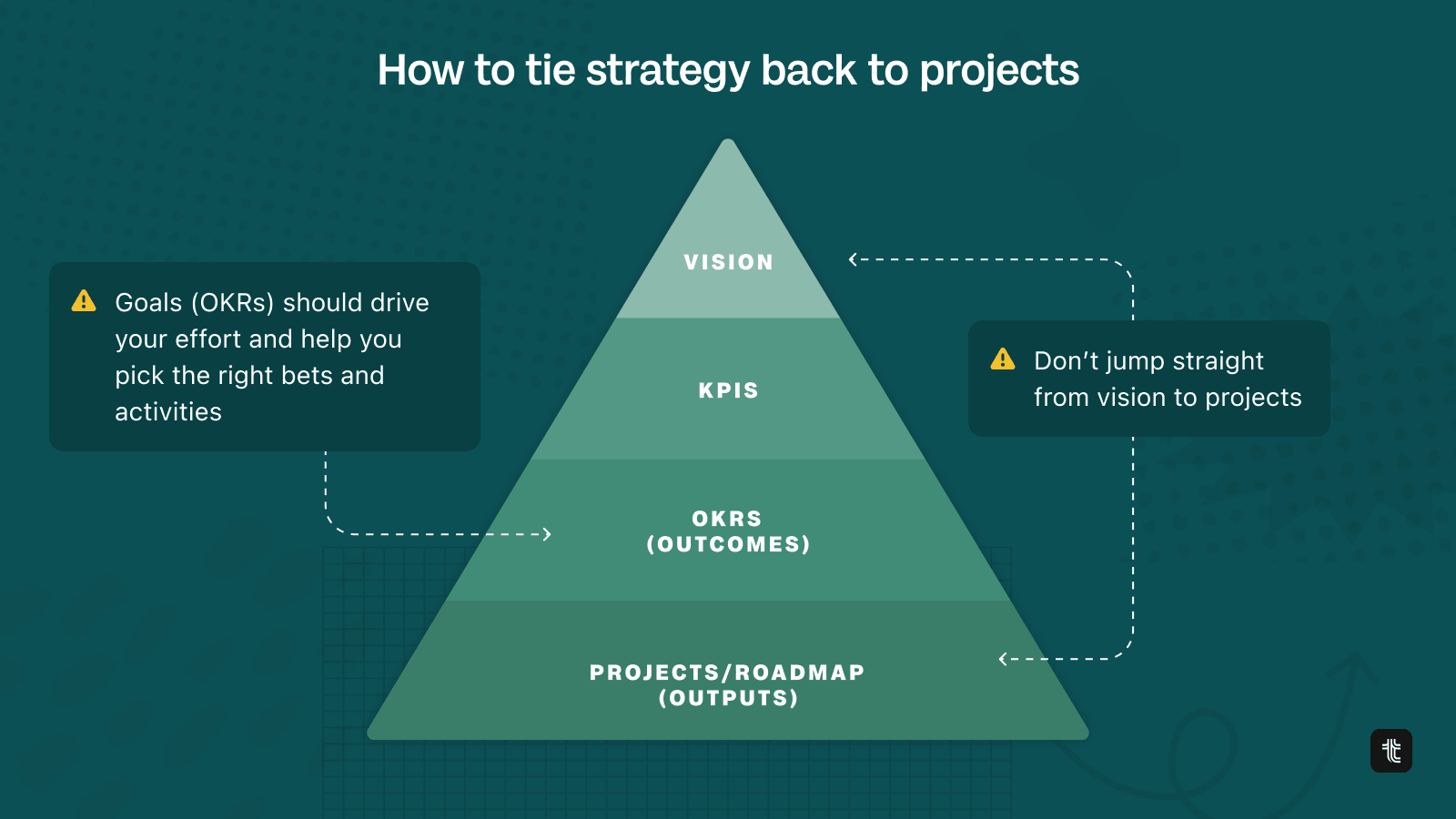
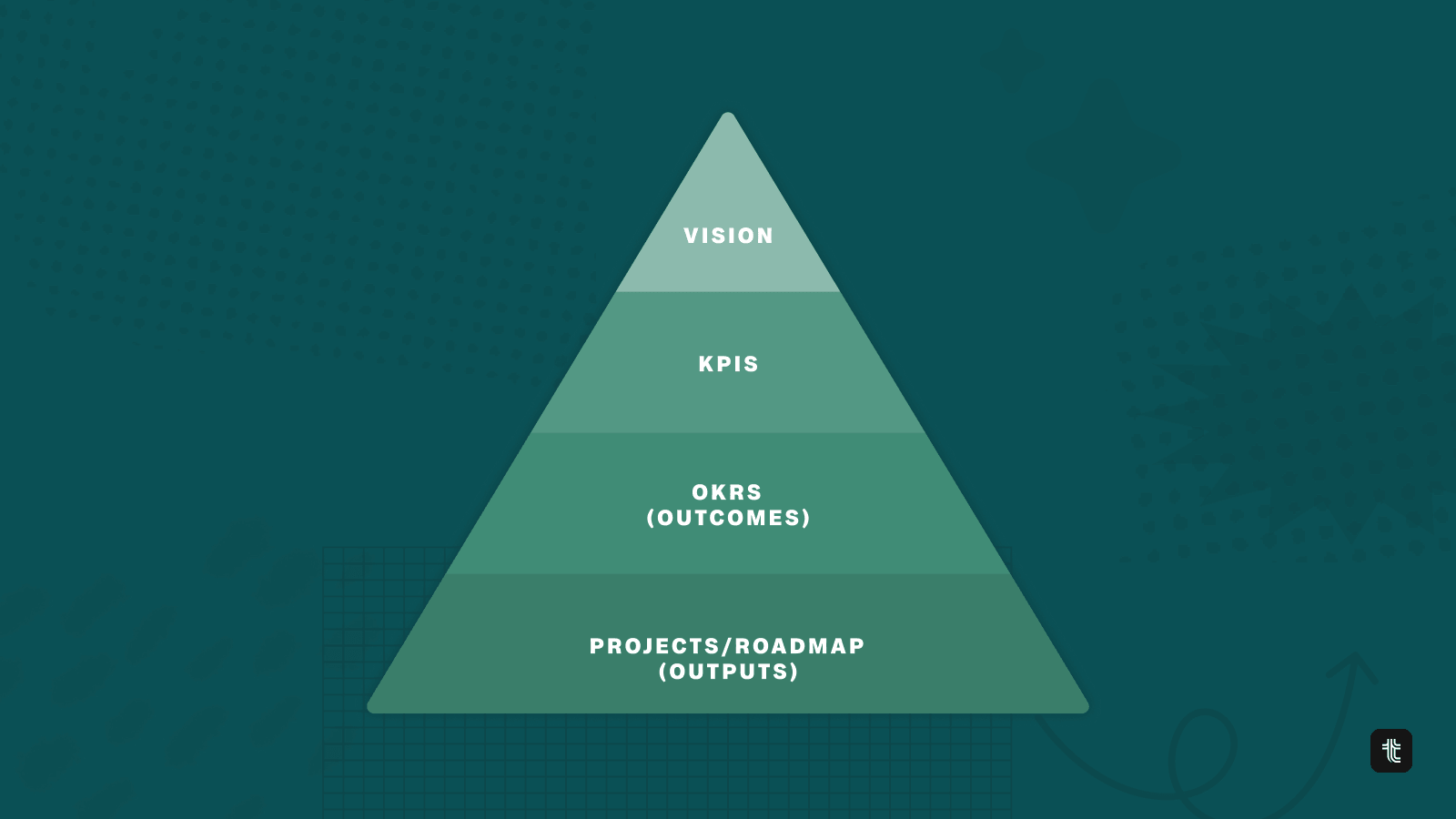
Once you have a strategy, your roadmap should flow directly from it via OKRs. Your objectives capture the big challenges you're trying to solve. Your key results define what progress looks like. And your roadmap initiatives are the bets you're making to hit those key results.
This gives every item on your roadmap a clear line of sight back to the strategy. If something can't be connected to an active objective, it probably shouldn't be on the roadmap.
One practical way to structure this is to organise your roadmap around your strategic pillars; the core areas of focus your strategy is built on. Each pillar gets its own OKRs, and every item on the roadmap traces back to one of them. If it doesn't fit under any pillar, that's a useful signal: either the work is genuinely out of scope, or the pillars themselves need revisiting.
This also makes stakeholder conversations much easier. Instead of defending individual features, you're defending strategic priorities.
This sounds obvious but it's rare in practice. Most roadmaps are a negotiated list of things different stakeholders wanted, with strategy added as an afterthought. Flip that order. Start with the strategy, define your pillars, set your OKRs against them, then figure out what needs to be built to move the needle.
How to keep it alive
A product strategy isn't a document you write once and file away. It needs to be revisited, not constantly, but regularly enough to stay relevant as you learn more about your customers and your market.
The vision should be stable. The challenge and target conditions should evolve as you make progress or as the context shifts. When something isn't working, update the strategy. Don't just keep building against a goal that's no longer the right one.
This is where a regular OKR cadence pays off. When your team is checking in on key results weekly and reviewing objectives each quarter, you create a natural forcing function to ask the harder question: is this still the right strategy?
The rhythm of OKRs keeps the strategy connected to reality, not just to what you planned six months ago. Teams that invest in their strategic operations go further; they build the systems and rhythms that keep strategy alive and connected to execution all year round, not just during planning season.
Where to start
If you don't have a product strategy, or the one you have is really just a roadmap, start here:
- Write down the vision for your product in two sentences or less
- Identify the single biggest challenge standing between where you are and that vision
- Define a measurable target condition that tells you when you've made real progress on that challenge
- Document the current state honestly, with data
- Translate your challenge and target conditions into OKRs so your team has something concrete to work towards each quarter
- Check your roadmap against all of the above and cut anything that doesn't connect
That's it. It won't be perfect the first time, it never is. But having a real strategy, even an imperfect one, is infinitely more useful than a polished plan that's pointing in the wrong direction.


.jpg)

.png)