
OKRs are meant to be ambitious—but not impossible.
Your goals shouldn’t be so easy that teams coast, but they also shouldn’t be so hard that you’re setting everyone up to fail. Striking that balance sounds simple on paper, but if you’re a Chief of Staff, operations manager, or the person running the OKR process, you know how messy it gets when people aren’t aligned on the types of goals they’re setting.
Some teams write goals they think should be inspiring. Others write goals they know they have to hit. Leadership wants stretch. Teams want clarity. And you’re left trying to interpret which targets are meant to push boundaries and which ones the business is relying on to run smoothly.
When those expectations aren’t clearly separated, planning becomes harder than it needs to be. Forecasts get skewed. OKR reporting gets inconsistent. Teams feel pressured by goals that were never meant to be commitments. And suddenly, what should be a clean alignment exercise becomes a cycle of confusion.
That’s why distinguishing between aspirational and committed goals is essential. It gives everyone a shared understanding of the types of goals they’re working with—what’s meant to stretch the team, and what absolutely needs to land.
What are committed goals
Committed goals are the outcomes the business expects to hit. These are the goals tied to budgets, forecasts, operational targets, and customer promises. When a committed goal is set, the assumption is simple: the team will do what’s needed to achieve it.
Committed goals aren’t about stretch or inspiration—they’re about reliability. They’re grounded in current capacity, known constraints, and the resources already available. If a committed goal is missed, it usually means something went wrong in execution, planning, or prioritisation.
Characteristics of committed goals:
- They’re realistic and achievable with current resourcing.
- They support operational health and predictable performance.
- They influence budgeting, hiring, and strategic decisions.
- They’re treated as promises, not aspirations.
These are the “must hit” goals that give leadership confidence that the business can run effectively quarter after quarter.
What are aspirational goals?
Aspirational goals are stretch targets—ambitious outcomes designed to push the limits of what the team believes is possible. They sit above current capacity and often require new thinking, experimentation, or bold decisions.
These goals aren’t expected to hit 100%, and that’s the point. Aspirational goals encourage innovation and challenge teams to imagine better ways of working. Progress is still measured, but success looks different: reaching 60–80% might still represent significant improvement or learning.
Characteristics of aspirational goals:
- They intentionally exceed current resourcing or capabilities.
- They inspire new ideas, innovation, and long-term thinking.
- They support strategic shifts, moonshot projects, or market expansion.
- Missing them isn’t failure—it’s part of the stretch.
Aspirational goals create space for teams to explore what could be possible, while committed goals keep the business grounded in what must be delivered.
Why the distinction between committed and aspirational goals matters
When teams don’t clearly separate committed and aspirational goals, everything downstream becomes harder. The goals might look fine on paper, but the expectations behind them are completely misaligned. Leaders assume a target is a commitment. Teams assume it’s a stretch. And suddenly the organisation is working toward two different interpretations of success.
.png)
This mismatch creates real operational pain:
- Forecasts become unreliable because no one knows which goals are guaranteed versus which ones are stretch targets.
- Reporting becomes inconsistent—some teams celebrate partial progress while others get penalised for not hitting 100%.
- Teams feel pressure or anxiety around goals that were never meant to be commitments.
Clear distinctions change that. When everyone understands the type of goal they’re working with, planning becomes sharper, prioritisation becomes easier, and conversations about performance become more honest. Committed goals keep the business steady. Aspirational goals keep it moving forward. Without explicitly calling out which is which, organisations end up doing both poorly.
Committed goals keep the business steady. Aspirational goals keep it moving forward.
Being intentional about the difference isn’t a process detail—it’s a fundamental alignment tool.
When to use committed goals
Use committed goals when the business needs reliability and predictable results. These are the outcomes that keep operations stable and allow leadership to make confident decisions. They’re best suited for:
- Quarterly or annual operational plans
- Revenue, retention, or cost targets
- Product delivery milestones with customer impact
- Metrics tied directly to budgeting or headcount
- Any goal where missing it would create risk or downstream issues
Committed goals give teams a clear baseline for what absolutely needs to happen for the business to run smoothly.
When to use aspirational goals
Use aspirational goals when you want teams to stretch beyond what’s currently possible. These goals are about exploring potential, not guaranteeing outcomes. They’re ideal for:
- Innovation and R&D efforts
- Entering new markets or testing new business models
- Moonshot ideas that challenge assumptions
- Long-term strategic bets that go beyond the current roadmap
- Areas where progress matters more than perfection
Aspirational goals help teams think bigger, experiment more freely, and pursue bold opportunities without the pressure of full certainty.
How to use both committed and aspirational goals in OKRs
While committed and aspirational goals often look similar on the surface, the way you interpret and discuss them internally should be completely different. That starts with making the distinction obvious and easy to work with.
Label them clearly (and make them easy to filter)
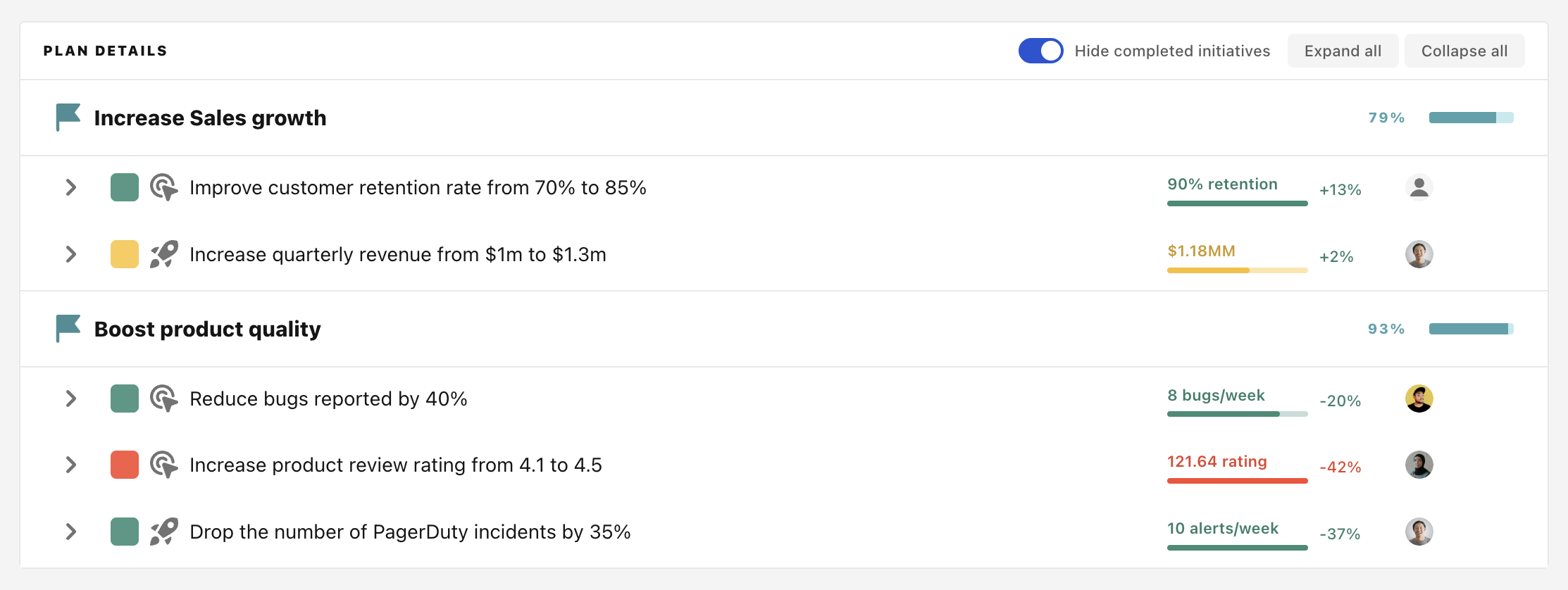
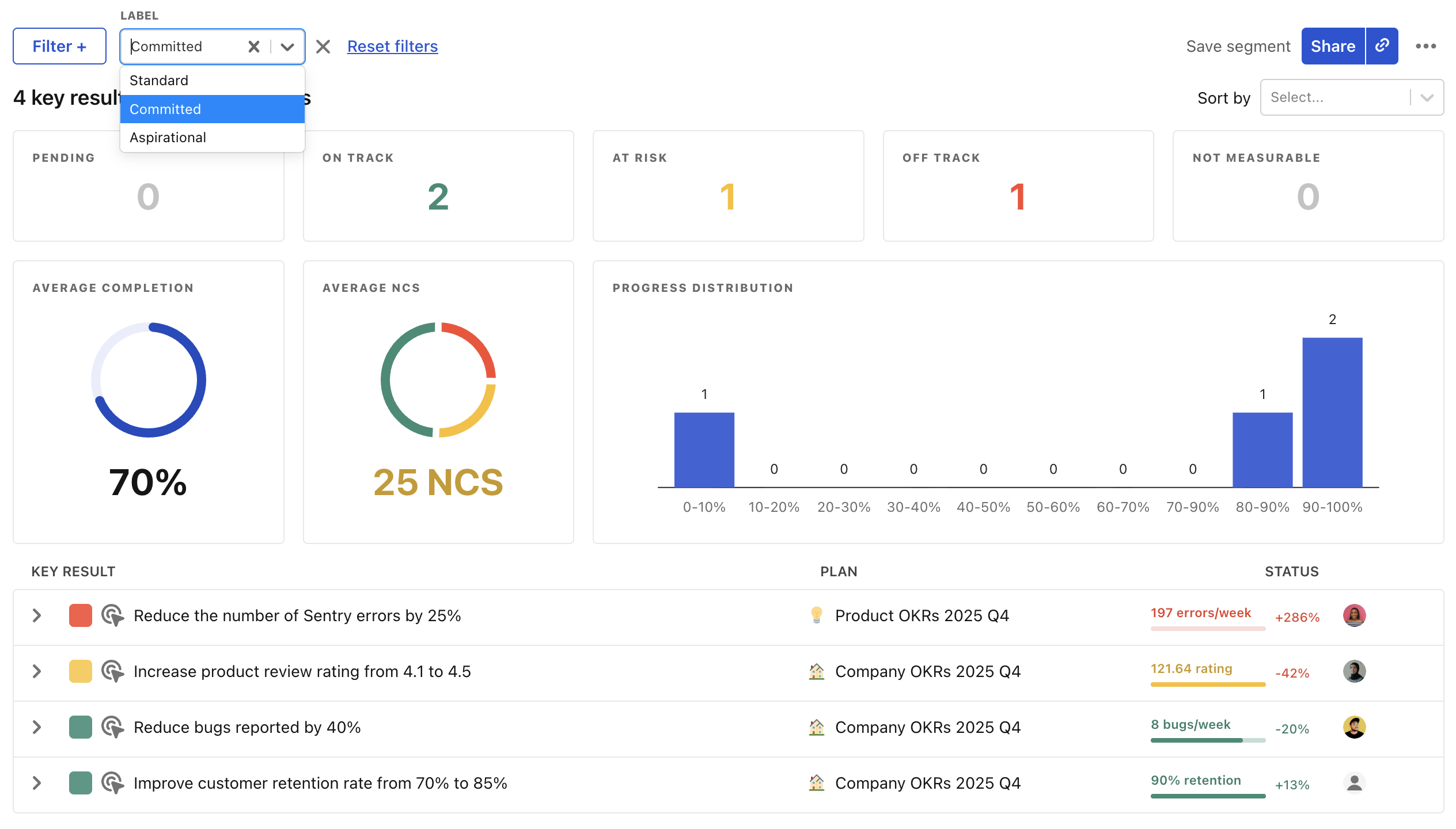
Adding a simple tag — Committed or Aspirational — removes a lot of ambiguity. But it also makes it easier for leaders to zoom out and understand the bigger picture.
You’ll usually see both types of goals side by side, but filters help clarify two important perspectives:
- How we’re performing on the critical, operational commitments
- Where we’re being innovative and how those exploratory efforts are progressing
This separation gives leaders a quick pulse on company health and a way to track whether the organisation is still pushing boundaries.
Treat results differently depending on the type of goal
Even if the OKRs look structurally the same, the way you interpret progress should not be.
- Committed goals: Success means you’re aiming for close to 100%. Falling short signals an issue worth digging into — not for blame, but for clarity and course correction.
- Aspirational goals: Success is about momentum. Landing at 50–80% might be a great result if it stretches the team and sparks new insights.
This difference in interpretation ensures teams aren’t penalised for ambition.
Make the distinction part of everyday conversations
When teams naturally talk about goals in terms of “committed” versus “aspirational,” progress updates get clearer and healthier:
- Teams feel safer setting bold stretch goals.
- Leaders read OKR results in the right context.
- Review meetings focus on learning, not pressure.
- Everyone understands what “good” looks like for each type.
Clarifying the difference isn’t just a process step — it’s what keeps ambition and accountability working together instead of against each other.
Conclusion
Knowing the difference between committed and aspirational goals isn’t just a planning detail — it’s what keeps your teams aligned, your reporting consistent, and your strategy realistic and ambitious at the same time. When everyone understands what’s a must-hit versus what’s a stretch, you avoid the classic OKR confusion that leads to pressure, frustration, or mismatched expectations.
A good OKR software, like Tability, makes it simple to label your OKRs as committed or aspirational, filter between them, and review progress with the right context. Leaders can quickly see how the company is performing on critical, operational goals, while also tracking the innovative, exploratory work happening across teams. Teams get clarity, leaders get visibility, and everyone gets a cleaner sense of what success actually looks like.
Clear goals, healthy expectations, better momentum. That’s the power of working with both committed and aspirational goals — and Tability helps you do it without the guesswork.


.jpg)
.png)