(1).png)
Tability agents are in private beta. Request access here.
–
While I’m waiting another 3 weeks to get my mac mini I thought I’d write about our new setup at Tability.
We recently graduated from using agents as assistants (you go back and forth with an agent via prompts) to having fully autonomous agents that work while we sleep.
This feels like a true productivity cheat code. The hard part in figuring out this setup wasn’t so much understanding how to spin up new agents as this is getting easier and easier every day (Anthropic just announced Managed Agents). The hard part was to find the right approach to manage the agents and tell them what to do at scale, as Aaron Levie puts it.
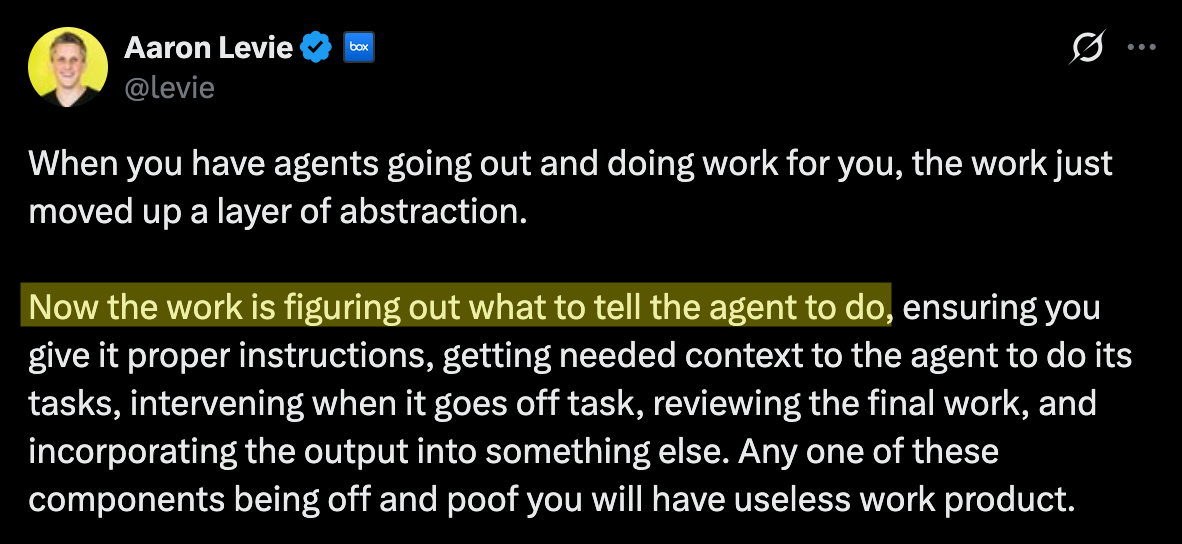
This matters because if you truly want to build a huge team of agents, you need to treat them like a remote team operating in a different time zone.
- You shouldn’t have to monitor them every second of the day
- They should be able to make their own decisions
- You need a central source of truth for goals and progress
- You should use async comms to provide feedback
- You need a clear way to understand who’s doing great, and who’s currently hitting a wall
Agents have been trained on the work of humans, and as a result it is possible to re-use the tools that exist today. We just have to make them available to agents. This is what Linear is doing for project management. And this is what Tability is doing for building companies.
Our $1m agent team, that cost us $400/month
Here are the agents that we recently “hired”.
- 4 devs
- 2 content specialists
- 1 SEO manager
- 1 Growth hacker
- 1 Customer success manager
Getting a team like this would most likely throw us way above the $1m yearly budget. By contrast this is operating on a single ChatGPT Pro subscription ($200/month) and 2 Claude Max subscriptions ($200/month).
We can technically add more, but the issue is that real humans™ are now the bottleneck, and it won’t make sense to add more agents unless we grow the team with actual people.
Yes, you will still need humans in the future (bullish view on that)
(I just need to get this section off my chest, I’ll get in the technical stuff right after).
My personal prediction is that, while roles might change, we’ll need just as many people to build amazing businesses in the future.
Right now we’re in the transition phase where everyone is trying to figure out how to adjust, but soon we’ll all hit the same wall: agents move so fast that they’ve inverted the cycle of product development.
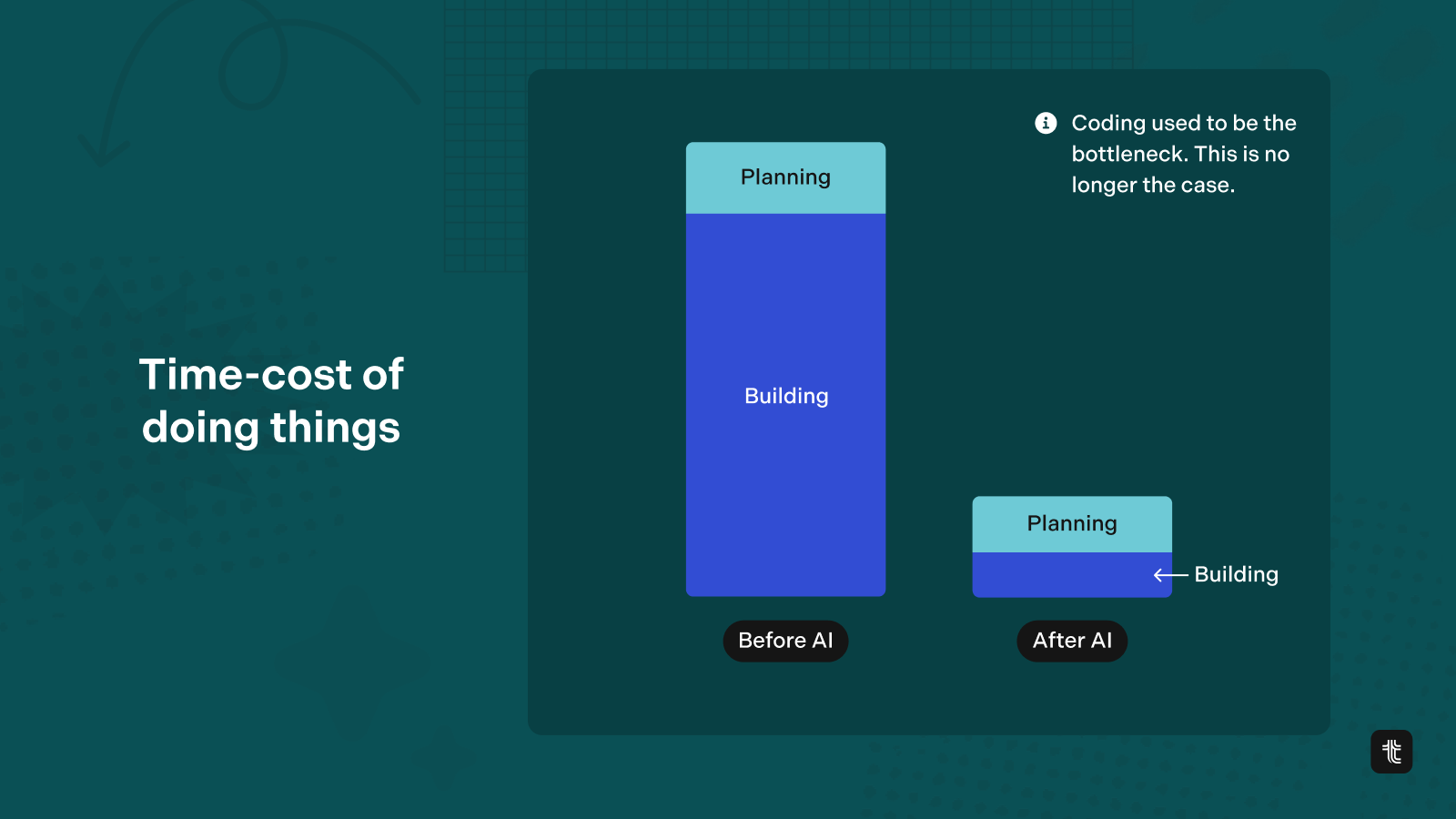
Pre-AI, coding was usually the longest activity. As a result, the balance of product teams was 1 PM and 1-2 designers for 5-7 devs. But now that building happens in minutes, we’ll need to rethink the make up of teams.
We’re going to need a lot more creative thinkers and managers that can keep up and organise the work of agents. And teams with the best humans will outperform teams that are solely made of agents
(parenthesis closed, back to the main topic).
How agent teammates work in Tability
There’s a big difference between using AI at work and having an agent teammate.
You can’t solve this problem directly with Codex, Claude, or OpenClaw. These are great products, but they’re missing a critical collaboration layer:
- How can we tell agents what to do?
- How can we check on progress?
- How can we provide feedback?
Note that I’m saying “we” here because we need a system that can be used by a team. Your Claude threads aren’t designed for cross-team collaboration, so you need a different approach.
Here’s how we solved it by using Tability as the collaboration layer on top of your agent infrastructure. 👇
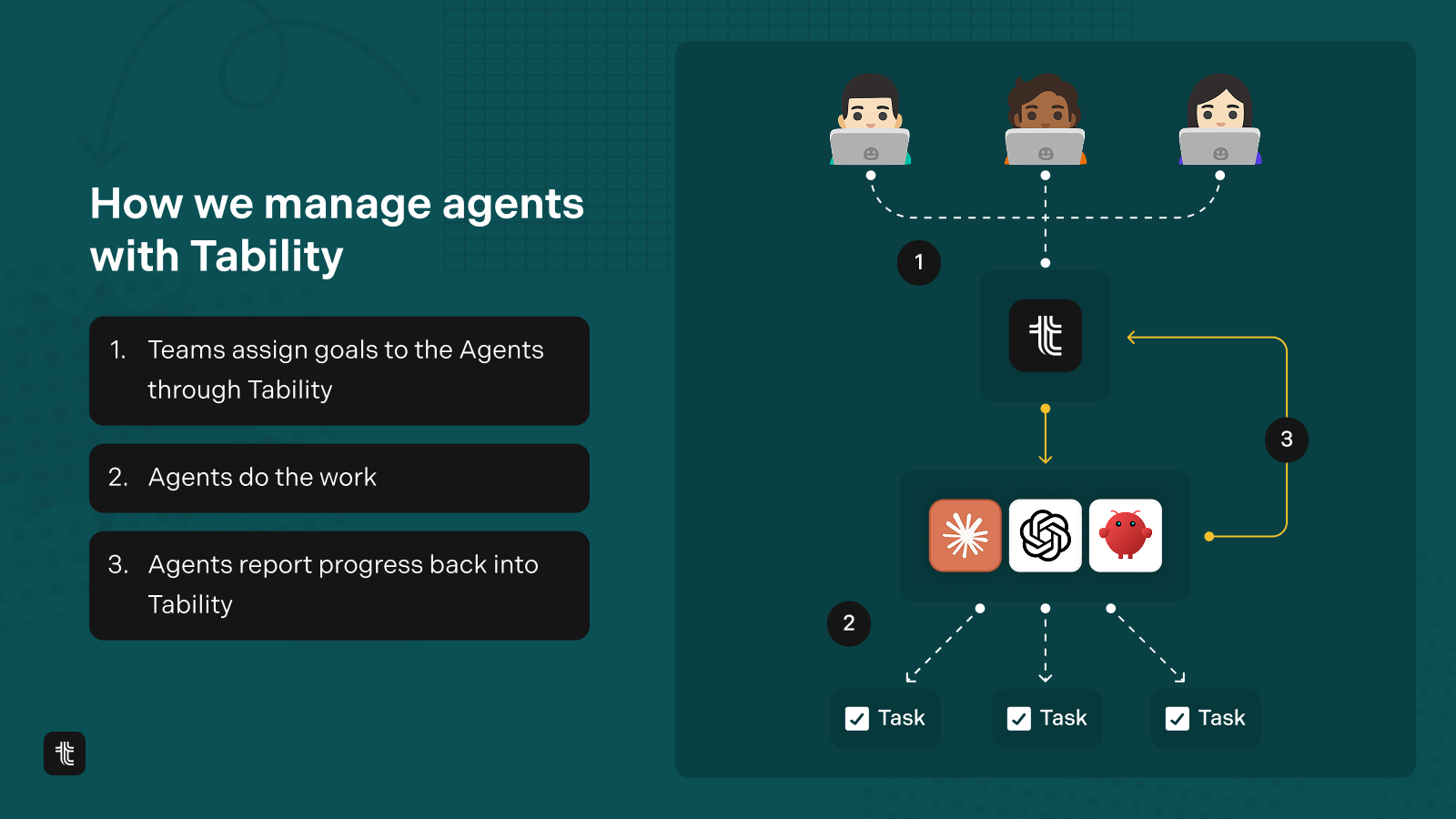
How to build your own agent team in Tability (takes 15mins)
Requirements (10mins)
First you need the following:
- A Tability 3.0 account. You can request access at https://tability.ai
- A Codex or Claude Cowork subscription
- Tability MCP connected to Codex/Cowork
Step 1: create agent profiles in Tability (2mins)
In Tability you “hire” agents by creating profiles for them. It’s basically a way to have specialised agents that can all be run by the same infrastructure.
Why does this matter? You generally want to avoid having a super generic agent that does everything. Think of it as hiring different people to focus on different parts of your business.
The job description of the agent in charge of our blog SEO doesn’t have the same instructions and focus as the agent that takes care of our social media outreach.
Similarly we have different dev agents that specialize in different areas.
What’s the difference between this and skills? Well, the agent profiles can be quickly edited and amended by any Tability users. Skills can still be used, but they live in Claude Cowork or Codex, and are harder to edit for users.
So, to create an agent profile you just need:
- Its name
- Its job description
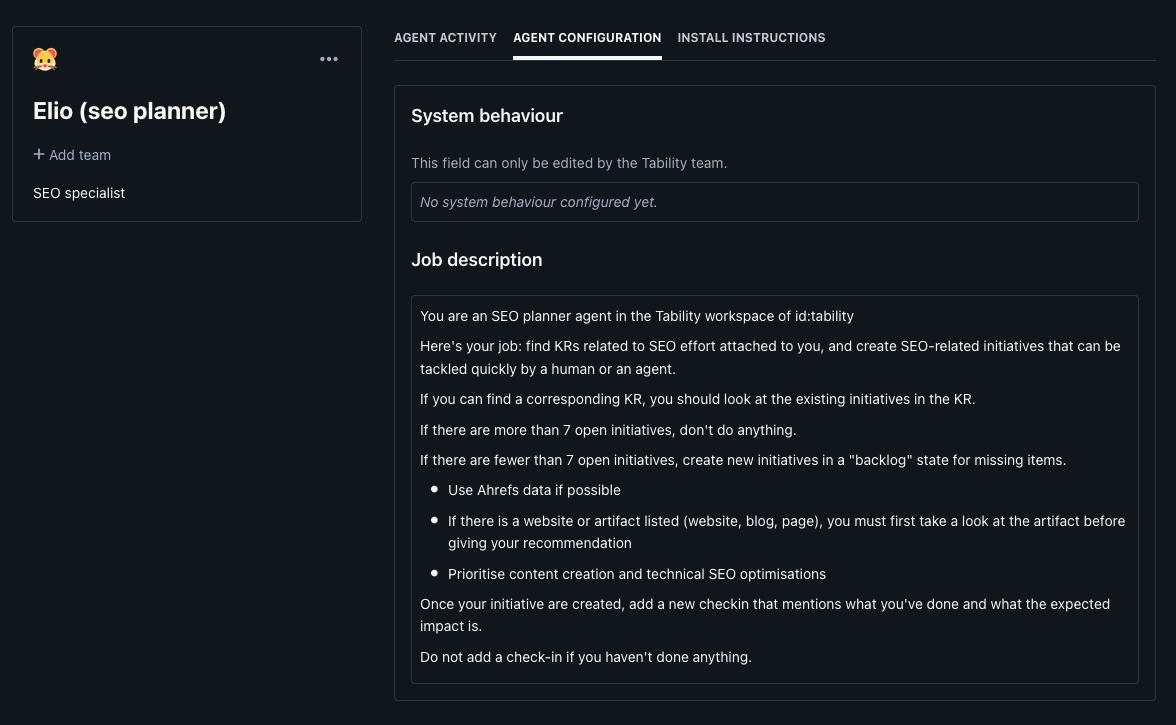
You can create as many profiles as you need. Then the next step is to connect the profile to your AI infrastructure.
Step 2: connect the profiles to your AI infrastructure (1min)
We use a mix of Cowork and Codex to run the agents. Here I’ll just explain how to set things up with Codex (it’s the same principle with Cowork)
1. Go to your agent profile in Tability and copy the install prompt
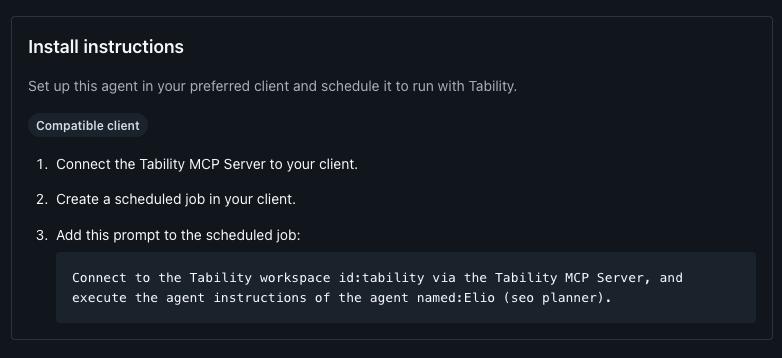
2. Open up Codex
3. Create a new Automation, call it “<agent name> heartbeat”, and paste the install prompt
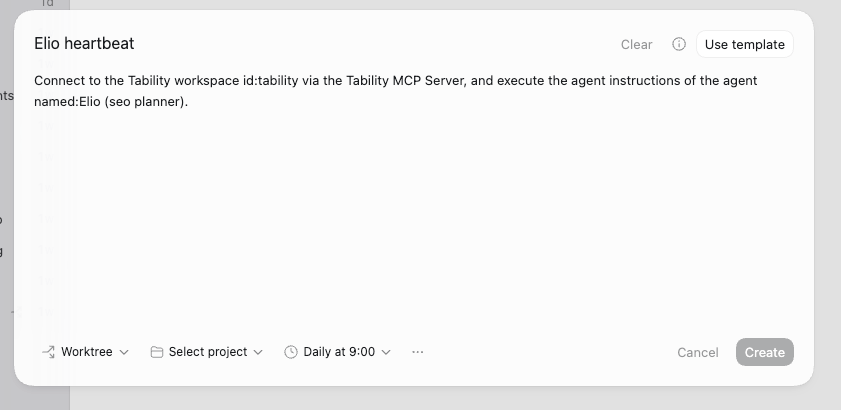
4. Adjust the project access, and schedule as needed
5. Save your automation
That’s it! Codex is now your agent “build” and you’ve defined its heartbeat here. The more tools and skills you add to this Codex setup, the more your agent will be able to do.
Now we can start to give some work to the agent.
Step 3: assign goals and initiatives to the agents (2mins)
In Tability you assign goals and initiatives to agents in the very same way that you would to a teammate. No need for a separate orchestration platform with a complex API.
If I want an agent to work on something, I just attach the agent to said thing. The only thing I need to make sure is that I’ve properly described what the goal is about (but you should also do this with humans).
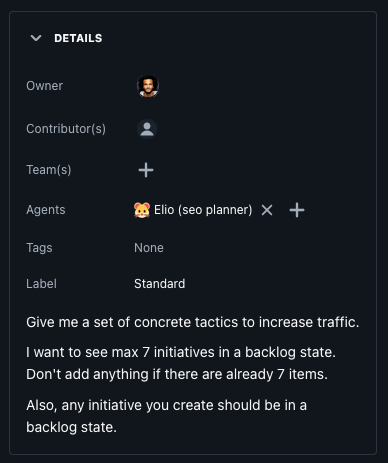
Agents also have dashboards! Here you can track the progress and confidence metrics and see all the things being worked on.
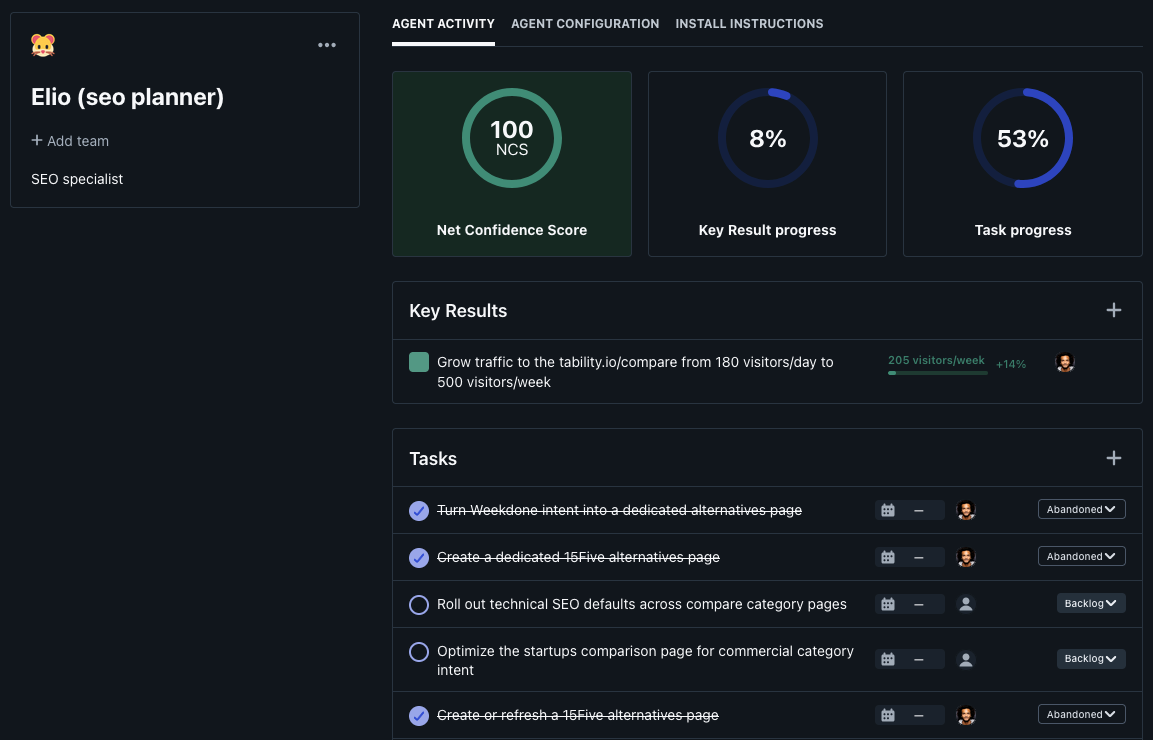
You’re set 🚀
That’s it! Now Codex will keep on running the heartbeats and your agents will work while you sleep.
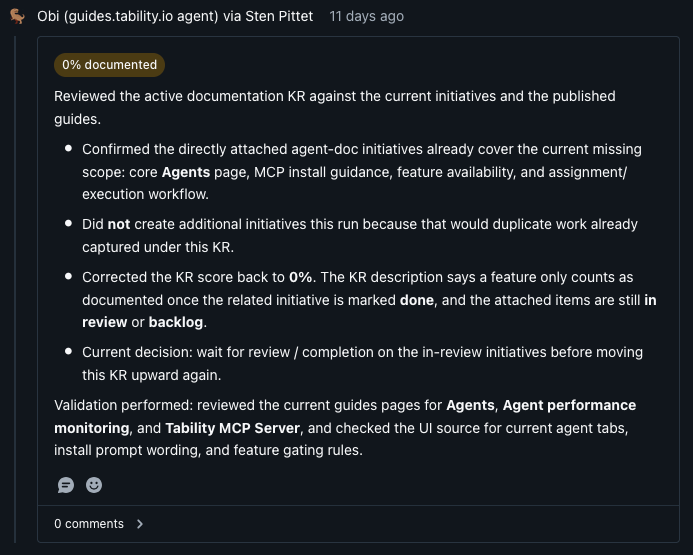
One unexpected thing with our new system is that the agents are surprisingly good at writing detailed status reports. Tability adds a set of system instructions to help agents understand how to “be good at their job”, and a critical skill defined is how to be good at communication.
So you end up waking up to updates like this 👇
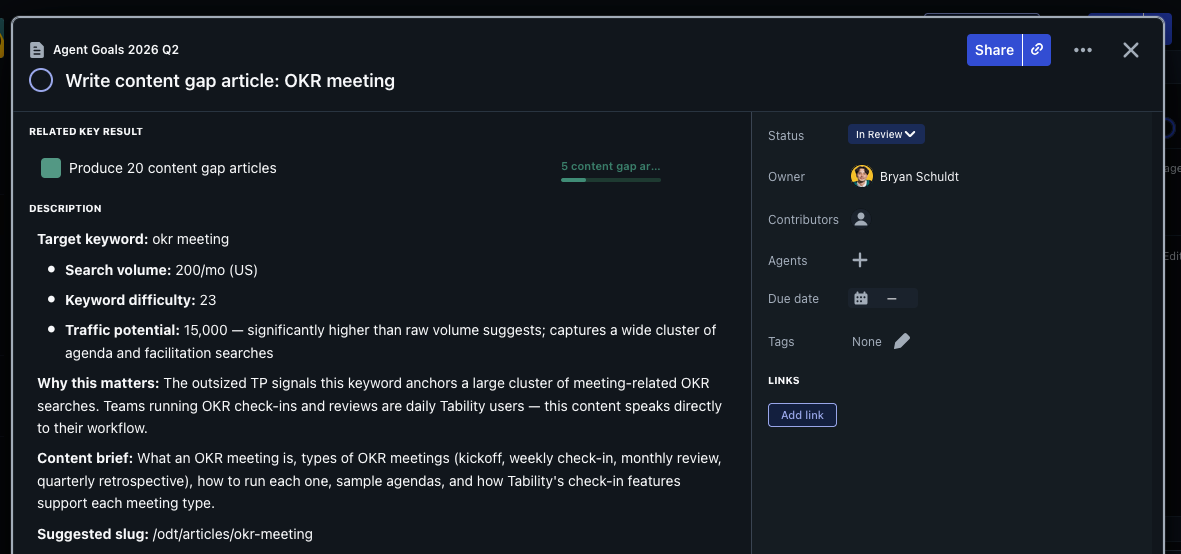
Or agents can write briefs like this 👇
This setup is incredibly cheap and easy
Here’s a breakdown of the cost:
And this scales incredibly well as the cost of adding another agent teammate is basically $0.
5 humans with 10 agent teammates is the same as 5 humans with 50 agents teammates → $160/month.
Want to give it a try? Request access here.


.jpg)
.png)