
If you haven’t heard of Scaling Up or EOS then you can probably skip this post entirely. But, if you’re familiar with these goal-setting frameworks, and if you’re hesitating about which one to adopt then this post should be helpful. I can even give you the answer right away:
Don’t use those. Use OKRs instead.
Almost every comparison of these three frameworks ends with the same answer: "they're not competing frameworks, they solve different problems, use whichever fits, or use both."
That answer is intellectually safe and operationally useless. The choice has real consequences for how fast you can change direction, how much documentation overhead your leadership team carries, and how the work that gets done actually connects to the strategy you said you cared about.
So this guide takes a position. OKRs are the better fit if you want to move fast, regardless of size. EOS and Scaling Up are excellent frameworks that genuinely work, but they were designed for orgs that are looking for a tightly controlled approach to management. Trying to bend them to fit a fast-moving team is where most adoption failures come from.
I have a lot of respect for EOS and Scaling Up as both are serious frameworks with serious results behind them. I just think that most teams today should adopt a nimble and agile approach for goals and accountability. That’s what OKRs are for.
A quick honest summary of each framework
Before the comparison, the basics. Each framework deserves to be represented as its strongest version, not as a caricature.
OKRs (Objectives and Key Results)
Developed at Intel by Andy Grove in the 1970s, popularised at Google by John Doerr in 1999 (read more: the full OKR history). The framework is deliberately minimal: each team or organisation sets 2 to 4 objectives (qualitative, ambitious direction) and 3 to 5 key results per objective (quantitative, measurable outcomes). OKRs are typically reviewed weekly, scored quarterly, and reset every cycle. There is no prescribed meeting structure, no required artifacts beyond the OKRs themselves, and no opinion about how teams organise. For a complete description, see our guide to OKRs.
The framework is small on purpose. The discipline lives in the rhythm of weekly check-ins, not in the volume of documentation.
EOS (Entrepreneurial Operating System)
Developed by Gino Wickman and outlined in his 2011 book Traction. EOS is a complete operating model:
- Vision (V/TO)
- People (Accountability Chart, GWC)
- Data (Scorecard)
- Issues (Issues List, IDS)
- Process (Core Processes)
- Traction (Rocks, Meeting Pulse, L10 Meetings)
Implementation is typically guided by a certified EOS Implementer over 12 to 24 months. The framework is comprehensive by design: every aspect of how the business runs is structured.
EOS works because it leaves very little to interpretation. Every meeting follows the same format, every decision flows through the same structure, every team uses the same artifacts.
Scaling Up (Rockefeller Habits 2.0)
Developed by Verne Harnish, building on his earlier Rockefeller Habits work. Scaling Up is organised around the Four Decisions:
- People
- Strategy
- Execution
- Cash
Tools include:
- One-Page Strategic Plan (OPSP)
- 7 Strata of Strategy
- BHAGs (Big Hairy Audacious Goals)
- Core Values and Purpose
- Cash Conversion Cycle
The framework has a five-tier meeting rhythm (daily, weekly, monthly, quarterly, annual). Often implemented with a certified Scaling Up coach.
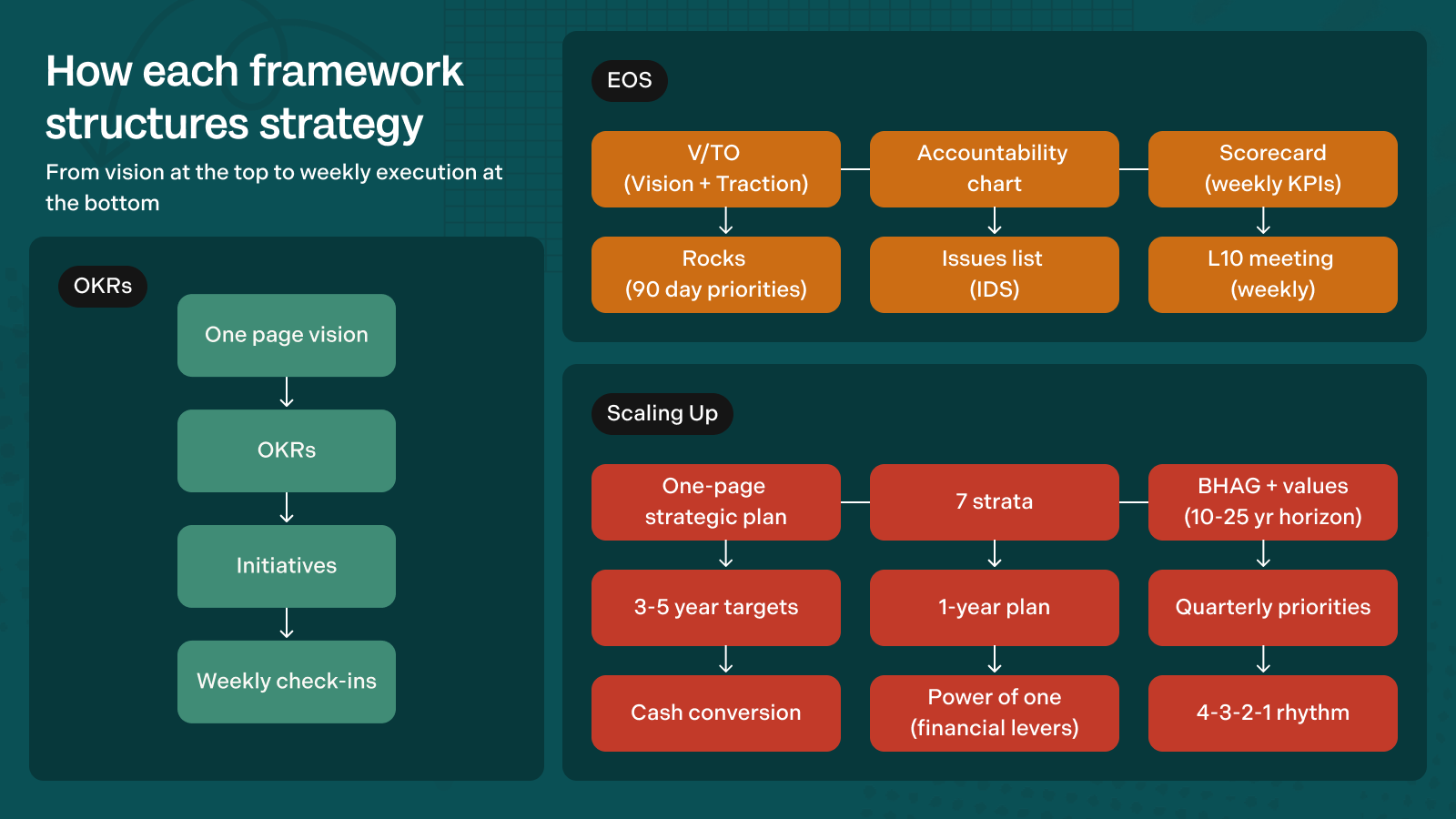
Compared to EOS, Scaling Up goes deeper on strategic planning and cash management. Compared to OKRs, it has significantly more structure and documentation overhead.
What each framework is genuinely good at
This is where most comparisons cheat. They flatten the differences to make the case for whichever framework the author is selling. Here's what each one actually does well.
EOS at its best: end-to-end operational discipline
EOS is exceptional at three things.
- Operational discipline in small to mid-market founder-led businesses: the Level 10 meeting structure, the Issues List, and the Rocks system give leadership teams who've never had structured operating cadences a complete playbook.
- Accountability clarity: the Accountability Chart forces founders to confront overlap and ambiguity in roles in a way no other framework does.
- Execution at companies with stable strategy: when the strategic direction doesn't change every quarter, EOS provides a 90-day rhythm that keeps execution tight.
Anyone who's seen a founder go from chaos to traction inside 12 months of EOS implementation has seen the framework work. It's real.
Scaling Up at its best: detailed strategy
Scaling Up is exceptional at three different things.
- Strategic depth: the 7 Strata and One-Page Strategic Plan force leadership teams to actually do strategic thinking, not just operational planning.
- Cash discipline: the Cash Conversion Cycle work is unique among growth frameworks and has saved more growing companies than any other single concept on this list.
- Leverage at scale: Scaling Up tools tend to outlast EOS at the 250+ employee threshold, where companies often outgrow the prescriptive simplicity of EOS.
Scaling Up companies tend to think more carefully about their strategy than companies running any other framework on this list. That's a genuine and durable advantage.
OKRs at their best: alignment and outcome-driven culture
OKRs are exceptional at three things.
- Adaptability: the framework was designed to be reset every cycle, which means a quarterly OKR cycle naturally accommodates direction changes without requiring a methodology overhaul.
- Cross-functional alignment: OKRs translate fluently across engineering, product, marketing, sales, and operations because the structure is generic.
- Outcome focus: by forcing every objective to have measurable key results, OKRs shift conversations from activity reporting to outcome accountability.
OKRs work best in environments where the strategy itself is being learned and refined, not just executed. The framework's biggest risk is overreach: teams that set too many objectives lose their focus. Used with discipline, the OKR minimalist approach is perfect to keep execution agile.
Where the comparison actually breaks: pace of change
A lazy approach to recommendations would be to use organisational size as the deciding variable. "EOS for 10 to 250 employees, Scaling Up for 50 to 500, OKRs for tech companies and Series A through C."
That's the wrong axis. What matters more is operating tempo: how often does the organisation need to change direction, re-prioritise, or absorb new market information?
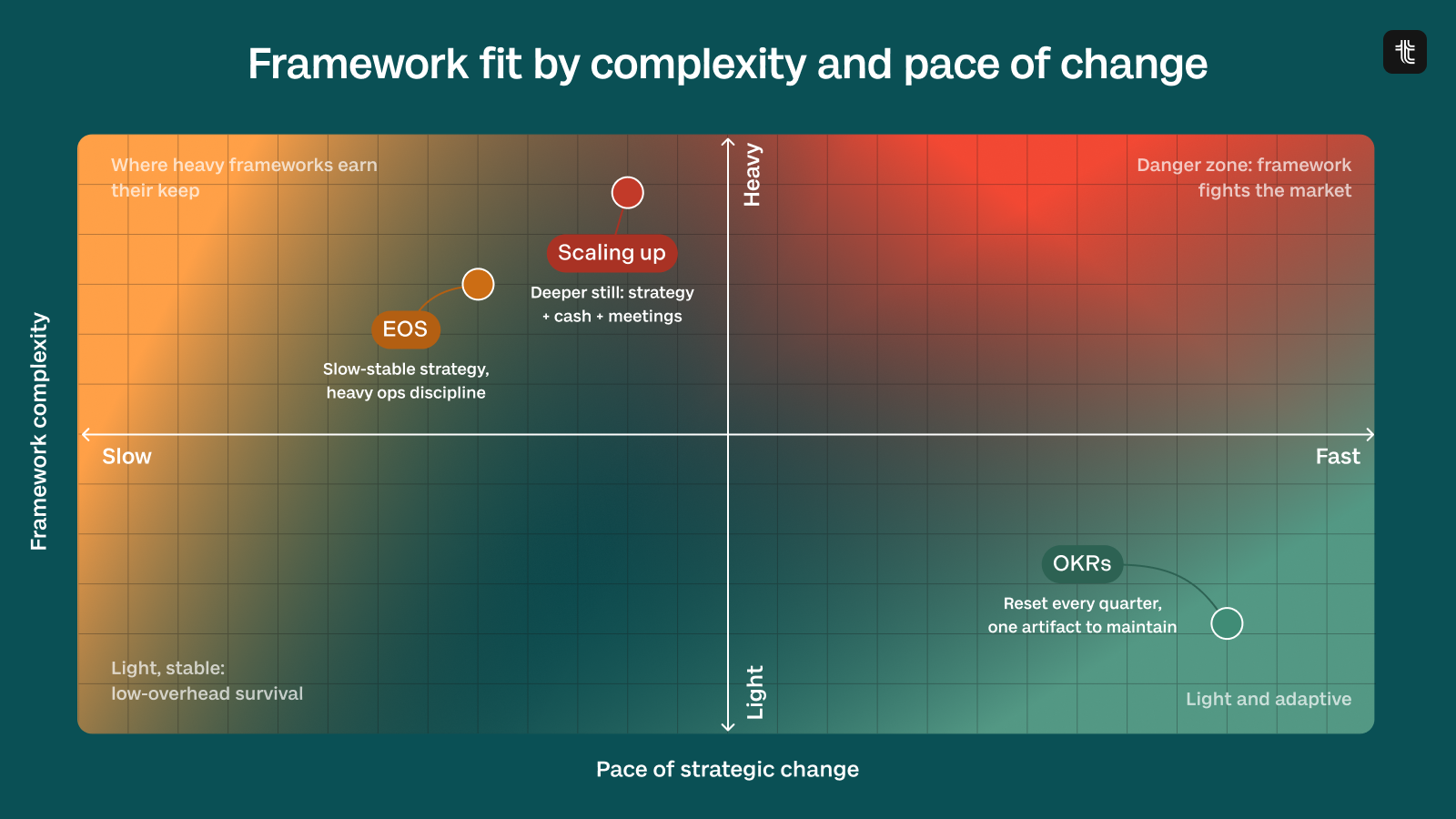
EOS or Scaling Up can be quite helpful if you’re in a slow-moving market, trying to bring order to your execution. But a 50-person AI startup or a 5,000-person company that just got disrupted will both be fast-tempo organisations, and OKRs will serve either of them better, regardless of size.

The reason isn't ideological. It's structural. EOS and Scaling Up require a lot of artifacts to be kept current: V/TOs, OPSPs, Balanced scorecards, Issues Lists, Accountability Charts, Quarterly Rocks, Annual Plans. Each of those documents was designed under an assumption that the organisation's strategy is stable enough to make the documentation worth maintaining.
When the strategy is stable, that overhead pays for itself. Everyone speaks the same language, every meeting has the same shape, every decision flows through the same structure.
But when your market is constantly reshaping, or when your strategy isn’t yet clear, then that overhead becomes a tax. The framework that was supposed to provide structure starts to feel like it's slowing the organisation down, because in a real sense, it is.
OKRs handle this differently. The framework's only meaningful artifact is the OKRs themselves. Vision can live in a one-page document. Weekly meetings should be short and focused on the outcomes. You go from having to look at 10+ docs to only having to consider the OKRs themselves.
That's the structural argument. In a fast-moving market, the maintenance cost of the framework should be as low as possible, because the strategy itself is the thing changing.
OKRs are minimal on purpose.
But what about the hybrid approach?
You might have read something like this in the past: "you don't have to choose! You can run EOS and OKRs together. Use Rocks as your OKRs, keep the V/TO, run Level 10 meetings."
While you can technically do this, this means that you’re still moving at the pace of EOS. If you use 2 frameworks together, you’ll be as fast as the slowest system.
The hybrid model can also break due to differences in expectations. EOS Rocks are 90-day commitments, OKRs are quarterly objectives reviewed weekly. The Issues List wants discrete issues, OKR check-ins want confidence scores and key result progress. Leadership teams end up running two parallel operating rhythms and quietly stop maintaining one. Usually the OKRs, because the EOS Implementer is in the room and the OKR coach isn't.
Frameworks can fight each other on philosophy: EOS assumes the strategy is set and the job is execution. OKRs assume the strategy is being learned and the job is iteration. When those assumptions collide, leaders waste time figuring out which one to pick.
If you're hesitating between frameworks today, make sure that you commit to one. And in case of doubt, OKRs is most likely going to be the right option.
When EOS or Scaling Up are genuinely the right choice
We took a position. We owe the other side specific scenarios where they're right.
EOS is the right choice when:
- You're a founder-led company between 10 and 200 employees that has never had a structured operating cadence and the team is drowning in chaos
- Your strategy isn't going to change significantly in the next 12 to 24 months, because the market you're in is stable
- Your leadership team needs more accountability discipline than strategic flexibility
- You have access to a strong EOS Implementer who can guide the rollout
Scaling Up is the right choice when:
- You're a growth-stage company between 50 and 1,000 employees with serious strategic planning needs (cash management, multi-year planning, succession)
- You have the bench to do real strategic thinking, not just operational planning
- Your market is competitive but not chaotic; you need depth, not pivot speed
- You have access to a strong Scaling Up coach
Neither is the right choice when:
- You want a continuous approach to strategy
- Your team needs to absorb new information from the market and re-prioritise quickly
- You don't have the bandwidth to maintain six to ten distinct framework artifacts
- The framework documentation already feels like it's slowing you down
In any of those last four cases, OKRs are the better fit. That's true whether you're a 30-person startup or a 3,000-person enterprise.
Start with OKRs. Reach for more only if you have to
Unless you have a specific reason to adopt a heavier strategy framework, OKRs should be your default.
Strategy frameworks have a hidden cost that doesn't show up in their comparison charts: the cost of maintaining the framework itself. EOS and Scaling Up are deep frameworks that pay for themselves when you can afford the maintenance tax.
OKRs are shallow on purpose. The framework is one page. The artifacts are minimal. The cadence is short. That shallowness is what makes OKRs survive in environments where the strategy itself is changing faster than the framework can document.
Start light. Keep the rhythm. Add structure only when the absence of it is actually costing you something.

.jpg)

.png)