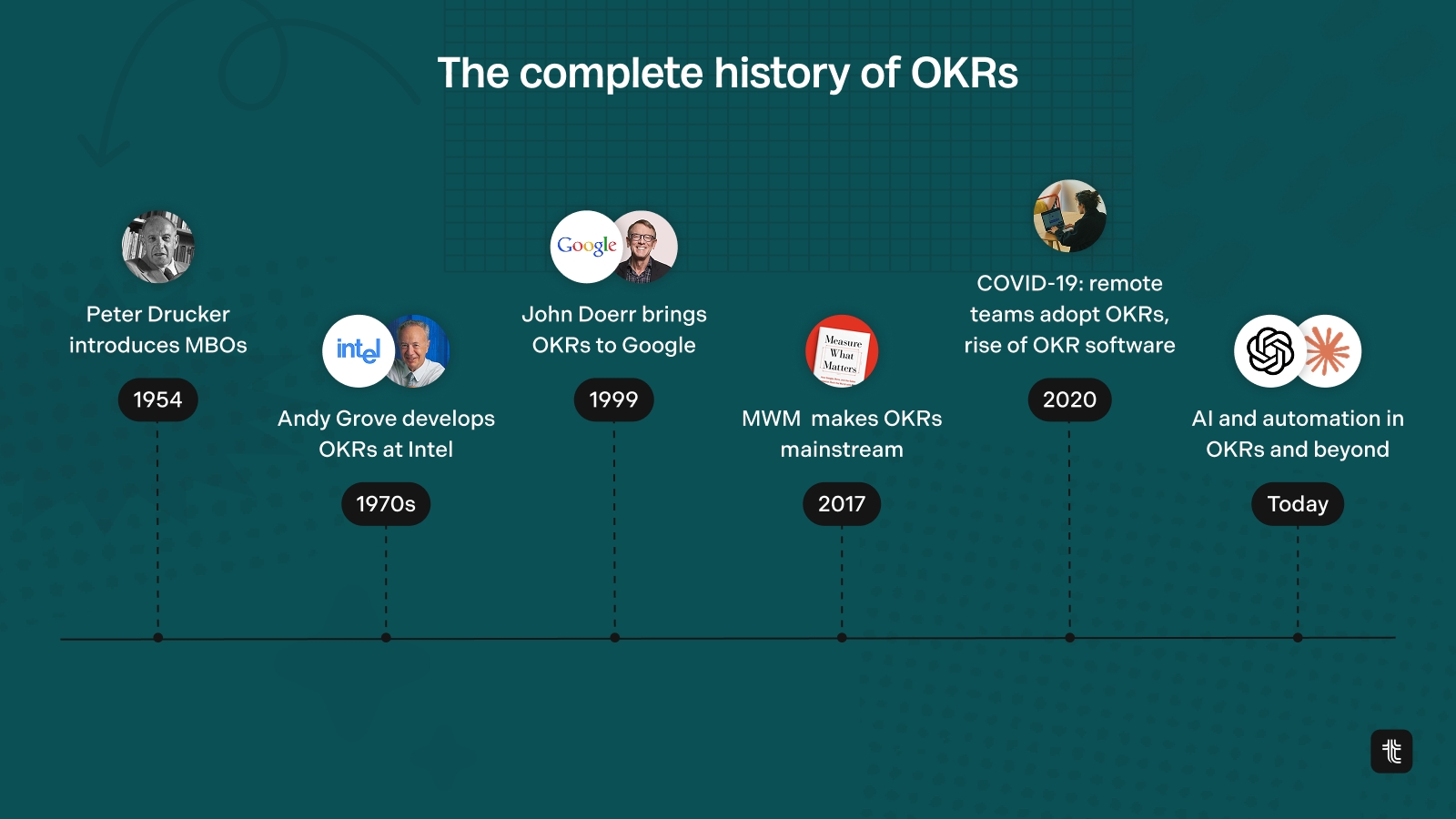

Most frameworks that claim to change how companies work are forgotten within a decade. OKRs are different. More than fifty years after Andy Grove first sketched them out at Intel, they are still the default goal-setting system for some of the world's most ambitious organisations. Which raises the obvious question: where did they actually come from, and why have they lasted so long?
This is the complete OKR history, from Peter Drucker's Management by Objectives in 1954, through Andy Grove's invention of OKRs at Intel in the 1970s, John Doerr's pivot to Google in 1999, and all the way to the AI-driven workplaces of 2026. If you want the short answer, it's in the next section. If you want to understand why the framework works the way it does, read the whole thing.
Who invented OKRs?
OKRs were invented by Andy Grove at Intel in the early 1970s. Grove had built on Peter Drucker's earlier Management by Objectives (MBO) framework, but stripped out the bureaucracy and added a critical missing piece: Key Results, the measurable outcomes that would tell you whether you had actually achieved your Objective.
The term 'OKR' is Grove's. The concept of connecting aspirational goals to measurable outcomes is his. And the practice of reviewing them on a quarterly cadence, rather than annually, is his too.
John Doerr, a venture capitalist who had worked at Intel, then carried OKRs to Google in 1999. That is the moment the framework went from 'Intel's internal system' to a Silicon Valley institution, and eventually to a global standard. If you want to know more about what OKRs are and how they work in practice, start there.
Before OKRs: the origins in Management by Objectives (MBOs)
The history of OKRs begins not at Intel, but in the mid-twentieth century with Peter Drucker. In his 1954 book The Practice of Management, Drucker introduced Management by Objectives (MBOs), a framework built on the idea that employees and managers could get better results if everyone agreed on clear, measurable goals tied to the organisation's overall direction.
MBOs were a genuine advance on what came before. Three principles sat at the core of Drucker's system:
- Goal clarity: employees needed to understand their objectives and how they connected to the organisation's success.
- Engagement: employees should be involved in setting their own goals, not simply handed targets from above.
- Accountability: progress should be tracked, and people should be responsible for hitting what they committed to.
The problem was the cadence. MBOs ran on an annual review cycle, which was too slow for any organisation operating in a rapidly changing environment. Goals set in January were often irrelevant by July. And MBOs tended to focus on individual performance, which made cross-functional collaboration harder, not easier. These limitations set the stage for something better.
The birth of OKRs at Intel (1970s)
Intel in the early 1970s was a company under real pressure. It was transitioning from memory chips to microprocessors, and that shift required the entire organisation to move fast and stay aligned across dozens of competing priorities. Andy Grove, who would eventually become Intel's CEO, needed a goal-setting system that could keep up.
Grove took Drucker's MBO framework and rebuilt it from the ground up. The result was the OKR system that Intel ran internally for years. He described it in detail in his 1983 book High Output Management, which remains one of the clearest accounts of why OKRs are structured the way they are.
The core innovation was the Key Results layer. An Objective tells you the direction. Key Results tell you whether you got there. Grove made them specific, quantifiable, and time-bound. Not 'improve customer satisfaction' but 'reduce support ticket resolution time from 48 hours to 24 hours by the end of Q2'.
The other thing Grove introduced was the concept of stretch goals. Intel's OKRs were set deliberately beyond comfortable reach. A score of 70% was considered good. Hitting 100% meant the target had been set too low. This was a deliberate design choice: it pushed teams to aim higher than they would otherwise, and created a culture where ambitious failure was more valued than safe success.
Intel's OKRs were structured around two components:
- Objectives (the WHAT): ambitious, inspiring goals that set the direction for the organisation or team.
- Key Results (the HOW): measurable outcomes that indicate whether the Objective has been achieved.
MBO vs OKR: key differences
Understanding the OKR origin requires understanding what OKRs fixed. The table below shows the core differences. For more on how OKRs compare to other performance frameworks, see our breakdown of OKRs vs KPIs.
The key difference is not just about cadence or measurement. It is about culture. MBOs encouraged people to set safe goals because hitting 100% was what got rewarded. OKRs deliberately broke that link, which freed teams to aim higher without fear of punishment for missing.
Who popularised OKRs? John Doerr and Google (1999-2017)
Andy Grove invented OKRs. John Doerr popularised them. The distinction matters.
Doerr had worked at Intel under Grove and seen OKRs in operation first-hand. When he became a partner at venture capital firm Kleiner Perkins and started working with a small search startup called Google, he brought the framework with him. In 1999, just one year after Google's founding, Doerr sat down with Larry Page and Sergey Brin and walked them through how Intel used OKRs to stay aligned during periods of rapid growth.
Google adopted OKRs almost immediately, and used them at every level of the company. Teams set OKRs quarterly. Results were visible across departments. Stretch goals were standard practice. The framework became so embedded in Google's culture that it is still in use today.
Google's success made OKRs synonymous with Silicon Valley ambition. LinkedIn, Twitter, Airbnb, and Dropbox all adopted the framework. By the mid-2000s, OKRs had spread across the tech sector as the default system for companies that needed to grow fast without losing coherence.
The framework got its biggest moment of mainstream attention in 2017 when Doerr published Measure What Matters, a book that combined the history of OKRs at Intel and Google with case studies from a range of other organisations. It introduced a broader audience to the framework and accelerated adoption outside the tech world, into healthcare, education, finance, and manufacturing.
Measure What Matters also introduced the concept of CFRs (Conversations, Feedback, and Recognition) as a companion to OKRs, emphasising that goal-setting without ongoing dialogue tends to produce static documents, not real results.
Where did OKRs originate? A quick timeline
Is Google still using OKRs?
Yes. Google has used OKRs since 1999 and the framework remains central to how the company sets goals at every level, from individual contributors to entire product divisions. Sundar Pichai has spoken publicly about OKRs as foundational to how Google operates.
That said, Google's implementation of OKRs has evolved. The company's scale means that OKRs are managed through internal tooling rather than a simple spreadsheet, and the cadence has been refined over time. But the core structure, Objectives plus measurable Key Results, reviewed quarterly, with results visible across teams, remains essentially unchanged from what Doerr introduced in 1999.
Widespread adoption and the rise of OKR software (2000-2020)
After Google's implementation of OKRs became public knowledge, adoption spread quickly through the tech sector. What started as a framework for venture-backed startups became the standard for any organisation that needed to scale fast without losing alignment.
The shift from annual to quarterly OKRs was a big part of this. Companies like Google and Netflix showed that a quarterly cadence gave teams enough time to make real progress, but enough urgency to stay focused. When the 2008 global financial crisis hit, the quarterly cycle proved its value again: organisations using OKRs could reassess and redirect priorities without waiting for an annual review.
The rise of SaaS tools for OKR tracking
As OKR adoption grew, so did the tooling around it. Dedicated OKR software platforms began appearing in the 2010s, making it easier for organisations to set, track, and share goals across distributed teams. These tools replaced spreadsheets and presentation decks with centralised dashboards, automated progress updates, and integrations with the systems teams already used, like Slack, Jira, and Google Sheets.
Transparency became a design feature, not an afterthought. When OKRs are visible across an organisation, it is much harder for teams to work in silos, and much easier for individuals to see how their daily work connects to the company's priorities.
If you are comparing options, our guide to best OKR software covers the leading platforms in detail.
OKRs in the remote and hybrid era (2020s)
The shift to remote and hybrid work, accelerated sharply by COVID-19 in 2020, created conditions where OKRs became even more valuable. Without shared physical spaces, the informal alignment that happens in offices disappears. You cannot rely on casual conversations to keep everyone pointed in the same direction. You need an explicit, shared system for goals and priorities.
OKRs filled that gap. The quarterly cadence, the transparent structure, and the focus on measurable outcomes made it possible for distributed teams to stay aligned without constant meetings. A problem that used to be felt mainly by organisations of hundreds or thousands of people started showing up in teams of five to twenty. OKRs became the new default way for teams to maintain focus when they were not in the same room.
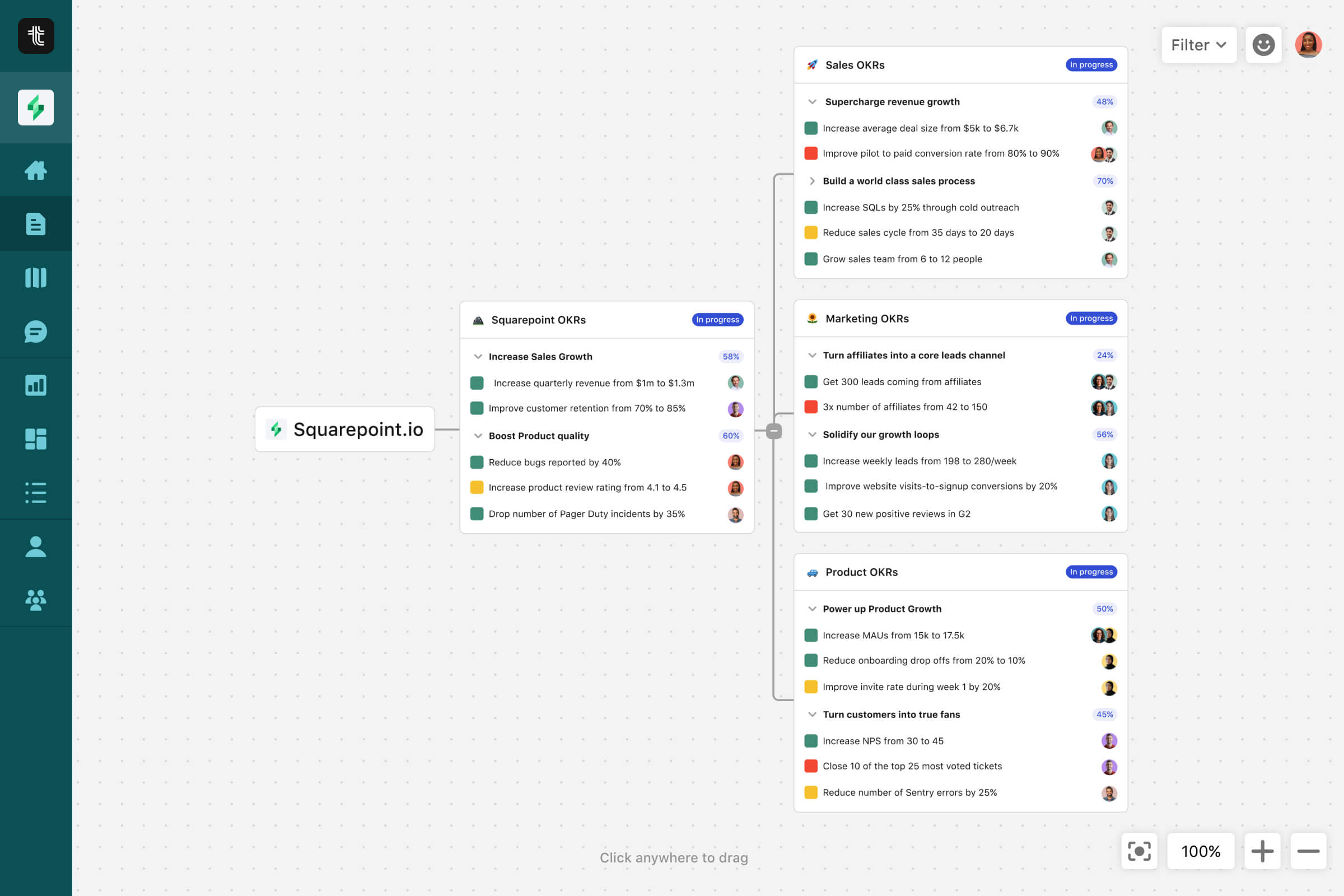
The remote era also drove adoption of more sophisticated OKR platform. Organisations needed tools that could manage asynchronous workflows, surface goal progress without requiring manual updates, and integrate with the collaboration tools their teams already depended on. This pressure accelerated the development of features like automated progress tracking, AI-assisted check-ins, and real-time dashboards.
OKRs and AI: what comes next (2025-2026)
The addition of AI to OKRs has not happened all at once. It has moved in distinct waves, and it is worth understanding each one, because the current wave is genuinely different from what came before.
The first wave arrived with ChatGPT in late 2023 and into 2024, and it solved a problem that had quietly undermined OKR programmes for decades: most people do not know what a good goal actually looks like. Writing an Objective that is ambitious but not vague, and Key Results that are genuinely measurable rather than just activity-based, is harder than it sounds. AI generators changed that overnight. Feed in a few ideas and a prompt, and you get back well-structured OKRs with correct formatting. For teams that were previously blocked at the writing stage, that was a significant unlock (See: How to write OKRS with AI).
The second wave was about feedback and reporting. Once you have OKRs in place, the next problem is staying on top of them. AI tools started reading goal progress in context, surfacing suggestions on what to do next, flagging when a Key Result was drifting, and generating progress reports that were actually accurate rather than padded. That last point matters. The classic OKR status update is either vague or optimistic. An AI that can look at real data from connected tools and produce a grounded, honest summary of where things stand removes one of the main reasons OKR reviews go badly.
The third wave changed how software itself gets built. Tools like Claude Code and OpenAI Codex became a core part of the development process, and as AI grew more embedded in everyday workflows, a new standard emerged: the Model Context Protocol. MCP servers started appearing across the software ecosystem, letting AI clients connect directly to external tools and data. This was not an OKR-specific development. It was a shift in how software and AI were expected to interact, and it had significant implications for goal platforms.
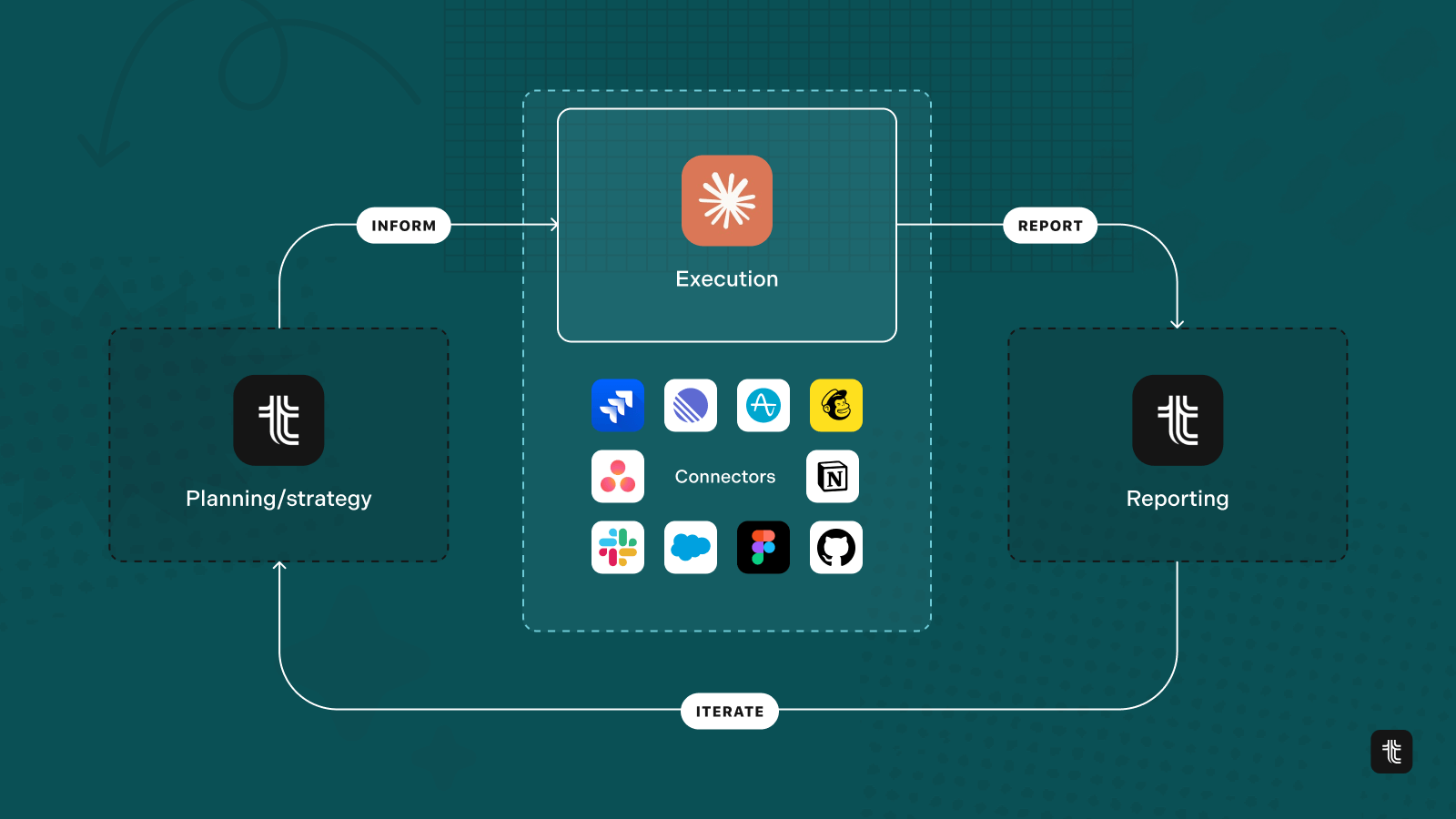
The fourth wave is agentic OKRs. Agents can now run check-ins on your behalf, prompt teams at the right cadence, collect updates, and keep goals from falling off the radar between quarters. The biggest structural failure in OKR programmes has always been the follow-through. Agents directly address that. And because MCP servers are now a norm rather than a novelty, your OKR data can be part of the conversation your agents are already having in Claude, ChatGPT, or whatever AI client your team runs. No context switching, no separate login.
What comes next is bigger still. AI agents are becoming a genuine part of the workforce, not just tools that humans use, but participants in the work itself. That creates a new challenge: how do you maintain the kind of transparency that OKRs were designed to provide when some of the contributors are autonomous agents rather than people? A handful of platforms are already building for this. Tability is one of them, working toward a world where human and agent work sits in the same goal system, visible to both, aligned toward the same outcomes.
How to get started with OKRs today
Understanding the history of OKRs is useful context. But the framework only delivers value when you start using it. If you are new to OKRs, the best place to start is learning how to write OKRs that are clear enough to be useful without being so prescriptive that they stop teams from being creative.
The common mistakes are predictable. Objectives that are too vague ('be more customer-focused'), Key Results that are actually tasks ('run five customer interviews'), and target-setting that is either too safe or too ambitious to be useful. Getting the basics right matters more than having the perfect tooling.
If you are building or scaling an OKR programme, Tability is built specifically for this. It handles the operational side, automated check-ins, progress tracking, and alignment across teams, without the overhead of an enterprise platform. You can sign up free or book thirty minutes with us if you want to talk through what this looks like for your organisation.
Conclusion
The OKR history spans more than seventy years, from Peter Drucker's Management by Objectives in 1954 to AI-powered goal tracking in 2026. Andy Grove invented the framework at Intel in the 1970s. John Doerr carried it to Google in 1999. And the book that made it mainstream did not arrive until 2017.
What makes OKRs endure is not complexity. It is the opposite. The framework is simple enough to be understood by anyone, flexible enough to work across industries and company sizes, and honest enough to tell you when things are not working. That combination has proven harder to improve on than most people expected when they first heard the name.


.jpg)