
When people come to us with OKR challenges, they usually want things like cascading views, OKR templates, check-in reminders and dashboards. It's hardly ever about reports.
But here’s the thing — reporting is where it all comes together for OKRs.
We’ve spoken to Chief of Staff, COOs, product managers, and even CEOs. When we dig deeper, one common issue keeps coming up: they’re spending way too much time creating reports.
They spend days turning obscure team updates, a sea of closed and backlogged tickets, and scattered data into something digestible for stakeholders. And it’s not just a time drain — it’s a blocker to doing actual strategic work — but we just think that's normal.
This is why reporting is one of the most underrated features in any OKR software. It’s the payoff for all the work you’ve done: setting thoughtful goals, keeping them on track, and nudging your team to stay engaged. In the end you get to see the results and have a big shiny report summarising all the great work we've done.
In this post, we’ll break down why reporting takes so much time, what good OKR reporting should look like, and how Tability can help you automate 80% of the process, without losing the context, insight, or momentum.
You spend a lot of time on reporting
How much time is spent on reporting each week?
Let’s do some rough math. If you’re a team lead or a manager, you might spend:
- 15–30 minutes per team member chasing check-ins
- 30–60 minutes collecting and reviewing status report data
- 1–2 hours building reports, formatting slides, and writing summaries
That’s easily 3–5 hours per week, and often more during review cycles or when preparing for exec presentations. Multiply that across managers and teams, and the cost quickly stacks up.
Some research backs this up. According to Asana’s Anatomy of Work Index, knowledge workers spend over 4 hours a week on "work about work"—which includes things like communicating about work, searching for information, switching between apps, managing shifting priorities, and following up on the status of work.
Don’t get us wrong; these activities are important. Good communication and reporting are key to keeping teams, leads, and stakeholders aligned. It’s a necessary part of business. But such a disproportionate chunk of your workweek is being spent on this communication and busywork vs. the skills you were hired to do.
That just doesn’t seem right 🤔
Why reporting feels like busywork
A lot of that time isn’t spent on strategy or insights—it’s spent on logistics. You're:
- Sending reminders to the team to submit OKR check-ins
- Collecting check-ins and progress updates from multiple sources
- Searching across tools (docs, dashboards, project boards) to gather supporting metrics for OKRs and KPI reporting
- Interpreting vague or inconsistent updates
- Manually updating spreadsheets and calculating progress percentages
- Building charts and visualisations to make progress more digestible
- Creating slide decks or detailed reports for different stakeholders
- Preparation for sharing via email or presenting it in meetings
The reporting process often becomes a chore instead of a strategic tool because there are so many tedious and manual aspects to it. This is exactly where a lot of processes break down—when the cost of reporting outweighs the clarity it’s meant to provide. Starts to feel like the whole process is not worth it.
Tability can automate 80% of your reporting
Most teams know what a great OKR process should look like — they just don’t have the time or tools to keep it running smoothly week to week. Manual reporting breaks down when it relies too much on memory, spreadsheets, and scattered follow-ups. That’s where Tability comes in.
Tability takes the heavy lifting out of reporting, so you can focus on strategy and outcomes instead of admin work. Here’s how:
Automate check-in reminders
No one likes to nag.
But I’m sure every leader or manager has had the chore of asking someone for overdue updates. It’s like you’re the repo man coming in from collections — you’ll never be met by a happy face.
Tability can make this process way less painful. With automated reminders, your team automatically gets a notification to do their check-ins once a week. Not only does this relieve you from having to nag your teammates, but it’ll also help build a more structured ritual and a healthier relationship with the check-ins.
One of our customers, Huzzle, even said that their team went from not doing check-ins to seeing it as a meaningful reflection that the team looks forward to and finds helpful:

To take it a step further:
You can even automate check-ins for days when a team member forgets or if you just want to automate the tracking altogether. We always trust a human to analyse progress better, but Tability AI can really help you fill the gaps when needed.
(Learn more about our Tability OKR Agent).
One place for all your OKR data
One of the biggest time-sucks in reporting is gathering all the data.
You might have revenue metrics in Stripe or HubSpot, product analytics in Mixpanel or Amplitude, website performance in Google Analytics or Ahrefs, and user behaviour data in Hotjar or FullStory. Add in project tracking from Asana or Jira, and suddenly you’re spending hours switching between tabs just to assemble one report.
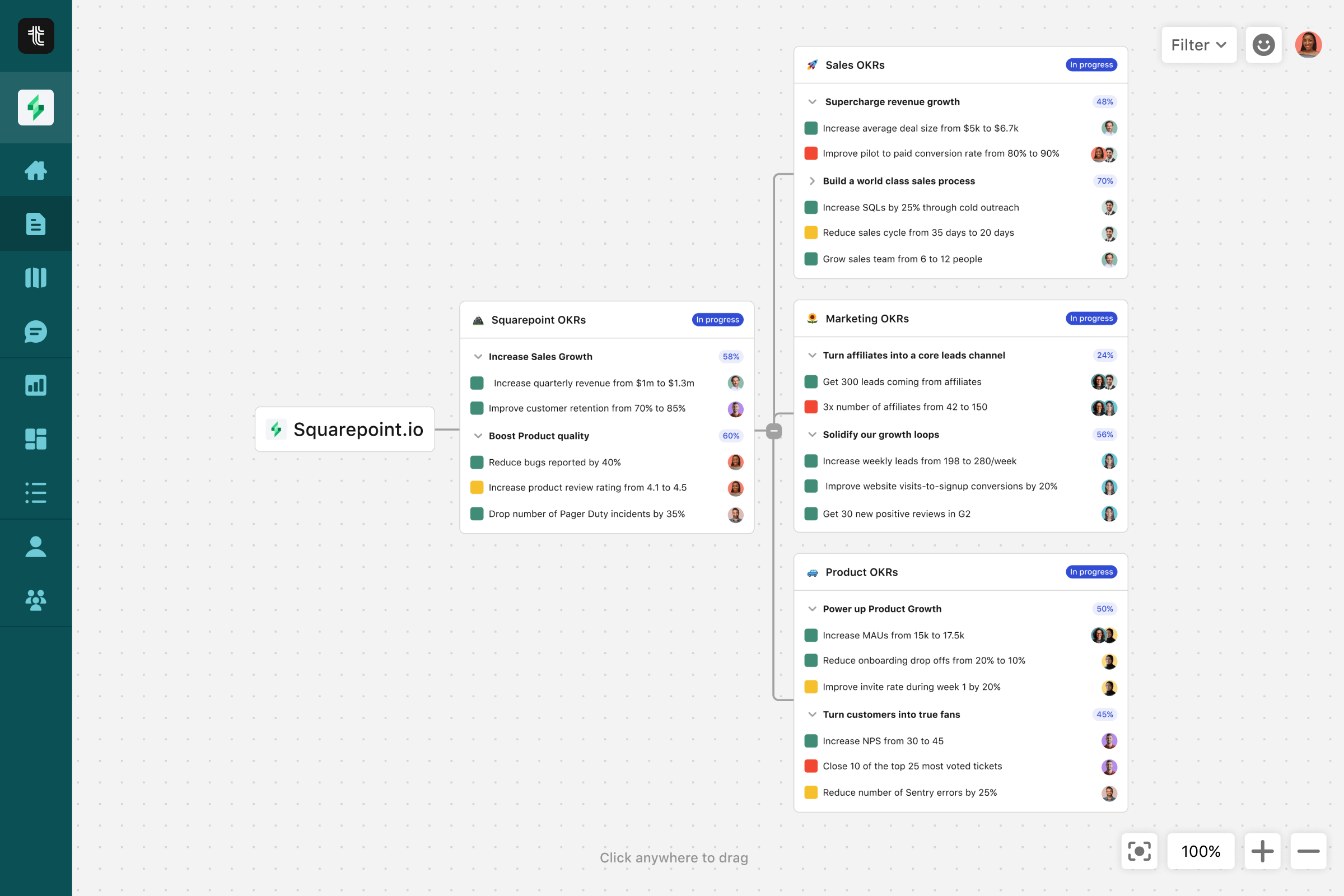
With Tability, updates, comments, tasks, and all your different types of goals and KPIs live in one shared workspace. You can link context, the latest stats, and completed tasks/projects together. This is great for a CEO or leadership person who doesn’t want to be in Jira looking at dev tickets and vice versa for a developer who doesn’t care about high-level strategy documents. It creates a single source of truth and a meeting place for different parts of the business.
Not only that, but with integrations with all of your tools, you don’t even have to manually connect the dots. You can set up automation and link data sources to goals so that things happen automatically throughout the quarter.
Live dashboards for transparent progress
Who doesn’t love a good OKR dashboard? Visualising a report can be one of the most tedious parts of the process. With Tability’s custom dashboards, you can build live visuals and insights to track just about anything around your goals.
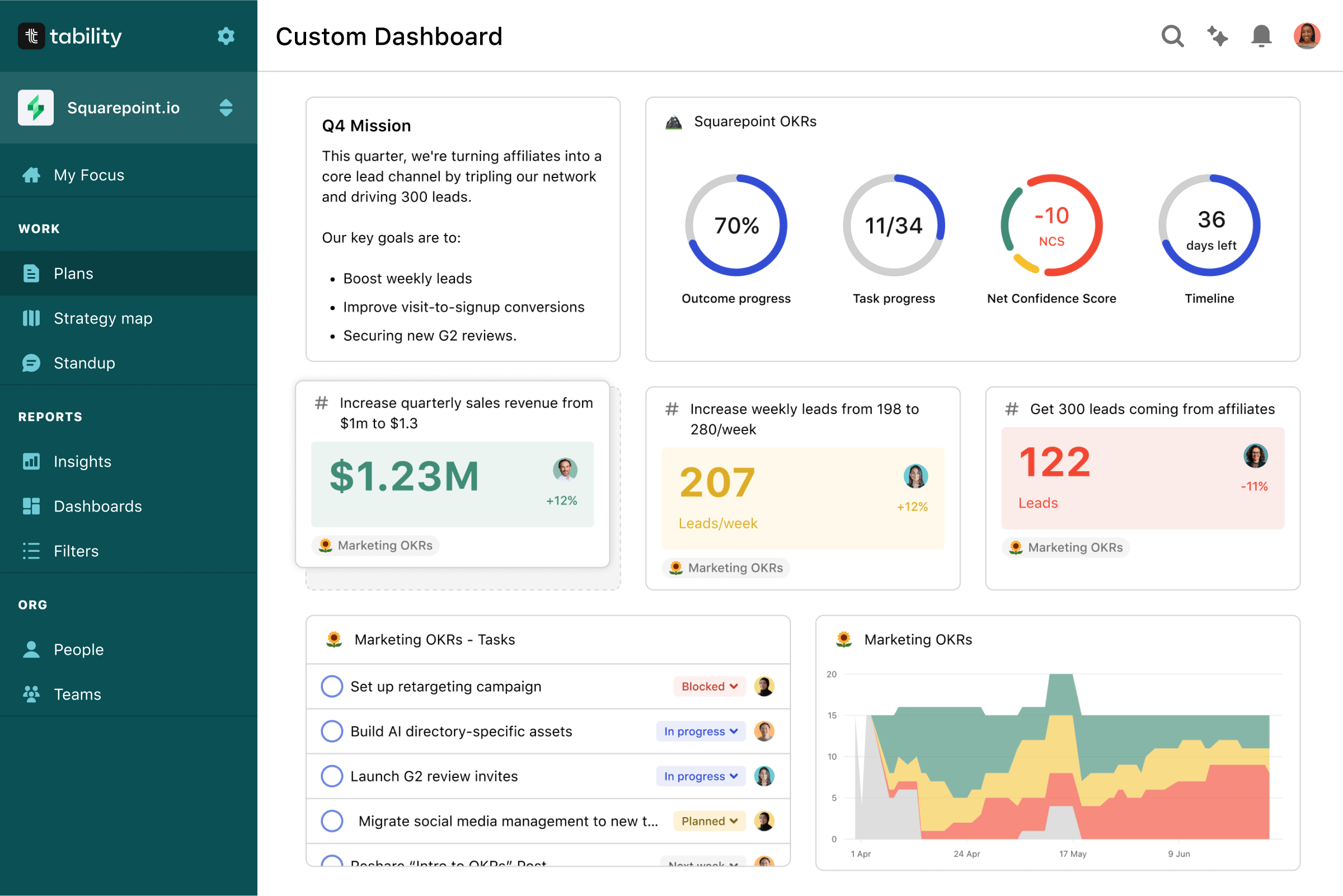
From here it’s easy to screenshot valuable graphs and datapoints or even just send a link to the dashboard so that your stakeholders can watch in real time too.
AI-generated reports
Imagine all the work that happens in your company — the conversations, the status updates, the goals, the tasks, the people. What if you could plug all of that into an LLM and get a summary on what’s happened in the past few months?
Tability can do that.
This is one of our favourite new tools: AI-generated retrospectives.
With one click, you can turn your weekly updates into polished, shareable reports. Tability’s AI can summarise key progress, flag risks, and give you a strong starting point for deeper insights — without starting from scratch.
See this real AI-generated report below:
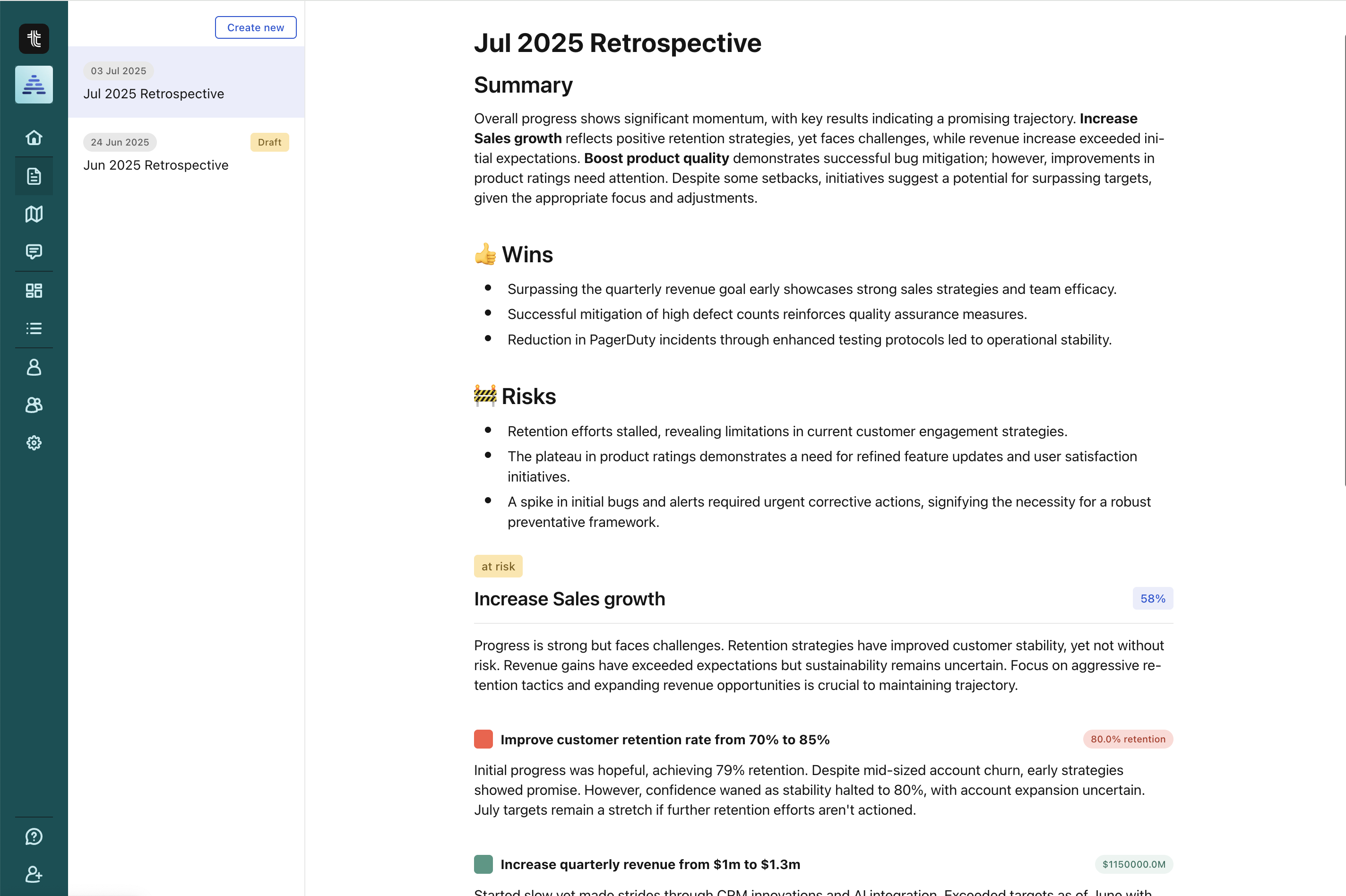
The beauty of this is that it takes the check-ins you’ve created, so the better your team’s check-ins are, the better report you’ll get. If you can get your team reporting like pros, this feature alone will save you 80% of your reporting time.
A consistent rhythm for reflection
This is a bit of a repeat from above, but we can’t reiterate enough how important a weekly check-in ritual is. Building that consistent rhythm for reflection helps your team stay aligned and focused on their long term goals throughout the entire quarter.
If your team doesn’t regularly check in, a lot of data gets lost between reflection cycles. Having shorter cycles means less chance of something going red and more chance that you can course correct promptly.

By removing friction from the process, teams can actually enjoy reporting again. Tability helps turn OKRs into a habit, not a chore — one that fosters clarity, transparency, and continuous improvement.
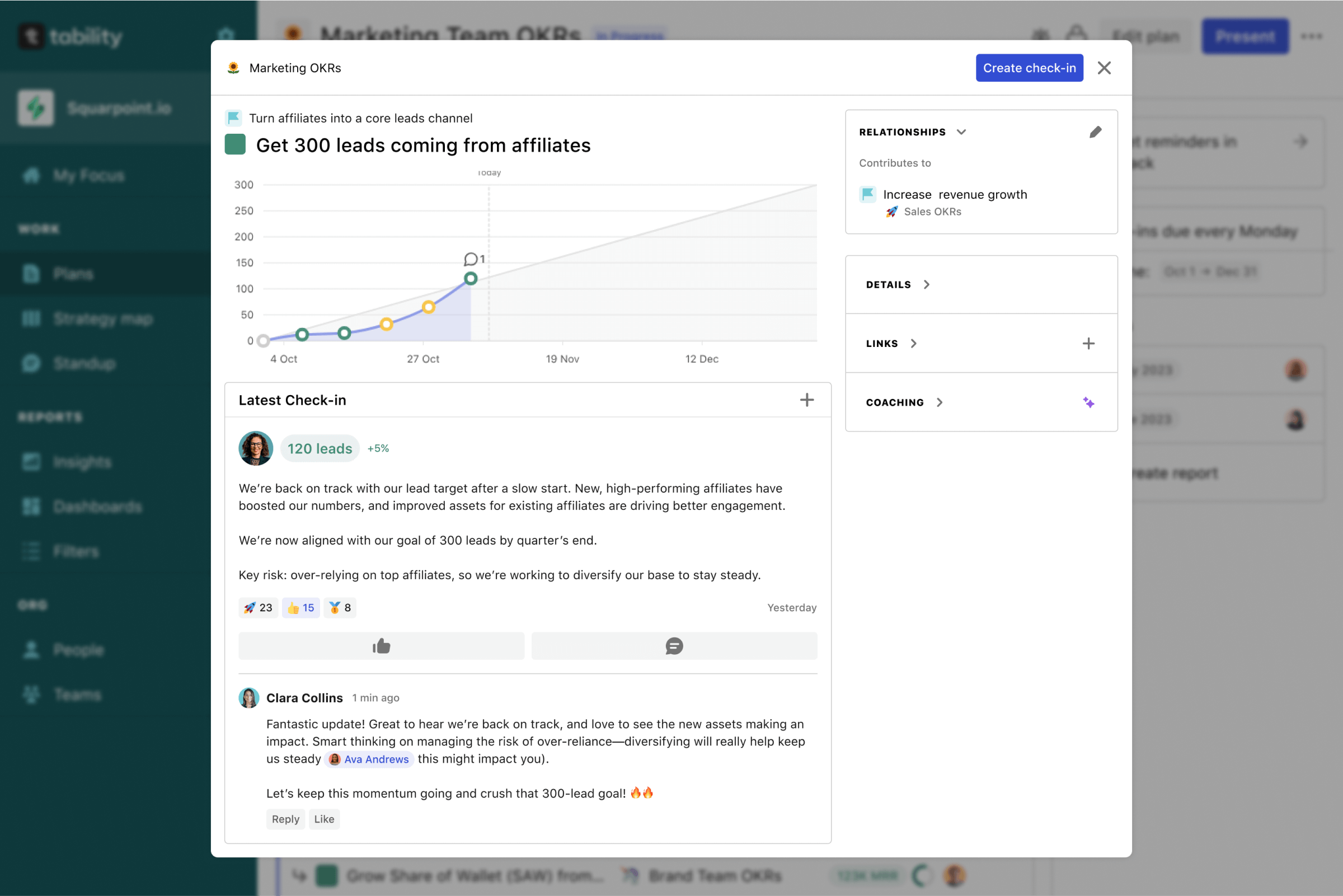
Lastly, the big payoff for getting your teams to do their check-ins comes in the reporting. When your team enjoys and puts effort into their check-ins, it makes your monthly/quarterly/yearly wrap-ups a breeze. Just grab all their beautiful check-ins and summarise.
Reclaim your time and focus on what matters
OKR reporting doesn’t have to be a weekly grind. When done right, it can drive alignment, visibility, and momentum across your entire team. But without the right tools, it too often becomes a chore, eating up hours that could be spent on actual progress.
Tability helps you cut through the noise by automating the repetitive parts of reporting, surfacing the insights that matter, and making it easy to keep everyone on the same page. Less chasing updates. More clarity, action, and impact.
Give your team the time and headspace to focus on what truly moves the needle.

.jpg)
.png)



.png)