Most companies have invested heavily in cross-functional collaboration. They have Slack. They have Confluence. They have weekly standups, monthly all-hands, and a project management tool that nobody updates. And yet, the product team still ships features sales never asked for. Marketing still launches campaigns that engineering wasn't ready for. Finance still blocks initiatives at the last minute because they weren't in the plan.
The collaboration tools aren't the problem. The problem is that each team is being measured on something different.
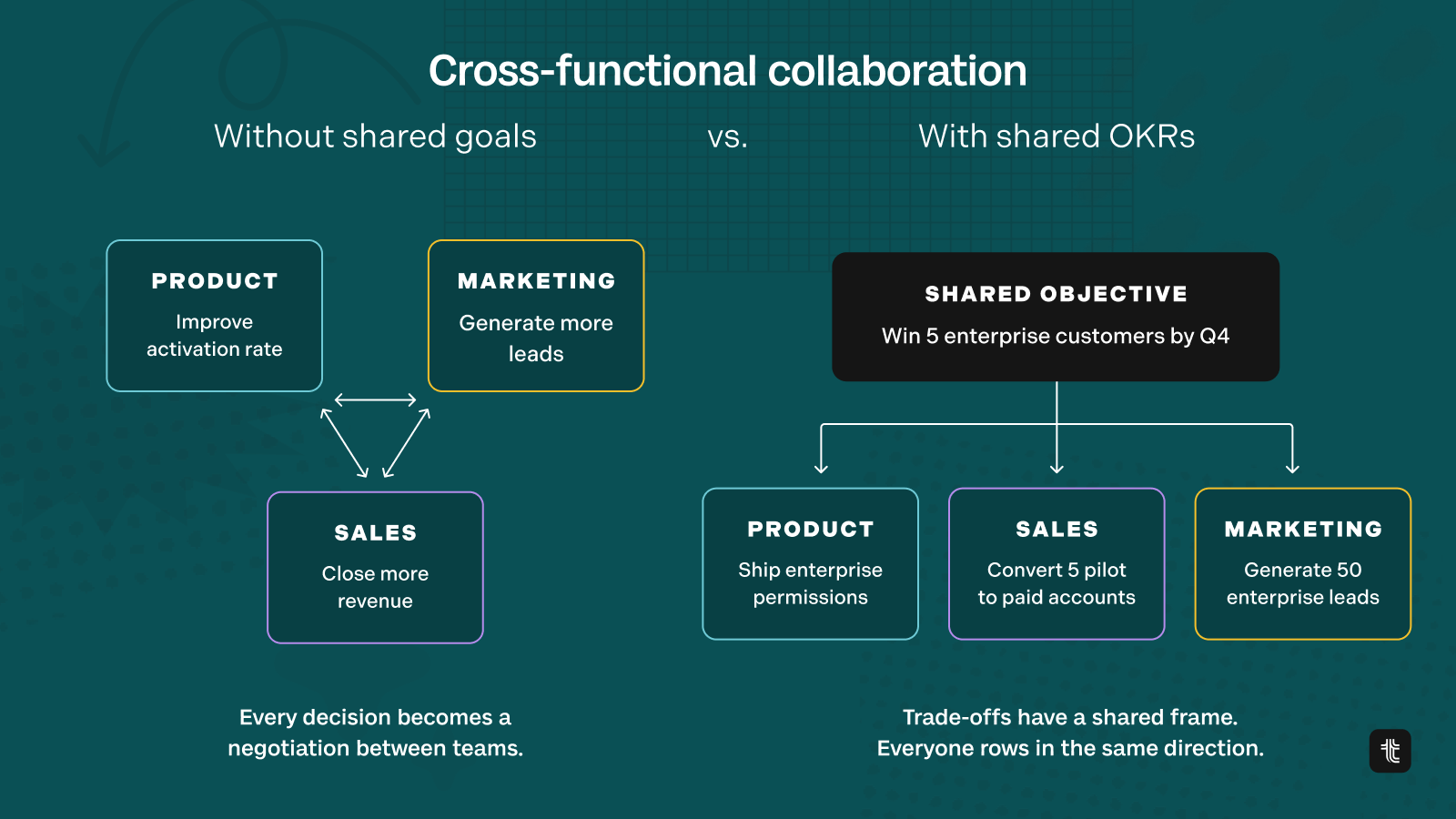
When the marketing team is measured on leads, the product team on activation, and the sales team on closed revenue, every cross-functional project becomes a negotiation. Not a collaboration. A negotiation about whose priorities matter more this quarter. This article is about why that happens, and how to fix it.
“Half the time people aren't misaligned on purpose, they just don't share the same priorities, timelines or mental model of what urgent means. And no matter how many meetings you set up, you can't force teams to magically work at the same speed.”
— u/EconomistFan666 in r/projectmanagement (Source: Reddit)
The real reason cross-functional collaboration breaks down
It's tempting to blame misalignment on communication. Teams aren't talking enough. They're not using the right tools. They need more meetings, or fewer meetings, or better meetings. So companies invest in more Slack channels and more standups and more project management software.
But the root cause isn't communication. It's accountability. When each team is accountable to a separate scorecard, cross-functional work is structurally at a disadvantage. The product team will always prioritise product outcomes. The sales team will always prioritise sales outcomes. Not because they're selfish or siloed — but because that's what they're measured on.
In practice, this means cross-functional projects get deprioritised whenever they compete with a team's own metrics. The initiative lives in a spreadsheet somewhere. Progress is everyone's responsibility and therefore no one's. Deadlines slip without consequence because the deadline isn't tied to anyone's actual performance measure.
The problem isn't that teams don't want to collaborate. It's that the system rewards individual team performance over shared outcomes.
What cross-functional collaboration actually looks like when it works
When cross-functional collaboration works, it's usually because the teams involved share a common outcome they're all accountable for. Not just aware of — accountable for.
Think about a company launching into a new market. If product, marketing, and sales all own a shared OKR around "successful expansion into the enterprise segment by Q3", the dynamic changes. Decisions that were previously negotiated — which features to prioritise, which segments to target, when to start selling — now have a shared frame. Everyone can ask: does this get us closer to the shared outcome?
This shared accountability doesn't remove individual team goals. It adds a layer of common ground that cross-functional decisions can reference. It's the difference between teams who happen to work near each other and teams who are genuinely rowing in the same direction.
The role of shared goals in cross-functional work
Shared goals serve a specific function in cross-functional teams: they make trade-offs legible. When teams have separate scorecards, every trade-off is a political conversation. When they share an outcome, trade-offs become a logical question with a clear answer.
This is why OKRs are particularly well-suited to cross-functional work. The OKR format — one objective, multiple key results — allows a single strategic outcome to be owned collectively, with each team tracking the specific metrics that sit within their control.
A marketing team might own "increase trial sign-ups from the enterprise segment" as a key result. A product team might own "reduce time-to-value for new users." Both roll up to a shared objective: "Become the default tool for enterprise strategy teams by end of Q2." Neither team loses visibility of what they're responsible for. But they both have line of sight to the shared outcome — and to each other's progress.
How to structure cross-functional OKRs
The structure matters. Cross-functional OKRs fail when they're either too vague (everyone agrees to the objective but nothing changes) or too prescriptive (the shared goal is actually just one team's plan imposed on everyone else).
Here's a structure that works:
- One shared objective. One shared objective owned by the cross-functional group. This should describe the outcome you're all trying to create, not the output or the activity. "Launch the enterprise product" is an output. "Win five reference enterprise customers by Q4" is an outcome.
- Team-specific key results. Team-specific key results that each team owns within their domain. The product team owns "complete enterprise-grade permissions by [date]." The sales team owns "convert five pilot customers to paid accounts." Marketing owns "generate 50 qualified enterprise leads."
- A shared check-in cadence. A shared check-in cadence. This is where most cross-functional OKR efforts fall apart. Setting up the goals is not enough. Teams need a recurring rhythm where they update their key results, flag blockers, and surface dependencies. A weekly async check-in with a structured format is often enough. Without this cadence, the shared goals become another artefact that nobody looks at.
Cross-functional OKR examples
Here are two patterns that appear in teams running cross-functional OKRs well.
Product and engineering launching a new feature
Objective: Deliver self-serve onboarding that reduces support load and improves activation.
- Product: Define onboarding flow and complete user testing with 10 customers.
- Engineering: Ship onboarding v1 to production by [date], with less than 2% error rate.
- Customer success: Reduce first-week support tickets for new users by 30%.
Marketing and sales driving a pipeline campaign
Objective: Build pipeline in the mid-market segment in Q3.
- Marketing: Generate 80 MQLs from mid-market accounts.
- Sales: Book discovery calls with 30 qualified accounts.
- RevOps: Ensure CRM tracking is in place for mid-market attribution.
The common thread across both: each team knows exactly what they own, but they can also see what everyone else is tracking. Dependency management becomes obvious. Blockers get raised earlier. And the shared objective gives everyone a reason to care about each other's progress, not just their own.
Tools and rhythms that support cross-functional collaboration
Getting the goals right is step one. The habits and tools around those goals are what determines whether they stick.
- Shared visibility. All teams should be able to see each other's progress against the shared objective. This sounds obvious, but most companies don't do it. Goals live in separate dashboards, separate spreadsheets, separate tools. When progress is siloed, so is accountability.
- Async check-ins. A weekly async update — where each owner notes progress, their confidence level, and any blockers — creates a lightweight paper trail that a meeting never can. It also surfaces blockers before they become emergencies.
- One owner per objective. Someone needs to be accountable for the shared objective as a whole. Not responsible for delivering every key result, but responsible for making sure the cross-functional effort is on track. This is typically a StratOps or PMO role, or a senior leader with cross-team authority.
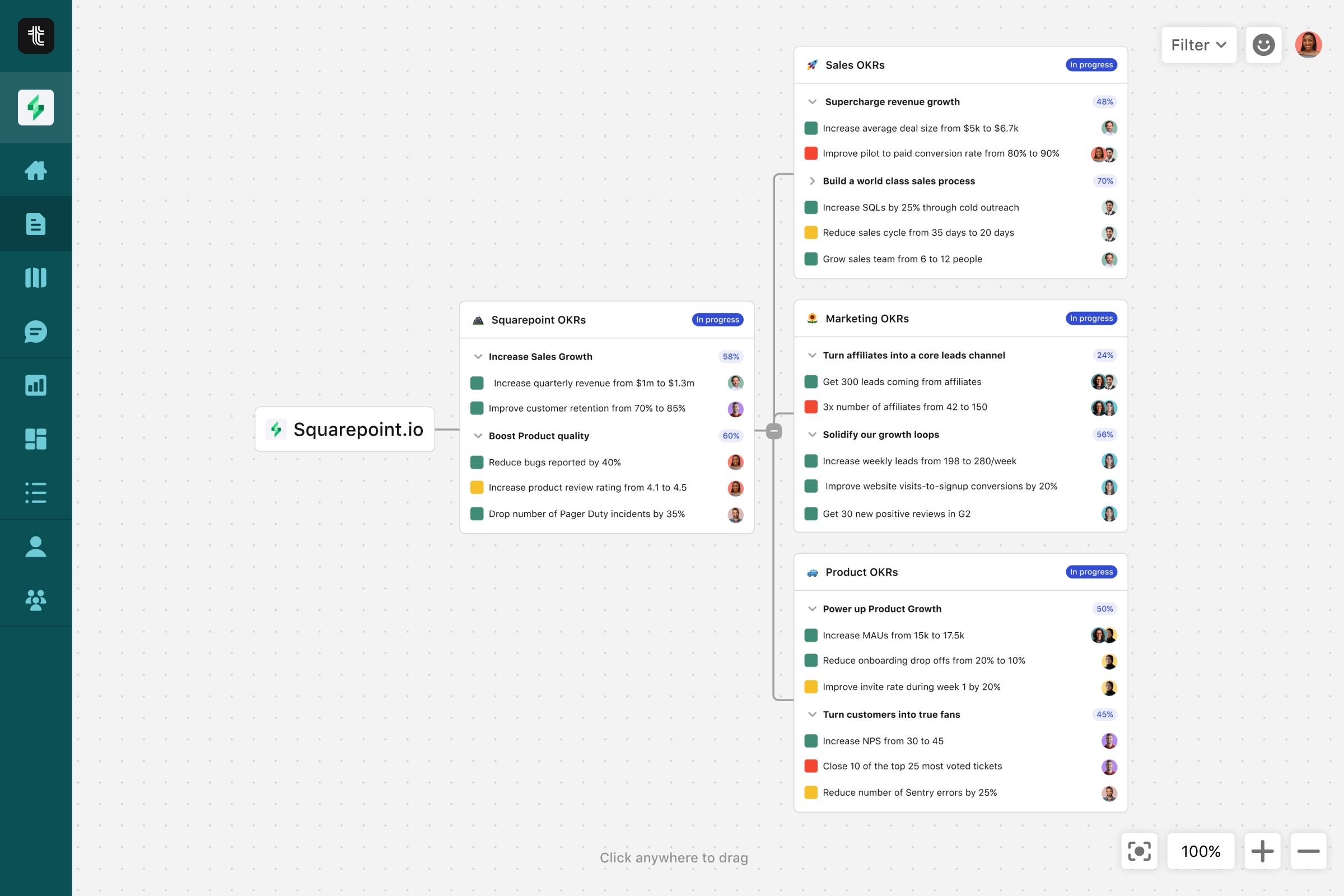
Tools like Tability are built specifically for this. They give teams a single place to set up shared OKRs, run check-ins, and track progress across functions — without the overhead of enterprise goal management platforms. Tability's strategy map shows how every team's goals connect to the shared objective, so cross-functional dependencies are visible at a glance. When a key result goes off track, the right people see it.
Teams are able to use tools like Tability to surface collaboration opportunities between teams. One valued customer, Rebill, noticed that Tability brought visibility into what every department was doing toward a specific objective, so that they can divide and conquer more efficiently, rather than stepping on each other's toes and causing redundancies.
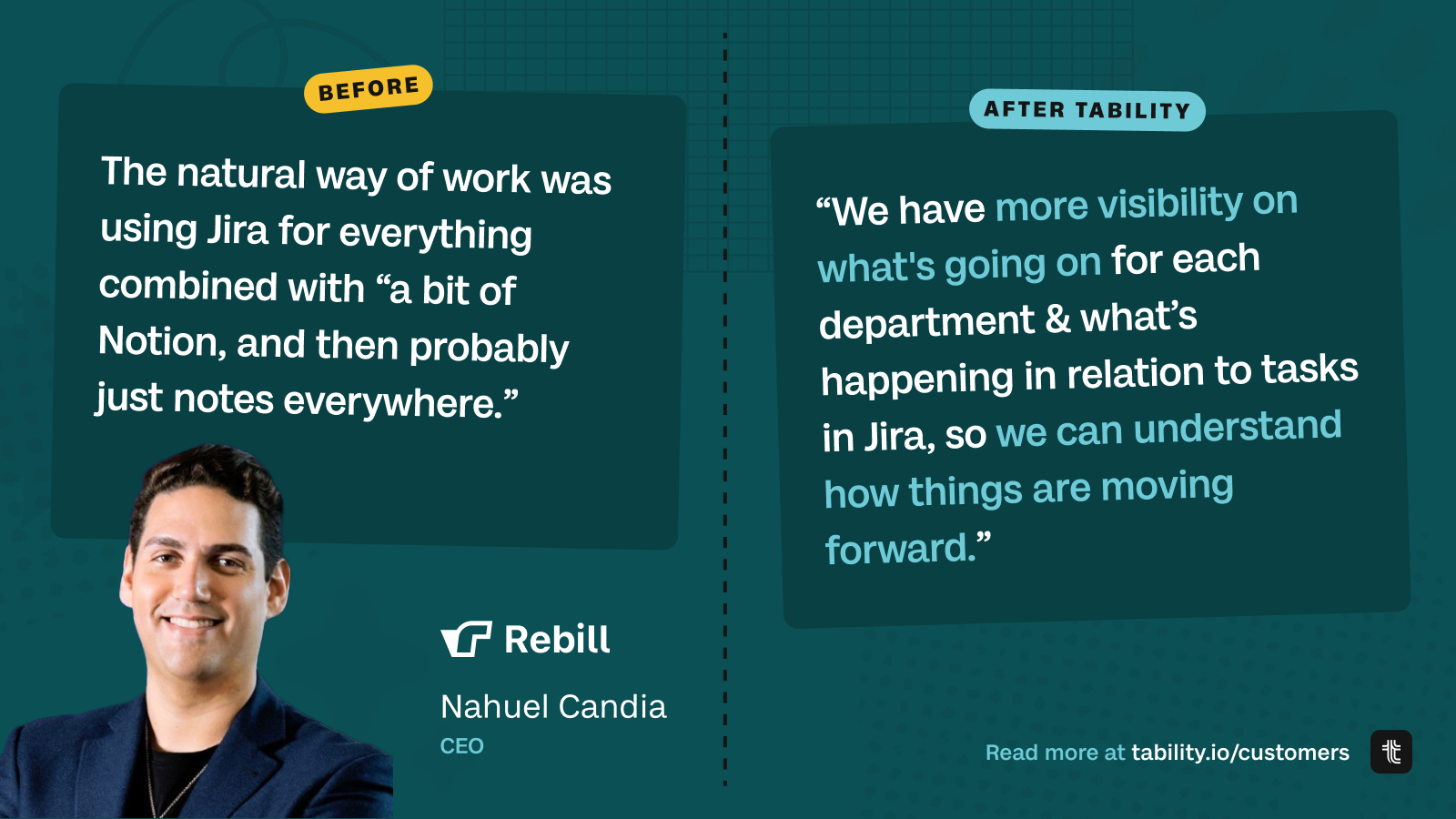
By having visibility into the full picture, teams are able to find more opportunities to help each other vs. getting lost in an unorganised mess of Jira tickets and various tasks.
If your cross-functional projects feel more like negotiations than collaborations, the fix probably isn't another standup. It's a shared scorecard.
Get visibility across teams — Try Tability for free
Try Tability free and set up your first cross-functional OKR plan in under 10 minutes, or book a time with the team and we'll help you get it right.


.jpg)
.png)