Most companies have core values. Most of them are useless. Not because values don't matter (they do, significantly) but because the ones plastered on office walls tend to be the same five words recycled across a thousand about pages. Integrity. Innovation. Excellence. Teamwork. Respect.
Nobody's against these things. But nobody's particularly inspired by them either. The companies that get core values right use them differently. They treat them as operating principles that shape decisions, hiring, strategy, and culture, not just marketing copy.
This is what company core values actually are, how they connect to your business strategy, and how to make them mean something beyond the onboarding slide deck.
What are company core values?
Company core values are the fundamental beliefs and guiding principles that shape how a business operates, makes decisions, and treats people, internally and externally. They're not aspirational statements about who you want to be. They describe who you actually are, what you prioritise when things get hard, and how you expect people to behave when nobody's watching.
The distinction matters. Aspirational values are what you'd like to be true. Operational values are what's actually true, tested under real pressure. The best company values are operational: they've been stress-tested against hard decisions and they've held up.
💡 A useful test: could your competitor claim the same values without anyone laughing? If yes, your values probably aren't specific enough yet.
Core values also differ from a company's mission or vision. The mission is why you exist. The vision is where you're going. Core values are how you get there: the non-negotiable behaviours and beliefs that guide every decision along the way.
Why core values matter for your business strategy and goals
Core values aren't separate from strategy. They sit at the top of it. Before you can set a meaningful direction, you need to know what your organisation fundamentally believes. Values shape which markets you'll compete in, what trade-offs you'll accept, how you'll treat customers when things go wrong, and what "winning" actually means to you.
Think of it as a layered structure (what some call the strategy pyramid). At the top are your values: the bedrock principles that don't change. Below that is your mission and vision. Then your strategic pillars, which translate values into focus areas. Then your goals, the measurable outcomes you're working toward this year or quarter. Many teams use OKRs at this layer to make those goals concrete and trackable.
When values are clear, strategic decisions become easier. "Does this acquisition reflect who we are?" becomes a real filter, not a rhetorical question. They also influence what you measure. If you value customer trust above growth, that should show up in your strategic pillars and ultimately in the goals you set. A company that says it values transparency but measures nothing related to internal communication isn't actually living that value. It's just decorating with it.
Values also shape hiring, and hiring shapes everything else. When a candidate asks "how does your culture actually work in practice?", the honest answer should trace directly back to your values. Companies that have done this well find that values-based hiring reduces friction, improves retention, and makes onboarding significantly faster because new hires already understand how to make decisions.
20+ company core values examples
The best way to understand what good values look like is to see them in context. Here are examples from companies that have put real thought into this, starting with one that set the benchmark.
Atlassian
Atlassian's values are the gold standard for a reason.
"Don't #@!% the customer" is unforgettable in a way that "Customer focus" will never be. "Open company, no bullshit" actually means something: it tells you how meetings are run, how feedback is given, and who gets promoted. Each value is specific enough to guide a real decision.
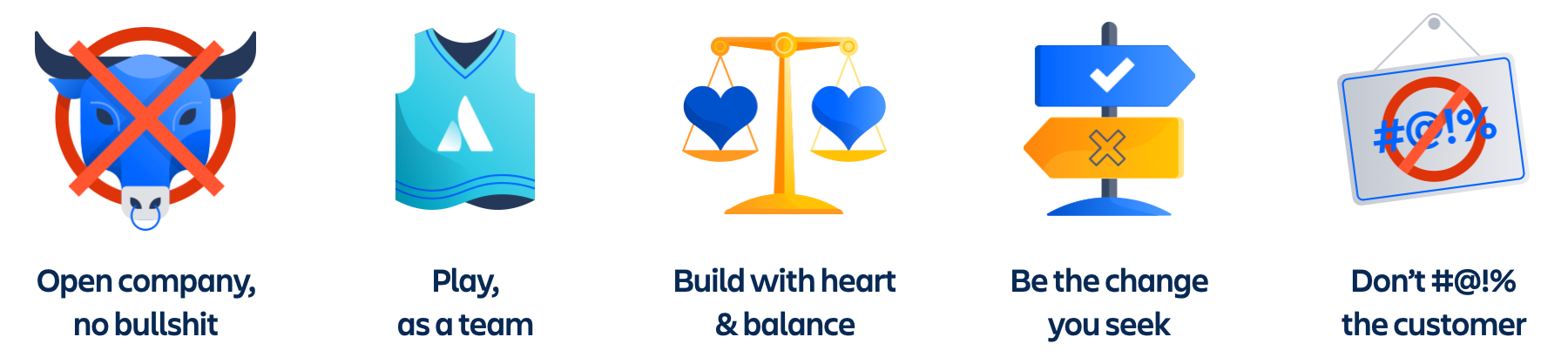
- Open company, no bullshit
- Build with heart and balance
- Don't #@!% the customer
- Play, as a team
- Be the change you seek
Note: these are specific, opinionated, and memorable. Nobody else can claim them.
I'm biased in highlighting this as a great example for company values, as I used to work at Atlassian myself. I saw first hand when I worked there, that company values can be part of everyday life (and should be!). They were quoted in all-hands, project meetings,
Netflix
Netflix famously published their full culture deck publicly. It went viral and attracted talent who self-selected in.
Netflix company values:
- Judgement: make wise decisions despite ambiguity
- Communication: listen well and be concise
- Courage: say what you think even if it's controversial
- Honesty: only say things about fellow employees you'd say to their face
- Selflessness: seek what's best for Netflix, not yourself or your group
Patagonia
Patagonia's values are inseparable from their strategy. "Use business to protect nature" isn't a CSR statement. It's an operating principle that rules out entire product categories and supply chain decisions.
Patagonia's company values:
- Build the best product
- Cause no unnecessary harm
- Use business to protect nature
- Not bound by convention
Patagonia's values are inseparable from their strategy. "Use business to protect nature" isn't a CSR statement. It's an operating principle that rules out entire product categories and supply chain decisions.
HubSpot
HubSpot turned their values into an acronym, then published their culture code publicly. Like Netflix, this became a talent magnet.
Hubspot company values:
- HEART: Humble, Empathetic, Adaptable, Remarkable, Transparent
Zappos
Zappos famously offered new employees $2,000 to quit after training if they didn't feel the culture fit. The ones who stayed were genuinely bought in.
Zappos company values:
- Deliver WOW through service
- Embrace and drive change
- Create fun and a little weirdness
- Be adventurous, creative, and open-minded
- Pursue growth and learning
Buffer
Buffer publishes salaries, equity, and revenue publicly.
"Default to transparency" isn't a value they've declared. It's a value they've demonstrated.
Buffer's company values:
- Default to transparency
- Communicate with clarity
- Choose positivity
- Show gratitude
- Improve consistently
Other companies worth referencing
- Amazon (14 Leadership Principles, often cited as the most operationalised values in tech)
- Salesforce (Trust, Customer Success, Innovation, Equality)
- Airbnb (Champion the mission, Be a host, Simplify, Every frame matters).
How to define your company's core values
The process matters as much as the output. Values handed down from a leadership offsite rarely stick. Values that emerge from a conversation about real behaviours (the ones you're already proud of and the ones that caused problems) tend to last.
- Start with behaviours, not words. Start with behaviours, not words. Ask: what did we do in the last six months that we're genuinely proud of? What decisions reflect who we are at our best? Work backwards from those moments to the underlying belief they express.
- Involve more than the leadership team. Involve more than the leadership team. Your best junior hires often have a clearer read on what the culture actually is (versus what leadership thinks it is). Include them in the conversation.
- Test against hard scenarios. Test each value against a hard scenario. "We value honesty": does that mean you'd tell a customer their purchase was a mistake? Does it mean you'd give genuinely critical feedback in a 360? If the value doesn't hold up under pressure, it's aspirational, not operational.
- Keep the list short. Keep the list short. Five to seven values is the practical ceiling. More than that and they become a poster, not a compass. If you can't remember them without looking, they're not guiding any decisions.
- Make them specific. Make them specific enough that a competitor couldn't steal them. If your values could belong to any company in your industry, they're not specific enough to yours.
How to make core values stick
"Put the cult in culture."
Defining values is the easy part. The hard part is making them a living part of how your company actually works. This requires what you might call a deliberate cultural infrastructure: the repeated, systematic reinforcement of values until they become instinct.
Put the cult in culture. That's not a joke. The companies that live their values most authentically have created rituals, artefacts, and shared language around them that borders on obsessive. And it works.
Here's what that looks like in practice:
- Physical presence. Physical presence. Values on the walls, on cards at every desk, in the email footer, in the Slack sidebar. This sounds superficial but it isn't: you can't internalise what you don't see. The goal is that a new employee encounters the values so frequently in their first month that they become automatic reference points.
At Atlassian, values weren't a strategy document you read once. They were everywhere. On posters in every office, on physical cards that got handed out, mentioned in every all-hands, embedded in the performance review process. It felt relentless, and that was exactly the point. By the time you'd been there three months, you didn't need to look up the values to know whether a decision aligned with them. They were just how you thought.
- Hiring and onboarding. Hiring and onboarding rituals. Every interview process should include values-based questions with specific examples. Not "do you value transparency?" but "tell me about a time you shared information that was uncomfortable to share." Onboarding should spend as much time on values as it does on product.
- Performance and recognition. Performance and recognition tied to values. If your performance review doesn't reference your values, you're sending a clear message: values are optional. Recognition programmes that call out specific examples of values in action ("this person just 'built with heart and balance' by doing X") reinforce the connection between words and real behaviour.
- Leadership modelling. Leadership modelling. The fastest way to kill a value is for a senior leader to visibly violate it without consequence. Equally, the fastest way to embed a value is for a leader to make a decision that costs them something (revenue, speed, comfort) because the value demanded it. People notice both.
- Language and vocabulary. Language and vocabulary. When values become part of everyday language ("that's very 'open company, no bullshit' of you", "we should be the change here"), they stop being poster words and start being shared shorthand. This happens naturally when leaders use the language consistently, and it spreads.
Common mistakes companies make with core values
Even well-intentioned values processes can go wrong. A few patterns worth avoiding:
- Writing for external audiences. Writing values for external audiences. If the primary question in the room is "how will this look to customers or investors?", you're writing marketing copy, not values. Values are primarily internal: they guide behaviour when nobody external is watching.
- Too many values. Too many values. A list of twelve values is a list that nobody will remember. Prioritisation is itself a values exercise: what do you care about most? The act of cutting the list from twelve to five is one of the most clarifying conversations a leadership team can have.
- The say-do gap. The say-do gap. The fastest way to corrode a culture is to have stated values that contradict actual behaviour. If you say you value work-life balance but reward people who answer emails at midnight, your real value is performance at all costs. People see this clearly even when leadership doesn't.
- Set and forget. Defining values once and never revisiting them. Companies change. A value that was authentic at 20 people may not reflect who you are at 500. Values should be revisited every few years, not to throw them out, but to check whether they still describe the company you're actually building.
💡 When your values are clear, they should flow through to your strategic priorities and the goals you measure. Tability helps teams connect company direction to measurable outcomes, from strategic pillars all the way to weekly check-ins.

.png)
.jpg)