Back in December 2024, our team shipped a series of improvements that drove a 600% jump in trials. And things have kept on getting better and better with each month passing by.
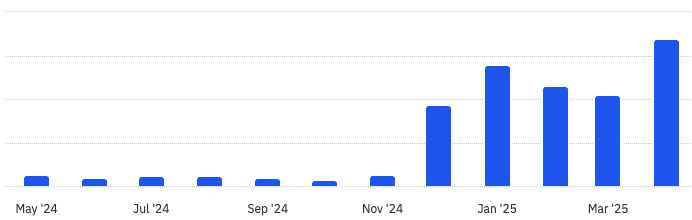
We don't have growth people. None of us are marketers. We're mostly product nerds.
I can share some of the projects that made a difference like using AI to create user-specific sample data, or updating our onboarding screens to be more value-driven. But what really made us successful is the system that we have in place to continuously solve hard problems – even when we're lacking expertise.
We’re not magicians but we're relentless, and we have a method.
Clear goals + fast feedback loops = continuous (l)earning
Building and growing products is very much like solving a hard puzzle.
Everyone can manage to get the edges and the outer layer done quickly. But then you will see a massive difference between the people that can deal with organised chaos, and those who just randomly try their luck until they meet success.
And luck can get really expensive in business, especially if you’re in a competitive market.
But thankfully, you can significantly improve your odds of success by adopting a systemic approach to finding what works:
- Step 1: Identify an opportunity
- Step 2: Set clear, measurable goals to track the opportunity gap
- Step 3: Adopt a weekly feedback cycle to review progress
- Step 4: List possible bets (aka initiatives) to reach the opportunity
- Step 5: Iterate on the bets until we close the gap completely
Once step 5 is done, we just move on to the next opportunity.
The 5 steps for a continuous learning process
Step 1: Identify an opportunity
The first step of our process is to make sure that we’re picking the right kind of problem to solve. And rather than problem, I prefer to use the word opportunity because it implies that there’s an upside at the end.
A good opportunity only needs to meet 2 criteria:
- It should yield significant benefits if successful
- It should be difficult for others to replicate
Picking these criteria isn’t rocket science, but sticking to them is harder than it seems in practice – because our nature gets in the way. We, humans, get dopamine hits whenever we solve puzzles. This means that we’re often more interested in finding problems to solve than finding problems that are valuable to solve.
This urge can manifest itself in various ways:
- Creating a sophisticated architecture for a service that is rarely used
- Endless debates on the design of pages that get <5% of the traffic
- Closing a lot of really small complexity tickets
Beware of the illusion of productivity when everyone is visibly busy, but none of the work done translates into meaningful improvements for your customers. The opportunity quadrant below is here to help you judge the good from the bad.
.png)
In our case, our biggest opportunity was to manage to be a product-led company in a space where most, if not all, other vendors are sales-led. It was definitely challenging to get there, but it paid off massively. Now we’re able to focus 80% of our efforts on the platform and it also makes us stand out from the crowd in terms of onboarding experience.
Here are some other examples of great opportunities in SaaS:
- Creating network effects
- Turning your product in a platform
- Having effective upsell touchpoints
- Leveraging AI for personalised onboarding
Step 2: Set clear, measurable goals to track the opportunity gap
Once an opportunity is established, the first thing you need to do is to define what success looks like. Ideally, you should be able to represent it as one or more metrics that correlate with success.
The reason is simple: drawing lines in the sand will help you know when to stop, or realise when you’re not making any material progress.
Ex: your goal is to become a leader in Europe.
Well, what does that mean exactly? How many customers are we talking about? How much revenue? Or maybe for the first quarter this is simply about recruiting a strong sales team?
Paint the picture of what great looks like 3 months from now. And once again, making it measurable will help you cast a better judgement on your achievements.
In our case, being product-led meant was measured by a set of metrics:
- Increasing weekly leads from X to Y, and
- increasing the number of customers from X to Y (where the growth was a significant uptick on our previous months)
Why not revenue? We do track revenue growth, but this metric can grow quickly by focusing on a handful of Enterprise customers. So, rather than attaching it to the product-led opportunity, we attached it to a separate growth opportunity. Our goal was to make sure that we were growing the top of the funnel and we needed metrics that would help us capture that effort.
I highly recommend using the OKR approach to write your goals rather than making your own system. OKRs are widely used now, and you'll find a lot of literature and people that can support you or give feedback.
Step 3: Adopt a weekly feedback cycle to review progress
A good KR is something that moves every week.
You need to be able to compare week n+1 to week n, and understand if you’re moving in the right direction. This is why a KR like “Secure 2 customers this quarter” isn’t great. It’s likely to stay at 0 for a while making it hard to understand if you’re doing the right things to close your leads.
What you need instead is a metric that you can easily observe. This will allow you to capture risks early (see KR below tracked in Tability) and create plans to fix things before it’s too late.
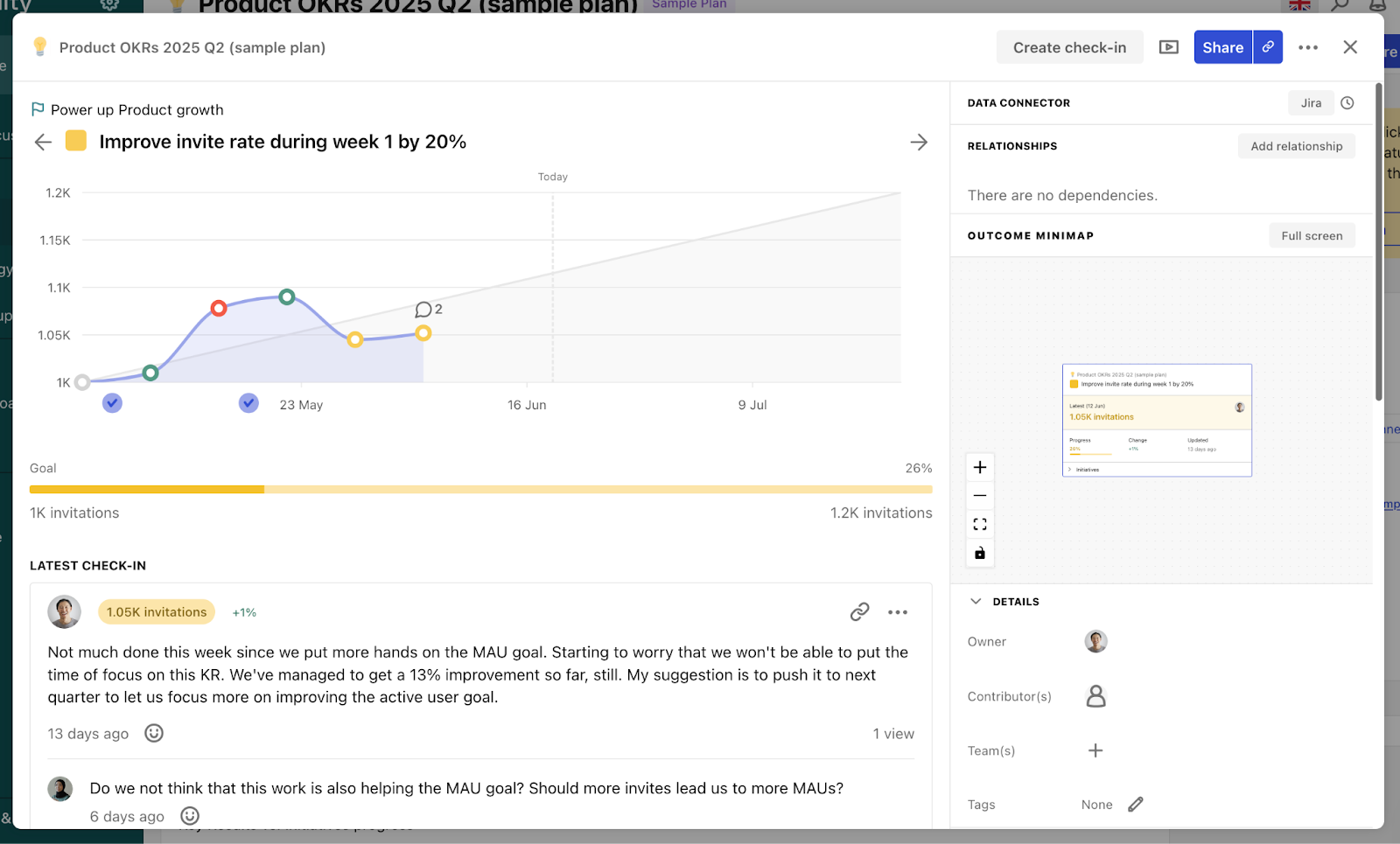
In our case we’re getting triple digits leads every week, which is more than enough to see big variations from one week to the next.
Now, we’re getting to the most important step: the weekly OKR review meeting.
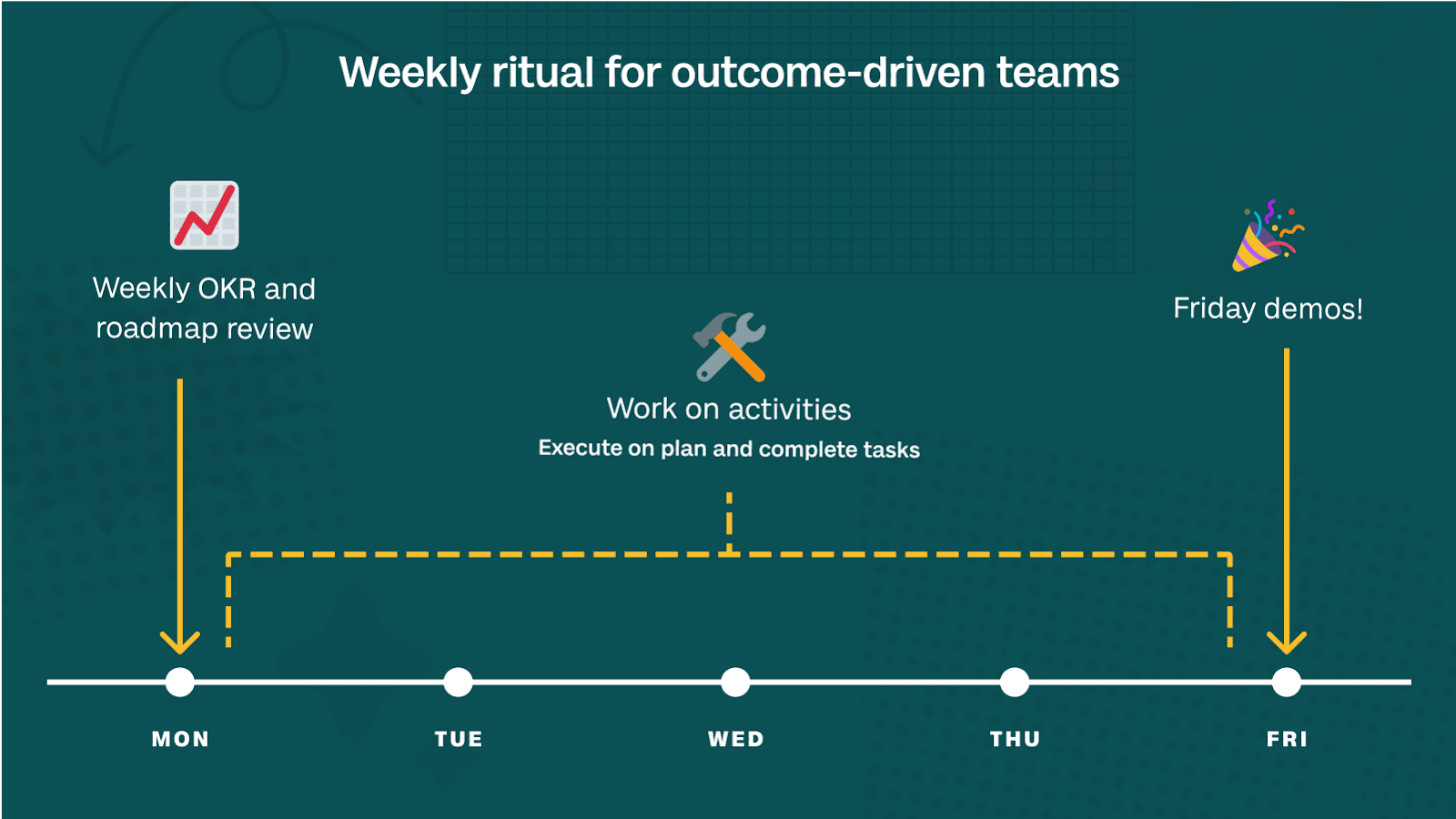
For each team that owns a set of OKRs:
- Open the calendar
- Create a 30min meeting for Monday 10am
- Invite the core team members
All OKRs need to be updated prior to the meeting. Then during the meeting, KR owners present their latest check-in. Don’t spend too much time on the items on-track, and make sure that you talk about “what’s next then?” for anything that is at-risk or off-track (but don’t get into panic mode too early, sometimes things can bounce back).
The weekly OKR review meetings are the easiest way to keep teams aligned and quickly adjust the strategy.
By week #6 you’ll notice that everyone always knows what the OKRs are, whereas a team that only meets once a month will struggle hard to give you their set of priorities.
Step 4: List possible bets (aka initiatives) to reach the opportunity
By step 4 you have:
- Clear OKRs that correlate highly with solving a valuable problem
- A process to assess progress every week
Now you can start working on the problem itself. The trick here is to change your mindset about the way you treat the work that you’ll be doing.
In a classic project management approach, your roadmap defines a set of items that need to be completed. Success = everything has been done. With OKRs, things are fairly different. You’re going to execute on a series of bets, and nothing can be guaranteed. If an initiative helps you move in the right direction then double down on it. But if it’s not showing any meaningful results you might want to consider moving to the next bet.
So, rather than establishing a complete roadmap, you should be creating a list of bets that are most likely to produce an impact. You can then use a now, next, later roadmap approach to manage the items.
Step 5: iterate on the bets until we close the gap completely
We’re not great salespeople. We’re not great marketers. We don’t have any growth specialists.
But we compensate by having an A+ process to learn fast and iterate quickly.
Every quarter we set our eyes on a specific puzzle, and we apply the same workflow:
- Identify the opportunity
- Set clear goals (OKRs) to measure success
- Use our weekly meeting to learn fast and adjust execution
- Continuously evaluate the best possible bets
- Double-down on what works, don’t hesitate to kill what doesn’t
And of course, a great OKR software at the core of this process as it makes steps (3) to (5) super easy to do.


.jpg)