

It’s the first week of the quarter.
Your company just wrapped up quarterly planning, and leadership has set the direction for the next 90 days. The strategy deck looks clean, the priorities make sense, and everyone’s feeling that “fresh quarter” energy.
Then the follow-up message lands in Slack:
“Each team needs to submit goals by Friday. We need goals that we can track weekly and roll up into our company OKRs.”
Now it’s on you.
Where do you start? Like most things these days, you probably start by asking your LLM. You go to ChatGPT or Claude and ask, “I need to write some goals for work. Where do I start?”
The good news is, your LLM is more than capable of helping you get that done.
However, it’s important to understand what that should look like so that you’re not just piecing together a bunch of AI non-sense and presenting it to your boss.
This guide shows you how to use AI tools (or any AI goal generator) to write better SMART goals faster — and then how to make sure those goals actually turn into outcomes.
What SMART goals are (and why most teams still get them wrong)
First when writing goals, it’s recommended to start with the SMART method. SMART is a goal-setting framework designed to prevent vague, feel-good goals that don’t translate into action.
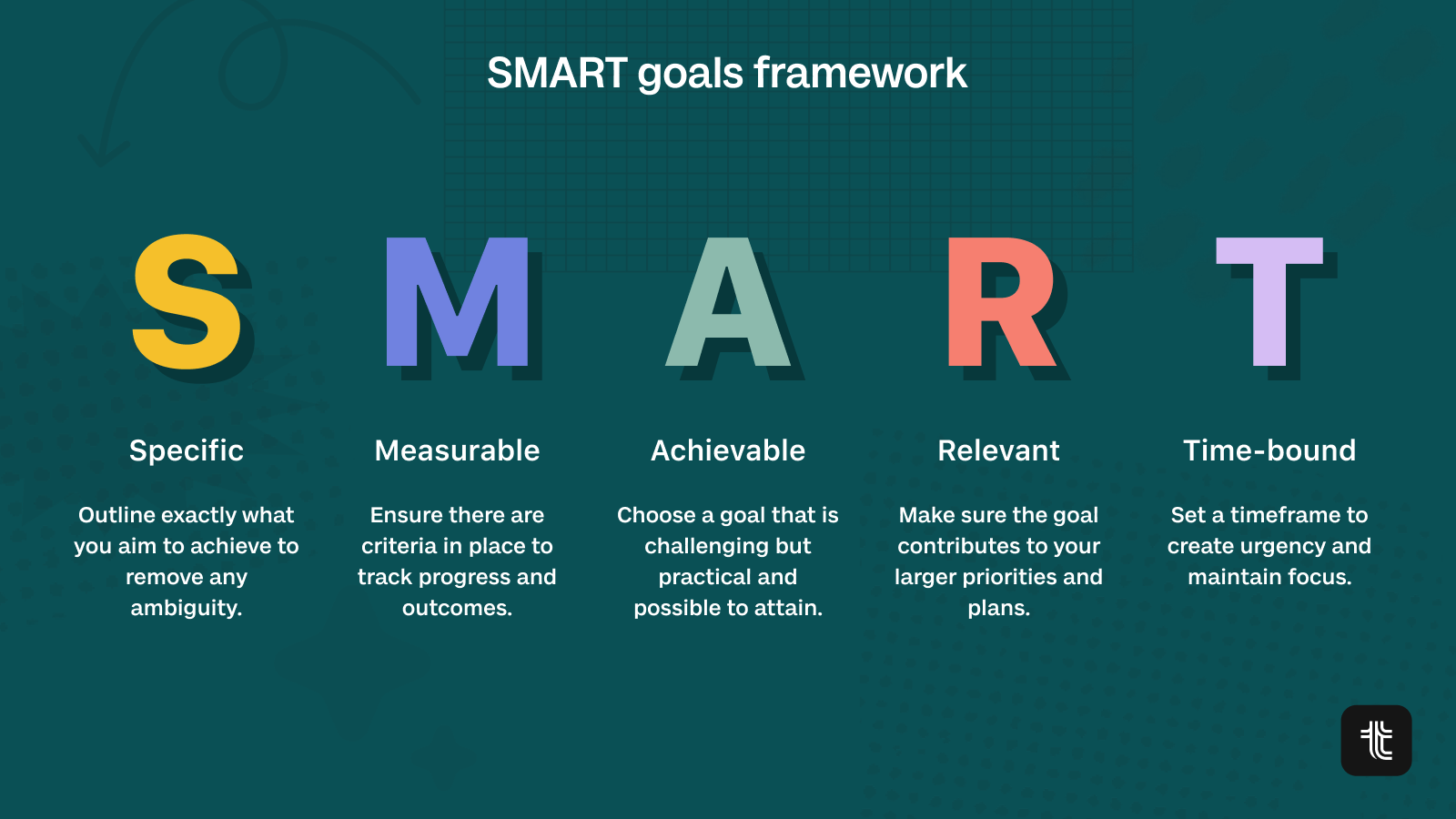
A SMART goal is:
- Specific: clearly states what you’re trying to achieve
- Measurable: has a metric you can track
- Achievable: realistic given constraints
- Relevant: connected to what matters right now
- Time-bound: includes a clear timeframe
In theory, SMART goals should be straightforward. In practice, most teams struggle because they treat SMART like a writing formula instead of a decision-making framework.
Common SMART mistakes
Here are the patterns that usually break SMART goals:
- “Measurable” without a source. The goal includes a number, but no one knows where the metric comes from or who owns it.
- “Achievable” that’s actually wishful thinking. Targets are set without baseline data or resource constraints.
- “Relevant” that’s disconnected from priorities. The goal sounds good, but it doesn’t tie back to the company’s current focus.
- “Time-bound” without a process. There’s a deadline, but no check-in rhythm or plan to review progress.
Quick example: vague vs SMART
Not SMART:
“Improve onboarding for new customers.”
SMART:
“Increase new user activation from 35% to 45% by the end of Q2 by improving onboarding completion and reducing time-to-first-value.”
The difference isn’t just better wording — it’s clarity about what success means, how you’ll measure it, and when you expect results.
ℹ️ For a step-by-step process, use our SMART goals template
Why AI helps with SMART goals (and where it doesn’t)
An AI goal generator is great at turning rough ideas into structured drafts. It’s fast, consistent, and surprisingly useful at suggesting measurable phrasing. That’s the upside.
The risk is treating the AI output as “done” instead of “draft.”
Where AI shines
AI is genuinely helpful when you want to:
- Convert vague intent into clearer wording
- Suggest measurable metrics and timeframes
- Produce consistent formatting across goals
- Generate multiple options quickly so you can choose the best one
If you’ve ever stared at a blank page thinking, “I know what we want, I just can’t phrase it,” AI is a cheat code.
Where humans still need to decide
AI can’t make business decisions for you — and this is where SMART goals usually go wrong if you rely on AI alone.
Humans still need to decide:
- Strategic direction, trade-offs, prioritisation
- Real, relevant targets for your team/business specifically
- Cross-team alignment (dependencies, shared ownership, coordination)
- Choosing the right metrics (and avoiding vanity metrics)
- Understanding the work involved (what your team actually does, capacity, constraints)
- What happens after writing the goal (AI can draft a goal, but it usually lacks tracking and process)
Put simply: AI can write a SMART goal. Your team still needs to make it true.
👋 Try free: Goal tracking software to turn your goals into outcomes
Step-by-step: how to write SMART goals using AI
If you want AI to produce strong SMART goals, your job is to provide better inputs and apply a quick validation loop.
Here’s a simple workflow you can follow every time.
Step 1: Start with a messy draft (don’t overthink it)
Begin with the raw intent. Don’t try to write it “properly.” Give AI what you’d say in a meeting.
Examples of messy drafts:
- “We need higher activation after sign-up.”
- “Support tickets are too high.”
- “We should shorten the sales cycle.”
- “Our onboarding is confusing.”
Your first use of AI isn’t to generate the final goal — it’s to clarify what you actually mean.
Prompt idea:
“Here’s what we’re trying to improve: [your messy draft]. Ask me 5 questions to clarify intent, scope, and measurement before you write the SMART goal.”
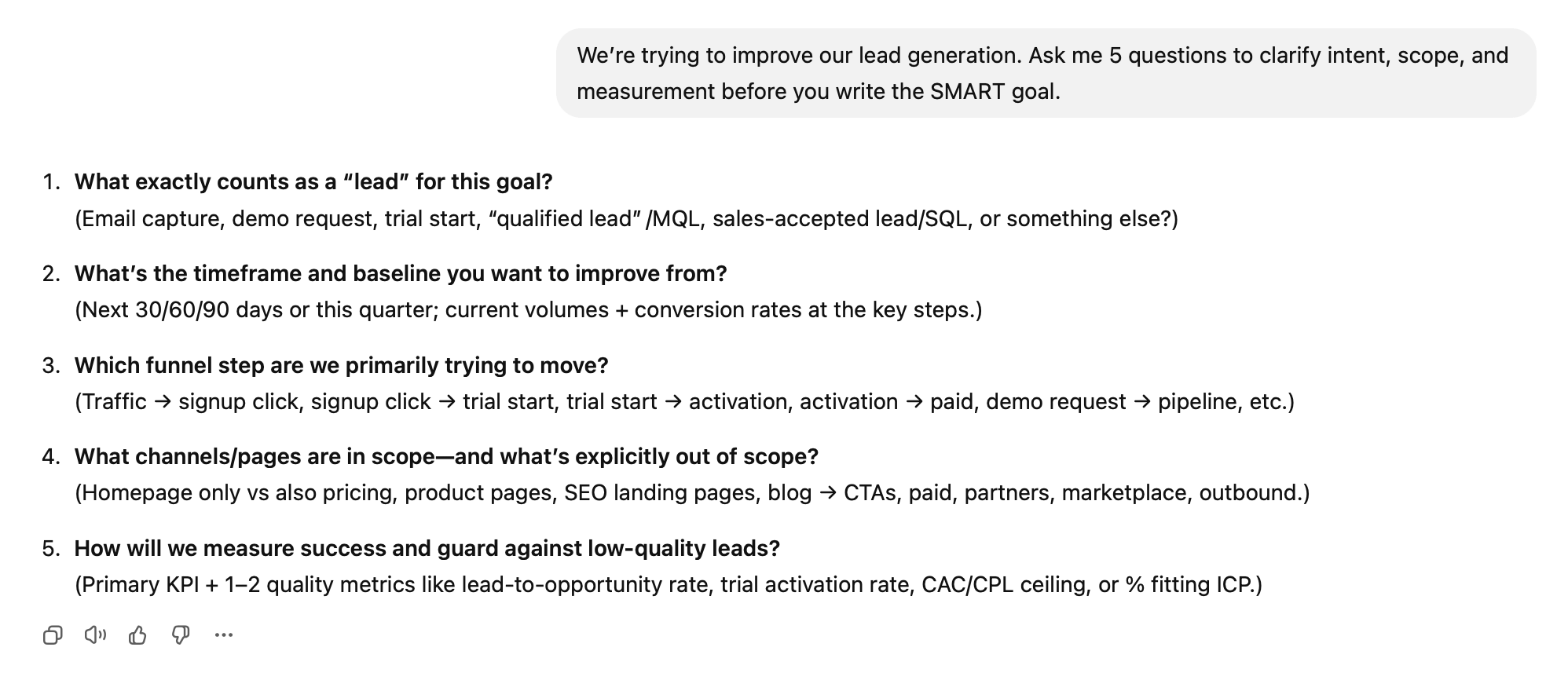
This prevents the classic failure mode where AI confidently spits out a goal that sounds right but isn’t rooted in your reality.
Step 2: Give AI the context it needs
AI outputs reflect input quality. The difference between a “meh” goal and a strong one is almost always the context you provide.
Before you generate a SMART goal, gather these inputs:
- Owner/team: who owns the outcome?
- Why it matters: what business outcome does it support?
- Include OKRs here. What objectives does this contribute to? Include both team and company level OKRs for more reference to work with and align to.
- Timeframe: what deadline or window are you targeting? This year? This quarter? This month?
- Starting point: where are you today?
- Constraints: budget, people, tech limitations, timing constraints
- Data source: where does the metric come from?
If you don’t know the baseline or metric source yet, that’s fine — just tell AI what you do know and ask it to propose options.
Tip: If you’re able to connect you LLM to an MCP server from your tools, this is a highly technical but more efficient way to gather a lot more data.
Step 3: Ask AI for 3 SMART goal options
Don’t generate one goal and hope it’s perfect. Generate three options so you can choose the best trade-off.
Ask for:
- Option A: Conservative
- Option B: Realistic
- Option C: Ambitious
Read: What are Stretch Goals?
Prompt idea:
“Using the context below, generate 3 SMART goal options (conservative, realistic, ambitious). For each option, include the SMART breakdown (S/M/A/R/T), define the metric clearly, and suggest a timeframe that matches the goal.”
Step 4: Validate the “M” (measurable) and the “A”(Achievable)
This step is where SMART goals become real.
Ask these questions:
- Can we measure this weekly? If you can’t measure progress regularly, you won’t manage it.
- Do we have access to the data? If the data isn’t available, the metric is fiction.
- Is the target plausible given our resources? “Achievable” means achievable for your team, not in a vacuum.
A great goal isn’t the most ambitious one — it’s the one that’s realistic, measurable, and aligned.
Step 5: Add a tracking plan
Most teams fail at SMART goals because they stop at writing the goal.
A SMART goal needs a simple process attached to it.
Ask AI to generate:
- Weekly check-in questions
- What “on track” vs “off track” looks like
- What you’ll do if progress stalls
Without this, SMART goals become “planning theatre” — well-written goals that no one uses.
AI prompts you can copy-paste: SMART goals AI prompt pack
Below are copy-paste prompts you can use with any SMART goals AI tool. These are designed to produce outputs you can actually use.
Prompt 1: Turn a vague idea into a SMART goal
“Turn the following goal into a SMART goal. Ask up to 5 clarifying questions first if needed, then generate 3 versions with different levels of ambition. Include the SMART breakdown and define the metric clearly.
Goal: [paste goal]
Context: [team, why it matters, timeframe, baseline, constraints, data source]”
Prompt 2: Generate SMART goals for a specific function
“Generate 5 SMART goals for a [marketing/sales/product/customer success/HR/finance] team based on the context below. For each goal, include the metric definition, a realistic target, and a suggested weekly check-in question.
Context: [paste context]”
Prompt 3: Convert OKRs into SMART goals
Many orgs use OKRs as their main goal setting and tracking framework. In this situation, SMART goals are synonymous with your KR or “Key Result”.
Objective: [paste]
Key Results: [paste]
Timeframe: [paste]
Constraints: [paste]”
Prompt 4: Improve an existing SMART goal
“Improve this SMART goal by making it more specific and measurable. Define the metric clearly, identify any missing baseline, and suggest a more realistic target if needed.
Current SMART goal: [paste]
Context: [paste]”
Prompt 5: Create leading indicators + weekly check-ins
“Given this SMART goal, suggest 3–5 leading indicators we can track weekly, and write weekly check-in questions for the owner. Also suggest what ‘on track’ looks like by week.
SMART goal: [paste]
Context: [baseline, timeframe, team capacity, data source]”
How to choose the right metrics (so AI doesn’t generate fluff)
AI can suggest metrics — but it can’t guarantee they’re the right metrics for your business.
This is where a lot of AI-generated SMART goals fall apart: they sound measurable, but they’re not meaningful.
Leading vs lagging indicators
- Lagging indicators confirm outcomes after they happen (revenue, churn, retention).
- Leading indicators predict outcomes and can be influenced weekly (activation steps completed, time-to-first-value, pipeline created, demo-to-trial conversion).
📖Read more: How to juggle leading vs lagging indicators
AI often defaults to lagging indicators because they’re obvious. Your job is to add leading indicators so progress is trackable before it’s too late to change course.
A good SMART goal usually has:
- One “north star” outcome metric, and
- A small set of leading indicators you review weekly
Avoid vanity metrics
Vanity metrics are numbers that go up but don’t clearly connect to outcomes.
Examples:
- “Increase website traffic”
- “Grow followers”
- “Improve engagement”
- “Get more impressions”
These can matter, but only when they connect to the next step in the funnel or a real business outcome.
If you can’t answer “so what?” in one sentence, it’s probably vanity.
Make metrics auditable
A SMART goal should be measurable by more than one person.
Before you lock in a metric, make sure you can answer:
- What’s the exact definition (and formula)?
- Where does the data come from?
- Who owns reporting it?
- How often will we review it?
If the measurement isn’t auditable, it’s not measurable — it’s negotiable.
Turn AI SMART goals into actionable outcomes with Tability
At this point, you can see the gap.
AI makes writing SMART goals easier. But everything around it — alignment, formatting, targets, tracking, check-ins, reporting — is still manual if you’re doing it with docs, spreadsheets, and copy-paste prompts.
That’s exactly where Tability changes the game.
Tability includes an AI SMART goal generator, but it goes beyond generating sentences. It gives you the structure and workflow you need so those goals actually turn into outcomes.
Generate AI SMART goals that are actually usable
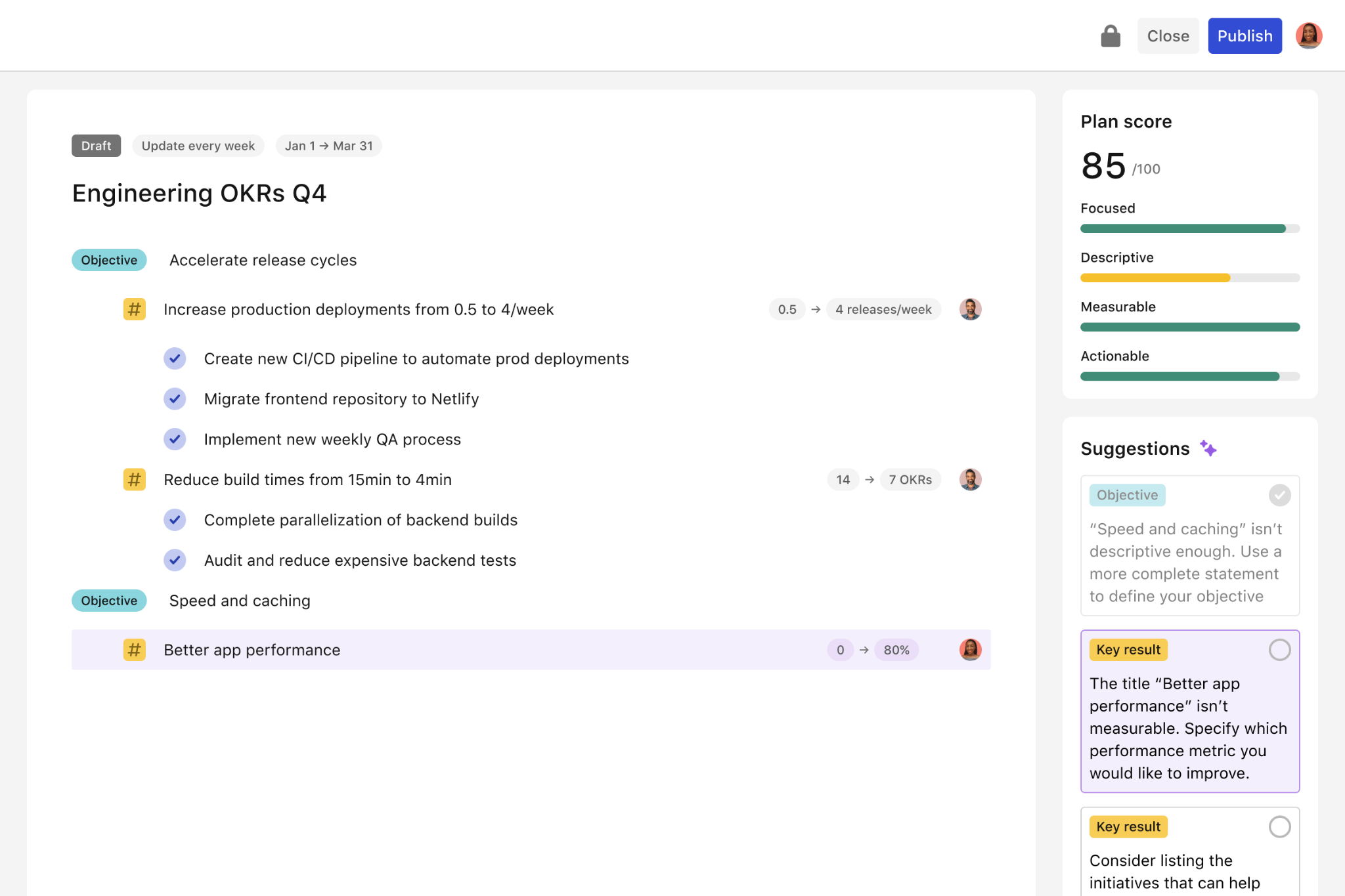
Instead of just producing goal text, Tability helps you create SMART goals that are:
- Properly formatted and consistent across teams
- Built with guidance and suggestions (so you’re not guessing targets)
- Supported by benchmarks and best-practice framing, so your goals aren’t pulled out of thin air
The output isn’t “a nice draft.” It’s a goal you can run your week around.
Make sure goals fit into a real system
SMART goals don’t exist in isolation. They need context.
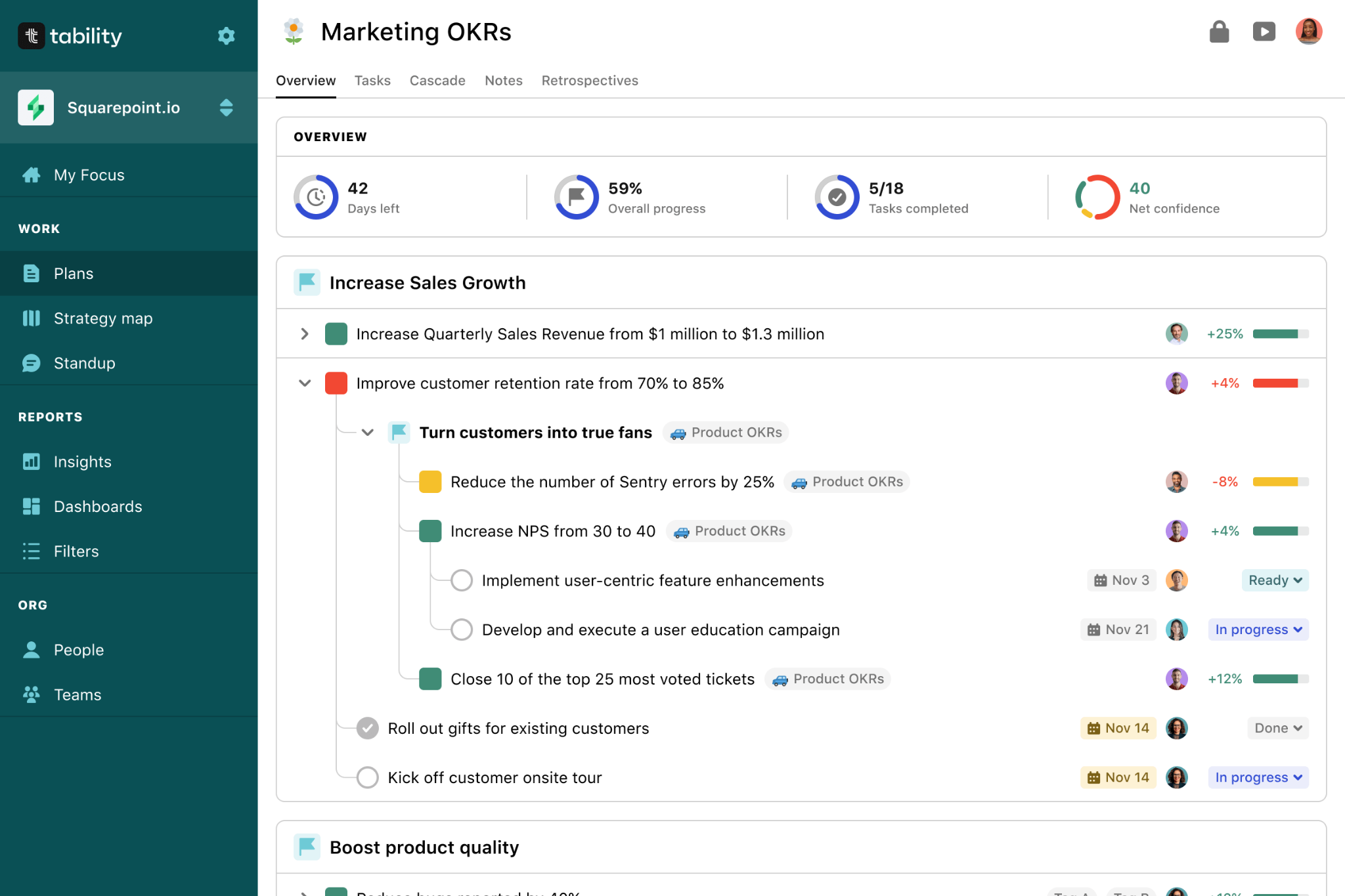
Tability helps with the part most teams struggle with: Where do these goals fit?
With Tability, you can align SMART goals with the rest of your OKRs, so teams understand:
- What the goal supports,
- How it connects to bigger priorities,
- And what other teams it depends on.
That alignment piece is what turns “a good goal” into “a goal that actually gets done.”
Everything after goal-writing is already handled
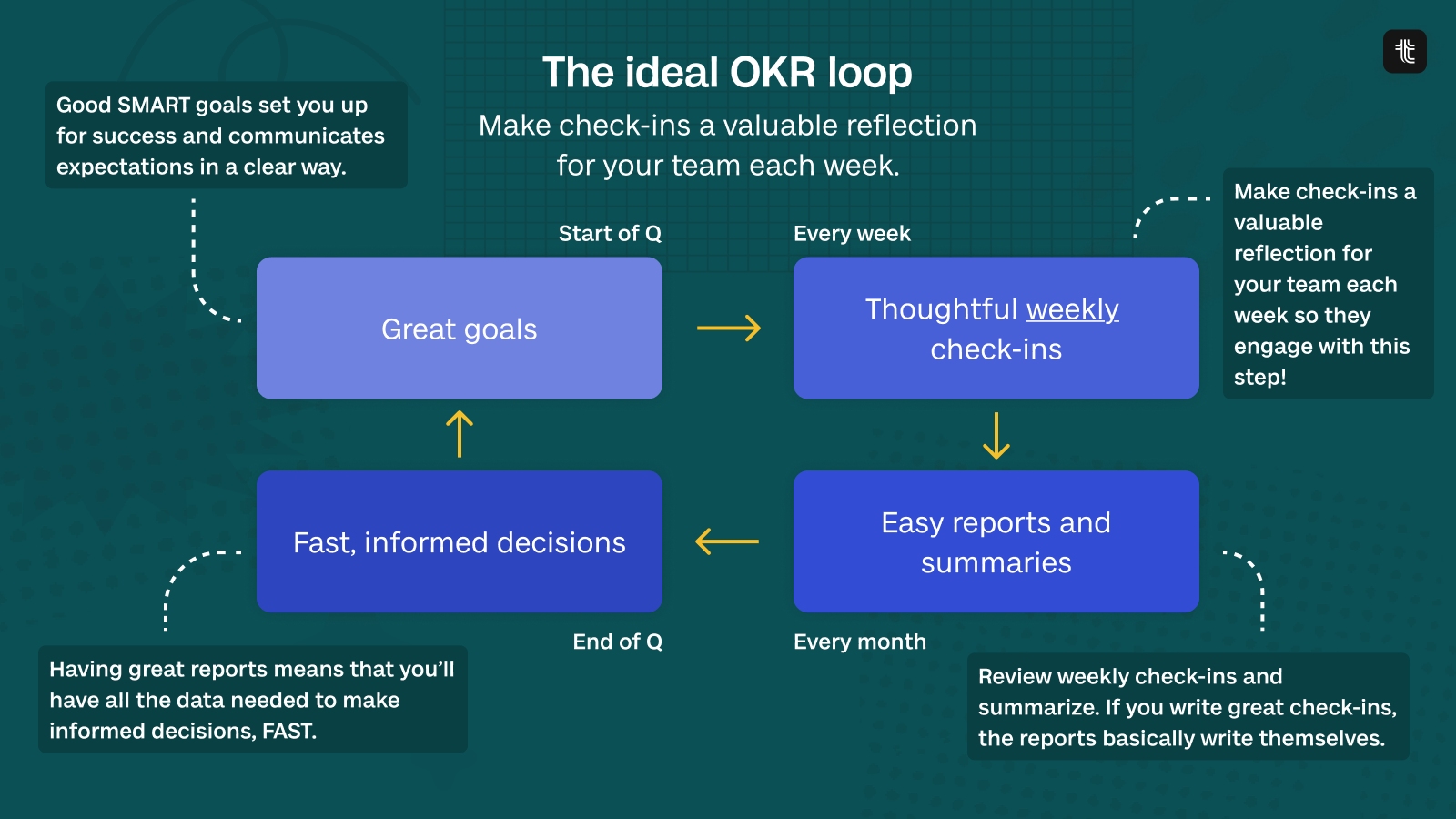
Even great goals fail without follow-through.
Tability has the tracking workflow built in:
- Weekly check-ins that keep goals alive
- Reporting that doesn’t require chasing updates
- Retrospectives that create a history of progress, learnings, and outcomes
- A complete process you can repeat every cycle, without rebuilding the system each time
This is the difference between writing goals and running a goal system.
Productive AI, beyond just generating ideas
The real advantage is that AI doesn’t stop after the goal is written.
Tability’s AI capabilities support the full goals journey — from drafting, to alignment, to ongoing tracking — so you can turn ideas into real results and outcomes without manual overhead.
With Tability’s OKR Agent, Tabby AI, you can automate check-ins entirely.
- Connect your data source to your goals
- Set a frequency of how often you want automated updates
- See check-ins written automatically week-after-week and see progress over time
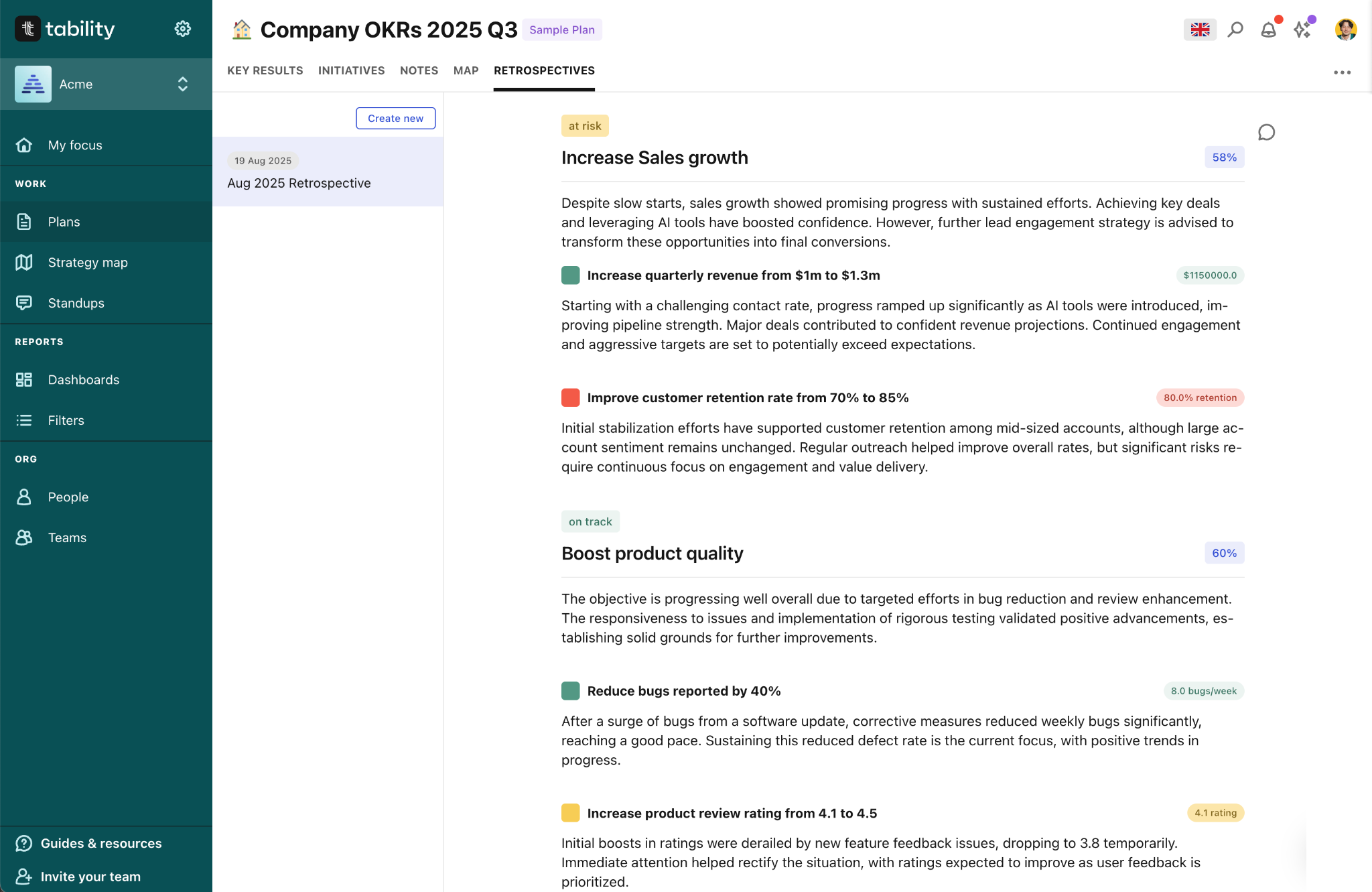
Beyond having your own personal OKR agent to help drive processes, Tability also offers automated reporting in AI retrospectives.
With the click of a button, generate a full retrospective report on your OKRs; pulling the latest check-in data, creating summaries, and even suggesting next actions.
Conclusion: AI is great for SMART goals — use it, then simplify the workflow
AI is an excellent way to write SMART goals faster. It helps you turn vague ideas into clearer, measurable drafts and explore better options in minutes.
But the real challenge isn’t writing the goal — it’s everything after: Alignment, tracking, check-ins, reporting, and follow-through.
Use AI to draft your SMART goals, then use Tability to make the entire workflow simple end-to-end — so your goals don’t just sound good.

.jpg)

.png)