.jpg)
OKRs and KPIs are both measurement tools, but they're built to do completely different jobs. A KPI (Key Performance Indicator) monitors the ongoing health of your business: it tells you if things are working. An OKR (Objective and Key Result) drives change: it sets a specific, ambitious outcome you want to hit in the next 90 days. Most high-performing teams run both, and mixing them up is one of the more common goal-setting mistakes we see.
Let's break each one down properly, starting with the one most teams already sort of understand.
What a KPI is actually measuring
A KPI is an acronym that stands for Key Performance Indicator. It is a metric that helps evaluate the success of an org, team, or project for a particular activity. There's an unlimited amount of KPIs available, and they will highly depend on the context in which they are used.

KPIs should be limited by definition. You need to focus on the 5-10 key metrics that best represent success for the activity that is monitored. KPIs do not have targets, but there should be thresholds that trigger alerts. For instance, a sudden drop in the volume of leads should probably trigger a meeting to address that issue, and redirect resources if needed.
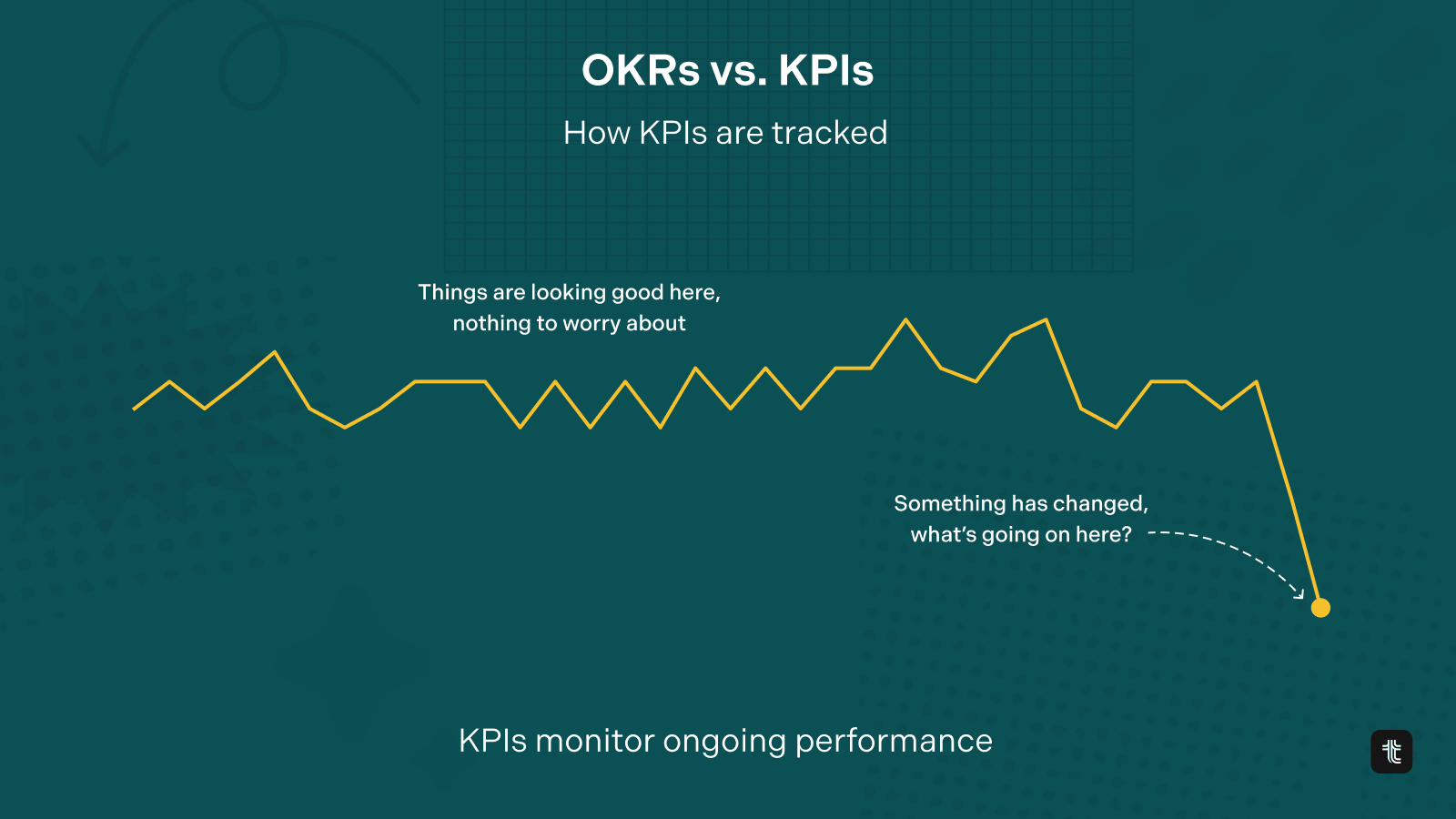
KPIs do not have a target associated, but if they do, they'll often be referred to as success metrics: the combination of a KPI plus the target that defines success.
KPI examples, by team
Most companies will have a set of KPIs at the top that reflects their growth funnel. Here are some classic examples of KPIs in business.
- Revenue
- Number of leads
- Number of customers
- Churn
- Burn
But, you can also be more specific at a team or project level. For instance, a team in charge of application performance might have the following set of KPIs:
- Page load time
- Apdex
- Memory Load
- Cost per transaction
For a complete list of KPIs, you can check our list of 100+ KPI and success metrics examples and you'll find a selection of KPIs below.
Sales KPI examples
- Monthly Recurring Revenue (MRR) - Measures monthly sales from ongoing subscriptions
- Sales Qualified Leads (SQLs) - Tracks number of sales ready leads passed to sales team
- Sales Cycle Length - Calculates average time from initial contact to closed deal
- Win Rate - Percentage of quoted deals that are won
- Customer Acquisition Cost - Costs involved per new customer obtained
Marketing KPI examples
- Site Traffic - Volume of visitors to company site over time
- Bounce Rate - Percentage leaving site after only viewing one page
- Email Open Rate - Percentage of emails sent that are opened by recipients
- Cost Per Lead - Marketing spend required to generate a sales lead
- Social Media Engagement - Likes, clicks, shares, comments on social posts
Customer Support KPI examples
- First Contact Resolution - Percentage of inquiries resolved in first interaction
- Customer Satisfaction Score (CSAT) - Survey feedback rating from customers
- Wait Time - Average time customer waits to have inquiry addressed
- Calls Handled per Agent - Daily average calls per service team member
- Escalations - Percentage of issues needing management involvement
Product KPI examples
- Active Users - Number of customers actively using product in set time period
- Churn Rate - Percentage of customers ending subscriptions in time frame
- Adoption Rate - Speed at which new features are used after launches
- Uptime - Percentage of time platform is accessible without downtime
- Defect Density - Bugs discovered divided by lines of code
Finance KPIs
- Cash Flow - Net cash generated from business operations
- Burn Rate - Speed at which available cash is spent per month
- Operating Costs - Overhead costs involved in running operations
- Gross Margin - Profitability after accounting for production costs
- Working Capital - Cash available to fund business expenses
How to tell if something's actually a KPI
KPIs are created by starting with a project, team or business, and then levelling up to identify metrics that are best correlated to performance. A simple test for whether or not a KPI is effective is to ask yourself this question:
Would we change what we're doing if <metric> goes down?
If the answer is no, then you are probably not looking at a critical metric for that system. But if the answer is a resounding "yes", then you're most certainly looking at a KPI.
KPIs should also stay fairly stable over time, and it's quite common to keep the same KPIs around for years.
What an OKR is actually driving
OKRs is an acronym that stands for Objectives and Key Results. It is a complete goal-setting framework that helps organizations set clear goals to achieve annually or quarterly. OKR history traces back to its introduction in the 70s at Intel by Andy Grove, and then it got popular after Google adopted it to drive their effort.
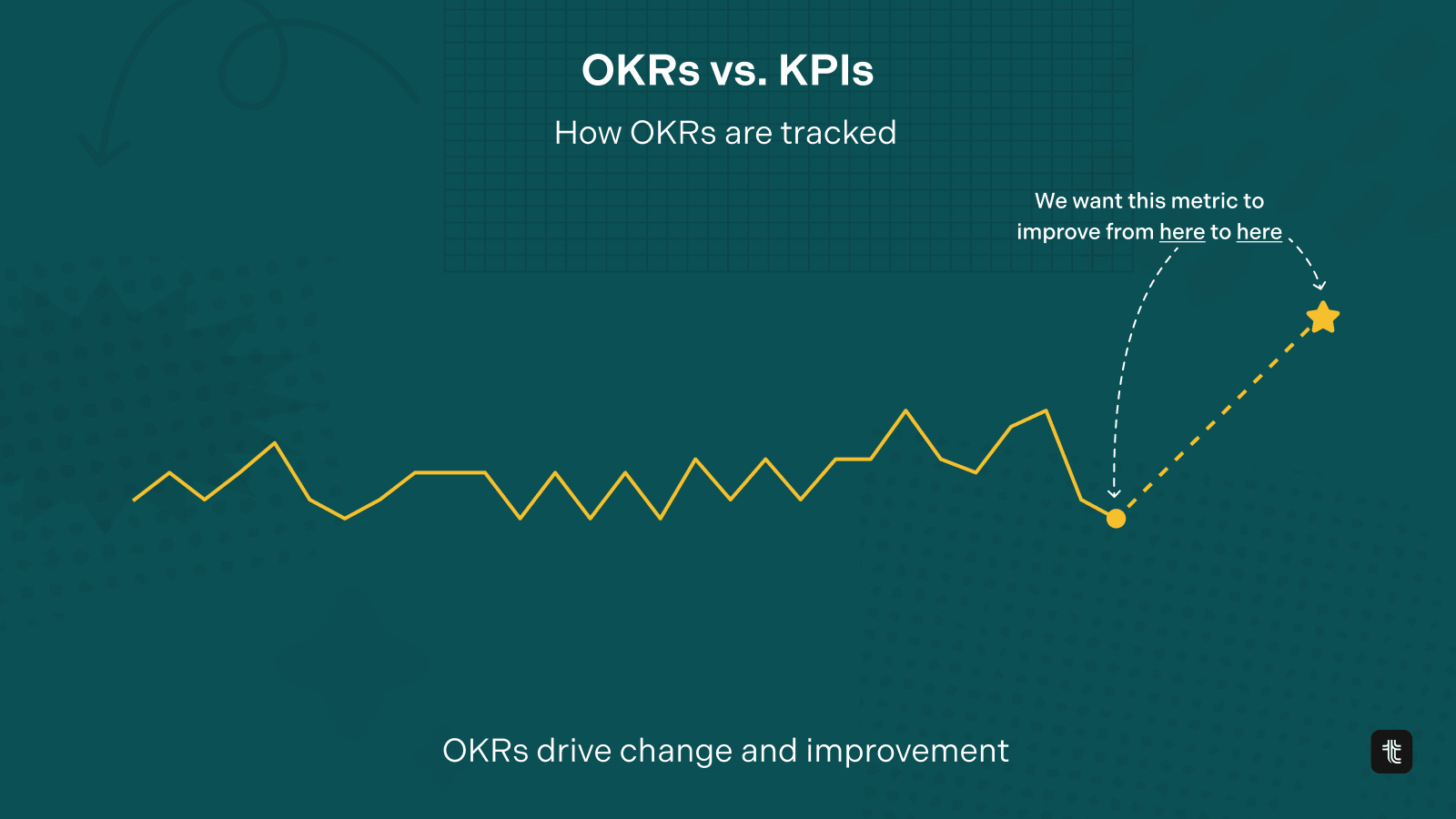
What used to be a goal-setting framework for Enterprise is now being used by teams of all sizes. It has become the go-to goal-setting framework and a way to align corporate level strategy with team execution.
OKRs are divided into 2 components:
- Objectives: they're qualitative statements that describe what we want to change by the end of the quarter.
- Key Results: they're quantitative statements that define how success will be measured for the Objectives.

OKRs can be seen as a quarterly North Star that defines a specific set of outcomes to achieve. They will change from one quarter to another, but they have a huge impact on the roadmap during the quarter.
OKR examples, by team
OKRs can be applied to any kind of theme that a team wants to focus on. They may use the same metrics as your KPIs, but they provide context around it. Below is an example that illustrates the different approach you take when writing a set of KPIs vs writing a complete OKR for the same business domain.Here's an example of OKRs for SEO
- Objective: Become the #1 online resource for the problem we solve
- Key Result 1: Secure 45 high-quality backlinks from industry influencers and publications
- Key Result 2: Get 30% more organic visits to our online resources
- Key Result 3: We rank in the top 5 results for 60% of our targeted keywords in Google
Here's an example of OKRs for Content Marketing
- Objective: Content is a significant driver for growth
- Key Result 1: 20 partners have joined our content partner program
- Key Result 2: Increase traffic to our blog to 3k visits/week
- Key Result 3: Increase content-to-lead conversion to 9%
Some more examples are listed below.
Sales OKR example
Objective: Expand enterprise customer success
Key Results:
- Onboard 5 new Fortune 500 logos
- Achieve 130% booked revenue renewal rate
- Maintain 98% customer retention rate
Marketing OKR example
Objective: Make the website a genuine demand engine, not just a brochure
Key Results:
- Grow qualified trial signups from organic search by 35%
- Cut cost per lead by 20% across paid channels
- Launch 3 comparison pages for our highest-intent keywords
Product OKR example
Objective: Launch self-service user analytics
Key Results:
- Ship beta analytics dashboard by mid-quarter
- Document analytics methodology and best practices
- Gain user adoption with 50% MAU
Customer Support OKR example
Objective: Make support fast enough that customers stop escalating to sales
Key Results:
- Cut first response time to under 2 hours
- Resolve 80% of tickets without escalation
- Lift CSAT from 4.1 to 4.6
Finance OKR example
Objective: Manage cash flow for growth goals
Key Results:
- Extend runway by raising $10M in capital
- Keep burn rate under $3M per quarter
- Reduce days sales outstanding below 30 days
Check out our list of OKR examples by function to learn more.
How to write your first OKR
OKRs start with a vision. You often start by deciding on specific themes that you want to address. A simple approach is to look at the AARRR funnel, and pick one or two parts of the funnel that you want to improve.
Once you have a general idea of your desired outcomes (customer retention, leads conversion, attack a new market...), you can turn them into an inspiring Objective and list the associated Key Results. For a more structured rollout across a whole team, our OKR implementation best practices guide covers the sequencing in more depth.
You'll repeat that process at the end of every quarter to start a new OKRs cycle.
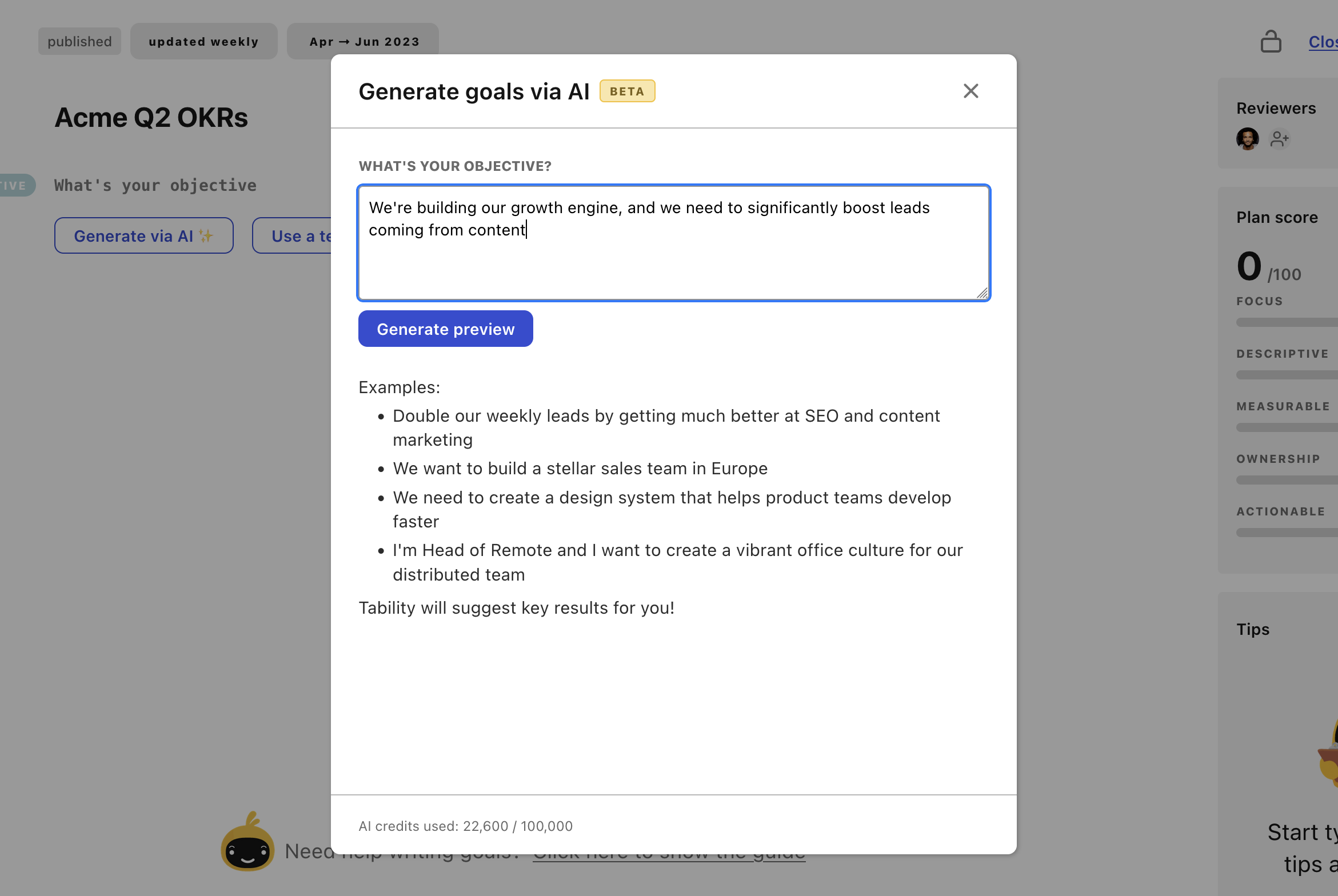
If you want to go faster, you can also leverage a goal-setting AI to get a draft of your OKRs in seconds.
Where OKRs and KPIs actually pull apart
KPIs are mainly a monitoring tool: they help you understand the current state of the business and get referred to during planning sessions to identify areas of improvement. Teams generally use a spreadsheet to track them, since the job is really just watching the evolution of a number over time.

OKRs work differently. They don't just get referred to, they drive the roadmap. They're the North Star that aligns and guides everyone for a set number of months, and because of that they're far more collaborative: there should be a weekly discussion on progress, which is why it's worth using a proper OKR-tracking solution rather than a spreadsheet nobody opens between planning sessions.

Put plainly:
- KPIs are a simple set of metrics, OKRs have both a descriptive and measurable aspect.
- KPIs are mainly a reporting activity, OKRs include feedback and conversations around goals.
- KPIs can stay the same for years, OKRs change every quarter.
- KPIs monitor the performance of existing activities, OKRs drive efforts to set new performance baselines.
- OKRs have a continuous impact on the roadmap, KPIs only alter it if there's a drop in performance.
The core meaning of OKRs is alignment, while the core meaning of KPIs is monitoring.
Can OKRs replace KPIs?
Yes, you can absolutely use OKRs and KPIs together as they have different roles. Your KPIs should be used to monitor the ongoing stability of your business, and trigger alerts whenever you see an unexpected dip in performance.
OKRs should not replace KPIs. Think of KPIs as the dashboard of your car: always on, always monitoring. OKRs are the destination you've set in the sat-nav this quarter. You need both, and here's why: your KPIs will tell you if something breaks; your OKRs tell you where you're going.
Your OKRs will align teams toward a specific set of outcomes, which will generally result in improving a certain number of KPIs.
OKR vs KPI: quick answers
What are the 5 elements of an OKR?
An OKR has five working parts, and most teams that struggle with them are usually missing one:
- The objective. A single, qualitative statement of what you want to achieve. Ambitious, not a to-do list item.
- Key results. Two to five measurable outcomes that tell you whether the objective actually happened. Numbers, not activities.
- Initiatives. The actual work: the projects and tasks your team runs to move the key results. This is where OKRs connect to the day-to-day.
- Confidence scoring. A running read on whether you'll hit each key result, usually a red/yellow/green or 0-10 scale, updated at each check-in.
- The check-in cadence. Weekly or fortnightly reviews where you update confidence, flag blockers and decide whether to adjust course.
Drop any one of these and OKRs tend to collapse into either a wish list (no key results) or a task tracker (no objective). All five need to be there.
Are OKRs still relevant?
Yes, though it's a fair question given how many teams have tried and abandoned them. The framework isn't the problem. Bad implementation is: OKRs set once a quarter and never looked at again, objectives that are really just KPIs in disguise, or key results tied to bonuses (which quietly encourages sandbagging).
Where OKRs are still doing real work: giving a team a small number of things to say no to everything else for, and forcing a conversation about what "done" actually looks like before the work starts. Neither of those needs goes away just because a framework's been around a while. What's changed is how much manual admin OKRs used to require to run properly, week to week, which is a big part of why they got a reputation for fizzling out.
What are the top 3 KPIs to track?
There's no universal top 3, it genuinely depends on the team, but if you're picking a starting set for any function, aim for one from each of these buckets:
- An output or revenue metric. What's actually being produced or earned (MRR, units shipped, deals closed).
- An efficiency metric. What it costs you to get that output (CAC, cost per ticket, cycle time).
- A quality or retention metric. Whether the output is actually good (churn rate, CSAT, defect rate).
Three KPIs that only cover output and ignore efficiency or quality will tell you you're winning right up until you're not.
Using KPIs and OKRs together
None of this is really about picking a winner. KPIs and OKRs are built for different jobs, and most teams that give up on one or the other are usually just using it for a job it was never meant to do: a KPI to drive a specific change, or an OKR to babysit a number that should just sit on a dashboard. Run them together and you get the full picture: what's happening right now, and where you're actually trying to get to next quarter.
If you're rolling out OKRs for the first time, or trying to get a team to actually keep up with the check-ins, tools like Tability handle the weekly nudging so it doesn't fall on one person to chase updates. Worth a look, Tability or not.


.jpg)

.png)