
Most teams searching for a goal-setting framework eventually come across two names: OKRs (Objectives and Key Results) and V2MOM. OKRs get the press. V2MOM gets the Salesforce logo next to it.
If you’ve heard of V2MOM and aren’t sure whether it’s the right fit for your organisation, this guide covers everything you need to know: what it is, how Salesforce actually uses it, where it falls short, and how it compares to OKRs. By the end you’ll have a clear picture of which framework makes more sense for where your team is right now.
If you want to see the origins of this framework, see how Salesforce uses V2MOM for their strategic alignment.
V2MOM overview
V2MOM is a goal-setting and alignment framework created by Marc Benioff, CEO of Salesforce, in 1999. According to Benioff, he wrote the first V2MOM the night before Salesforce’s official founding to get the founding team aligned before they started building.
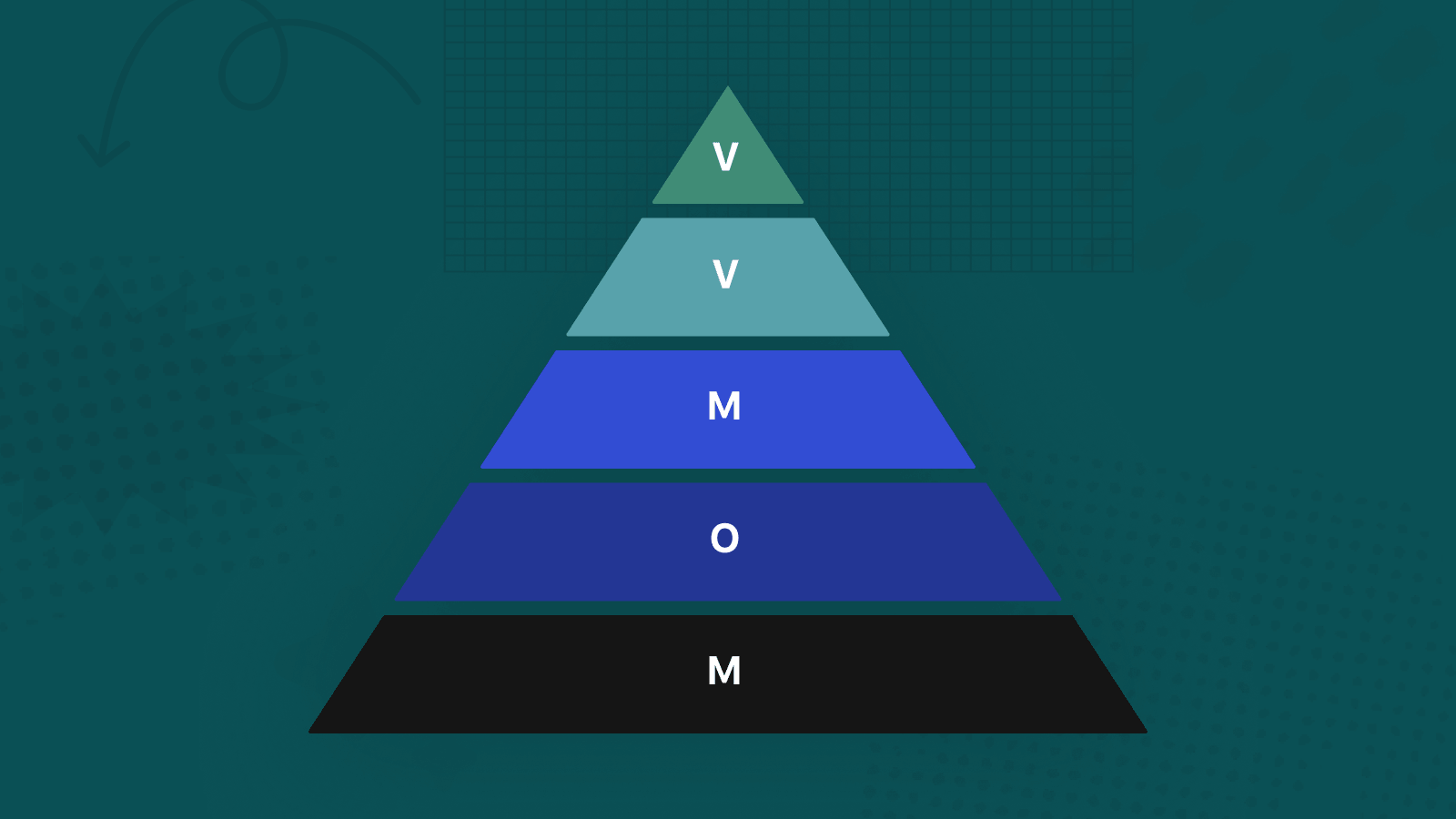
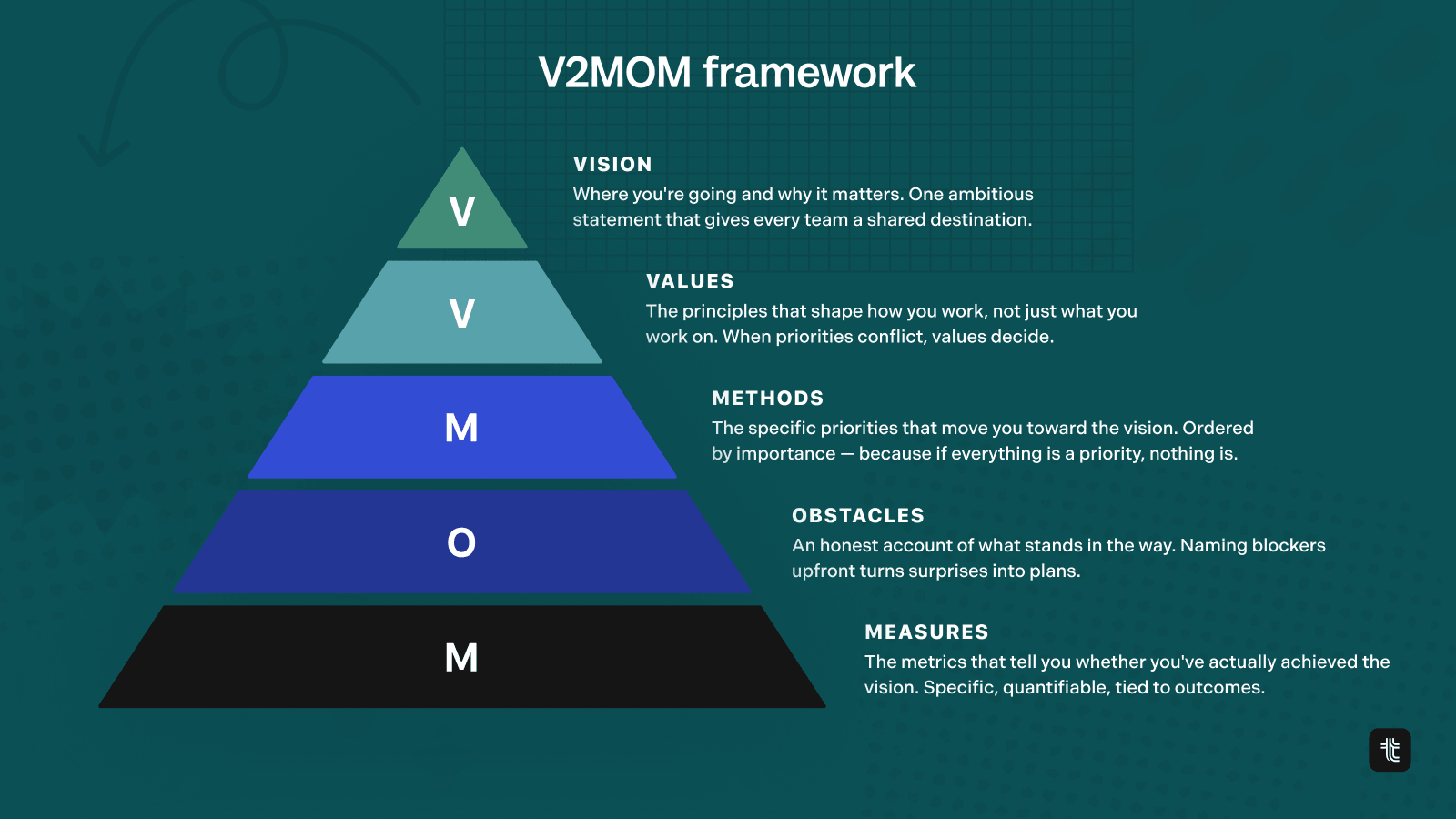
The name is an acronym for five components:
- Vision: Where you’re going and why it matters
- Values: The principles that guide how you’ll get there
- Methods: The specific actions and priorities required to achieve the vision
- Obstacles: The challenges and constraints standing in the way
- Measures: How you’ll know when you’ve succeeded
The framework has been used at Salesforce annually ever since. Benioff publishes it openly on Salesforce’s Trailhead learning platform, which is a big part of why it spread beyond Salesforce into the broader startup and enterprise world.
The five components of V2MOM, unpacked
Let’s be concrete about what each component actually means in practice.
Vision is a one-sentence statement of where the company or team is headed. It should be ambitious and specific. Not ‘improve our product’ but ‘be the world’s most trusted CRM platform.’ It answers: what are we building, and why does it matter?
ℹ️ What's the difference between vision and mission?
Values are the non-negotiable behaviours and beliefs that define how you operate. At Salesforce, these include trust, customer success, innovation, and equality. Values in V2MOM aren’t aspirational corporate language. They’re meant to be decision-making filters: if two methods conflict, your values tell you which one wins. If you haven’t defined yours yet, these company core values examples are a useful starting point.
Methods are your priorities. What specific initiatives and projects will move you from where you are to the vision? This is the ‘how.’ Most V2MOMs include three to five methods, ordered by priority. The ordering matters: it forces a conversation about what’s actually most important.
Obstacles are the honest acknowledgment of what’s in the way. This is V2MOM’s most distinctive component. Most planning frameworks skip this entirely. Naming obstacles upfront forces teams to think about risk and resource constraints before they become surprises mid-quarter. A quick SWOT analysis is one of the best ways to surface obstacles before writing this section: Weaknesses and Threats map directly to what V2MOM asks you to name. For external environmental factors, a PEST analysis can also help identify macro-level blockers your team might otherwise overlook.
Measures are the success metrics. How will you know the vision has been achieved? These should be specific and quantifiable. If your measures are vague, your V2MOM is essentially a mission statement with extra steps.
How Salesforce uses V2MOM
At Salesforce, V2MOM operates at every level of the organisation. The executive team creates a company-wide V2MOM, then each division, team, and individual creates their own that cascades from it.
The process runs on an annual cycle, timed to the fiscal year. Critically, each V2MOM is shared openly across the organisation. This transparency is part of what makes it work: when everyone can see the company V2MOM, individual teams can write their own methods and measures in a way that deliberately connects to the top-level vision.
It’s worth noting: Salesforce is a $35 billion organisation. The fact that V2MOM has scaled with them is a genuine endorsement of its utility for large, complex organisations where strategic alignment across hundreds of teams is the core challenge.
V2MOM vs OKRs: the key differences
This is where most teams get stuck, and it’s the question worth spending time on.
Both frameworks are tools for setting goals and creating alignment. Both work at multiple levels of an organisation. But they’re built on different assumptions about how organisations operate. If you need a primer on what OKRs actually are before diving into the comparison, that’s a good place to start.
A few differences worth highlighting:
Cadence. OKRs are typically set quarterly, creating a rhythm of short cycles, frequent check-ins, and regular adjustments. V2MOM runs annually. Annual planning suits long-range strategic work, but it can feel slow when priorities shift mid-year.
Obstacles. OKRs don’t formally capture obstacles. V2MOM does. This is a genuine differentiator for teams operating in complex or high-risk environments where naming blockers early is valuable.
Check-in structure. OKR frameworks typically include a weekly or bi-weekly check-in cadence to track progress in real time. V2MOM doesn’t prescribe a check-in process. In practice, this means many teams write a V2MOM in January and revisit it in December.
Where V2MOM falls short
To be frank: V2MOM has structural weaknesses that matter for most modern teams.
The biggest is the absence of a tracking cadence. A V2MOM tells you what you’re trying to achieve and how you’ll measure it, but it doesn’t tell you how often to check in, who reviews progress, or what happens when you’re off track. Planning without a feedback loop is just wishful thinking with good formatting.
The annual cycle also creates rigidity. Strategy changes. Markets shift. A framework built for annual planning can struggle to accommodate the pivots and reprioritisations that most growth-stage companies need to make.
The Measures component, while present, isn’t as rigorously structured as OKR key results. V2MOM measures often end up as directional statements rather than specific, trackable numbers. ‘Increase customer satisfaction’ is a measure. ‘Increase NPS from 42 to 55 by 30 June’ is a key result.
When OKRs might be a better fit
If your team needs any of the following, OKRs are likely the better framework:
- Shorter planning cycles with regular course-corrections (quarterly is the standard)
- Clear, measurable outcomes tracked in real time, not just at year-end
- A structured check-in cadence that connects weekly work to quarterly goals
- Visibility into progress (not just priorities) across the organisation
OKRs aren’t perfect either. They require discipline, clear ownership, and a genuine commitment to outcome-based thinking rather than output-based activity. But for teams that want a living goal system rather than an annual planning artefact, OKRs provide the accountability structure that V2MOM doesn’t.
V2MOM remains a strong choice for culture-forward organisations, large enterprises on long strategic cycles, and any team where naming obstacles upfront is a cultural priority. It’s also worth noting: you don’t have to choose. Some teams run a V2MOM annually for long-range direction and use OKRs quarterly to manage execution.
How to track your goals, whichever framework you choose
Whether you go with V2MOM, OKRs, or a combination of both, the same problem eventually surfaces: the plan lives in a document, and day-to-day work happens everywhere else.
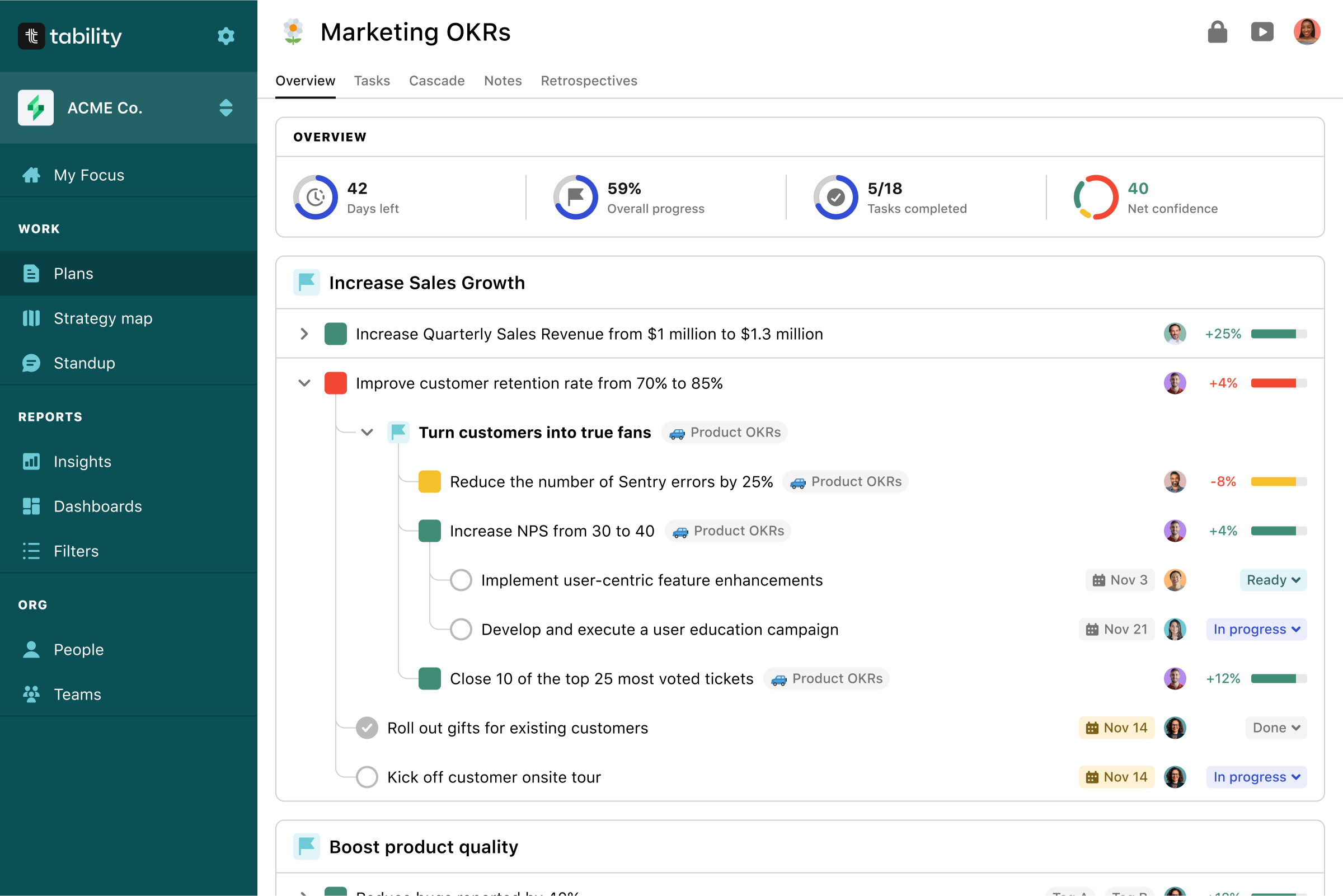
Tability is built to close that gap. It gives strategy and ops teams a single place to track outcomes, run check-ins, connect initiatives to goals, and report on progress without the overhead of a spreadsheet or an enterprise platform.
If you’re running OKRs or considering making the shift from V2MOM, start free at tability.io or book 30 minutes with us and we’ll help you figure out what the setup looks like for your team.


.jpg)