.png)
“It takes me about a week to find churn risks.”
This is what I told Sten a while ago. I wasn’t exaggerating, either– we’re a small team, so most of my time is spent talking to customers or giving demos or responding to support questions or creating new onboarding materials or any of the other 100 things we do at startups. And as important as finding churn risks and doing intervention is (it’s cheaper to keep a customer than to get a new one, afterall), it took time– time I didn’t always have.
My gut instinct was to ask for the tens of thousands of dollars a year (and who knows how many hours of engineering time) that I would need to purchase and implement anti-churn software. We’d get all of the bells and whistles (automated entry to drip campaigns, pretty charts and graphs), but really, all I needed was just a list of customers I should go talk to. And as we discussed what I needed, we thought there could be a better way.
Enter Tattle, our AI churn agent.
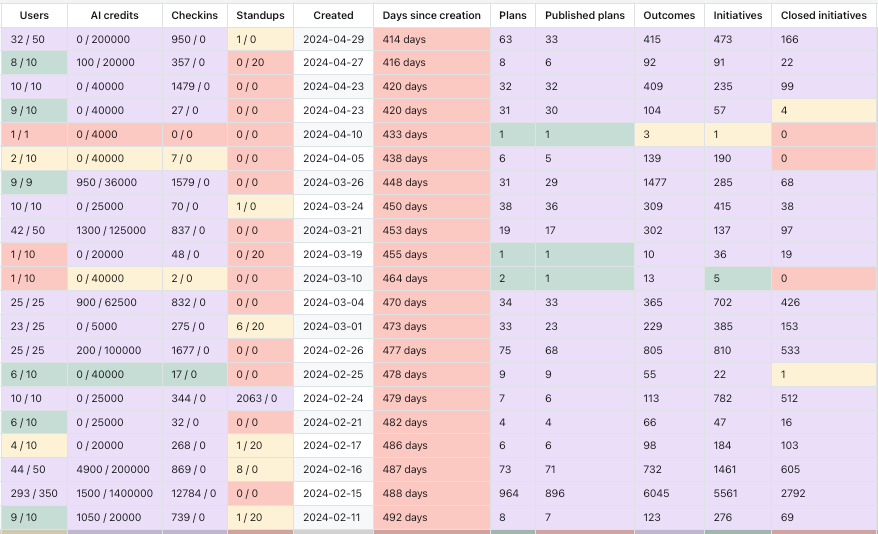
The old way: squinting through 100s of rows
Finding churn risks used to mean pulling up our internal dashboard, copying multiple pages into a spreadsheet, sorting by user count to find the highest MRR accounts, then clicking into each profile to look at historical data– if a customer is declining in the number of check-ins, that’s a sign of potential churn, or if they haven’t added key results into their plans despite being a few weeks into the quarter, or if they only have a handful of users active.
I’d add columns to the spreadsheet, throw on conditional formatting to make it easier to read, and then start writing emails, marking rows complete as I went. And I did this all between meetings and demos as the user base and new leads grew, which made the whole process– pulling the data, organizing the data, and then acting on the data– take a week to complete. By the time I reached out to some accounts, the damage had already been done.
Timing matters when someone is slipping away.
Why we built an AI agent instead
"The first time I used the email from Tattle instead of running the data myself, I was thrilled"
We’ve seen how having AI tools available in Tability has saved our customers time and given them better results. When they need a jump start on drafting their OKRs, they leverage our AI goal generator. When they need to summarize their progress, they automatically generate a report using our AI retrospectives. So why not leverage AI for our own internal tooling?
Our AI agent, Tattle, can plug directly into our data, pull the same reports that I was pulling, add the same context I added, and organize the results the same way I would, but in a process that can run in the blink of an eye. Every day, I get an email from Tattle, organized into high, medium, and low risk accounts, with details about why I should reach out to each account. If there was erratic usage, Tattle shows me the pattern. If there is a decrease in the number of users accessing the workspace, Tattle gives me the percentage decrease.
The coolest part? It doesn’t just look at data—it interprets it. I used to rely on instinct and hours of context-gathering to figure out what mattered. Now, that same logic is baked into our agent.
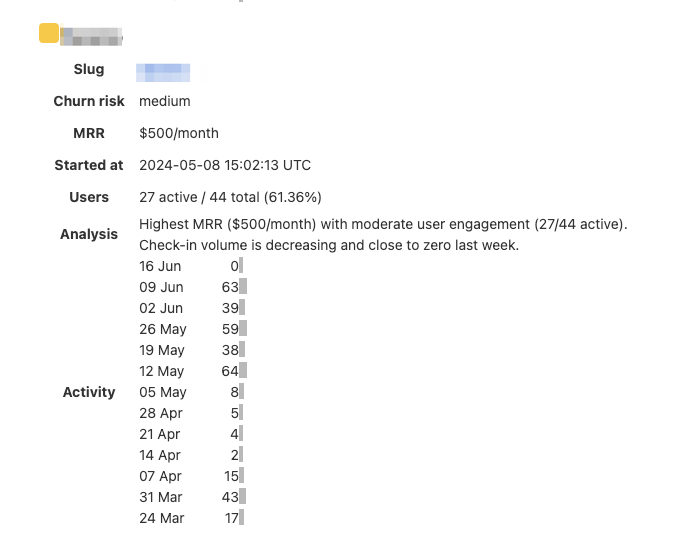
The first time I used the email from Tattle instead of running the data myself, I was thrilled– I could write new emails to customers and reference their specific issues just like I did before, but it took me minutes to get through it all.
Before, I used to set aside a week once a month in order to dig into the churn risk customers. But now that they’re surfaced daily, I can reach out to those customers the moment they start to show signs of struggle. And the responses back show that our customers appreciate this, too. They feel seen earlier, supported sooner, and often course-correct before issues become real problems.

What comes next?
Since we developed the AI agent, it gives us far more flexibility when it comes to the functionality of the tool. If we wanted to add more criteria based on specific features, we can. If we want to repurpose the tool to help us discover expansion opportunities, we can adjust the prompts and start finding orgs to nurture further. If we wanted to see which organizations that are currently setting up Tability would be worth reaching out to proactively to ensure they have a chance to grow, we could do that as well (and have with our onboarding agent, Obi– though that’s another story).
As a team that focuses so much on measurable goals, though, we’ll want to ensure that we’re continuing to get the results that we’ve seen so far. Measuring Tattle’s performance is key, so much so that we’re giving it its own churn key result for next quarter.
If only there was a tool that measured the performance of AI agents alongside their human counterparts… 🤔


.jpg)
.png)